- The paper demonstrates that the one-loop p-adic string worldsheet action matches the Néron-Tate local height function on the Tate curve up to an additive constant.
- It employs explicit spectral analysis and zeta-function regularization to compute Green's functions and determinants associated with p-adic moduli spaces.
- The results establish a holographic correspondence that bridges non-Archimedean string amplitudes with classical arithmetic invariants, impacting p-adic AdS/CFT.
One-loop p-adic String Theory and the Néron Local Height Function
Introduction and Motivation
This paper rigorously establishes a correspondence between the one-loop worldsheet action in p-adic string theory and the Néron-Tate local height function on the Tate elliptic curve. While p-adic string theory has a rich history since the pioneering work of Freund and Olson, providing non-Archimedean analogues of tree-level and loop-level string amplitudes, the genus one (one-loop) case remains less developed due to the more intricate geometry of the associated Bruhat-Tits trees. Recent advances clarified this picture, culminating in the dual worldsheet/boundary description on the Tate curve Qp∗/qZ, with q parametrizing the modulus.
The main result is that the two-point function for the boundary dual of the p-adic one-loop action coincides with the local Néron-Tate height function on the Tate curve, up to an explicit additive constant. This deepens the interplay between non-Archimedean physics and arithmetic geometry, highlighting the significance of Green's functions and spectral properties of associated pseudo-differential operators acting on p-adic moduli spaces.
The p-adic One-loop Worldsheet and Boundary Dual
The p-adic string one-loop amplitude is constructed from the quotient of the Bruhat-Tits tree Tp by a rank-1 Schottky subgroup p0, resulting in a genus 1 graph. The asymptotic boundary is the Tate curve p1, modeled as the disjoint union of fundamental domains on which Haar measures are naturally defined.
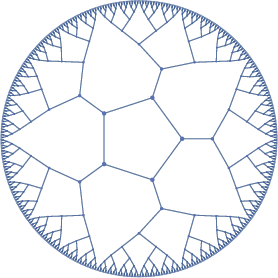
Figure 1: The p2-adic string worldsheet at one loop: the tree quotient p3 for p4, p5.
The bulk (tree) Laplacian action reduces, via holography, to a non-local boundary action,
p6
where p7 is a singular, self-adjoint, positive semi-definite operator constructed from a weight function p8 encoding the geometric interaction kernel of the worldsheet. p9 is characterized by explicit formulae depending on p0, p1, and the valuations of its arguments, ensuring invariance under dilations and inversions.
Symmetries of the Action and Operator Structure
The specific form of p2 guarantees the action's symmetry under dilatations and inversions, reflecting the modular properties of the underlying Tate curve. Under a change of variable or group action, the kernel p3 transforms covariantly, preserving the self-adjoint structure of p4 and ensuring its spectral properties align with expectations for two-dimensional Laplacians on quotients of trees.
This symmetry extends to the spectrum of p5, as it acts diagonally on the abelian multiplicative character basis of p6. This yields a decomposition into radial (valuation-dependent) and angular (unit-dependent) eigenfunctions, with eigenvalues governed by conductors and roots of unity, respectively.
Green's Functions and the Néron Local Height
A central technical result is the explicit calculation of the Green's function p7 for p8. For p9, this coincides with the Néron-Tate local height function
Qp∗/qZ0
where Qp∗/qZ1 denotes Qp∗/qZ2-adic valuation and Qp∗/qZ3 reflects the Tate module.
The calculation proceeds by decomposing the integration domain according to valuation strata, evaluating finite sums over cosets in the multiplicative group, and leveraging group-theoretical relations to show that Qp∗/qZ4 for Qp∗/qZ5, with Qp∗/qZ6 the measure of Qp∗/qZ7. By leveraging covariance, this extends to all Qp∗/qZ8 (up to an additive constant and symmetrization).
This is a strong claim: up to a constant, the Green's function for a non-local Laplacian on a Qp∗/qZ9-adic stringy worldsheet is identical to a key geometric invariant from arithmetic geometry.
Spectrum and Weyl Law for q0
The operator q1 is shown to have discrete spectrum, with eigenvalues corresponding to multiplicative characters on q2. Radial eigenvalues depend solely on the conductor q3 and are of the form q4. The degeneracies follow from the group structure, yielding explicit multiplicities in analogy with Laplace spectra on Riemann surfaces.
Angular eigenvalues are parameterized by roots of unity q5, with corresponding eigenvalues
q6
The smallest eigenvalue is always among the angular sector, governing the spectral gap and determining the asymptotics.
A Weyl-type law is established for eigenvalue counting, mirroring classical spectral asymptotics for two-dimensional Laplacians.
Regularized Determinant and Amplitude Interpretation
The determinant of q7 is evaluated via a zeta-function regularization, splitting contributions into angular and radial parts. Explicit closed-form expressions are derived:
- The angular determinant is a finite product over eigenvalues at roots of unity.
- The radial part gets a resummed representation via zeta regularization, with contributions depending only on q8 and q9.
The total determinant,
p0
serves as the one-loop vacuum partition function for the p1-adic string on the genus one worldsheet. This makes the calculation directly relevant for physical amplitude computations in p2-adic string and AdS/CFT contexts.
Holographic Interpretation and Arithmetic Implications
Within the holographic p3-adic AdS/CFT framework, the operator p4 emerges as the boundary limit of a bulk Laplacian. The dimensionless limit (p5) of the two-point function of the dual operator p6 yields the Néron local height, including normalization constants. This shows that arithmetic invariants computed from intersection theory have a natural appearance as correlation functions in the p7-adic holographic boundary theory.
This result has several implications:
- It provides a direct analytic realization of arithmetic heights as physical correlators.
- The machinery developed can potentially generalize to higher genus, other p8-adic moduli spaces, and to the study of quantum gravity models on graphs.
- It points toward interactions between p9-adic string theory and the arithmetic geometry of elliptic curves, with consequences for partition functions, quantum amplitudes, and possibly non-Archimedean entanglement entropy.
Conclusion
This work demonstrates that the one-loop, genus-one p0-adic string worldsheet action is holographically dual to a boundary theory encoding the Néron-Tate local height function on the Tate curve. The identification of the two-point function with the local height, the explicit spectral analysis, and the determinant computation together suggest a robust and calculable correspondence between non-Archimedean physics and classical invariants in arithmetic geometry. The results pave the way for deeper exploration of p1-adic AdS/CFT, connections to arithmetic quantum field theory, and explicit calculations in non-Archimedean string theory, with potential ramifications for number theory and theoretical physics alike.