- The paper demonstrates the explicit construction of 1D boundary Hamiltonians in 2D Potts SPT phases via a cohomology-driven unitary transformation.
- It reveals that the complex boundary theory reduces to primary models with commuting projector structures, including Temperley–Lieb algebra realizations, contingent on the arithmetic properties of N.
- The study elucidates a nontrivial 't Hooft anomaly through projective symmetry actions and defect sectors, offering insights for tunable topological quantum computation.
Boundary Modes in ZN×3 SPT Phases from the 2D Potts Model
Introduction and Context
This paper develops explicit one-dimensional (1D) boundary Hamiltonians for two-dimensional (2D) symmetry-protected topological (SPT) phases protected by ZN×3 symmetry in a triangular lattice realization of the Potts paramagnet. The approach is based on a cohomology-driven unitary transformation, leveraging nontrivial 3-cocycles to precisely construct edge modes and analyze their algebraic and topological features.
The theoretical framework is motivated by the systematic group cohomology classification of bosonic SPT phases, particularly the role of short-range entanglement and nontrivial boundary properties such as gapless edge states and anomalous symmetry actions. A central claim is that, despite the high-dimensional cohomology structure, all nontrivial boundary theories in this class can be reduced to a set of “primary models” with local defect degrees of freedom that split the boundary into independent segments.
Lattice Construction and Cohomology Implementation
The starting point is an N-state Potts model on a 2D triangular lattice. It is reformulated via a triangular superlattice, where each supernode aggregates three original sites, thus embedding a local ZN×3 symmetry structure. The physical degrees of freedom at each supernode are indexed by color/flavor, providing the required symmetry sectors for cohomological classification.
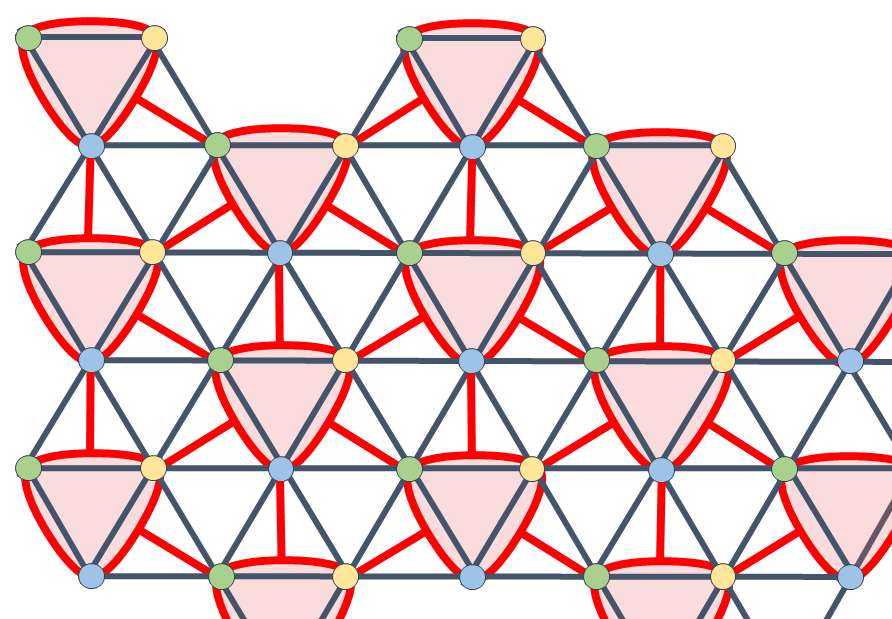
Figure 1: Superlattice structure—green, blue, and yellow circles indicate ZN nodes, grouped into supernodes with red shading and red lines forming the superlattice.
Within this symmetry group, H3(ZN×3,U(1))=ZN×7 yields distinct SPT classifications, with the paper focusing on the genuinely three-color, non-reducible sector. The explicit cohomology generator ω3o is constructed as εn1An2Bn3C, where ε=exp(2πi/N). The non-exactness and closedness of this cocycle are proved algebraically.
A general symmetrized Hamiltonian transformation is implemented via Uk, built from this cocycle, yielding the boundary Hamiltonian:
ZN×30
with the symmetry implementation ultimately non-on-site and anomalous.
Explicit Structure of the Boundary Hamiltonians
A significant technical result is that the structure of the emergent boundary Hamiltonian depends strongly on the arithmetic nature of ZN×31:
- Prime ZN×32: A dramatic algebraic simplification occurs (ZN×33 for ZN×34), yielding Hamiltonian terms of the projector form:
ZN×35
with nontrivial dynamics only when neighboring sites are in the same state. The model admits a two-site representation in terms of commuting projectors, and the algebra naturally organizes into two mutually commuting Temperley–Lieb (TL) algebras.
- Prime Powers ZN×36: The boundary degrees of freedom decompose into ZN×37 independent ZN×38 sectors. The Hamiltonian inherits a tensor product structure, with hierarchical constraints projecting onto increasingly refined subspaces as one moves through the “digits” of the radix-ZN×39 expansion of the site variables.
- General Composite N0: The boundary theory factorizes over the prime decomposition of N1, with each factor contributing an independent field. The Hamiltonian for a nontrivial phase N2 with N3 can be expressed in terms of the primary model for N4, plus defect fields that effectively cut the chain into segments.
The paper presents explicit forms for these Hamiltonians, discussing their commuting projector structure, their decomposition into projective sectors, and the appearance of defect degrees of freedom that act as dynamical constraints partitioning the boundary Hilbert space.
Algebraic Structure and Temperley–Lieb Algebra Realization
A salient feature for prime N5 is that the Hamiltonian organizes naturally into a staggered sum of two mutually commuting TL algebras. After a basis change, projectors N6 and N7 satisfy:
N8
and mutually commute if N9. The Hamiltonian simplifies to:
ZN×30
This structure is suggestive of links to integrable systems, loop models, and exactly solvable statistical mechanics systems. The explicit emergence of the TL algebra provides natural prospects for identifying critical regimes and for establishing connections to conformal field theories (CFTs) in the continuum limit.
Symmetry Analysis and the 't Hooft Anomaly
The global ZN×31 symmetry is shown to act on the boundary in a non-on-site, projective, and anomalous fashion. The explicit calculation demonstrates a nontrivial associator:
ZN×32
with the phase ZN×33 directly reproducing the underlying 3-cocycle, giving a concrete lattice realization of the corresponding 't Hooft anomaly.
Symmetries, Conserved Quantities, and Topological Sectors
The boundary Hamiltonians possess large permutation symmetry groups—ZN×34 (or products thereof) acting on different sectors—and support extensive sets of nontrivial conserved quantities (winding- and laterality-like). The counting of independent symmetric and antisymmetric charges follows from the structure of the local degrees of freedom and their interaction constraints.
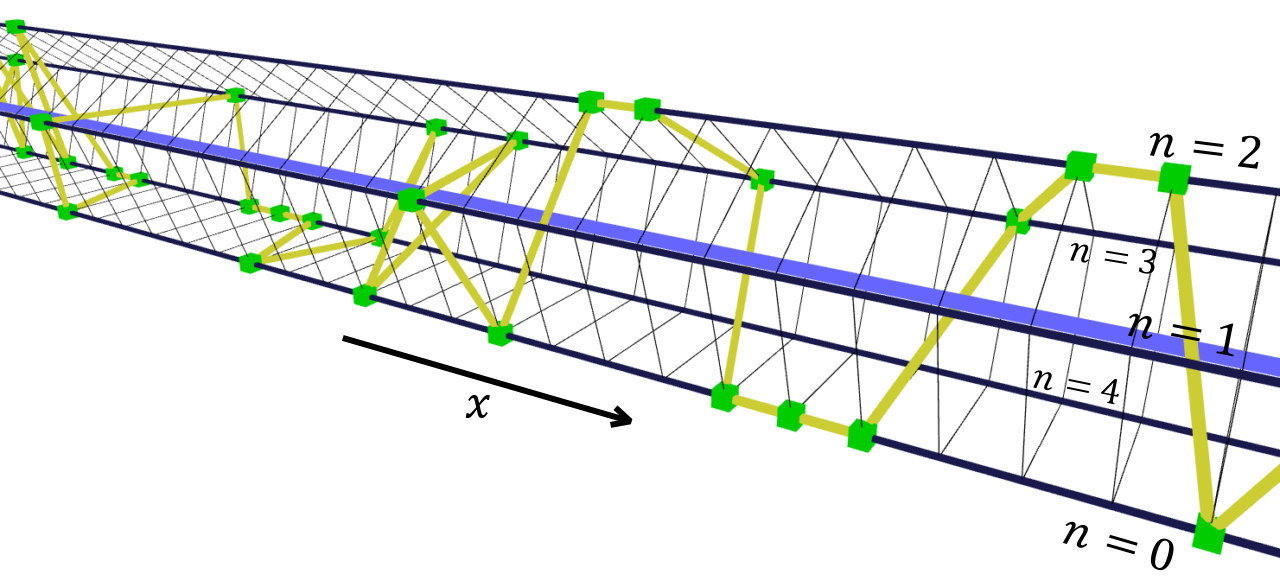
Figure 2: A geometric depiction of the winding charge ZN×35 for ZN×36, corresponding to the number of revolutions of the site configuration around a virtual axis.
Additionally, in the particle-like representation, the number of “active elements” or morphable sites matches the number of parenthesis pairs in a maximally nested description, indicating nontrivial excitation and degeneracy structure.
Defect Sectors and Hierarchical Decomposition
For composite ZN×37 and non-primary phases, local defects arise (described by projectors ZN×38 with nontrivial degeneracy), acting as splitting points that partition the chain into independent segments. The low-energy states are defect-free; the existence of defects is energetically penalized.
This hierarchical organization leads to a systematic reduction of all phases to primary models, plus controlled defect decorations, which is argued to capture the full topological and dynamical content of the family.
Implications and Prospects
The explicit boundary Hamiltonians and their algebraic structure clarify the SPT–anomaly correspondence in ZN×39-protected Potts models and provide an organizing principle for boundary phase diagrams across all ZN0. The presence of TL algebra connections motivates investigation into integrability, CFT description of the continuum limit, and possible mappings to loop and RSOS models.
Of practical interest, the genericization to composite ZN1 and the realization of dynamical defects suggest additional opportunities for engineering tunable entanglement and excitations—likely relevant for measurement-based quantum computation in SPT phases with enlarged symmetry.
Future directions include:
- Mapping the continuum limit, especially at criticality, and characterizing universality classes.
- Explicit construction of particle-like excitations, their braiding, and exchange statistics.
- Connecting with integrable structures and exact solutions where possible.
- Extension to other symmetry groups and higher-dimensional SPT classifications.
Conclusion
This work provides a comprehensive constructive analysis of boundary Hamiltonians in 2D Potts SPT phases protected by ZN2 symmetry. The models are classified and organized by their arithmetic properties, with all phases reducible to a pyramid of primary models supplemented by dynamical defects. The explicit realization of a nontrivial 't Hooft anomaly at the boundary, together with the identification of TL algebra structures, underpins the theoretical and practical importance of these results for future studies of topological phases, quantum computation, and exactly solvable systems.
Reference:
"The ZN3 symmetry protected boundary modes in two-dimensional Potts paramagnets" (2604.00910)

