- The paper demonstrates that both scalar and axial-vector [6] channels are weakly attractive while the [̅15] channels are repulsive, contradicting tetraquark expectations.
- It employs SU(3)_f-symmetric lattice ensembles, careful charm mass tuning, and multi-exponential correlator fits to extract reliable energy shifts.
- The findings favor a hadronic molecule interpretation for these mesons, setting a benchmark for future explorations of exotic multiquark states.
Structure of the Lightest Positive-Parity Charmed Mesons from Lattice QCD
Introduction and Motivation
The nature of the low-lying positive-parity charmed mesons, in particular the scalar Ds0∗(2317) and axial-vector Ds1∗(2460), remains a central issue in hadronic spectroscopy. Traditional quark models fail to reproduce their anomalously low masses, suggesting substantial contributions from four-quark configurations—either in the form of compact tetraquarks or hadronic molecules. Theoretical arguments stemming from SU(3) flavor multiplet structures indicate that the two scenarios make sharply divergent predictions for the spectrum, particularly for [6] and [15] flavor multiplets in the scalar and axial-vector channels.
Model Predictions: Hadronic Molecule vs. Tetraquark Structure
The hadronic molecule hypothesis, primarily formulated using unitarized chiral perturbation theory (UChPT), predicts a strongly attractive [3ˉ], a moderately attractive [6], and a repulsive [15] within an SU(3)f-symmetric theory. This expectation is grounded in the interaction patterns between light pseudoscalar mesons and open-charm states.
Conversely, the tetraquark model, where dynamics are dominated by correlations between diquarks and anti-diquarks, posits that the [15] axial-vector state should be near-degenerate with the Ds1∗(2460)0 and Ds1∗(2460)1 representations, and significantly lower than in the scalar sector, due to the cost of generating "bad" diquarks and anti-diquarks. The spectrum construction, as summarized by Guo and Hanhart, makes these qualitative differences explicit—most notably, a deeply bound axial-vector Ds1∗(2460)2 should manifest if the diquark-driven tetraquark picture is realized.
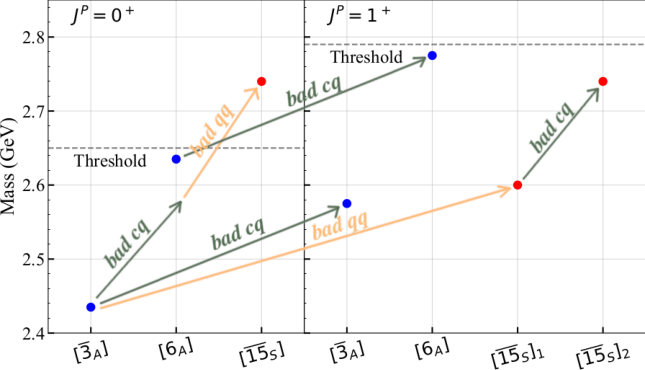
Figure 1: Plot from Guo & Hanhart \cite{Guo_2025}, illustrating the theoretical level shifts between different Ds1∗(2460)3 multiplets under diquark cost assumptions.
Such contrasting predictions make the determination of Ds1∗(2460)4 and Ds1∗(2460)5 highly discriminating tests for the underlying structure of these states.
Lattice QCD Calculation: Ensemble Design and Methodology
The investigation utilized Ds1∗(2460)6 clover-improved dynamical gauge configurations at the Ds1∗(2460)7-symmetric point with a physical charm mass, leveraging the large-volume (Ds1∗(2460)8) ensemble to ensure minimal finite-size effects. The tuning protocol sequentially adjusted the charm quark mass based on the ratio Ds1∗(2460)9, with the lattice spacing calibrated via hyperfine splitting, and the degenerate light quark mass set to achieve SU(3)0 MeV. This pion mass choice aligns with previous Hadron Spectrum Collaboration results on virtual bound state formation in the sextet channel, ensuring meaningful comparison and maximized sensitivity for low-lying four-quark states.
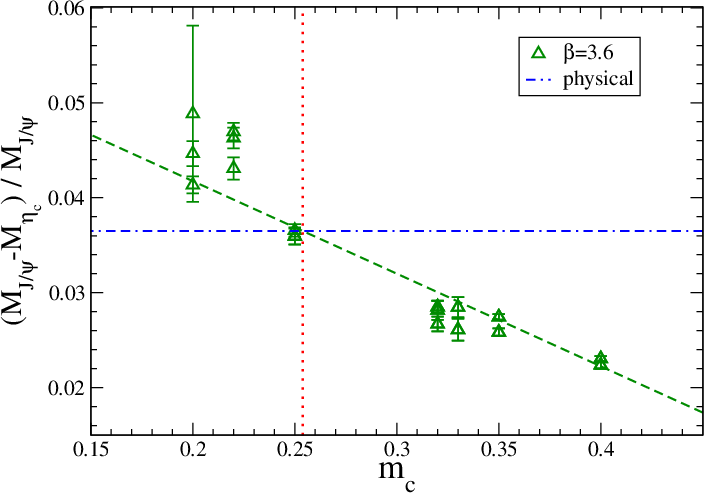
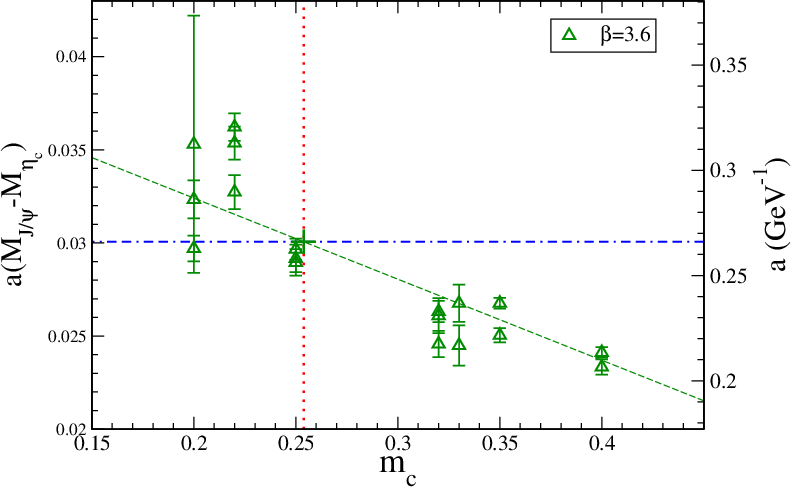
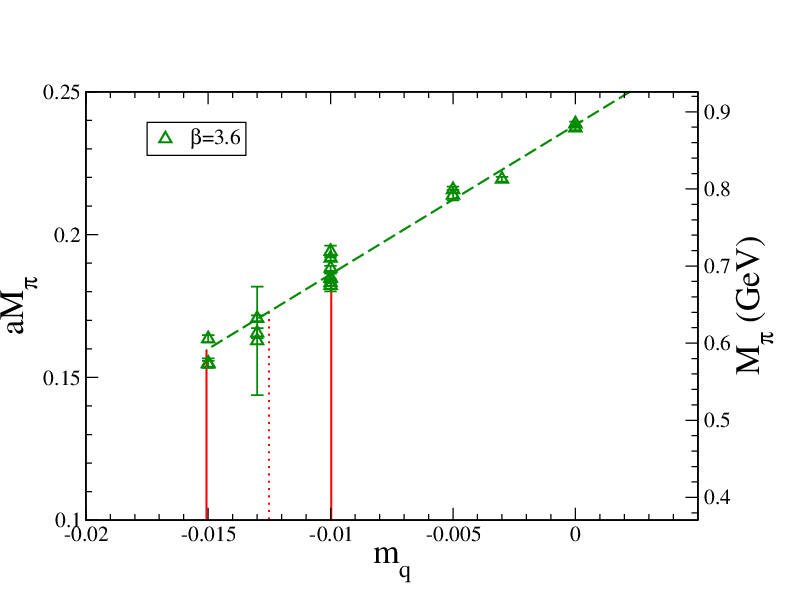
Figure 2: Tuning process for SU(3)1 ensembles, illustrating the sequential calibration of the charm mass, lattice spacing, and light quark mass using hyperfine and pseudoscalar benchmarks.
The calculation focused on flavor-exotic interpolators transforming in the SU(3)2 and SU(3)3 multiplets for both scalar and axial-vector sectors. Disconnected Wick contractions, required for the SU(3)4 representation, were omitted. Contractions for SU(3)5 and SU(3)6 differ only by a sign, with explicit inclusion of backward-forward correlator contributions arising from periodic boundary conditions.
Correlator Analysis and Fit Strategies
State energies were extracted by multi-exponential fits to the calculated two-point functions, employing both smeared and point sources/sinks for improved ground state isolation. The analysis made use of the Akaike Information Criterion for weighted model averaging over fits with varying time windows and state counts (SU(3)7), thereby integrating systematic uncertainties from excited-state pollution.
Representative correlators illustrate the signal quality for the SU(3)8, SU(3)9, axial-vector [6]0, and [6]1 channels.
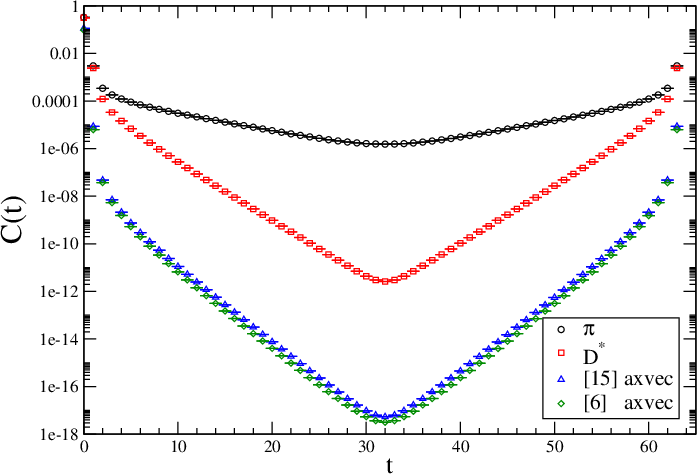
Figure 3: Representative two-point correlators in the [6]2, [6]3, [6]4, and [6]5 channels, demonstrating extraction quality for the relevant energy shifts.
Ground-state mass shifts, defined relative to the appropriate threshold ([6]6 for scalars, [6]7 for axial-vectors), encapsulate the interaction strength: negative (attraction), positive (repulsion).
Numerical Results
The mass shifts obtained are:
- [6]8 MeV
- [6]9 MeV
- [15]0 MeV
- [15]1 MeV
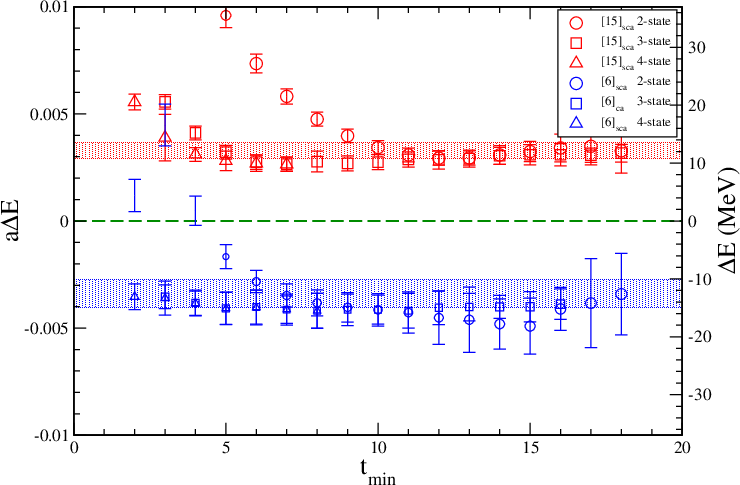
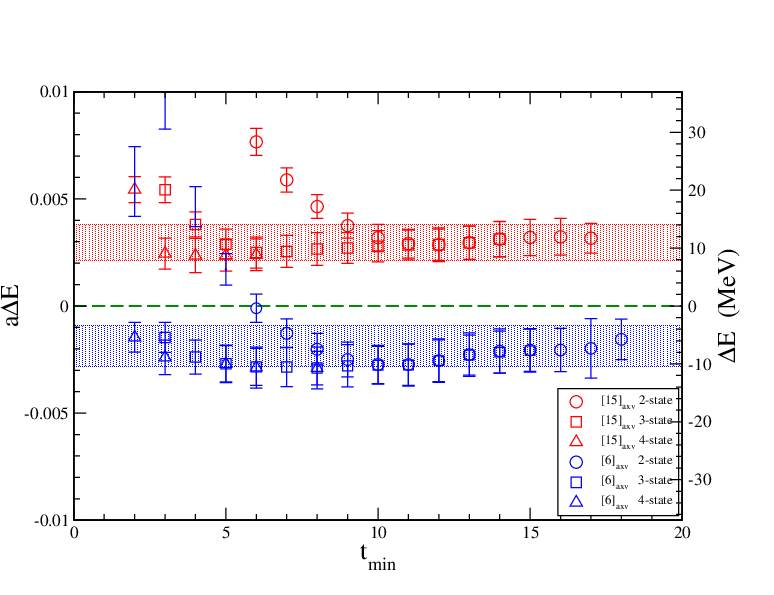
Figure 4: Fit results for ground-state mass shifts for [15]2 (red) and [15]3 (blue) in both scalar (left) and axial-vector (right) sectors, compared to non-interacting thresholds (green dashed lines).
The observed pattern is unambiguous: both scalar and axial-vector [15]4 channels are weakly attractive, while both [15]5 channels are repulsive. This is a robust outcome with negligible model dependence, as indicated by the consistency across independent fit strategies.
Implications and Outlook
The numerically precise demonstration of repulsion in the [15]6 channels is in direct contradiction to the tetraquark model's prediction of an attractive axial-vector [15]7, providing compelling evidence against diquark–anti-diquark tetraquarks as a structural paradigm for these states. Instead, the results are fully consistent with the hadronic molecule picture, including detailed flavor and parity assignments.
This finding has direct consequences for the interpretation of experimental spectra of positive-parity open-charm hadrons, guiding both phenomenological model-building and future experimental searches for exotic multiquark states. The methodology employed—leveraging [15]8-symmetric lattice ensembles and flavor-selective operators—proves to be a decisive discriminator between competing four-quark scenarios. Remaining open questions include the fate of these patterns away from [15]9 symmetry and the relevance for yet higher-lying states.
Conclusion
The lattice QCD calculations demonstrate that the lightest positive-parity open-charm mesons are not compact tetraquarks but are better described as hadronic molecules. The clear observed repulsion in the [3ˉ]0 channels—contrary to tetraquark-model expectations—eliminates diquark–anti-diquark tetraquarks in this mass region. These results strengthen the hadronic molecule interpretation and set a benchmark for future theoretical and experimental exploration of exotic hadrons.