- The paper presents an extended multi-phase ISM model that accurately reproduces IR, CO, and radio observations in low-mass and dwarf galaxies.
- It demonstrates that low metallicity and elevated cosmic ray ionization rates drive higher CO-to-H₂ conversion factors and an increased fraction of CO-dark gas.
- It confirms that key scaling laws, such as the IR-radio and SFR–H₂ relations, persist in low-mass systems while revealing elevated thermal radio fractions.
Introduction
The work rigorously extends a physically motivated, multi-phase ISM model to the domain of local star-forming low-mass and dwarf galaxies, systematically addressing the CO and dust continuum emission, as well as the radio continuum, across a wide parameter space in stellar mass and metallicity. Unlike higher-mass spirals where classical scaling relations such as the IR-radio and Kennicutt-Schmidt laws are empirically robust, the status of these relations in lower-mass, low-metallicity galaxies is unresolved due to the difficulty of detecting tracers like CO and the prevalence of "CO-dark" molecular hydrogen. The model, previously validated on massive galaxies, is adapted and calibrated using updated cosmic ray (CR) ionization rates, improvements in chemical abundance calculations, and a detailed coupling to the physical galactic environment.
Modelling Framework
The model treats galactic gas disks as turbulent, clumpy star-forming accretion disks. Large-scale dynamical structure is set by the rotation curve and baryonic disk, supplemented by a cored isothermal dark matter halo, while local ISM structure is described through scaling relations for gas density and turbulence. The chemical state of the gas is computed with the Nautilus time-dependent gas-grain code, interpolated onto a grid in CR ionization rate, temperature, density, and time.
The CR ionization rate—the dominant driver of low-temperature heating and key chemical processes—is dynamically computed, normalized to local SFR density, and shown to be on average three times higher than the local solar neighborhood. Molecular line emission is evaluated with RADEX using local conditions as input. Radio continuum emission is likewise synthesized through a steady-state CR electron propagation model. The calculations are performed for each galaxy as concentric annuli, yielding both global and radial observables.
Validation: IR, CO, and Radio Emission
Dust and IR Emission
The IR spectral energy distributions (SEDs) and total IR luminosities (TIR) for the sample galaxies are recovered to within a factor of two, accounting for the known omission of stochastically heated small grain and PAH contributions below 50 μm. The models yield dust temperatures typically in the range 13–23 K, with a mean of 19 K for the large-grain population, consistent with empirical fits.
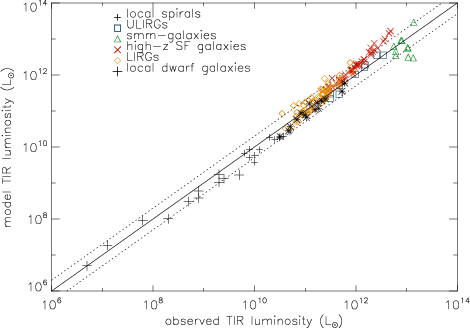
Figure 1: Model TIR luminosity compared to observed TIR luminosity; most modelled galaxies are within a factor of two scatter.
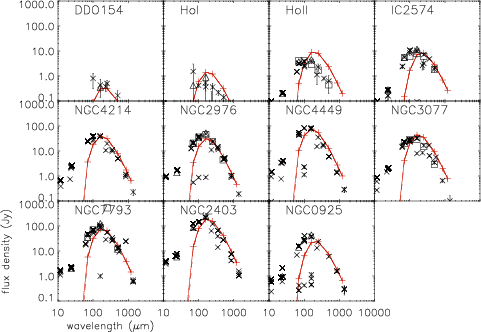
Figure 2: Example IR SEDs illustrating model performance across the sample; observed data points and model fits are juxtaposed.
CO Line Emission
The model systematically overproduces CO luminosity by ~50%, with reduced metallicity runs bringing the predictions into better agreement with observations for all but the most extreme outliers. The inability to detect CO in many dwarfs is robustly reproduced, as the model assigns most H2 to CO-dark molecular gas in these environments.
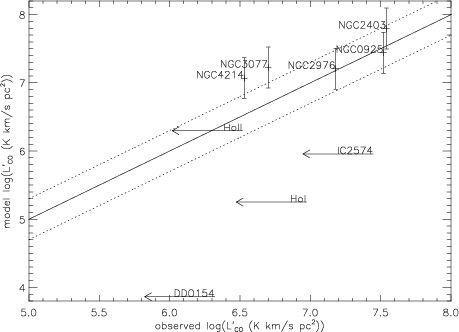
Figure 3: Modeled versus observed CO luminosities display overall consistency within uncertainties, confirming model applicability at low metallicity.
Radio Continuum and IR-Radio Correlation
The model achieves accurate fits to the broadband radio continuum SEDs, successfully capturing both thermal and non-thermal contributions. It reproduces the observed flattening of the spectra at higher frequencies as the thermal (free-free) fraction increases. The IR-radio and radio–SFR correlations, including their power-law slopes and offsets, are maintained down to the lowest galaxy masses in the sample, although the three smallest dwarfs exhibit excess 1.4 GHz emission.
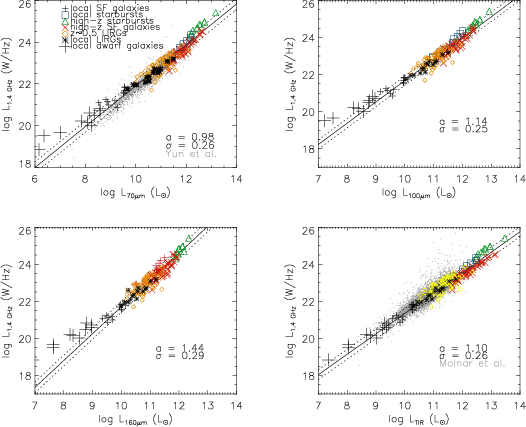
Figure 4: IR–radio (TIR–1.4 GHz and monochromatic) correlation for all galaxy samples; low-mass galaxies robustly align with trends set by massive galaxies and LIRGs.
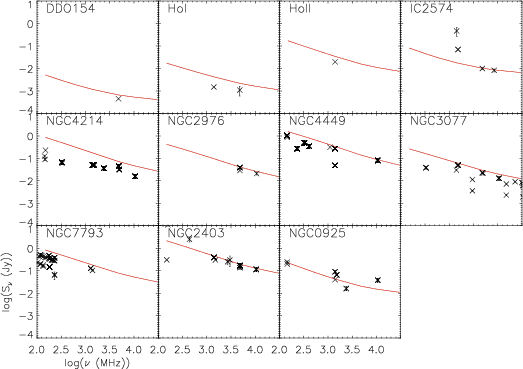
Figure 5: Broadband radio SEDs for sample dwarfs, with model curves matching VizieR photometry over more than a decade in frequency.
Physical Implications
CO-to-H2 Conversion Factor and CO-Dark Gas
The model yields CO-to-H2 conversion factors (αCO) spanning from 5 to 500 M⊙ (K km s−1 pc2)−1 across the sample, scaling approximately as αCO∝Z−1.2 with metallicity, in strong agreement with [C II]-calibrated and radiative transfer-based literature relations.
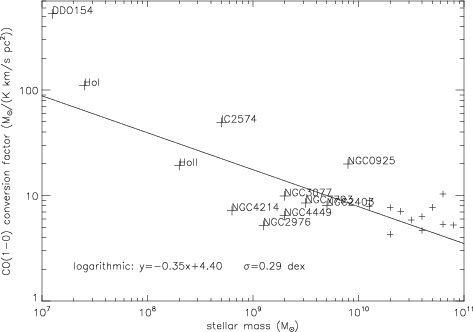
Figure 6: αCO as a function of stellar mass, showing systematic increase toward low mass.
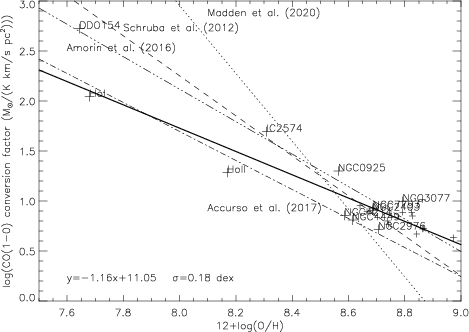
Figure 7: αCO as a function of metallicity, displayed with literature comparisons; model follows nearly inverse-linear scaling.
CO photodissociation is the dominant regulator of αCO in dwarfs: when CO-dark gas is suppressed in the model, αCO flattens to values only mildly above Galactic, indicating the ISM outside the CO-bright regions is dominated by self-shielded H20, mostly untraced by CO.
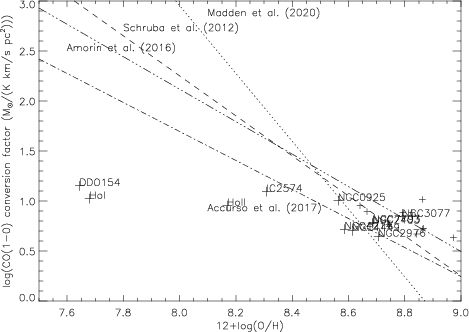
Figure 8: 21 vs. metallicity calculated without CO photodissociation; demonstrates the central role of CO-dark gas.
The transition to completely CO-dark H22 occurs sharply below 23, as illustrated by DDO 154; less massive dwarfs become essentially undetectable in CO even when H24 is present.
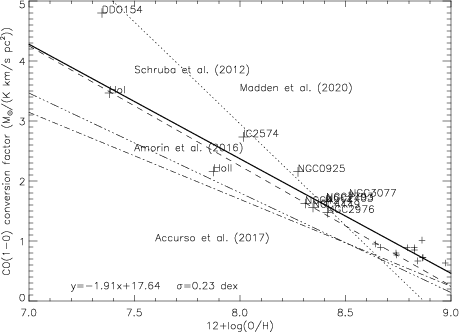
Figure 9: Doubling the metallicity drop results in drastically steepened 25 for the lowest-mass systems.
The SFR–H26 (Kennicutt–Schmidt) relation is recovered as a multi-regime power law: 27linear for main sequence galaxies (depletion time 282 Gyr), steepening to 29 for LIRGs/intermediate-redshift main sequence objects, and 20 for starbursts. The molecular gas depletion time–specific SFR relation is also reproduced, with smaller dwarfs exhibiting higher sSFR and lower depletion times.
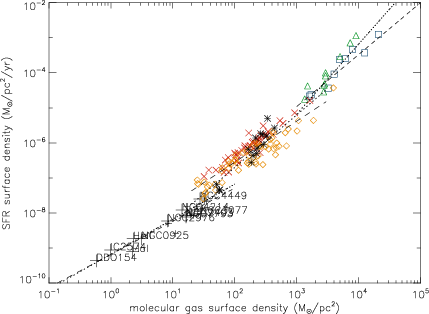
Figure 10: SFR surface density versus molecular gas surface density; power-law slope increases with molecular surface density.
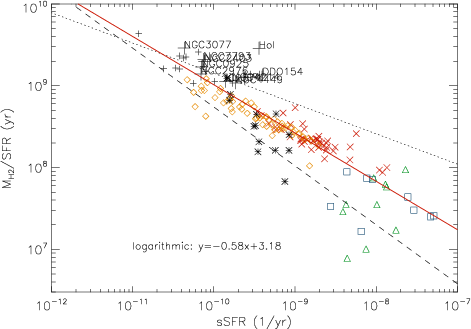
Figure 11: Molecular gas depletion time as a function of sSFR, with model relation compared to observationally calibrated literature lines.
These star formation laws are insensitive to the vertical self-gravity of the gas disk, with the scaling driven by the synergy of disk accretion rate, pressure regulation, and turbulence, rather than direct gravity.
Radio Continuum: Thermal Fraction
A key result is the elevated thermal fraction (free-free emission) of the integrated radio continuum at 1.4–5 GHz for low-mass and dwarf galaxies (20–45%), compared to 21 in massive spirals. This is attributed to weaker ordered magnetic fields and reduced synchrotron loss efficiency in low-mass systems.
Broader Implications and Future Directions
This modelling work demonstrates that the key empirical scaling relations for galactic star formation persist down to low-mass, low-metallicity galaxies, provided one accounts for the sharp increase in CO-dark H22 and the elevated thermal radio fraction. The direct computation of the CR ionization rate, grounded in physical ISM properties and SFR, reveals that external galaxies host higher low-energy CR flux than the Galactic disk, influencing ISM chemistry and emission lines. The model’s ability to reproduce multi-wavelength observables with minimal free parameters suggests that turbulent, pressure-regulated feedback cycles universally sculpt star-forming disks.
Further progress will arise from high-resolution spatially-resolved observations of CO and [C II] emission in dwarfs, to unambiguously separate the photodissociation and excitation contributions to observed line emission. Additional constraints on the CR spectrum in external galaxies will refine the normalization of chemical heating and non-thermal emission. This framework provides a baseline for connecting local star-forming dwarfs to intermediate- and high-redshift populations, constraining the chemical and physical drivers of galaxy evolution across cosmic time.
Conclusion
This work applies a unified, turbulent ISM model to star-forming low-mass and dwarf galaxies, achieving quantitative agreement with IR, CO, and radio observations to better than a factor of two. The model naturally explains the high 23 values and prevalence of CO-dark gas at low metallicity as a photodissociation effect, and confirms the continuity of empirical scaling relations (IR-radio, SFR–H24) down to the lowest stellar masses accessible. Theoretical predictions regarding the thermal fraction of radio continuum emission and the dominance of pressure-regulation in star formation should guide the interpretation of upcoming observational surveys. This approach forms a foundation for continued comprehensive multi-phase galaxy modeling as future datasets expand parameter space coverage.
Reference:
"Predicting CO and dust emission of star-forming galaxies" (2604.00708)