- The paper presents a numerical analysis that computes heteroclinic connections among first-order mean motion resonances, unveiling direct pathways for resonance hopping.
- The paper employs manifold computations, Poincaré maps, and Fast Lyapunov Indicator maps to correlate phase-space structures to observable 'arches of chaos'.
- The paper demonstrates that these heteroclinic networks enable rapid chaotic transport of small bodies like quasi-Hildas and Jupiter-family comets.
Heteroclinic Connections and Chaotic Transport in the Sun-Jupiter System: Manifolds, Resonance Hopping, and the Arches of Chaos
Introduction and Context
The study "Arches of chaos, heteroclinic connections of first-order MMRs and the chaotic transport of small bodies in the Sun-Jupiter system" (2604.00679) addresses the explicit computation of heteroclinic connections arising from the interplay of stable and unstable manifolds of unstable periodic orbits associated with primary mean motion resonances (MMRs) in the planar restricted three-body problem (RTBP). Specifically, the analysis is centered on first-order MMRs (2:1, 3:2—interior; 2:3—exterior). The research leverages manifold computations, Poincaré surfaces of section, and Fast Lyapunov Indicator (FLI) maps to relate these heteroclinic networks to observable structures in the (a,e) phase space—namely, the "arches of chaos" [todetal2020].
This work builds on resonance overlap theory (Chirikov, Wisdom) and the geometric framework of resonance connections via Lagrangian point Lyapunov orbits (PL1, PL2) [koon2000, koonetal2001], establishing numerical evidence for more general, direct heteroclinic connections between resonances that transcend the canonical "resonance chain" involving the co-orbital resonance (1:1, PL3). These chaotic pathways facilitate resonance hopping for small bodies such as quasi-Hildas (QH) and Jupiter-family comets (JFCs), with implications for the transport, capture, and escape phenomena in planetary systems.
Model, Methods, and Manifold Computation
The primary dynamical context is the planar circular RTBP for the Sun-Jupiter-massless body system, with the Jacobi energy EJ as an integral, directly mapped to the Tisserand invariant TJ. The equations are integrated with high numerical precision, and both the equations of motion and variational equations are used to compute FLI maps for grids of initial conditions. The FLI serves as a chaos indicator, with forward/backward integration isolating the stable/unstable manifolds, respectively, of hyperbolic periodic orbits.
Manifold computations are performed by locating fixed points of the Poincaré map (multiplicity equal to the resonance index, e.g., m=q for a q:p resonance) and propagating small segments along their stable/unstable eigendirections. This enables direct visual comparison between manifold intersections and ridges in the FLI maps, validating that the principal lagrangian coherent structures (LCS) in phase space correspond to bundles of invariant manifolds associated with interior and exterior resonances.
Key numerical findings include:
- For 2≤TJ≤3, the PL3 manifold lobes penetrate deeply into both the inner (to 2:1) and outer (to 2:3) MMR domains, with high eccentricity periodic orbits linking the co-orbital region to standard resonance zones.
- Manifolds of PL1/PL2 primarily participate in close encounters (temporary satellite capture, TSC) or transitions involving the quasi-satellite regime, but not necessarily in all resonance-to-resonance transitions.
- Direct heteroclinic connections between inner (e.g., 2:1) and outer (e.g., 2:3) MMRs exist, bypassing the co-orbital manifold (PL3), especially at TJ<3.
Numerical and Visual Results
The study presents a comprehensive numerical exploration, with figures demonstrating phase portraits, FLI maps, explicit manifold structure superpositions, and the mapping of FLI ridges to (a,e) space. Key features include:
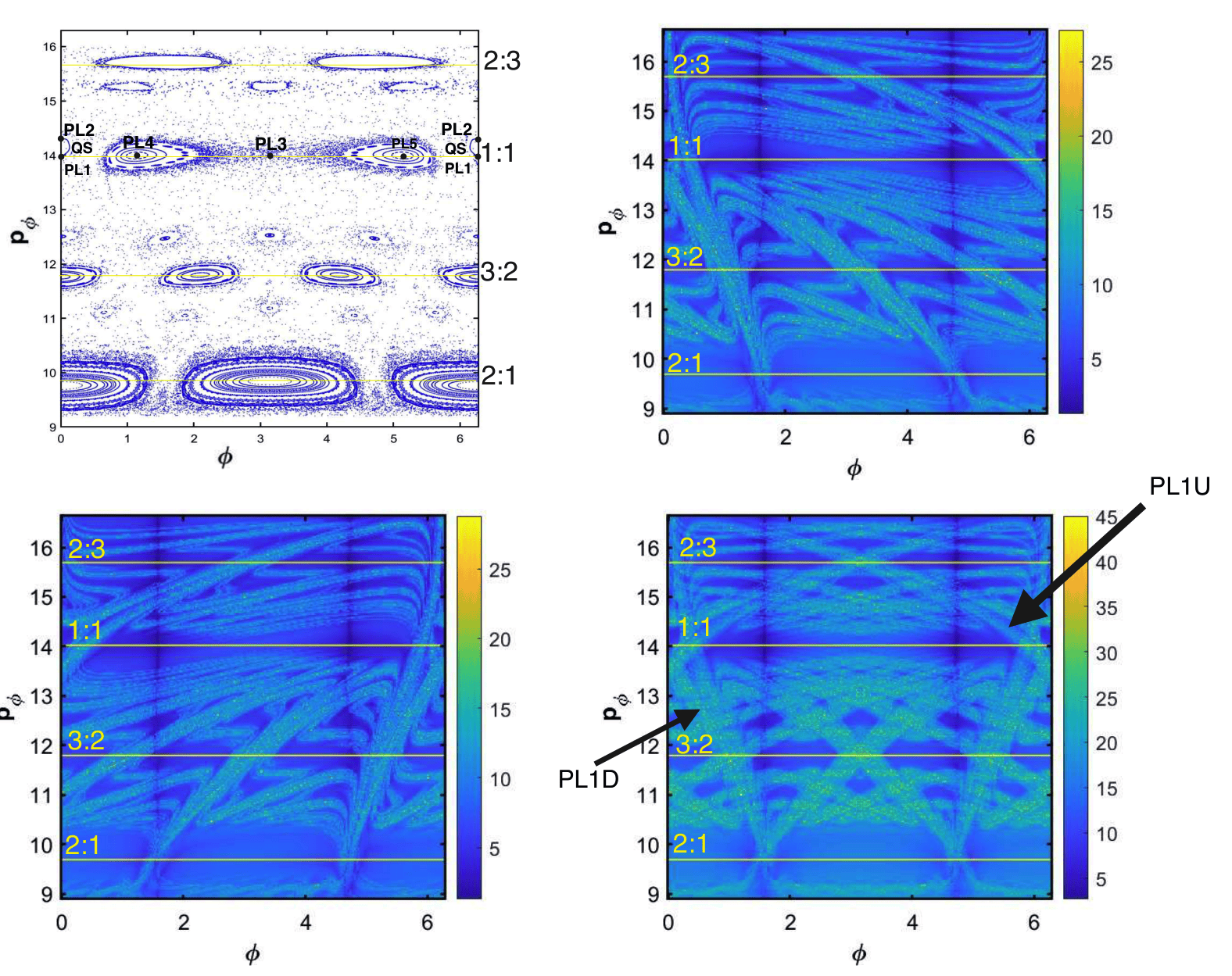
Figure 1: Phase portrait and manifold structure for EJ=−1.48, TJ=2.96, showing the islands and separatrices corresponding to 2:1, 3:2, 2:3 MMRs and the co-orbital region.
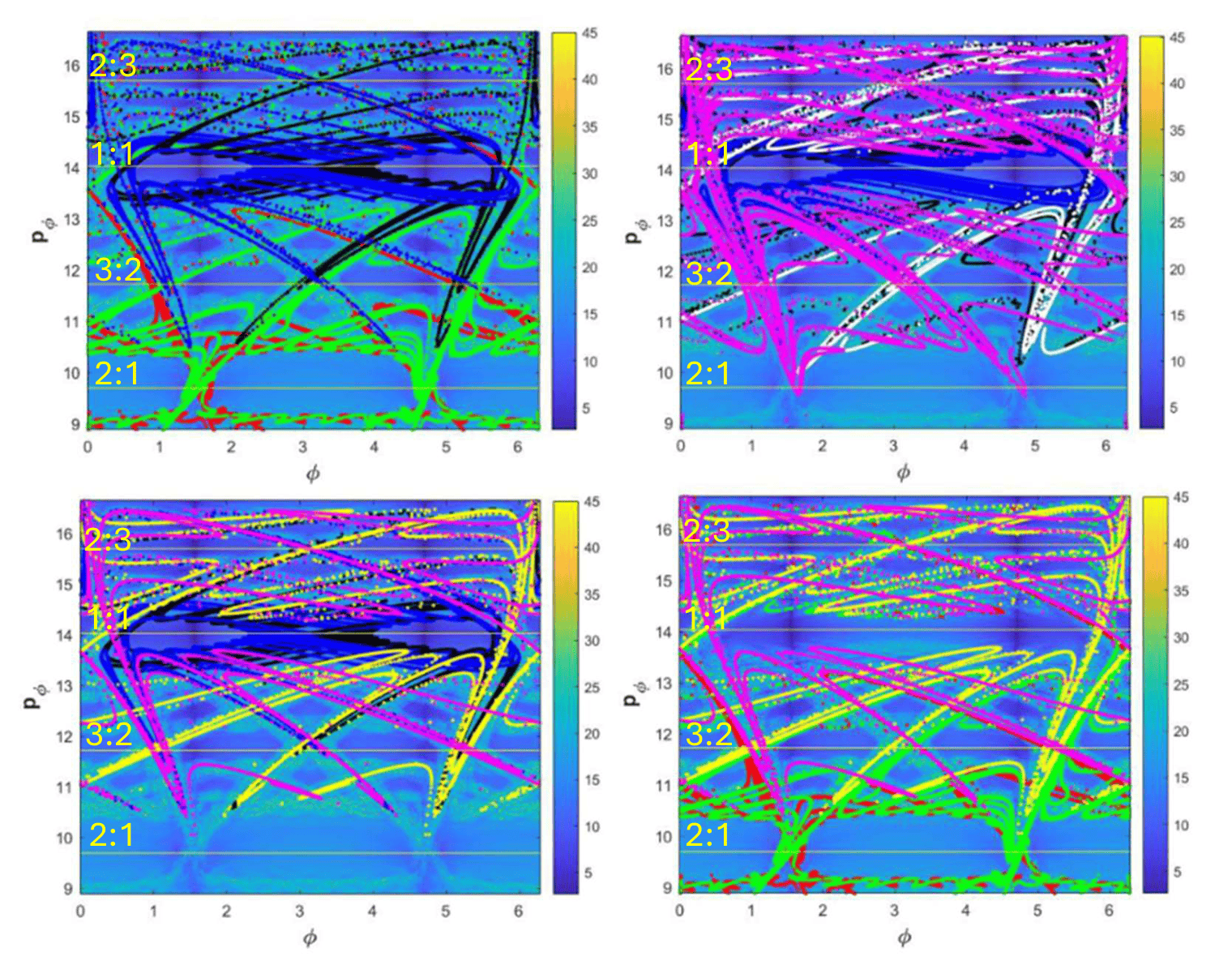
Figure 3: Superposition of FLI maps with unstable/stable manifolds of unstable periodic orbits: 2:1, PL3, 3:2, 2:3, highlighting manifold intersections as heteroclinic channels.
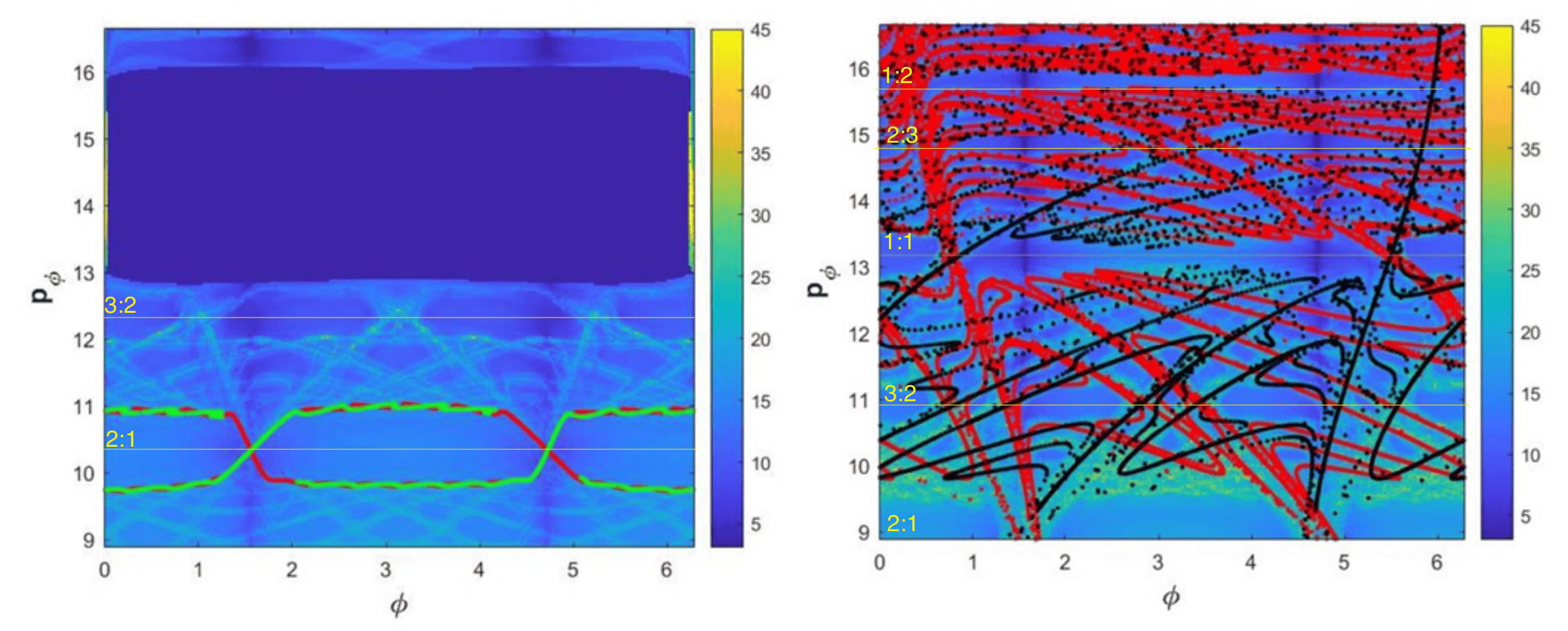
Figure 2: FLI maps and 2:1 manifold overlap for EJ0 and EJ1, demonstrating the variation in chaos and accessibility of heteroclinic channels as energy is varied.
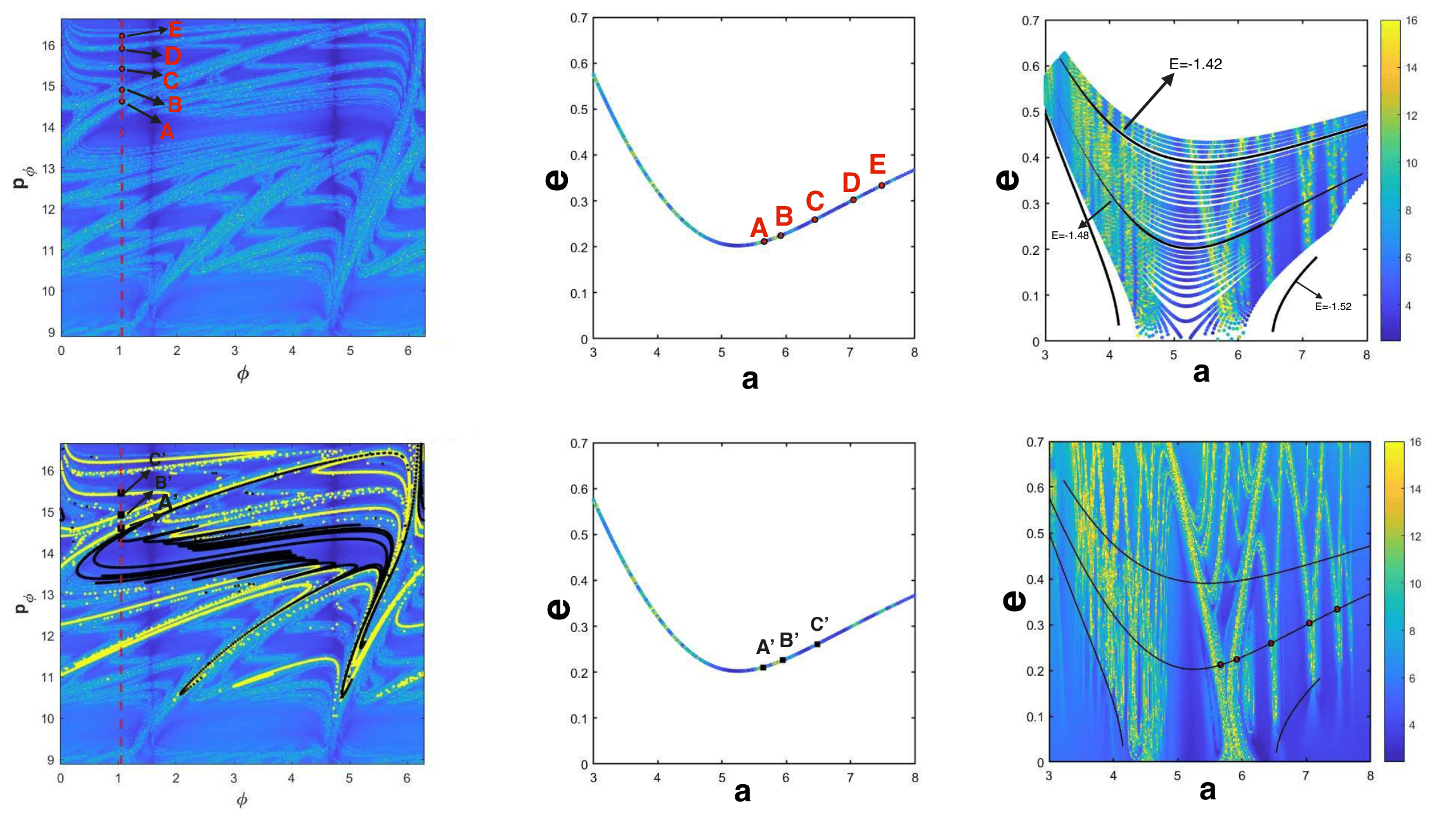
Figure 4: FLI map for EJ2 and forward integration, used to reconstruct ridges mapped into the EJ3 plane ("arches of chaos").
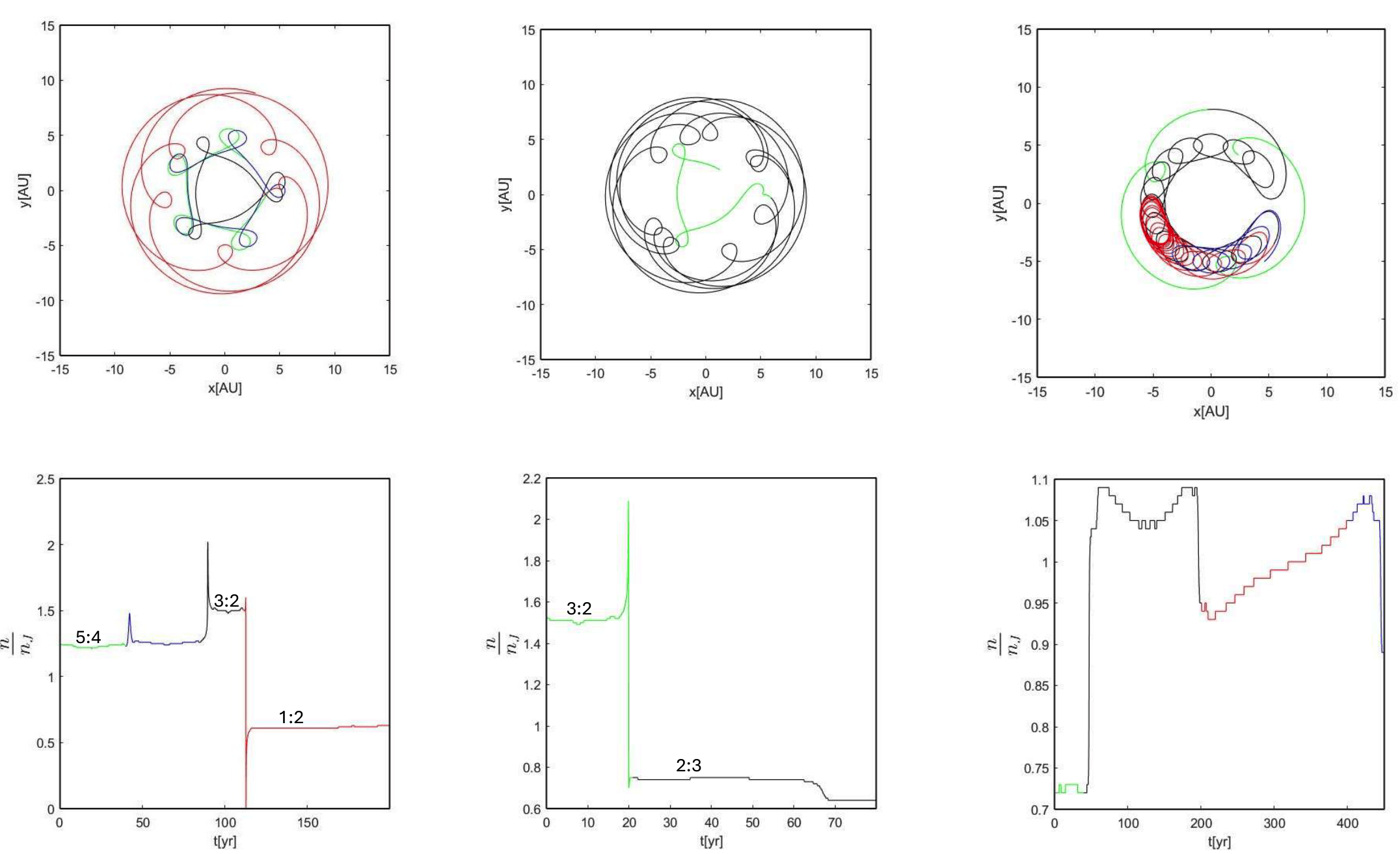
Figure 5: Three trajectories exhibiting resonance hopping, with transitions marked in the EJ4 time-evolution (ratio of mean motions), covering multiple MMRs via manifold shadowing.
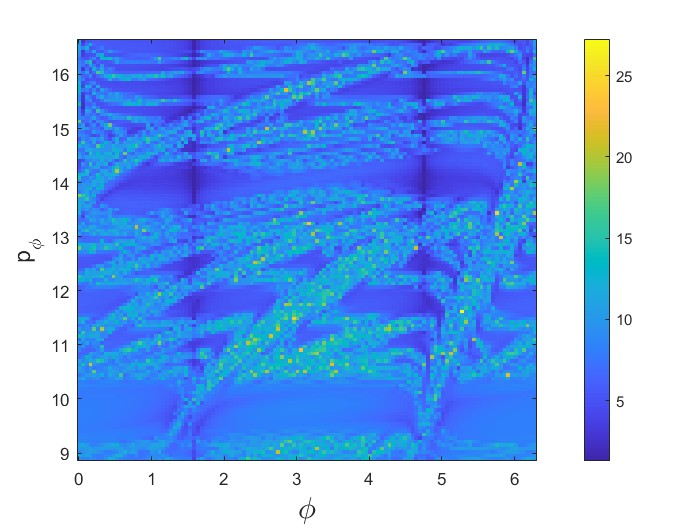
Figure 6: Forward FLI map for the elliptic RTBP (ERTBP), confirming the persistence of manifold structures even as orbital elements for Jupiter vary with time.
Implications and Theoretical Insights
Manifold Topology and Chaotic Transport
The union of stable and unstable manifolds for all first-order periodic orbits generates a dense heteroclinic network spanning the entire resonance overlap zone beyond Jupiter's 2:1 resonance. The explicit identification of direct (non-co-orbital) heteroclinic connections implies that resonance-hopping for asteroids and comets can occur rapidly and without mediation through the 1:1 resonance, particularly in regions where EJ5.
This result substantiates the LCS interpretation of chaotic saddles: transport is facilitated not merely by classical resonance chains but by a global manifold web linking all primary resonances. The method allows clear attribution of observed "arches of chaos" [todetal2020] in stability maps of orbital element space to the structure and intersections of these manifolds.
Relationship with Observed Small Body Dynamics
Shadowing of these heteroclinic orbits by real particle trajectories leads to resonance hopping—proven here numerically for generic initial conditions near prominent heteroclinic channels. This provides a robust theoretical underpinning for numerical and observational reports of resonance transitions for QH asteroids, JFCs, and Centaurs, and for statistically quantifying leak rates from the outer belt, QH lifetimes, and pathways for comet injection.
Robustness and Applicability Beyond the Circular Model
The invariant manifold structure, as visualized in FLI maps, remains qualitatively intact in the ERTBP where Jupiter's orbit is elliptic. This invariance under perturbation is critical for the plausibility of using such manifold frameworks for solar system studies, despite the complex, higher-dimensional structure induced by planetary perturbations and orbital inclination.
Future Directions
Potential directions include:
- 3D manifold computations to include inclination dynamics and perturbations from the entire giant planet system, addressing the limitations of the planar/circular restriction.
- Statistical modeling of resonance hopping timescales and leakage rates, calibrated by the explicit manifold structures to inform population models of QHs and JFCs.
- Application to exoplanetary architectures—identifying passageways for cometary injection/capture in multi-planet systems via global manifold analysis.
Conclusion
This study provides explicit numerical evidence and a geometric framework for understanding chaotic transport, resonance hopping, and the origin of the arches of chaos in the outer solar system. The identification of both direct and indirect heteroclinic connections between first-order resonances, and their manifestation in observable stability features, constitutes a significant advance in mapping the phase space topology underlying small-body dynamics in the Sun-Jupiter system. This work lays the foundation for manifold-guided statistical and semi-analytical modeling of chaotic transport in both solar and exoplanetary contexts (2604.00679).

