- The paper demonstrates that detailed radiative transfer models resolve the momentum problem by linking wind acceleration to iron opacity features.
- It employs 1D, comoving-frame, non-LTE hydrodynamics to self-consistently compute mass-loss rates based on the local critical point.
- The study shows that the mass-loss rate scales with the cube of the critical radius, highlighting the impact of envelope composition and sub-photospheric structure.
The Complex Dependencies of Wolf-Rayet Winds: A Summary
Introduction and Motivation
Wolf-Rayet (WR) stars exhibit mass-loss rates that greatly exceed those of OB-type stars, leading to wind efficiencies (η) well beyond unity. Classical models based on single scattering could not initially account for the observed high M˙, raising the so-called momentum problem in WR winds. Subsequent advances highlighted the critical role of line overlap, necessitating a reinterpretation as an opacity problem, particularly due to the contribution of iron M-shell opacities. Multiple scattering and the closure of radiative "gaps" by ionization structure are fundamental to understanding WR wind driving. These points motivate the development of self-consistent, detailed radiative transfer models that can capture the sophisticated physics at play.
Hydrodynamically-Consistent Atmosphere Models
Recent advances leverage 1D, comoving-frame (CMF), non-LTE atmosphere models with explicit hydrodynamical coupling. The essential formulation involves calculating the radiative acceleration arad as a local function of radius, integrating the equation of motion from the critical point (set by the local sound or turbulent velocity) both inward and outward to recover the wind velocity structure. This approach eschews the use of force multipliers, focusing instead on a direct, numerically robust integration scheme. The mass-loss rate is not a free parameter but is fixed via a global conservation constraint — typically, the conservation of total optical depth — ensuring self-consistency between radiation, hydrodynamics, and detailed opacity sources.
Physical Origin and Scaling of WR Mass Loss
Hydrodynamically-consistent models elucidate the physical basis for the WR wind mass-loss scaling. Opacity arises primarily from iron M-shell transitions at the so-called "hot iron bump," with the critical point often residing deep in optically thick layers. This contrasts with OB-type winds, where the critical point is in the optically thin regime. In WR stars, wind launching occurs at high optical depth, making the wind onset sensitive to sub-photospheric structure and metallicity, a dependence confirmed in detailed model sequences.
A key result is the scaling of mass-loss rate with the cube of the critical point radius for hydrogen-free, core He-burning stars:
M˙∝Rcrit3
This demonstrates that models restricted to compact, He main-sequence configurations may underestimate M˙ by neglecting possible envelope inflation or evolutionary expansion.
Mass-loss rates derived from models can reach M˙>10−4M⊙yr−1 in phases with extended envelopes, though such values typically exceed empirically inferred rates for the bulk of WR stars except during rapid transitional evolution.
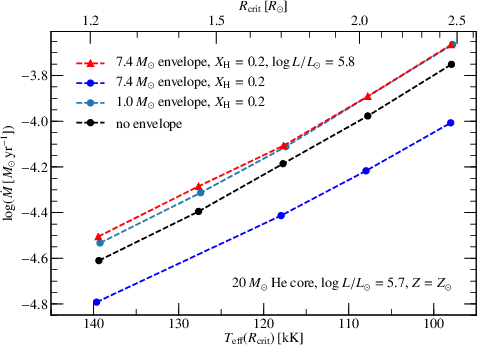
Figure 1: Mass-loss rates versus effective temperature at the critical point for various hydrogen-containing envelopes on a 20M⊙ He star; dots show individual models, red triangles indicate an added shell-burning luminosity of $0.1$ dex, and the upper x-axis maps Rcrit for M˙0.
Effects of Hydrogen-Containing Envelopes
Later-type, hydrogen-rich WNh stars present additional complexity. The presence of a hydrogen envelope introduces two competing effects: additional free electrons (modestly enhancing M˙1) and increased gravitational binding (reducing M˙2 for large envelope mass). Detailed model sequences show that small hydrogen envelopes slightly increase the mass-loss rate, but this trend reverses with growing envelope mass. However, if envelope inflation or shell burning increases the critical radius or adds luminosity, the net effect on M˙3 can be positive and substantial, as illustrated by models where moderate increases in M˙4 and M˙5 reverse the sign of the envelope effect.
This nuanced behavior challenges empirical mass-loss scaling laws that predict monotonic M˙6 enhancement as hydrogen abundance drops. Detailed modeling suggests that the resolved mass fraction and radius configuration are crucial, implying that empirical recipes may over- or underestimate mass-loss in certain evolutionary phases.
Implications, Limitations, and Future Directions
One prominent open issue is the terminal wind velocity. Achieving observed M˙7 often requires ad hoc clumping assumptions that lack independent justification from hydrodynamical first principles in 1D, suggesting missing physics. Multi-dimensional effects — including turbulence, anisotropic instabilities, and density-velocity anti-correlation — can significantly alter wind structure and the location of the critical point. Emerging 2D and 3D RHD simulations, while limited in scope, indicate that phenomena like radiative-driven turbulence and failed wind launching may be prevalent, especially near the iron opacity peak.
Further, the existence of a "failed wind regime" in which wind launching cannot be sustained from the hot iron bump implies that continuous, universal empirical M˙8 prescriptions may not exist for all WR subtypes. Theoretical treatments must be attentive to detailed sub-photospheric structure, turbulence, clumping, and multi-dimensional radiative-hydrodynamical coupling.
Conclusion
This work synthesizes the latest generation of hydrodynamically-consistent atmosphere models to delineate the parameter dependencies and physical mechanisms controlling WR winds. The analysis reveals a multifaceted landscape in which mass-loss depends critically on both global properties (mass, luminosity, metallicity) and local structure (envelope composition, critical point location, turbulence). The models offer clear directions for improvement of empirical wind recipes and underscore the need for 2D/3D treatments to capture clumping and non-radial instabilities. The results have substantial implications both for the interpretation of WR spectra and for theoretical predictions of massive star evolution and feedback, including pre-SN mass loss and the progenitors of gravitational wave sources.