- The paper introduces a proactive ISFR framework that orders semantic features by importance during training, leading to a structured representation with enhanced communication efficiency.
- The paper presents a novel SI-UEP method that optimally maps features to channel resources using a mixed-integer nonlinear programming approach, achieving over 23% improvement in reconstruction fidelity.
- The study integrates semantic representation learning with adaptive error protection, paving the way for resilient 6G/IoT systems that gracefully degrade under resource constraints.
Proactive Importance-Ordered Feature Restructuring for Semantic Communications with Enhanced Unequal Error Protection
Introduction
This work addresses the critical inefficiency in existing semantic communication (SemCom) systems where the intrinsic heterogeneity in semantic feature importance is not exploited to its full potential during wireless transmission. By incorporating an explicit importance-ordered semantic feature restructuring (ISFR) mechanism and a rigorous multi-dimensional resource allocation approach for semantic importance-aware unequal error protection (SI-UEP), the paper demonstrates substantial gains in robustness and transmission efficiency, particularly in adverse channel conditions.
Methodology: ISFR and Resource Allocation
Importance-Ordered Semantic Feature Restructuring (ISFR)
Unlike conventional methods that rely on post hoc or implicit importance estimation (e.g., gradient-based, masking, or attention-analysis), ISFR proactively shapes the importance distribution of semantic features during the model training process. The ISFR framework imposes a descending hierarchy of feature importance through two key mechanisms: a BER matching module inducing non-uniform synthetic channel noise, and a nested dropout protocol introducing progressively higher retention probabilities for early features.
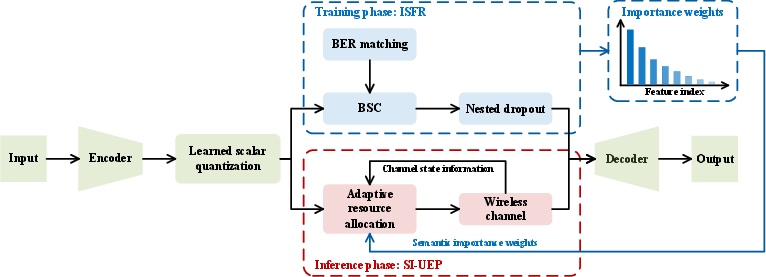
Figure 1: System model of the proposed ISFR and SI-UEP schemes. The ISFR training module induces a steeply decaying importance distribution, supporting SI-UEP through importance-driven resource allocation.
This structured approach forces the model to concentrate salient semantics into the front-end features, yielding a representation with pronounced order and superposition properties: leading features carry fundamental information, while subsequent features provide refinements. The training alternates two stages, first stabilizing the nested dropout for analog transmission, then enabling digital quantization and BER matching for further differentiation.
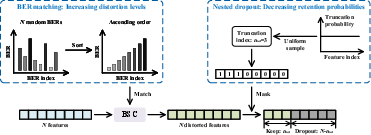
Figure 2: The BER matching module and nested dropout reliably impose non-uniform error statistics and hierarchical feature retention during ISFR model training.
Semantic Importance-Aware Unequal Error Protection (SI-UEP)
Based on the ISFR-derived feature importance prior, the SI-UEP mechanism jointly optimizes the mapping between semantic features and channel resources. The resource allocation is configured as a mixed-integer nonlinear program: the system seeks the optimal subset of features to transmit (feature selection), per-feature modulation and power settings, and channel-feature assignments, under a total power constraint and minimum rate guarantee.
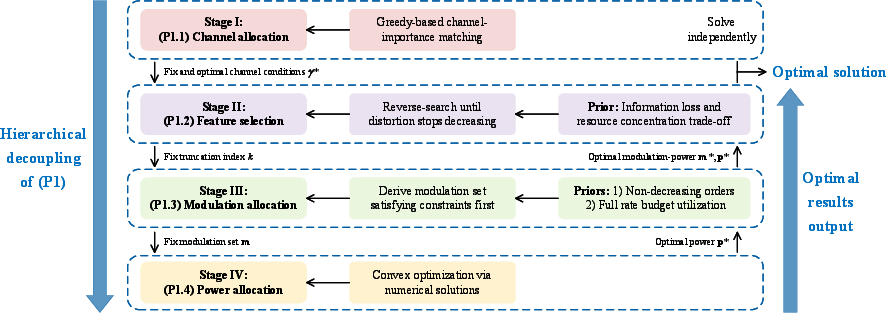
Figure 3: Block diagram of the OPHD algorithm for SI-UEP: greedy channel matching, monotonic pruning for modulation selection, convex power allocation, and ordered truncation search for feature selection.
To address the intractability of joint optimization, the Ordered Prior-assisted Hierarchical Decoupling (OPHD) algorithm exploits the strict ordering of semantic importance—significantly reducing the search space. Key algorithmic contributions include greedy channel-feature assignment (highest importance to best channel), monotonic modulation ordering (lower modulation for higher importance), convex programming for power allocation, and early-stopping truncation search.
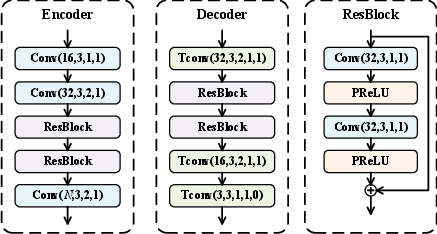
Figure 4: Semantic codec network configuration detailing the encoder-decoder architecture for feature extraction and reconstruction.
Empirical Results
The methodology is robustly benchmarked on CIFAR-10, ImageNet, and DIV2K datasets, using PSNR, SSIM, and LPIPS as evaluation metrics. Under adverse channel conditions (e.g., SNR <0 dB, low power), the ISFR-SI-UEP configuration consistently yields over 23% improvement in reconstruction fidelity relative to traditional uniform-importance (UI) strategies across all metrics. Notably, importance differentiation (by two orders of magnitude across features) enables graceful task degradation: the system maintains essential semantics even with aggressive resource truncation.

Figure 5: Visualization of reconstructed high-resolution images on DIV2K: ISFR maintains structural fidelity and perceptual quality under adverse transmission, compared to detail-losing UI-EPP and noise-amplified UI-M baselines.
The ISFR-induced importance distribution exhibits a highly ordered, rapidly decaying profile. In contrast, classical post-training evaluations (mask-based, gradient, Taylor, correlation) yield nearly flat importance allocations and suffer catastrophic performance collapse under resource constraints.
The resource allocation component is shown to be near-optimal: the OPHD algorithm matches exhaustive search in output quality with polynomial versus exponential complexity, as confirmed across data regimes. The monotonic, importance-prioritized allocation ensures optimal use of scarce resources for high-value semantic features.
Implications and Theoretical Insights
This work demonstrates that proactive structuring of feature importance is fundamentally superior to passive or shallow importance adaptation when UEP is required. There is clear evidence that trading marginal informativeness (at most 1.3% reduction in peak PSNR under ideal SNR) for robustness leads to pronounced increases in resilience and utility under challenging conditions—a performance regime of central importance for edge intelligence and 6G/IoT deployments.
The technique unifies the tasks of semantic representation learning and communications resource allocation, providing a practical route to cross-layer cooperation in task-oriented communication systems. The explicit ordering and superposition induced by ISFR serve as an architectural regularizer, mitigating the brittle failure modes of existing methods.
Future Directions
Potential extensions include making the importance distribution adaptive during inference via online CSI feedback, integrating advanced dynamic dropout schedules, and generalizing the approach to multi-modal semantic sources. The synergy of explicit ordered priors with real-time resource optimization is likely to yield new theoretical bounds and practical gains in communication efficiency and reliability.
Conclusion
By tightly coupling proactive semantic importance ordering (ISFR) with multi-dimensional SI-UEP resource allocation, this work establishes a highly effective methodology for robust semantic communications, particularly suited to next-generation wireless systems where channel and computational resources are highly heterogeneous and constrained. The findings highlight the necessity and sufficiency of explicit importance differentiation for enabling practical, resilient, and low-complexity semantic communications.