- The paper re-assesses 20 candidate shielding materials using DFT data and GNN predictions to show that boron-rich ceramics outperform beryllium by nearly an order of magnitude.
- It demonstrates that layered materials like h-BN and B₄C can reduce shield mass by 22%-47% while providing enhanced mechanical stiffness and neutron absorption.
- The study proposes a multilayer shield design combining graphene, h-BN, HDPE, and aluminum, optimizing each layer for specific threats in interstellar environments.
Introduction and Historical Context
Interstellar travel at substantial fractions of the speed of light necessitates robust, low-mass shielding materials to protect spacecraft from the high-fluence bombardment by the interstellar medium (ISM). Project Daedalus (1973–1978), the canonical engineering study of its era, selected a 9 mm beryllium shield for its favorable density and mechanical properties. However, Daedalus's material choices predated recent advances in both materials discovery—such as the isolation of two-dimensional (2D) materials and ultra-high-temperature ceramics (UHTCs)—and computational property prediction methodologies, notably high-throughput density functional theory (DFT) databases and graph neural networks (GNNs).
This work systematically re-examines 20 candidate materials, including conventional metals, 2D materials, and ceramics/superhard compounds, leveraging the JARVIS-DFT database and the ALIGNN GNN framework for rapid and accurate property prediction. The analysis is contextualized within the Daedalus mission architecture, adopting its geometric and environmental parameters for direct comparison.
Criteria and Methods for Material Selection
A four-pronged performance assessment is employed:
- Specific Mechanical Stiffness (KV/ρ): The Voigt bulk modulus KV normalized by mass density ρ quantifies mechanical resilience per shield mass.
- Sputtering Resistance: High kinetic energy (∼6.7 MeV) ISM impacts drive erosion; a material's surface binding energy Esb approximates its resistance to sputtering in this regime.
- Thermal Neutron Absorption Cross-Section (σa): Materials containing isotopes such as boron-10 can dramatically attenuate neutron flux produced by secondary reactions and the galactic cosmic ray background.
- Thermodynamic Stability: Stability is assessed via DFT formation energies, specifically the position above the convex hull.
The JARVIS-DFT database (76,000 materials) is used to extract elastic, thermodynamic, and other relevant properties, while ALIGNN is employed for independent validation and to probe the consistency and generalizability of GNN-based property surrogates.
Layered and covalent ceramics—specifically diamond, graphite, c-BN, and h-BN—exhibit the highest specific moduli, with values in the KV/ρ range of $92$–$125$ GPa⋅cmKV0/g. Diamond's and graphite's in-plane stiffness dominate, but their negligible neutron absorption limits their utility as standalone shielding solutions.
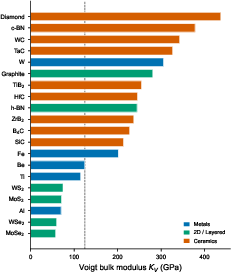
Figure 1: Voigt bulk modulus KV1 evaluated for 20 candidate materials, contextualizing ceramics and 2D materials against the beryllium baseline.
The mechanical merit of layered materials must be interpreted with respect to the Voigt/Reuss dichotomy. The highly anisotropic nature of graphite and h-BN inflates their Voigt bulk modulus due to exceptional in-plane covalent bonding, an effect that is physically relevant for in-plane loading such as high-velocity particulate impacts.
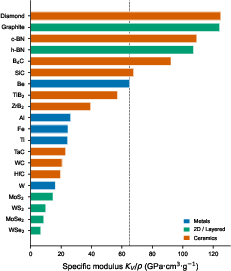
Figure 2: Specific modulus (KV2) comparison, underscoring the mass efficiency of leading ceramics and 2D materials relative to beryllium.
Transition metal dichalcogenides and high-Z metals, despite some having high absolute moduli, are eliminated due to low specific stiffness or prohibitive mass.
Erosion and Mass Optimization
Erosion-corrected shield masses, computed by integrating sputtering resistance and minimum viable structural thickness, reveal that graphite, h-BN, and BKV3C can achieve mass reductions of KV4–KV5 compared to the original beryllium specification.
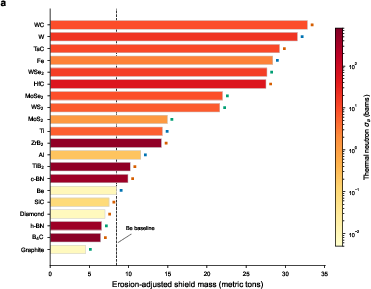
Figure 3: Mass of an erosion-optimized shield for each candidate, with bar color denoting neutron absorption cross-section; h-BN and BKV6C outperform beryllium in both mass and radiation protection.
Materials containing boron, such as h-BN and BKV7C, uniquely combine high specific stiffness and sputtering resistance with cross-sections for neutron absorption orders of magnitude higher (384–614 barns) than beryllium (0.008 barns).
Multi-Objective and Pareto Analysis
A multi-objective screening visualizes the tradeoff between specific modulus and neutron shielding, revealing that boron ceramics (h-BN, BKV8C, c-BN, TiBKV9, ZrBρ0) populate the Pareto front, offering no-compromise solutions for simultaneous mechanical and neutron shielding.
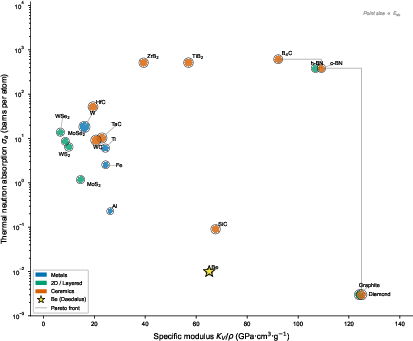
Figure 4: Pareto front showing specific modulus versus neutron absorption for all candidates, with marker size proportional to surface binding energy; beryllium is notably off the front.
In contrast, high-stiffness materials without boron (diamond, graphite) are penalized by their negligible neutron shielding, while beryllium delivers only moderate mechanical performance devoid of significant radiation protection.
Machine Learning Validation with ALIGNN
ALIGNN parity with JARVIS-DFT on bulk and shear moduli is excellent (ρ1, MAE = 4.4 GPa for ρ2), with the exception of Bρ3C due to its structural complexity and poor training set representation.
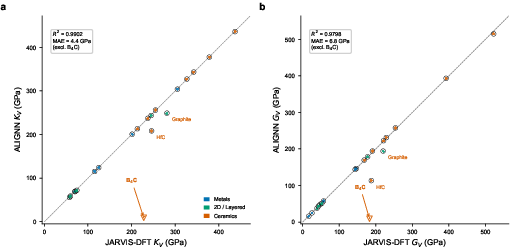
Figure 5: Parity analysis between ALIGNN GNN predictions and DFT values for ρ4 and ρ5, highlighting Bρ6C as an outlier.
This outlier underscores the necessity for diverse and representative datasets in GNN training, especially for low-symmetry and chemically distinct compounds relevant to space applications.
Proposed Layered Heterostructure Design
The study synthesizes its insights into a graded shield concept:
- Layer 1: Graphene/graphite for initial particle impact and sputtering resistance.
- Layer 2: h-BN as a neutron-absorbing, mechanically robust envelope.
- Layer 3: High-density polyethylene (HDPE) for cosmic ray proton moderation.
- Layer 4: Aluminum structural support.
This architecture yields an estimated total mass 47% lower than the Daedalus design, dramatically improved neutron absorption, and modular layers each optimized for a distinct physical threat.
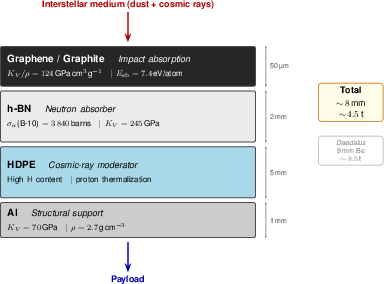
Figure 6: Schematic of the proposed four-layer heterostructure, optimized for sequential impacts, neutron capture, cosmic ray moderation, and mechanical support.
A multiplicative figure of merit encompassing all criteria positions h-BN, Bρ7C, c-BN, and TiBρ8 as dominant, all containing boron. These materials surpass beryllium by nearly an order of magnitude in composite performance. Diamond and graphite, while outstanding in specific stiffness, are penalized for negligible neutron cross-section.
Implications and Future Directions
This analysis demonstrates that half a century of advances in materials synthesis and AI-accelerated screening offer substantial gains over legacy solutions for interstellar engineering. Boron-containing ceramics, particularly h-BN and Bρ9C, offer unique dual-function capacities essential for practical relativistic travel. The identification of such materials highlights the utility of modern computational tools in revisiting foundational engineering challenges.
Practically, the main barrier to implementation remains propulsion rather than shielding materials; thus, these findings become actionable upon the realization of fusion-pulse drive or similar high-velocity architectures. In a broader sense, this work emphasizes the importance of consistent re-evaluation of engineering assumptions given rapid progress in both materials science and computational AI surrogates.
Potential future avenues include:
- Incorporating high-fidelity models of radiation damage and defect accumulation.
- Extending machine learning validation to more complex, underrepresented materials.
- Experimentally validating proposed multilayer architectures under simulated ISM bombardment.
- Exploring manufacturability and scale-up strategies for bulk boron-based layered systems.
Conclusion
AI-accelerated computational screening, leveraging exhaustive DFT datasets and GNN property predictors, enables a rigorous and quantitative reevaluation of materials for extreme aerospace applications. For the specific case of interstellar dust shielding, boron-rich ceramics decisively outclass beryllium in nearly all relevant metrics. The work proposes a layered shield structure that, if coupled with viable high-speed propulsion, materially advances the engineering prospects for interstellar exploration.

