- The paper introduces a Bayesian extension to MSM, addressing continuous treatment processes with unmeasured confounding in dynamic settings.
- It employs point-process models and stabilized IPTW reweighting to achieve unbiased estimates of dose and time effects under simulated confounding.
- Empirical validation using oxytocin data in peripartum care demonstrates the framework’s potential for managing subtle treatment effects.
Bayesian Causal Inference for Continuous-Time Dynamic Treatments with Unmeasured Confounders
Introduction
The paper "Estimating causal effects of continuous-time dynamic treatments with unmeasured confounders" (2604.00544) addresses a significant limitation in longitudinal causal inference: the estimation of causal effects for continuous-time, dynamically-adjusted treatment regimens from observational data, particularly in the presence of unmeasured confounding. Existing MSM-based approaches assume time-evolution in discrete intervals and require no unmeasured confounders, conditions that do not hold in many real-world clinical scenarios, such as intravenous drug administration. This work extends the MSM paradigm, constructing a Bayesian methodology to estimate causal effects in continuous time, explicitly marginalizing over unmeasured confounders in the likelihood.
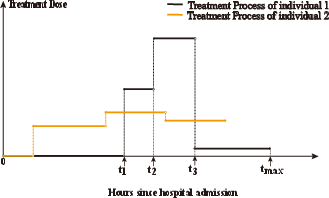
Figure 1: Illustration of oxytocin administration processes for two individuals highlighting non-uniform dose adjustments and delivery timings.
Estimation of causal effects for continuous-time treatment processes requires overcoming several technical barriers:
- Treatment Path Representation: Treatment, e.g., oxytocin dose, is a controlled process A(t) updated at arbitrary times, potentially depending on observed covariates Lˉ(t), baseline variables Z, and unmeasured confounders U.
- Dynamic Covariate Dependence: Treatment intensities, both in terms of when a change occurs and what value it assumes, evolve as a stochastic process that may depend on latent variables.
- Unmeasured Confounding: Observational settings rarely guarantee control of all confounders, complicating the identifiability of standard causal parameters.
- Likelihood Construction: Classical MSMs leverage IPTW based on the observed treatment regime, but in the presence of U, proper weighting requires integration over unobserved data.
The investigators formalize this setting precisely with point-process notation, counting processes for treatment adjustments (NA(t)) and treatment cessation (NTmax(t)), and construct likelihoods accordingly. Unmeasured confounders are accommodated within a Bayesian marginalization framework.
Methodology
Causal Model Specification
Potential outcomes are defined as Y(aˉ,tmax), the outcome observed under the treatment function path aˉ to time tmax. The continuous-time MSM:
Lˉ(t)0
is proposed, where Lˉ(t)1 and Lˉ(t)2 encode the dose and time-effect dynamics respectively, and Lˉ(t)3 is Gaussian noise. The exponential kernel for time-diffusion generalizes decay of treatment effect, leveraging the Hawkes process' established modeling formalism.
Likelihood Construction and Bayesian Marginalization
Treatment and cessation events are modeled using intensity functions for the associated counting processes, yielding full likelihoods Lˉ(t)4 (observed data generating process), and Lˉ(t)5 (interventional regime). The framework marginalizes over Lˉ(t)6, constructing stabilized inverse-probability weights via the Radon-Nikodym derivative of these regimes, Lˉ(t)7.
This allows construction of an "IPTW pseudo-population" where confounding by Lˉ(t)8 is addressed. Bayesian posterior computation proceeds via integration over priors for unknowns, including the confounding structure parameterization.
Estimation and Computational Aspects
The estimation procedure involves:
- Marginalization of unmeasured Lˉ(t)9 either via analytic or MCMC integration, with explicit mention of Stan/NUTS-based sampling schemes and, when possible, empirical Bayesian use of external information for priors.
- Computation of target parameters via bootstrapped or posterior sample-weighted log-likelihood optimization, utilizing Bayesian bootstrap to generate posterior predictive draws.
Empirical Validation
Simulation Studies
The simulation section evaluates five estimators, including naive (unweighted), frequentist IPTW ignoring Z0, IPTW with observed Z1 (oracle), a truncated IPTW variant, and the proposed Bayesian approach.
Key observations:
- When no unmeasured confounding exists (Z2), all methods perform adequately except IPTW ignoring Z3, which suffers extreme bias and variance due to model mis-specification.
- With increasing confounding (Z4), both naive and truncated IPTW methods manifest strong bias and under-coverage, whereas the Bayesian estimator maintains approximately unbiased estimates and nominal interval coverage, matching the performance of the unattainable oracle method.
- Point estimation and interval coverage for Z5 (dose effect) and Z6 (time effect) via the Bayesian approach closely track the true, simulation-defined targets even under strong unmeasured confounding.
Real-World Application: Oxytocin and Postpartum Hemorrhage
Applying the Bayesian estimator to data from the Consortium on Safe Labor (CSL), the paper evaluates the dose-duration-response of peripartum oxytocin on postpartum hemorrhage (PPH).
- The Bayesian MSM (Z7, CI: Z8; Z9, CI: U0) implies that increases in both the dose and duration of oxytocin marginally increase blood loss risk, but the effect size is mild.
- For a prototypical patient, the predicted increment in hemorrhage for sustained oxytocin is approximately 29ml, which is likely subclinical.
- Importantly, the credible interval for U1 includes U2, suggesting that while dose effects are robust, the time decay effect may be variable.
Implications and Future Directions
This Bayesian framework formally extends continuous-time MSM methodology to admit unmeasured confounding, a scenario not previously addressable by existing approaches. It provides:
- A computationally viable, principled approach for handling complex treatment regimes where time is best measured continuously.
- A direct means to integrate external information or prior knowledge via Bayesian marginalization, enhancing real-world applicability in medical, reliability, and engineered systems domains.
On the theoretical side, the explicit connection via posterior predictive reweighting opens paths to flexible extensions, such as accommodating "frailty" variables or further latent structures, and to consideration of nonparametric adaptations for even greater robustness to model misspecification.
Practical computational improvements, e.g., high-efficiency approximation of cumulative hazards, are highlighted as promising areas for improving scalability and adoption.
Conclusion
The presented Bayesian methodology enables robust estimation of causal effects for complex, continuous-time treatment processes with unmeasured confounding, filling an analytic gap present in current MSM frameworks. Theoretical soundness and simulation-backed empirical validation underscore its utility, particularly in high-stakes domains such as peripartum care. Future work should prioritize computational scaling, nonparametric model integration, and broader adoption in dynamic treatment settings, potentially catalyzing advances in both causal inference theory and applied biostatistics.

