- The paper introduces MATHENA, a unified framework using Mamba-based SSMs that achieves 93.78% mAP₅₀ in tooth detection and high Dice scores in segmentation tasks.
- Methodologically, it combines a hybrid CNN and SSM backbone with a Global Context State Token and sequential transfer learning to enhance multi-scale feature fusion.
- Empirical results on the PARTHENON benchmark demonstrate superior performance over models like YOLOv8 and UNet, indicating its potential for scalable clinical dental diagnosis.
MATHENA: Unified Mamba-SSM Framework for Panoramic Dental Diagnosis
Introduction
The paper introduces MATHENA, a comprehensive architectural framework for automated analysis of dental panoramic radiographs (OPGs), encompassing four critical diagnostic tasks: tooth detection, caries segmentation (CarSeg), anomaly detection (AD), and dental developmental staging (DDS). MATHENA is designed to reflect clinical workflows while leveraging Mamba’s recent advances in State Space Models (SSM), achieving linear complexity O(N) global context modeling that outperforms both CNNs lacking contextual range and Vision Transformers with prohibitive quadratic resource requirements. The approach is validated on PARTHENON, a benchmark aggregating over 15,000 annotated OPG instances from ten datasets, enabling rigorous comparative evaluation.
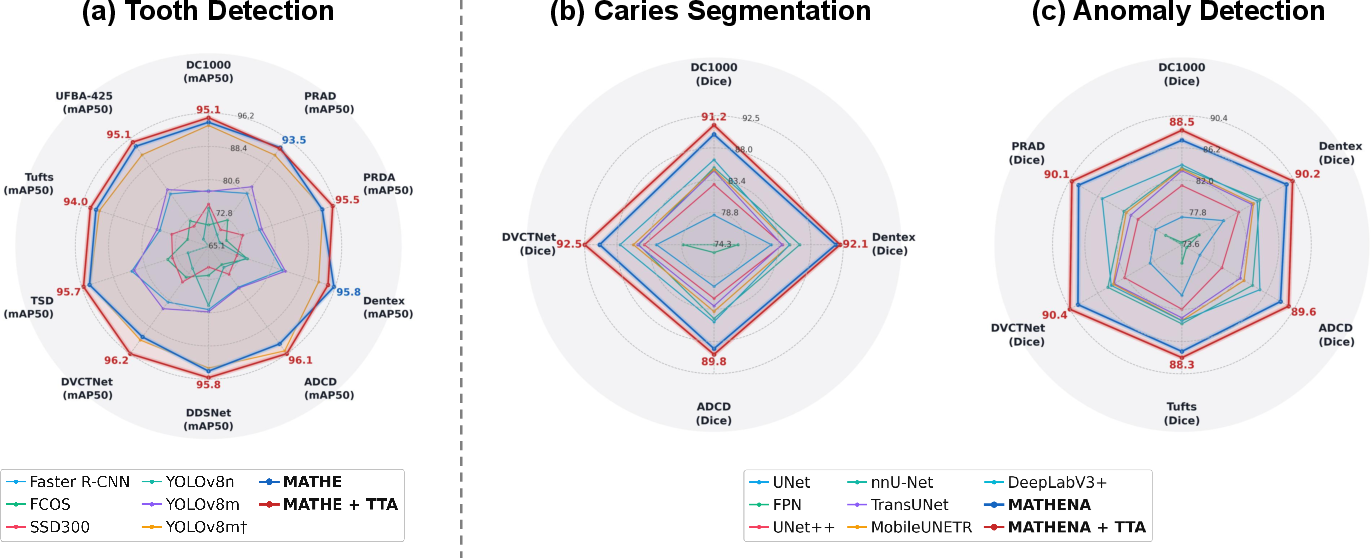
Figure 1: Quantitative results on PARTHENON: MATHE variants outperform baseline models in tooth detection (mAP50); MATHENA variants show superior Dice scores in CarSeg and AD.
Methodological Advances
MATHE: Mamba-based Architectural Tooth Hierarchical Estimator
MATHE is tasked with tooth detection, leveraging a hybrid backbone architecture. Early layers deploy convolutions for high-resolution feature extraction, while deeper layers incorporate C2fSSM blocks with four-directional Vision State Space (VSS) units, conferring efficient global context aggregation. Multi-scale features are fused via a BiFPN with learnable weights, extending receptive fields and facilitating robust detection even in crowded anatomical regions. Detection heads utilize decoupled towers and are optimized with Wise-IoU (WIoU), which dynamically modulates gradients by bounding box quality.
HENA: Holistic Evaluation Network for Anatomy
HENA operates on per-tooth crops, implementing a lightweight U-shaped encoder-decoder inspired by MobileUNETR but replacing Transformer modules with Mamba VSS blocks for intra-tooth dependency modeling. The bottleneck introduces a Global Context State Token (GCST), allowing efficient aggregation of local-global semantics via linear recurrence. Decoder skip fusions further modulate spatial representations through FiLM leveraging GCST, ensuring effective cross-scale information propagation.
A triple-head design processes CarSeg, AD, and DDS. CarSeg is trained upstream to establish robust shared representations before freezing the backbone for downstream AD and DDS, the latter employing GAP at the bottleneck for dental maturity classification via ordinal regression. This sequential, frozen-trunk transfer learning achieves competitive accuracy with substantial reductions in computational resource demand.
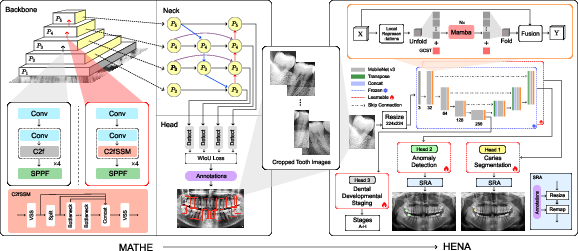
Figure 2: MATHENA architecture: MATHE backbone with BiFPN and detection head; HENA encoder-decoder with GCST skip fusion for holistic multi-task analysis.
Benchmarking and Experimental Results
On the PARTHENON dataset, MATHE achieves 93.78\% mAP50 for tooth detection, rising to 94.89\% with test-time augmentation (TTA). MATHENA delivers 90.11\% Dice for CarSeg, 88.35\% Dice for AD, and 72.40\% accuracy for DDS, consistently outperforming standard detectors (YOLOv8, RetinaNet) and segmentation models (UNet, DeepLabv3+, nnU-Net).
Ablation analyses reveal the indispensability of global context modeling: eliminating GCST drops detection by 4.36\% mAP50, removing Mamba bottlenecks reduces CarSeg Dice by 2.36\%, and replacing Mamba with Vision Transformer modules degrades multi-task efficacy, underscoring architectural superiority in both representational power and computational efficiency.
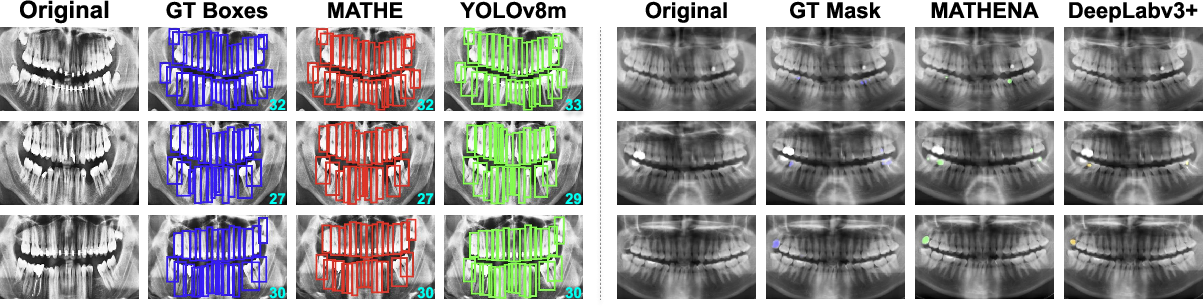
Figure 3: Visual comparison: left, MATHE robustly detects teeth; right, MATHENA produces precise caries segmentation.
Architectural Implications and Future Directions
The findings demonstrate that linear-time SSMs (Mamba) are highly effective for medical image analysis tasks where global context and anatomical dependencies are paramount. The GCST mechanism and sequential transfer learning strategy yield both accuracy and efficiency, facilitating deployment in clinical settings with tight computational budgets.
Practically, MATHENA provides a scalable foundation for multi-task diagnosis, potentially extending to additional anatomical regions and modalities. The unified approach reduces fragmentation typical in dental imaging research and enables richer clinical assessment pipelines.
Theoretically, MATHENA reinforces the value of recurrence-based global modeling and hierarchical representations, suggesting avenues for further unification of detection, segmentation, and classification tasks via SSMs. Ongoing advances in linear-complexity sequence modeling may expand the scope for similar networks in high-resolution, high-throughput medical analytics.
Conclusion
MATHENA offers a robust, unified architecture for panoramic dental analysis, empirically validating its efficacy and efficiency across large-scale, multi-task benchmarks. The adoption of Mamba-based SSMs provides both global context and computational scalability, yielding superior performance in tooth detection, segmentation, anomaly localization, and developmental staging. PARTHENON establishes a rigorous baseline for dental AI research, setting the stage for future refinement and broader anatomical generalization.