- The paper demonstrates that combining strong-coupling expansion with two-point Padé interpolation yields uniformly accurate global approximations of lattice φ⁴ two-point functions.
- The authors introduce an explicit combinatorial and diagrammatic formulation to compute high-order corrections systematically, reducing reliance on asymptotic perturbative methods.
- Benchmarks on zero- and one-dimensional models show that the two-point Padé method significantly cuts numerical errors and computational cost compared to traditional approaches.
Strong-coupling Expansion and Two-point Padé Approximation for Lattice ϕ4 Field Theory
Introduction and Motivation
The computation of correlation functions in lattice ϕ4 field theory at intermediate and strong coupling presents substantial challenges. Traditional weak-coupling perturbative expansions are often asymptotic or have a finite radius of convergence, failing to capture non-perturbative effects that emerge in such regimes. While non-perturbative numerical techniques exist (e.g., lattice Monte Carlo, tensor networks), these methods tend to be resource-intensive and often encounter algorithmic obstacles such as the fermion sign problem.
This work synthesizes strong-coupling expansions (SCE) with two-point Padé rational approximation strategies, providing a systematic procedure for constructing global approximations to the two-point correlation function across the full range of coupling strengths. Rational approximants are constructed to interpolate between the weak- and strong-coupling expansions, giving highly accurate results even at intermediate coupling where neither expansion alone is reliable. The methods are benchmarked on the zero-dimensional and one-dimensional lattice ϕ4 models, with detailed numerical and analytic convergence analysis.
The Hamiltonian for the d-dimensional lattice ϕ4 theory is
H=ij∑2tij(ϕi−ϕj)2+i∑(2μϕi2+4!gϕi4)
with g the coupling parameter. The observable of interest is the two-point function Gij, defined as the thermal average of ϕiϕj in the interacting ensemble.
The authors derive a strong-coupling expansion valid as g→+∞ using a novel combinatorial methodology. The core steps are: (1) application of a Hubbard–Stratonovich transformation to isolate the Gaussian sector, (2) explicit sitewise moment expansion, and (3) evaluation of Gaussian moments via Wick’s theorem, mapped onto Feynman diagrams. M\"obius inversion is used to convert exclusion sums (arising from the requirement of distinct indices in diagram counting) into inclusion sums more amenable to symbolic computation.
The resulting SCE recovers the leading trivial behavior at large ϕ40, with systematic higher-order corrections derived as explicit diagrammatic series. For general local interactions, this combinatorial structure facilitates the algorithmic calculation of expansion coefficients to high order, an important advantage over previous treatments.
Padé and Borel-Padé Analytic Continuation from Multiple Asymptotic Regimes
The main barrier to extending the range of perturbative expansions is the existence of non-analytic features, such as branch cuts, at the origin or infinity in the coupling parameter. Classical Padé, Borel-Padé, and resurgence-based methods attempt to analytically continue the series, but typically rely on one-sided information (i.e., the weak-coupling expansion around ϕ41) and are sensitive to truncation and singularity structure.
In contrast, the two-point Padé construction interpolates between both the weak (WCE) and strong (SCE) asymptotic regimes. By matching the truncated series at ϕ42 and ϕ43, a rational function is constructed that captures analytic characteristics at both ends. The evaluation of such two-point Padé approximants is algorithmically efficient and their analytic structure can reproduce the global behavior of the correlation function over the entire real axis.
Numerical Validation: Zero- and One-dimensional ϕ44 Models
The interpolation methodology is first tested on zero-dimensional ϕ45 theory, where the partition function is a single quadrature and all correlation functions can be computed exactly. This allows a stringent pointwise comparison between (i) weak/strong coupling truncated series, (ii) classical one-point Padé approximants, (iii) Borel-Padé resummation, and (iv) two-point Padé-based interpolation.
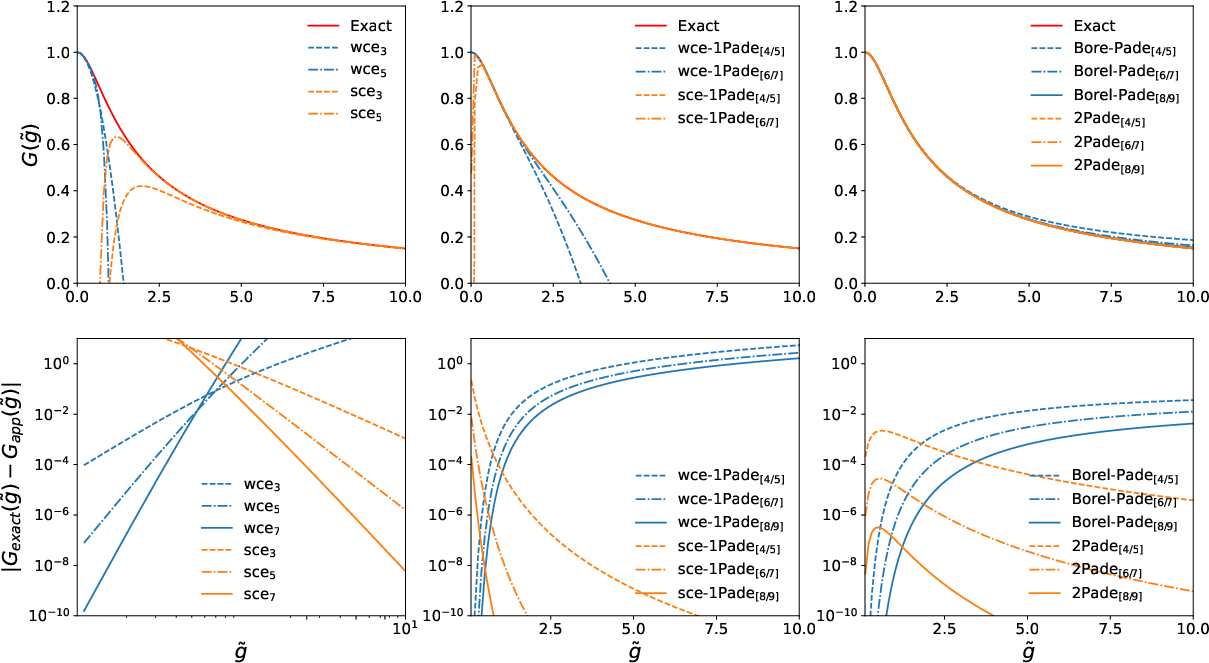
Figure 1: Different approximations of ϕ46 for zero-dimensional ϕ47 field theory, including WCE, SCE, one-point Padé, Borel-Padé, and two-point Padé schemes. The two-point Padé yields near-exact results across all ϕ48.
The one-point Padé and Borel-Padé approaches exhibit characteristic domain biases: Padé on the weak-coupling series is accurate only for small ϕ49, and its accuracy degrades as ϕ40 increases; similarly, Padé on the SCE is accurate for large ϕ41 and fails at small coupling. Two-point Padé, by contrast, delivers uniform accuracy across the full coupling domain, with numerical errors several orders of magnitude smaller than one-sided approaches.
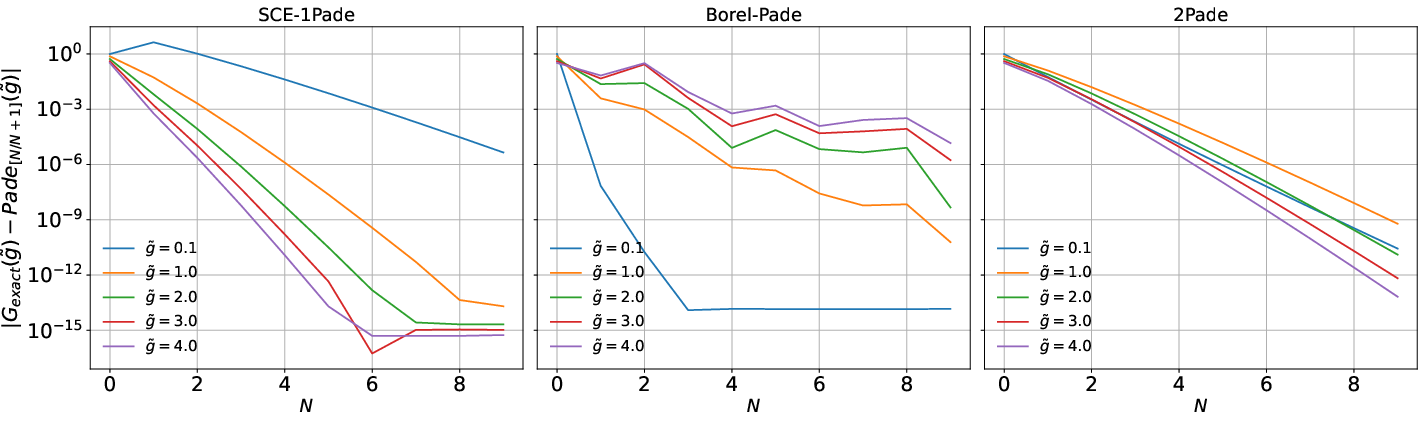
Figure 2: Convergence rates for SCE-1Padé, Borel-Padé, and 2Padé approximations, highlighting the order-by-order exponential reduction in error for two-point Padé over the entire coupling range.
Analogous results are obtained in the one-dimensional lattice case, with Monte Carlo (Langevin-dynamics-based) results serving as the ground truth. The two-point Padé construction continues to exhibit robust, nearly uniform accuracy that is unattainable with either WCE or SCE alone, even at comparable truncation orders.
Analytic Structure and Convergence Analysis
A major insight is the identification of distinct analytic structures in the coupling plane for the WCE and SCE. The WCE is nonanalytic at ϕ42 due to a branch point, explaining its divergence away from weak coupling. By reparametrizing the problem in terms of ϕ43, the SCE gives rise to a function ϕ44 analytic at ϕ45; thus, the singularity is circumvented in this variable. Padé approximants (particularly two-point) then serve as a practically efficient means of analytic continuation (AC) through these regular domains, yielding global rational approximations faithful to the nonperturbative structure expected physically.
Domain coloring diagnostics and AC error analyses further confirm that the two-point Padé interpolant recovers the analytic structure deep into the complex plane, with error contours overlapping those of exact solutions in physically relevant half planes.
Comparison with Borel and Resurgence-based Approaches
The approach is contrasted with classical Borel resummation, which seeks analytic continuation by Laplace-transforming a Borel series and is effective where the series is Borel summable. However, Borel-Padé (and related resurgent treatments) are inherently one-sided and require many coefficients for competitive accuracy with two-point Padé, even in scalar field theory. The two-point approach is identified as more computationally efficient and directly generalizable provided a suitable alternative (e.g., strong-coupling) expansion is available.
Implications, Extensions, and Outlook
The explicit combinatorial formulation of the SCE and the generality of the two-point Padé scheme suggest immediate extensions beyond lattice ϕ46. For interacting fermion models (e.g., Hubbard model) or higher-dimensional and continuum theories, the same principles could yield global interpolation formulas. Of practical relevance is the factorial reduction in computational cost: an ϕ47-order two-point Padé approximation requires only ϕ48 coefficients from each regime, compared to ϕ49 for a one-sided approach, which is significant given the combinatorial growth in diagram count at high orders.
The expected convergence of two-point Padé for analytic correlation functions on finite systems is supported, though a general rigorous proof remains out of reach. The method's robustness in the presence of weak non-analyticities and its expected applicability to large-d0 expansions, high-/low-temperature dualities, and more general functional constructions is emphasized.
Conclusion
This work establishes a powerful framework for global, rapidly converging analytic approximations to correlation functions in lattice d1 field theory by unifying explicit strong-coupling expansions with two-point Padé interpolation strategies (2604.00525). The described numerical evidence and analytic arguments demonstrate that the two-point Padé approach captures non-perturbative dynamics efficiently, requires significantly fewer expansion coefficients, and generalizes naturally to other systems where complementary asymptotic expansions can be constructed. Future research is anticipated in rigorously establishing convergence in broader settings and in automating the generation of high-order SCE and matching routines for more complex field-theoretic models.