- The paper introduces a quantum Oppenheimer-Snyder model that modifies classical black hole structures with a non-singular, bouncing interior.
- Methodology involves numerical solutions of the Teukolsky equation to demonstrate enhanced greybody factors in quantum-corrected regimes.
- Findings show that suppressed Hawking radiation widens the viable mass window for primordial black holes to comprise all dark matter.
Quantum Oppenheimer-Snyder Primordial Black Holes as All the Dark Matter
Motivation and Context
The paper "Quantum Oppenheimer-Snyder primordial black holes as all the dark matter" (2604.00515) explores the viability of primordial black holes (PBHs) with quantum-corrected structures – specifically, quantum Oppenheimer-Snyder (qOS) black holes – as candidates for accounting for all dark matter. Traditionally, PBHs are modeled as Schwarzschild or Kerr black holes, solutions derived from general relativity (GR) and containing central singularities. However, GR incompletely addresses the singularity and information-loss problems, motivating the exploration of quantum gravity corrections in black hole structure. The qOS model, leveraging loop quantum cosmology (LQC) modifications to the Oppenheimer-Snyder collapse, yields a non-singular interior and an exterior spacetime with an additional α-dependent term, distinguishing it substantially from the classical Schwarzschild metric.
Quantum Oppenheimer-Snyder Black Hole Structure and Thermodynamics
The interior metric of the qOS black hole is identical in form to a spatially flat FLRW metric but incorporates a modified Friedmann equation such that energy density ρ is bounded by a critical value ρc, preventing singularity formation and enforcing a bounce when collapse would otherwise reach infinite density. The exterior metric is static and spherically symmetric: f(r)=g(r)=1−2M/r+αM2/r4, with α quantifying quantum corrections. For α→0, the conventional Schwarzschild solution is recovered.
The Hawking temperature of the qOS black hole, crucial for characterizing evaporation rates and observational constraints, is computed from the horizon surface gravity, yielding:
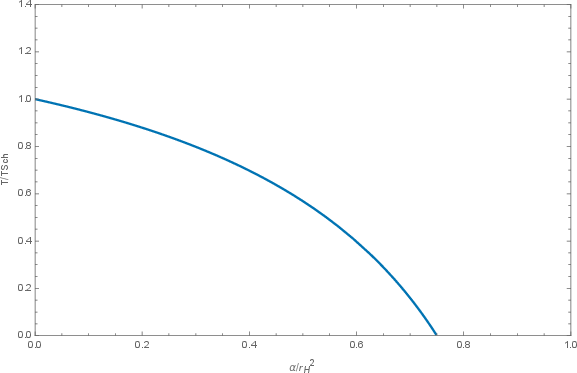
Figure 1: Normalized T/TSch as a function of α/rH2, showing suppression relative to the Schwarzschild case.
This figure demonstrates monotonic temperature suppression for increasing α/rH2. Notably, for α/rH2≈0.75, the qOS temperature approaches zero, indicating exponentially suppressed Hawking emission for large quantum corrections.
Greybody Factors and Particle Tunneling
Hawking radiation, after accounting for the spacetime-dependent potential barrier, is not purely blackbody as greybody factors modulate the transmission probability for emitted particles. The paper solves the Teukolsky equation numerically for the qOS metric, extracting transmission probabilities for photon modes:
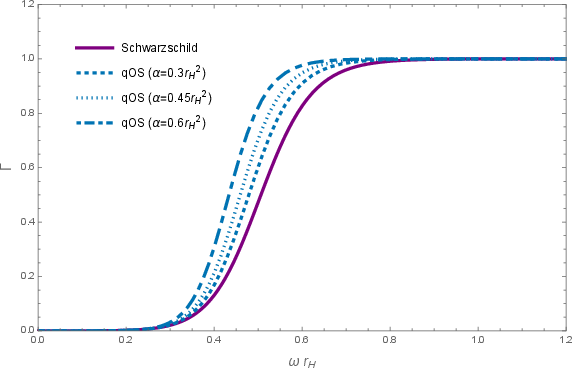
Figure 2: Greybody factors versus ρ0 for different ρ1 values, revealing enhanced transmission in quantum-corrected cases compared to the classical Schwarzschild limit.
The results show, for certain frequency domains, greybody factors for qOS black holes exceed those for Schwarzschild black holes, implying that photons can more readily escape quantum-corrected PBHs in these regions. The enhancement is sensitive to ρ2, manifesting primarily in the low-temperature regime where quantum corrections dominate over classical terms.
Hawking Radiation Spectra and Astrophysical Implications
The combined effect of reduced temperature and modified greybody factors is assessed via the Hawking radiation photon spectrum. The net effect, despite enhanced greybody factors, is the suppression of the overall photon number density – the temperature reduction overwhelms the modification in particle transmission:
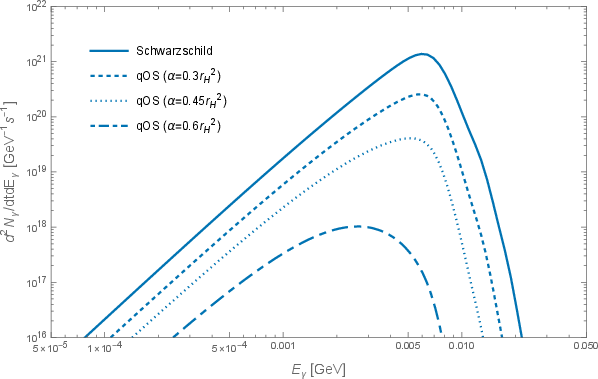
Figure 3: The particle number density for Hawking radiation as a function of particle energy, demonstrating systematic suppression for higher ρ3 values.
For fixed PBH mass (ρ4g), the suppression is pronounced, with the spectrum for ρ5 being more than three orders of magnitude lower compared to the Schwarzschild case. This result is robust for ρ6, reflecting the dominant impact of temperature in quantum-corrected black hole evaporation.
Constraints on PBH Dark Matter Fraction
With the suppressed evaporation rates, the authors evaluate constraints on PBH abundance from extragalactic gamma-ray background measurements (HEAO-1, COMPTEL, EGRET). Lower Hawking emission yields weaker observational bounds, broadening the viable mass window for PBHs to constitute the entirety of dark matter:
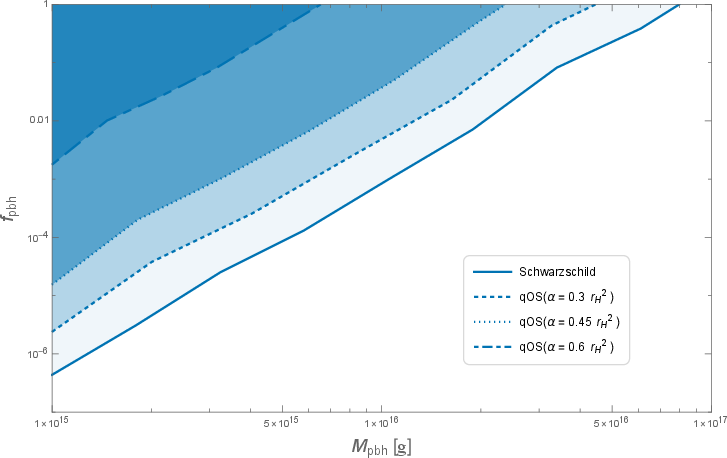
Figure 4: Dark-matter fraction ρ7 as a function of PBH mass for Schwarzschild and qOS cases, illustrating a broadened allowed window for increased ρ8 values.
The mass range for ρ9 in the qOS scenario (ρc0) is more than an order of magnitude wider than in the Schwarzschild limit, directly attributable to the quantum suppression of photon emission.
Theoretical and Observational Implications
The paper's results challenge the prevailing constraints on asteroid-mass PBHs as dark matter, showing that quantum corrections can significantly relax gamma-ray bounds and alter viable parameter space, particularly in mass windows below ρc1g. This advocates for revisiting PBH abundance limits with quantum-corrected metrics, and motivates further study of loop quantum gravity-inspired modifications in black hole evaporation, including non-singular dynamics, entropy, and information retention.
Theoretically, the results reinforce the utility of effective quantum gravity approaches in astrophysical contexts, especially in exploring possible resolutions to singularity and information-loss problems. They also highlight the sensitivity of observational constraints to underlying black hole physics and the need for models beyond classical GR in cosmological analyses.
Conclusion
Quantum-corrected Oppenheimer-Snyder primordial black holes, with their modified thermodynamics and greybody factors, create a new regime for PBH dark matter models. The suppression of Hawking radiation for substantial ρc2 values relaxes observational constraints and expands the asteroid-mass window where PBHs could form all the dark matter. The dominant effect is temperature reduction rather than increased particle tunneling, demonstrating the significance of quantum-gravity corrections. These results prompt further exploration of non-singular PBH cosmology and underline the importance of quantum modifications in dark matter phenomenology.