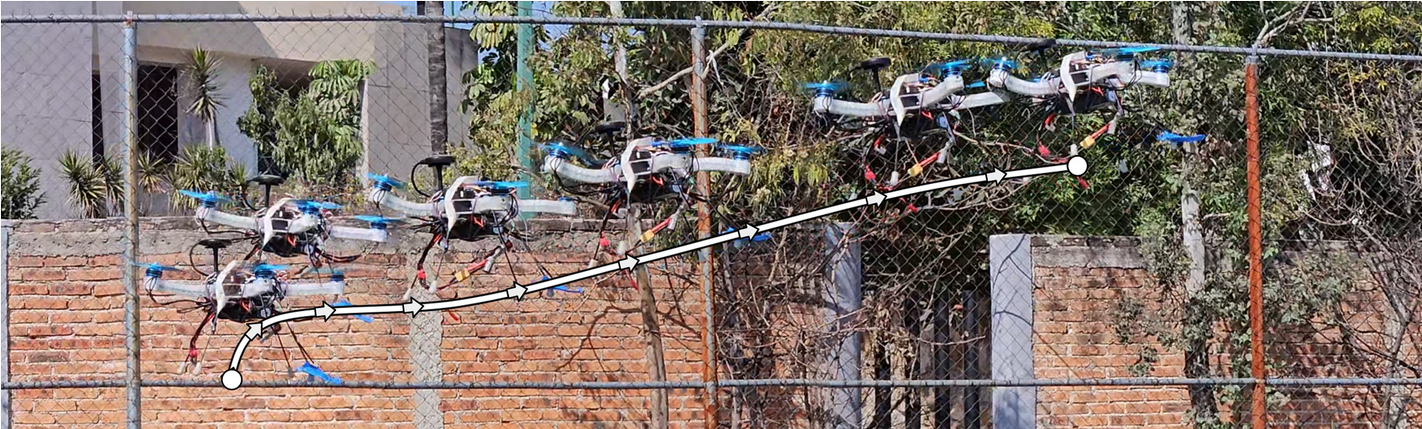
- The paper demonstrates a novel design using tendon-driven soft arms that enable in-flight morphological adaptation without sacrificing stability.
- It employs a continuum arm design with tailored anisotropic stiffness, validated by analytical modeling and outdoor flight tests showing up to 22° curvature.
- The integration with a stock Pixhawk and unmodified PX4 firmware highlights the system's potential for reliable, adaptive thrust-vectoring in conventional quadrotors.
QuadSoft: Design, Construction, and Experimental Validation of a Soft and Actuated Quadrotor
Introduction and Motivation
The paper introduces the QuadSoft, a fully actuated quadrotor platform that integrates tendon-driven, continuum soft robotic arms for in-flight morphological adaptation (2604.00496). Traditional rigid quadrotors are constrained in adaptability and maneuverability, particularly in cluttered or dynamic scenarios. By leveraging advances in soft robotics—specifically the combination of rigid and compliant materials—QuadSoft demonstrates that significant, controllable changes in airframe morphology can be achieved without compromising flight stability or requiring custom flight control hardware. This enables new capabilities in thrust vectoring, space adaptation, and resilience, forming the basis for next-generation aerial vehicles with enhanced interaction and navigational capabilities.
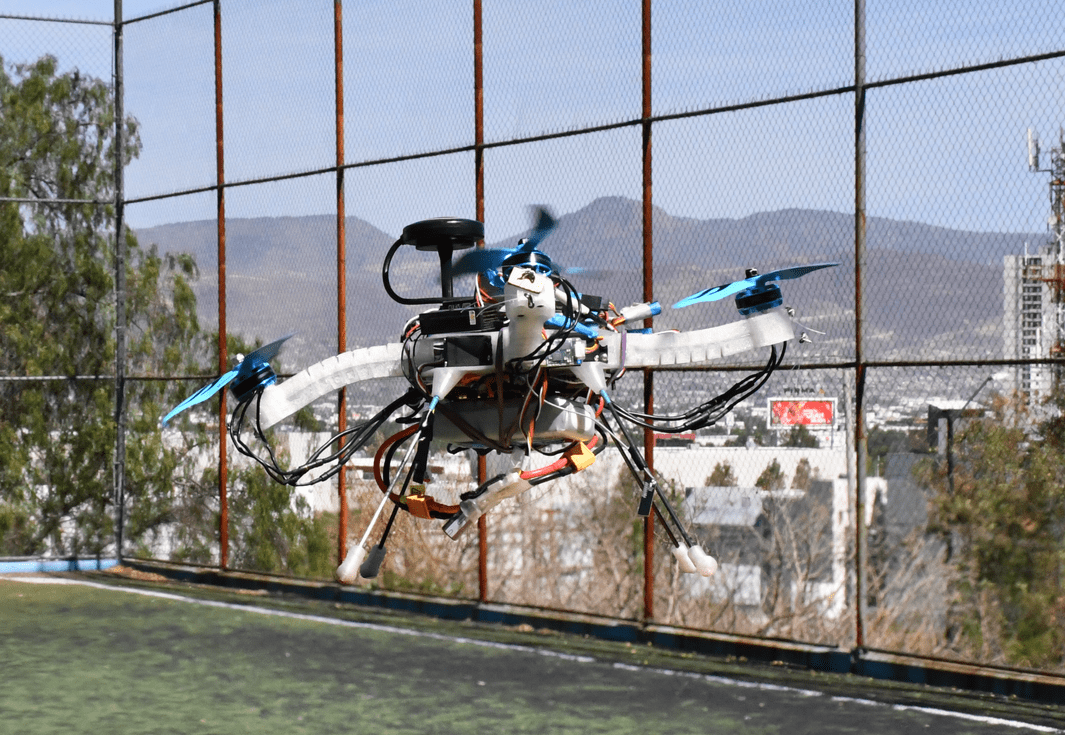
Figure 1: QuadSoft prototype during outdoor flight, displaying tendon-driven soft arms actuated for in-flight morphological adaptation.
The state-of-the-art in aerial morphing robotics reveals key contrasts between various design philosophies:
- Impact resilience vs. active morphing: Designs like Morphy [Petris] focus on passive compliance, whereas dual-axis tilting rotor approaches [10752979] achieve 6-DOF actuation via added complexity and multiple independent actuators.
- Hybrid architectures: Platforms such as SMORS [Ryll] and SCORPION [11223764] employ partial flexibility, often constrained to discrete joints, and predominantly target perching/interaction rather than aerodynamic adaptation.
- Soft morphing UAVs: The dominance of hinging and hybrid arms (e.g., SOPHIE [9851515]) limits the continuum of achievable configurations, often requiring more than four rotors for functional compensations.
QuadSoft differentiates itself by implementing a constant-curvature, tendon-driven continuum architecture within a conventional four-rotor setup, enabling full six degree-of-freedom actuation without mechanical complexity or dependence on nonstandard control stacks.
Mechanical and Actuation Design
The core innovation of QuadSoft is its arm construction, which uses a semi-rigid carbon fiber core encased in a TPU matrix with internal air chambers for tailored anisotropic stiffness. This arrangement provides high compliance for intentional bending in a single plane (flexural) while rendering the structure torsionally stiff, preventing unwanted yaw dynamics. The inclusion of one or two antagonistic nylon tendons per arm enables continuous positive and negative curvature, constrained by design to preempt propeller-arm collision and excessive control demand.
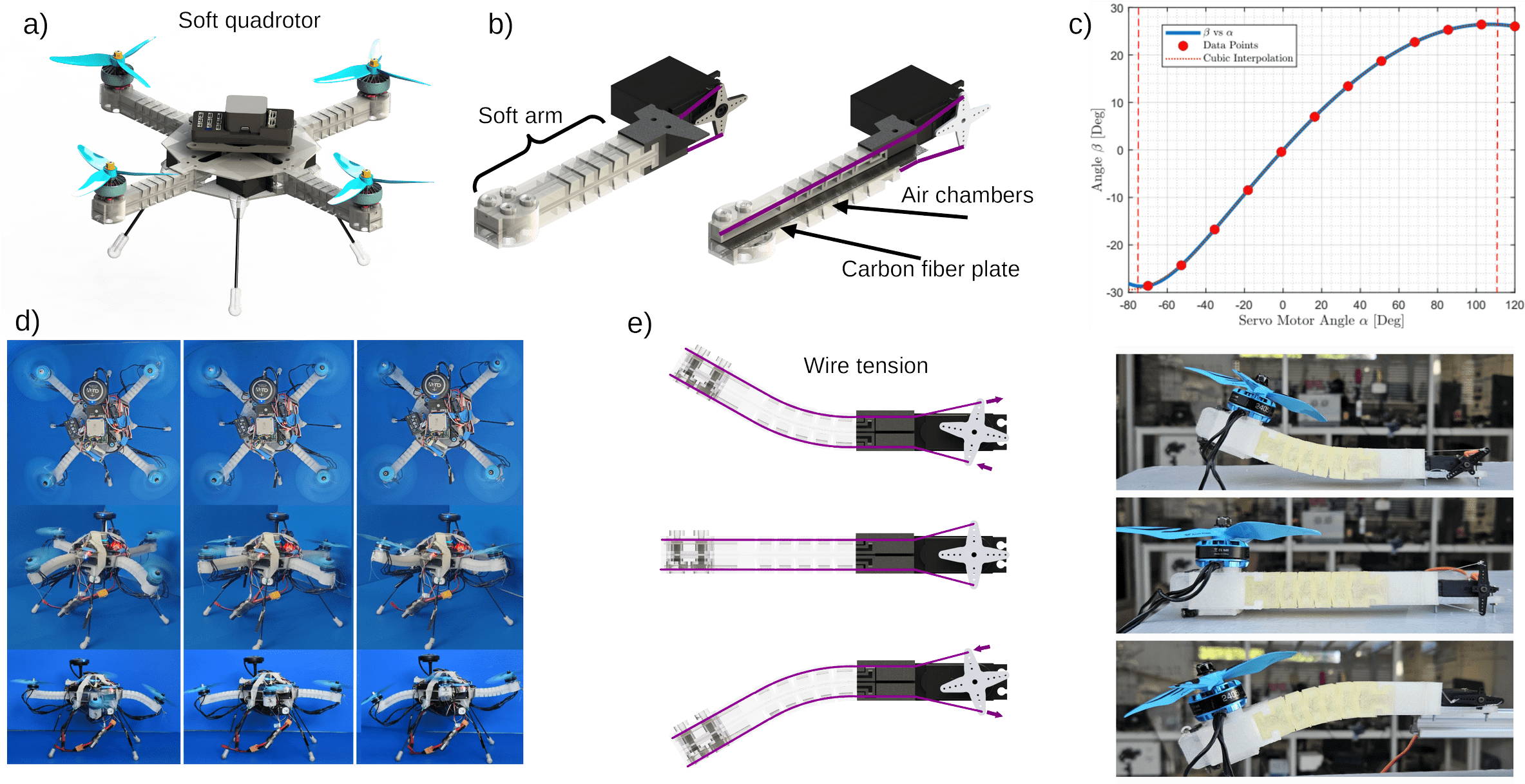
Figure 2: Design of QuadSoft, showing (a) integrated platform, (b) flexible soft arm structure, (c) experimental mapping and modeling of servo-activated arm curvature.
An explicit geometric mapping between servo input angle α and the resultant arm curvature angle β is derived analytically and further fitted with a cubic experimental model, providing a robust link for closed-loop or feedforward control in future work. Empirical validation confirms this mapping is highly predictive and that the physical structure maintains up to 22∘ of curvature well within the stability thresholds of the platform.
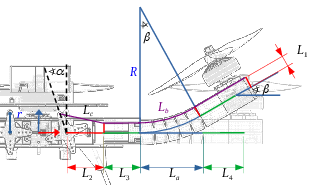
Figure 3: Schematic of the flexible arm geometry and variables critical to predicting arm curvature as a function of actuator input.
Electronics and Control Integration
A principal result highlighted in the paper is the seamless integration of QuadSoft with a stock Pixhawk V5+ controller running unmodified PX4 firmware. Flight stability—including all tendon actuation events—relies solely on OEM rate and attitude control loops, with tendon actuation signals managed by the same RC input pathways as traditional control. Key hardware includes a custom power distribution setup and dedicated UBEC for the servos, ensuring consistent power delivery during dynamic reconfiguration.
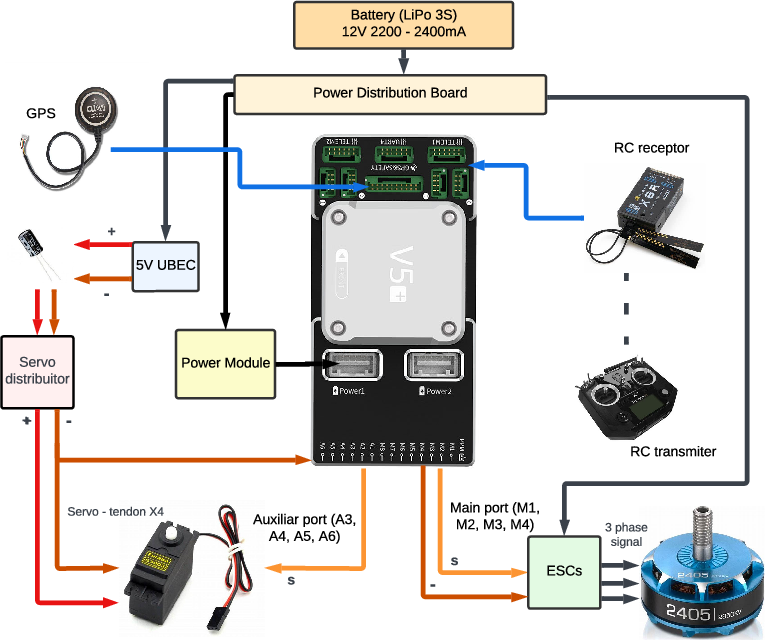
Figure 4: Electrical system diagram detailing power, control, and tendon actuation pathways.
The ability to demonstrate disruptive airframe morphing under a generic autopilot framework without tuning establishes a crucial experimental baseline for future morphing and adaptive aerial platforms.
Experimental Validation and Results
Outdoor flight experiments validate the platform's ability to sustain baseline hover, execute takeoff/landing, and realize lateral translations induced by active tendon-controlled morphing.
Hover Stability: Zero-curvature hover tests subject to moderate outdoor wind demonstrate that arm compliance and passively damped deflections (<1∘) do not degrade setpoint tracking or controller convergence.
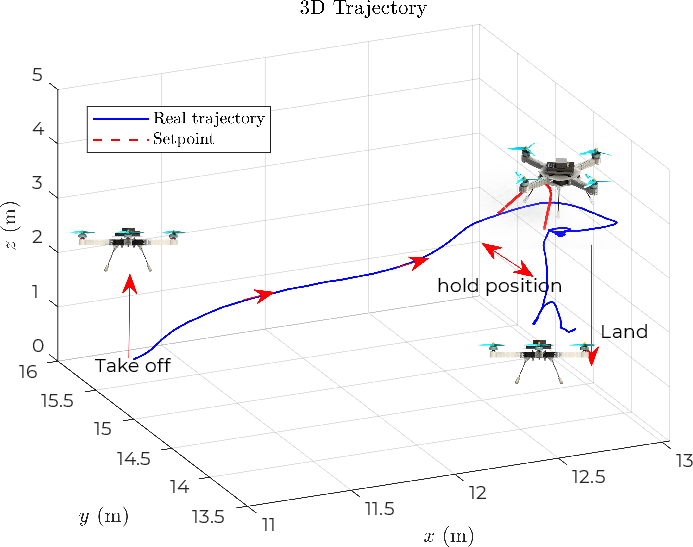
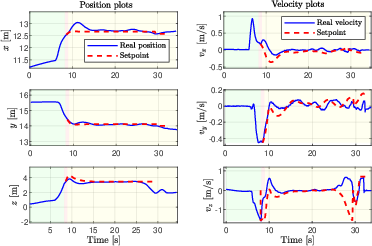
Figure 5: Three-dimensional trajectory during take-off, hover, and landing with soft arms, illustrating controller adherence to setpoints.
Morphology-Induced Translation: Controlled horizontal displacement is achieved—without global pitch or roll excursions—by selectively curving the arms in-flight. Key numerical results include:
Theoretical and Practical Implications
The paper offers strong, experimentally supported claims:
- Maintainability of baseline flight stability with high compliance arms—contradicting persistent assumptions in aerial robotics that significant frame flexibility is incompatible with tight flight control.
- Controlled and predictable thrust-vectoring via continuous arm curvature—instead of discrete, stepwise morphologies—achieved within established flight hardware frameworks.
- Physical separation of position and attitude control during morphologically induced translation, hinting at future applications in aerial manipulation, collision avoidance, or harsh-environment adaptation without complex controller redesign.
Practical deployment scenarios include cluttered indoor inspection, soft-contact manipulation, and operation in environments where both resilience and gentle interaction are required.
Future Directions
Potential research avenues suggested by this work include:
- Development of custom 6-DOF control allocation methods (mixer matrices) tailored for continuum soft morphing platforms.
- Expansion to dynamic repositioning, perching, or aerial manipulation with soft end-effectors.
- Integration with adaptive state estimation frameworks leveraging onboard sensing for closed-loop morphing feedback.
- Broader architectural studies examining trade-offs between compliant morphing and remaining mass/energy efficiency constraints in UAVs.
Conclusion
QuadSoft demonstrates that tendon-actuated, continuum soft arms can be effectively deployed on quadrotor platforms, providing a validated design, control, and experimental baseline for morphologically adaptive UAVs. The study establishes that advanced morphological compliance can serve as a physical asset—rather than disturbance—to flight controllers, utilizing only stock autopilot firmware. This work anticipates a shift toward more versatile and resilient aerial systems integrating soft robotics paradigms, with direct implications for flight in constrained environments, multi-role aerial manipulation, and adaptive control for future UAV research.