Electronic Raman scattering from 2D metals with broken inversion symmetry
Published 1 Apr 2026 in cond-mat.mes-hall | (2604.00486v1)
Abstract: Lack of inversion symmetry in metals breaks SU(2) symmetry which results in spin-splitting of the electronic states at the Fermi level due to various types of spin-orbit coupling (SOC) such as Dresselhaus, Rashba, or Ising (also called valley-Zeeman). This splitting is known to enable both incoherent spin-flip excitations and coherent chiral-spin modes. Another effect of breaking of SU(2) is the introduction of a direct spin-photon interaction. We use this concept to formulate a theory of inelastic scattering of photons from the charge carriers of such a system [electronic Raman scattering (eRS)]. As a result of broken SU(2), we show that the eRS probe, unlike conventional theory of Raman scattering, couples to spin excitations even without tuning the laser to an internal resonance. We show that the spin dependent excitations induced by photon scattering are sensitive to the polarization geometries as well as to the spin structure of the Hilbert space of the low-energy states. As a concrete realization, we examine doped/gated graphene on substrates with strong SOC with various compositions of Rashba and valley-Zeeman SOC and compare their spectra with those for a model 2D electron gas (2DEG). The spectra are shown to have a resonant feature in select polarization geometries near the SOC-splitting energy and, importantly, is shown to be different in the two systems. The signal in graphene systems is shown to be stronger than that in a 2DEG by orders of magnitude owing to the large Dirac velocity. We also outline how the lineshapes from the spectra can be used to infer various components of SOC in the system.
The paper introduces a generalized Raman cross-section formula that directly incorporates spin-photon coupling in 2D metals with broken inversion symmetry.
It details how Rashba and valley-Zeeman spin-orbit couplings yield distinct excitations and polarization-dependent Raman responses in graphene and 2DEG systems.
The study underscores that full Hilbert space modelling is crucial to capture virtual off-shell processes, ensuring accurate predictions of spectral weight and resonance features.
Electronic Raman Scattering in 2D Metals with Broken Inversion Symmetry
Introduction and Context
This work presents a rigorous theoretical framework for understanding electronic Raman scattering (eRS) in metallic two-dimensional (2D) systems where inversion symmetry is broken, leading to a loss of SU(2) symmetry and resulting in spin-split electronic band structures due to spin–orbit coupling (SOC). The study is motivated by the emergence of chiral-spin excitations and direct spin-photon interactions unique to systems with nontrivial SOC (e.g., Rashba, valley-Zeeman). Previous theories of Raman scattering, generally formulated for inversion-symmetric systems, do not accommodate direct coupling between photons and spin excitations except via internal resonances. Here, the authors articulate a general theory for non-resonant eRS that incorporates SU(2)-symmetry breaking at the level of photon-matter interaction, and apply this to concrete models of SOC-engineered graphene and 2D electron gases (2DEGs).
Theoretical Framework and Derivation
The central result is a generalized Raman cross-section formula that incorporates direct and indirect spin-photon interactions, capturing the effect of inversion-breaking SOC across arbitrary Hilbert spaces. The theory builds on the minimal coupling prescription, extending the conventional approach by emphasizing the structure of velocity and inverse mass tensors in multiband systems where commutators do not vanish. The cross-section features both a direct (contact) and indirect contribution, with leading and subleading terms arising from powers of the inverse incident photon energy.
Notably, the theory elucidates how SU(2)-symmetry breaking due to SOC modifies the Raman tensor through three channels:
altering the energy spectrum,
changing the spinor wavefunctions,
and embedding nontrivial spin dependence in the velocity operator, thereby enabling direct photon-spin coupling absent in inversion-symmetric systems.
Electronic Raman Response in SOC Graphene
Rashba and Valley-Zeeman SOC
The implications of the general theory are examined for monolayer graphene subjected to strong proximity-induced SOC from a substrate. Both Rashba and valley-Zeeman (VZ) SOC scenarios are treated, with explicit construction of the 4×4 Hamiltonian and corresponding light-matter couplings. The dominant excitation channels and the resulting Raman responses differ fundamentally between the Rashba and VZ cases:
Rashba SOC:
Allows both chirality-preserving and chirality-flipping transitions.
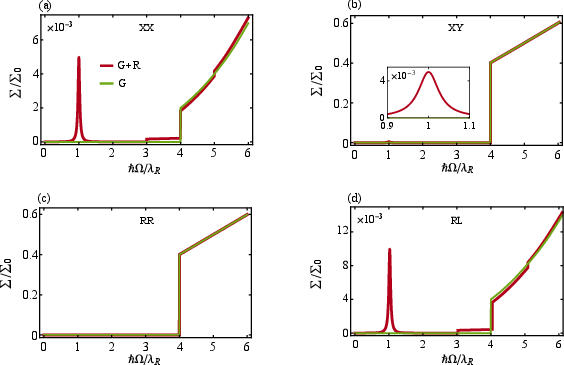
Spin-flip excitations yield distinct resonant features in the Raman spectrum at energies corresponding to the SOC splitting, as well as stepped features at 2μ and 2μ±λR.
The response is polarization-selective: for instance, the RR (right-right circular) geometry is insensitive to spin-flip excitations, while XX and XY geometries are not.
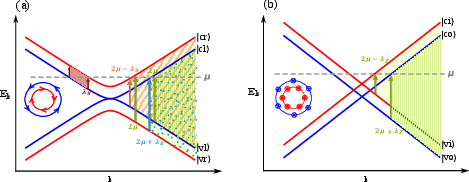
Figure 1: Electronic structure and allowed excitations for Rashba- and VZ-dominated SOC scenarios in 2D metals, illustrating chiral and spin textures at the Fermi surface.
Figure 2: Differential Raman cross-section for graphene with Rashba SOC across different polarization geometries, demonstrating prominent spin-split features and polarization sensitivity.
Valley-Zeeman SOC:
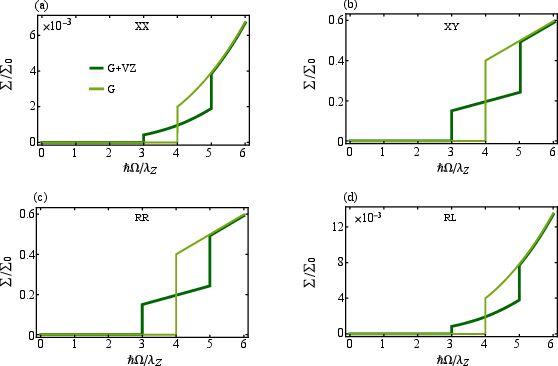
Only spin-preserving excitations are allowed; Raman tensors are explicitly independent of λZ.
The excitation thresholds are shifted to 2μ±λZ, with no spin-flip resonant features present.
Figure 3: differential cross-section for graphene with VZ SOC, indicating absence of spin-flip resistances; features arise solely from spin-conserving transitions.
Interplay of Rashba and VZ SOC
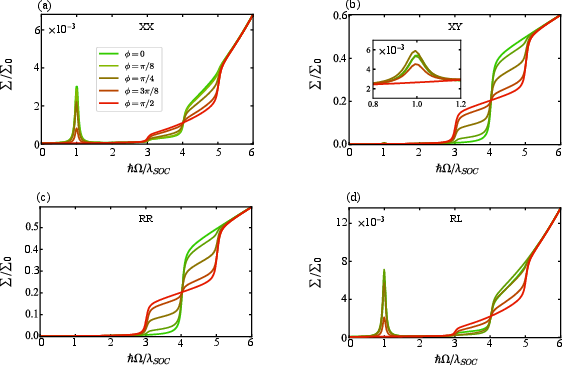
For general cases where both Rashba and VZ SOC are present, spectral features interpolate between the Rashba and VZ limits. The resonance energy is set by the combined SOC splitting λSOC=λR2+λZ2, but spectral weight at resonance is determined primarily by the Rashba component. This leads to a characteristic three-step feature in the spectrum, allowing extraction of the relative strengths of the SOC mechanisms via polarization-resolved measurements.
Figure 4: Evolution of Raman cross-section with varying Rashba/VZ SOC ratios, highlighting resonance weight control by Rashba SOC and threshold splittings by VZ.
Projected Low-Energy Subspaces and the Role of Intermediate Bands
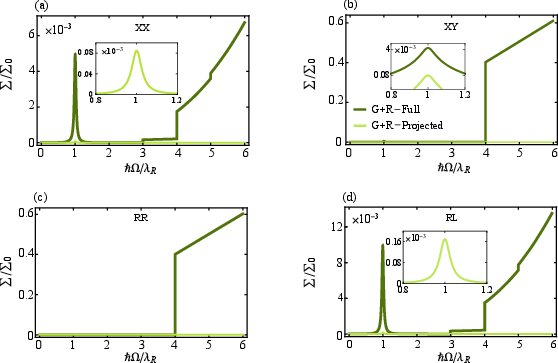
The study critically analyzes Hilbert space truncation by projecting onto the low-energy spin-split subbands (e.g., conduction band only, 2×2 model), detailing the impact on spectral weight and selection rules. While the correct resonance energies and symmetries for low-energy transitions are retained, the Raman scattering amplitude is substantially suppressed compared to calculations in the full Hilbert space. This suppression is attributed to the neglect of off-shell virtual processes involving higher energy (projected-out) states, which in the full theory contribute significantly to the Raman tensor, especially for non-resonant (off-shell) processes.
Figure 5: Comparative Raman cross-section for full (4×4) and projected (2×2) graphene models, illustrating that projection captures resonance frequency but underestimates signal strength due to missing spectral weight from intermediate bands.
Comparison with 2D Electron Gases
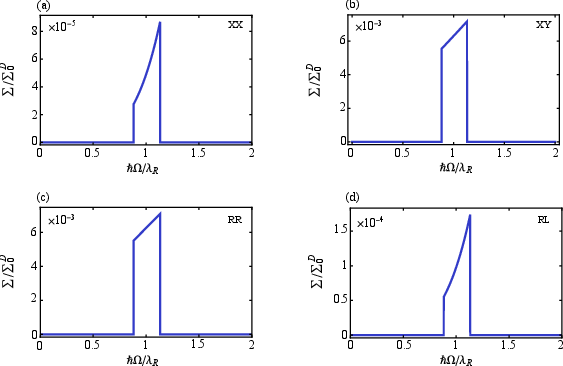
The theory is further applied to Rashba-coupled 2DEG systems, which, despite sharing similar low-energy band structures with projected graphene, exhibit marked differences in light-matter coupling structure. For the 2DEG, the Raman tensor includes crucial contributions from direct (A2) terms, and leading transitions in XY geometry correspond to chirality-flipping (not chirality-preserving) excitations. All polarization channels, including RR, are sensitive to chiral excitations in the 2DEG, unlike the graphene case. Moreover, the overall signal for 2DEG is weaker by several orders of magnitude due to the smaller Fermi velocity and additional suppression by 2μ0, signifying a clear advantage for graphene-based platforms in experimental detection.
Figure 6: Differential Raman cross-section for Rashba-2DEG, showing dominant chirality-flipping response and relative signal diminishment compared to graphene-like systems.
Numerical Estimates and Experimental Implications
Quantitative estimates indicate that, for typical parameters used in graphene-based platforms (e.g., 2μ1 ms2μ2, 2μ3 meV, 2μ4 meV), the predicted features from the leading and SOC-induced subleading contributions are well within detectability in modern Raman experiments. However, the spectral signature of the chiral-spin resonance is weaker and may require optimization of sample size and experimental geometry for unambiguous observation. The analysis underscores the necessity of modeling the response using the full Hilbert space rather than low-energy projections, except when care is taken to account for the missing spectral weight associated with virtual transitions.
Conclusions
The analysis provides a unified theory for eRS in 2D metals with inversion symmetry breaking, emphasizing the crucial role of low-energy Hilbert space structure and virtual off-shell processes in shaping polarization-resolved Raman spectra. SOC-induced spin-flip excitations are found to be polarization selective and strongly system-dependent, offering a route for spectroscopic disentanglement of different SOC sources through line-shape analysis. Graphene and related Dirac materials are identified as favorable candidates for experimental observation due to their high signal strength and sensitive polarization-dependent features. Future directions include incorporating many-body correlation effects, more complex band topology, and exploration of tailored van der Waals heterostructures hosting engineered SOC environments.
“Emergent Mind helps me see which AI papers have caught fire online.”
Philip
Creator, AI Explained on YouTube
Sign up for free to explore the frontiers of research
Discover trending papers, chat with arXiv, and track the latest research shaping the future of science and technology.Discover trending papers, chat with arXiv, and more.