- The paper demonstrates that terahertz illumination leads to critical current suppression through bolometric heating in graphene Josephson junctions.
- It details a device with encapsulated graphene and NbSe2 contacts, featuring gate-tunability and precise low-temperature superconducting transport measurements.
- The work reports high voltage responsivity (88 kV/W) and low noise (NEP 45 aW Hz⁻¹/²), underscoring its potential for ultrasensitive quantum THz sensing.
Gate-Tunable THz Photoresponse in Graphene Josephson Junctions
Introduction
The study investigates the photoresponse of van der Waals (vdW) graphene Josephson junctions (JJs) under terahertz (THz) illumination, addressing the longstanding challenge of quantum sensing in the underdeveloped THz spectral range. By leveraging graphene’s ultralow electronic heat capacity, rapid electron-electron thermalization, and weak electron-phonon coupling, the work demonstrates that THz illumination induces pronounced electronic heating, which can be transduced into strong electrical signals through critical current suppression in the JJ configuration. The work establishes both the underlying bolometric mechanism and optimal responsivity, and it highlights the platform’s electrostatic tunability and potential for quantum THz sensing.
Device Architecture and Superconducting Transport
The device is a monolayer graphene-based JJ encapsulated between hBN layers, with naturally cracked NbSe2 flakes serving as superconducting contacts, as visualized in Figure 1. Local gating is provided by a graphite back-gate, which allows continuous electrostatic tuning of the Fermi level in the graphene weak link. The four-terminal configuration ensures precise resistance and voltage measurements decoupled from lead effects.
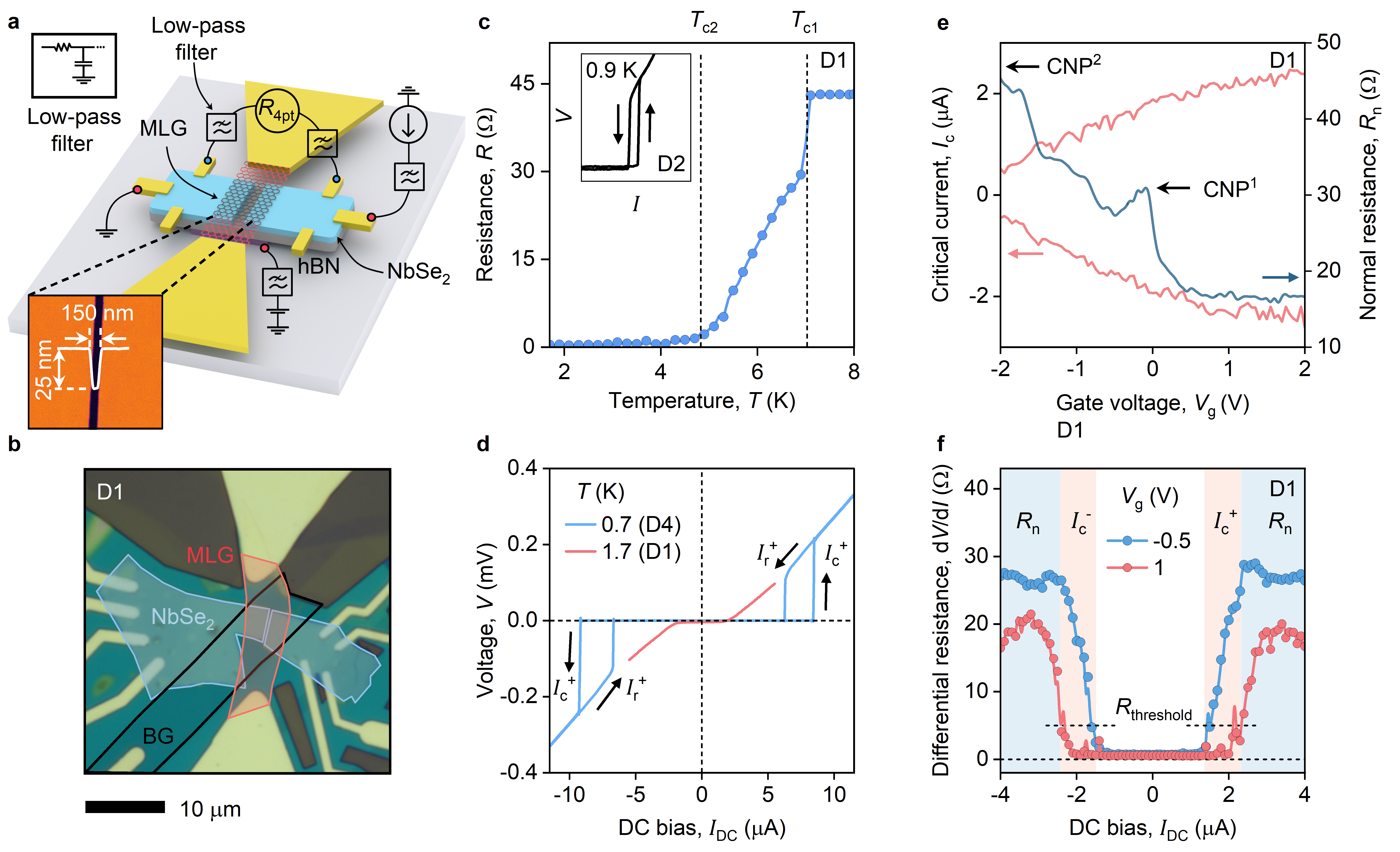
Figure 1: Schematic, micrograph, and characterization of the vdW graphene Josephson junction, including the hBN/graphene/NbSe2 heterostructure, gating layout, and temperature/resistance profiles.
Low-temperature transport measurements reveal a superconducting transition at Tc1≈7 K (NbSe2 onset) and a fully developed Josephson state at Tc2≈4.8 K. The JJ exhibits strong gate-tunable supercurrent, with Ic decreasing as the charge neutrality point is approached, consistent with proximity-induced doping. Pronounced I–V hysteresis, attributed to underdamped Josephson dynamics enhanced by self-Joule heating, persists up to $0.9$ K, which is relevant for potential single-photon detection above dilution refrigerator temperatures.
THz Photoresponse and Critical Current Suppression
The optical setup for THz illumination employs both a 0.14 THz IMPATT source and quantum cascade lasers at 2.5 and 3.5 THz, with convex lens focusing and careful IR-blocking filtering to eliminate spurious background. Alignment is maintained by a visible laser beam.
Figure 2 evidences THz radiation–induced suppression of the JJ critical current. Under illumination, the zero-resistance window narrows, with the superconducting gap closing symmetrically at increasing incident power. This is compatible with bolometric heating: the THz power raises the electronic temperature, which directly suppresses Ic, and this suppression quantitatively tracks with that induced by bath temperature elevation, validating the thermal origin.
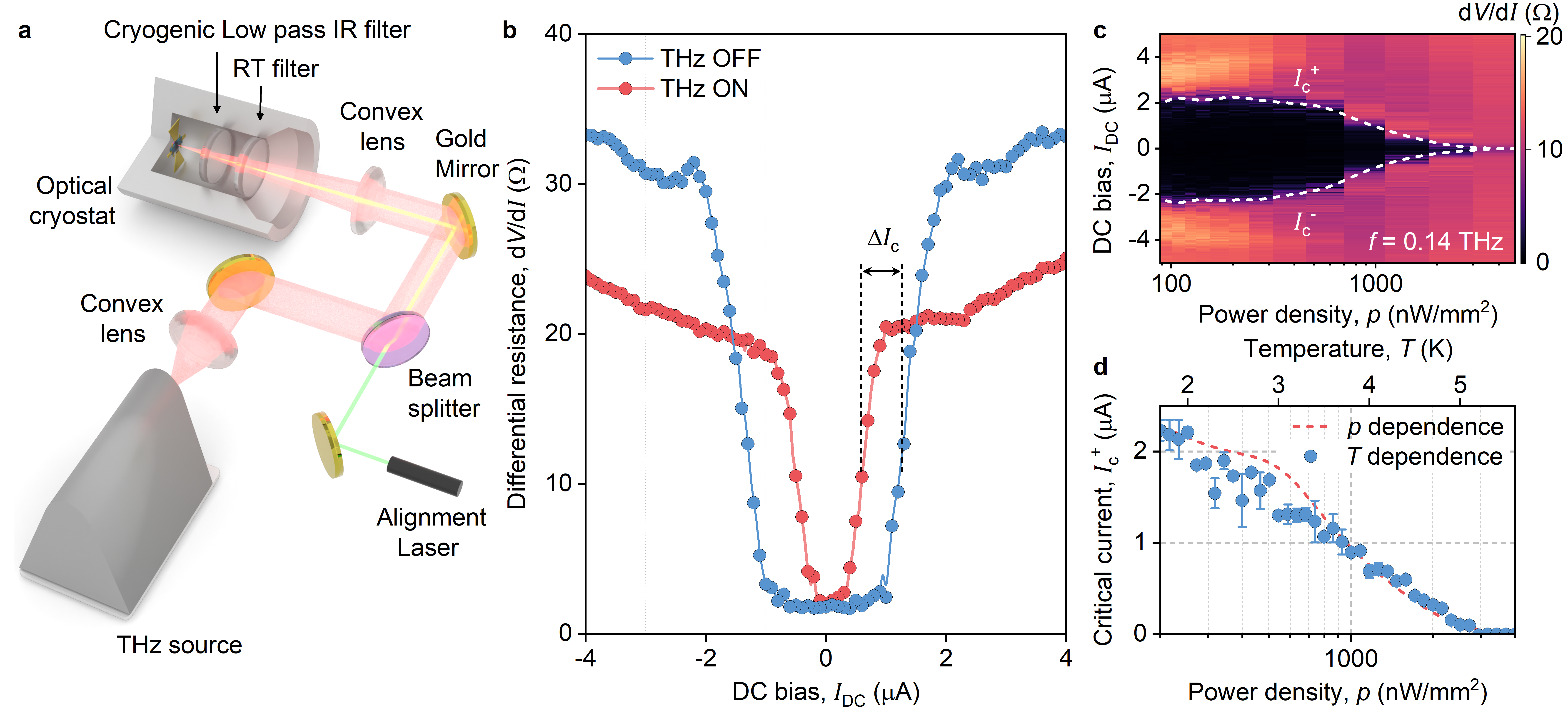
Figure 2: Experimental setup and differential resistance color maps demonstrating THz-induced critical current suppression in graphene JJs.
By recording I–V traces with THz on/off, the device exhibits measurable photovoltage (Vph) centered around the switching point to the normal state. Vph is highly sensitive to bias current, charge density, frequency, and temperature, as depicted in Figure 3. The response persists up to liquid helium temperatures and from mm-wave to far-IR frequencies. Maximum photovoltage is observed at carrier densities near the peripheral graphene’s charge neutrality point, coinciding with the minimal electronic heat capacity and maximal bolometric response.
Calibration against independently measured electron heating yields a voltage responsivity of 20—substantially exceeding standard superconducting hot-electron bolometers. The extracted thermal noise-equivalent power (21) reaches 22 at 23 K, with gate tunability allowing optimization across the charge density regime.
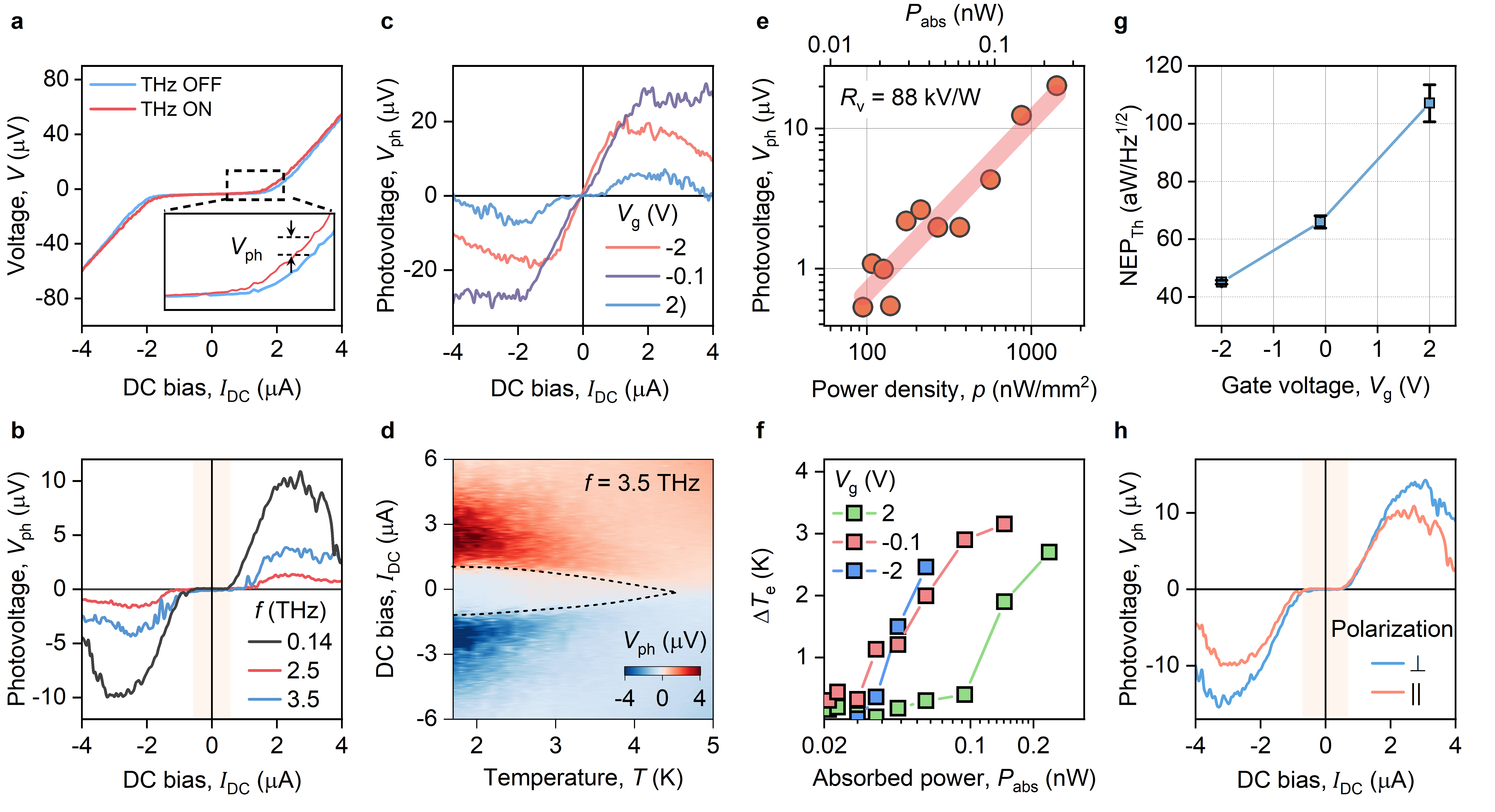
Figure 3: THz-induced 24–25 traces, extracted photovoltage, responsivity, noise-equivalent power, and gate/polarization dependence.
Polarization measurements indicate that the bow-tie antenna is not the dominant absorption mediator; instead, direct free-carrier absorption in the extended graphene regions is responsible. This suggests that hot carriers diffuse from the leads into the junction, as further schematized in Figure 4.
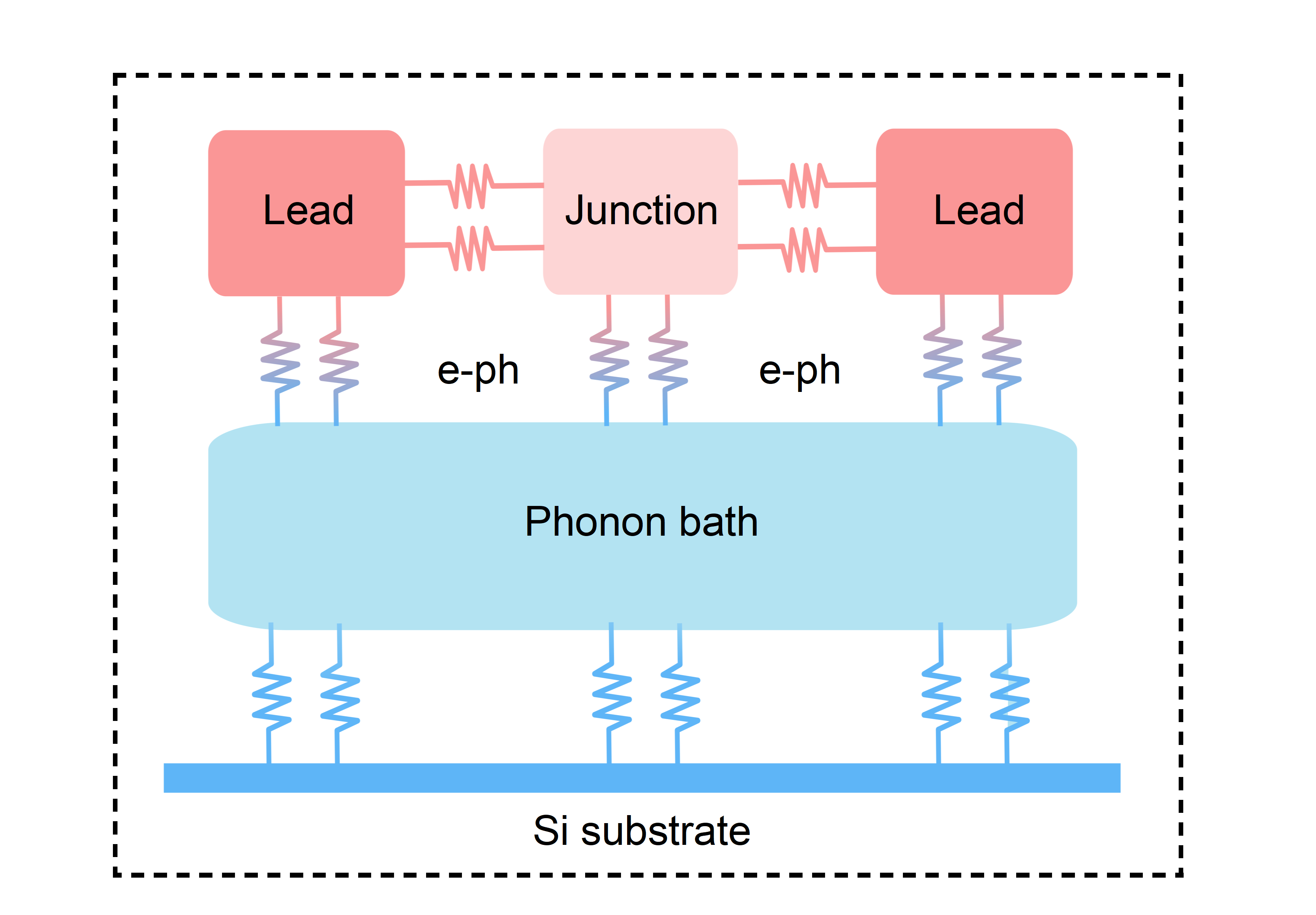
Figure 4: Heat transport schematic illustrating hot carrier diffusion from graphene leads and energy extraction via electron-phonon coupling.
Physical Mechanism and Limitations
The bolometric mechanism is confirmed by the strong dependence of 26 and 27 on carrier density and electron temperature. The responsivity and NEP both outperform prior JJ- or superconductor-based THz sensors, particularly at accessible (liquid helium) base temperatures and without SQUID-based readout. The thermal pathway is dominated by lateral electronic diffusion from the larger graphene regions rather than direct absorption at the junction, implying that optimization of electromagnetic coupling and thermal isolation has significant headroom.
The current device’s limitations include impedance mismatches at the THz antenna, which reduce the direct power coupling efficiency to the junction. Improved antenna design or optical cavity integration is anticipated to enhance local absorption. Thermal architecture modifications—such as further reducing the electronic heat capacity or engineering even longer diffusion pathways—could further increase sensitivity and facilitate single-photon THz detection.
Implications and Future Directions
Graphene JJs with gate-tunability, broadband THz sensitivity, and ultra-low noise parameters constitute a versatile cryogenic detector platform. The clear demonstration of strong photoresponse and critical current modulation at THz frequencies extends the reach of quantum-sensing architectures into a critical spectral window previously lacking high performance detectors. Electrostatic control and hysteretic switching above 0.9 K support the prospect of single-THz-photon detection in accessible cooling regimes.
Future developments may include integration with optimized antennas or photonic cavities, refinement of the heat flow geometry for tailored speed/sensitivity trade-offs, and extension to vdW superconductor/graphene hybrids or moiré-engineered heterostructures for further enhancement of nonlinear and quantum detection regimes. The platform is well-positioned for THz astrophysics, quantum-limited spectroscopy, and other applications at the interface of quantum optoelectronics and superconducting devices.
Conclusion
This work establishes a strong, gate-tunable, and broadband photoresponse in graphene Josephson junctions at THz frequencies, featuring exceptional responsivity (28) and theoretical noise limits (NEP 29) at Tc1≈70 K. The mechanism—electron heating–induced suppression of the Josephson current with lateral heat transport—permits rich tunability and optimization, positioning this architecture as a compelling candidate for ultrasensitive and potentially single-photon THz quantum sensing (2604.00409).