- The paper introduces a universal topological framework for multifold exceptional points in nonlinear eigenvalue problems using frequency-momentum winding numbers.
- It generalizes the doubling theorem by proving that every EP with a positive winding number must be paired with an EP having an opposite charge.
- Numerical models in PT-symmetric and nonlinear resonator systems confirm the robustness of the FM winding invariant and its broad applicability.
Nonlinear Frequency-Momentum Topology and Doubling of Multifold Exceptional Points
Introduction
The paper "Nonlinear Frequency-Momentum Topology and Doubling of Multifold Exceptional Points" (2604.00366) establishes a comprehensive topological framework for exceptional points (EPn, n≥2) in nonlinear eigenvalue problems, particularly those with nonlinearity in the eigenvalues, and generalizes the doubling theorem to multifold exceptional points of arbitrary order. Previous results were confined to two-fold exceptional points (EP2) in linear systems with at most two bands, but no general topological invariant existed for multifold (n≥3) EPs, especially in nonlinear and multi-band settings. This work addresses this critical gap via the introduction of frequency-momentum (FM) winding numbers and elucidates the global topological structure underlying the presence, pairing, and symmetry protection of EPns.
Frequency-Momentum Winding Numbers and Topology of EPns
The doubling of topological defects—originally typified by the Nielsen-Ninomiya theorem for fermionic quasiparticles in lattice systems—arises in non-Hermitian contexts as the enforced pairing of exceptional points with opposite topological charges. In nonlinear systems described by frequency-dependent matrix-valued nonlinear eigenvalue equations, the location of EPns is controlled by simultaneous vanishing of the function and its higher frequency derivatives, leading to a set of $2n$ real constraints in the complex frequency-momentum space.
The core advancement is the definition of FM winding numbers, topological invariants constructed from a vector d(ω,k) incorporating the real and imaginary parts of detF and its higher-order derivatives with respect to frequency (up to order n−1). This enables an explicit map from the enclosing n≥20-sphere in frequency-momentum space to the n≥21-sphere in n≥22-space, classified by the homotopy group n≥23. The FM winding number is thus robust against perturbations, insensitive to the matrix size, and can be computed for any n≥24.
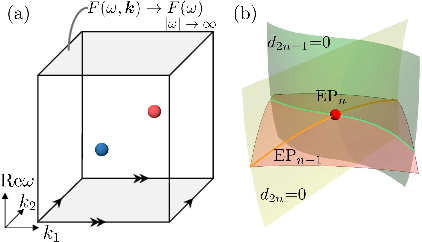
Figure 1: Illustration of the doubling theorem of nonlinear EPn≥25s in n≥26-dimensional n≥27-n≥28 space indicating that every EPn≥29 of charge n≥30 must be paired with another of charge n≥31 due to Brillouin zone periodicity and boundary conditions.
A key corollary is the hierarchy of these EP manifolds: an EPn≥32 arises generically on intersections of EPn≥33 manifolds, reflecting a recursive topological structure.
Doubling Theorem for Nonlinear EPn≥34s
The sum of FM winding numbers over all EPn≥35s in the Brillouin zone vanishes due to boundary conditions at infinity—specifically the n≥36-independence of n≥37 as n≥38. This enforces a doubling theorem: every EPn≥39 with n0 must be accompanied by an EPn1 with n2, a result previously unattainable even for linear cases with n3 and arbitrary band number.
In the case of two-fold exceptional points (linear EP2), the FM winding number reduces to previously known invariants, generalizing and unifying prior approaches.
Symmetry-Protected Topology and Codimension Analysis
The framework systematically incorporates symmetry constraints—parity-time (n4), charge-parity (n5), chiral, and pseudo-Hermitian symmetries—each modifying the codimension of EPn6 manifolds, the structure of the vector n7, and the frequency subspace where EPn8s reside. For instance, n9 symmetry enforces reality of frequency and allows EPn0 in n1 dimensional BZs, while n2 symmetry enforces pinning at n3 and creates parity-selective constraints on the frequency derivatives.
The FM winding number retains its n4 character in many cases; for n5-symmetric EP2, the winding number distinguishes robust EP2s that are invisible to the standard n6 classification, indicating previously unrecognized stability.
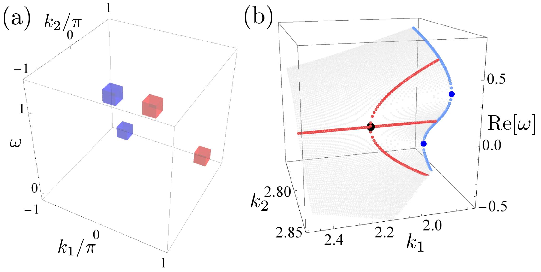
Figure 2: Computed winding number n7 for each mesh point in a 2D toy model with n8 symmetry, demonstrating the pairing of n9 (red) and n0 (blue) EP3s.
Tables in the work provide an exhaustive classification of symmetries, codimensions, and explicit forms for n1, enabling direct computation of the winding invariant in each scenario.
Numerical Demonstration and Model Applications
The theoretical developments are confirmed by explicit numerical calculation in minimal models. In a 4-band, 2D system with frequency-dependent nonlinearity and n2 symmetry, the presence of EP3s with nonzero FM winding number is demonstrated numerically; all EP3s occur in n3 pairs, in accordance with the doubling theorem.
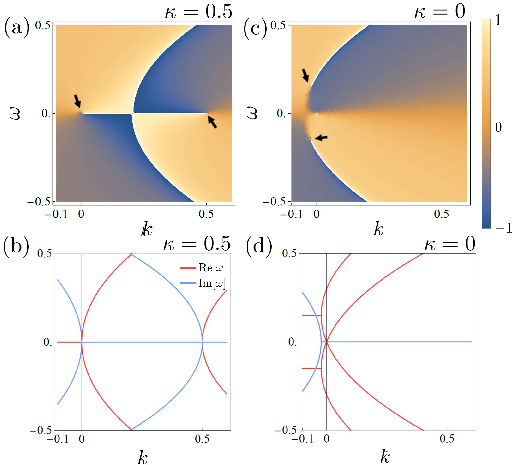
Figure 3: Color plots of n4 as functions of n5 and n6 for a toy Hamiltonian, with winding number n7 for paths enclosing EP2s; red and blue denote real and imaginary eigenvalues, respectively, highlighting robust n8-symmetric EP2s.
The FM winding invariant captures not only the presence and pairing of EPn9s but also the breakdown of simple annihilation for symmetry-protected higher-winding points, distinguishing them from ordinary (annihilable) pairs.
Additionally, the formalism is shown to apply to nonlinear coupled resonator systems where eigenvalue nonlinearity leads to effective higher-order EPs, and the topological classification persists even for scalar, non-matrix reductions.
Hermitian Mapping and Theoretical Implications
An important technical aspect is the mapping from the FM winding invariant of the nonlinear non-Hermitian problem to the Chern or winding number of an associated Hermitian Hamiltonian constructed from $2n$0 and appropriate Clifford algebra generators. This Hermitization enables the use of standard topological computational methods and solidifies the interpretation of FM winding numbers as true topological invariants.
Implications and Future Directions
The introduction of FM winding numbers, the associated doubling theorem for multifold EPs in nonlinear, multi-band, and symmetry-constrained systems, and the explicit characterization of hierarchical EP structure have far-reaching implications:
- Nonlinear photonics and metamaterials: The formalism applies to dispersive and nonlinear media where frequency dependence in eigenvalue problems is intrinsic.
- Quantum matter: EPs in quasiparticle spectra with finite lifetimes and interactions can now be systematically classified.
- Sensing and signal amplification: Nonlinear systems engineered for EP singularities can utilize the robustness and pairing rules to design enhanced sensors and devices.
- Broader mathematical physics: The methodology paves the way for classification of physical systems beyond Hermitian symmetry and linearity, opening up new directions in topological phases.
Open problems remain, notably in situations with nonlinear Kramers pairs ($2n$1), where the interplay of degeneracy and nonlinearity inhibits standard topological arguments.
Conclusion
This work establishes a general topological theory for multifold exceptional points in nonlinear systems, introduces the FM winding number as a universal invariant, and proves the doubling theorem in great generality. The hierarchical, symmetry-dependent structure of EP$2n$2s is fully elucidated, and concrete models corroborate the theoretical predictions. This framework offers new tools for the design and understanding of topological phenomena in nonlinear, non-Hermitian, and multi-band platforms, with significant implications for both condensed matter and photonic physics.