- The paper reviews the evolution of spin from its discovery to its central role in testing quantum mechanics and probing beyond-Standard-Model physics.
- It details state-of-the-art experimental techniques, including Penning traps and storage rings, that achieve sub-ppb precision in measuring magnetic and electric dipole moments.
- The results provide actionable insights into symmetry tests, CP/T violation, and novel dark matter candidates, underscoring spin's impact on modern physics.
The Centenary of Spin: Foundations, Symmetry Tests, and Probes of Beyond-Standard-Model Physics
Historical Foundations: The Origin and Fundamental Role of Spin
The concept of spin, introduced a century ago through the analysis of anomalous atomic spectral lines, underpins modern quantum mechanics, quantum field theory, and the study of fundamental symmetries. The hypothesis of electron spin, formalized by Uhlenbeck and Goudsmit in 1925, was instrumental in resolving standing puzzles in spectroscopy and in the articulation of the Pauli Exclusion Principle. The role of spin expanded with the identification of proton spin by Dennison, clarifying cryogenic specific heat anomalies in hydrogen.
Spin Magnetic and Electric Dipole Moments: Precision Frontiers
The Dirac equation predicted the electron g-factor (g=2) and identified the magnetic and (more subtly) electric dipole couplings. Measurement of the g-factor of free and bound electrons, as well as those in highly charged ions, provides a stringent test of the quantum electrodynamics (QED) sector. Advances in Penning trap technology and single-particle detection, exemplified by coherence in antiproton spin-flip spectroscopy,
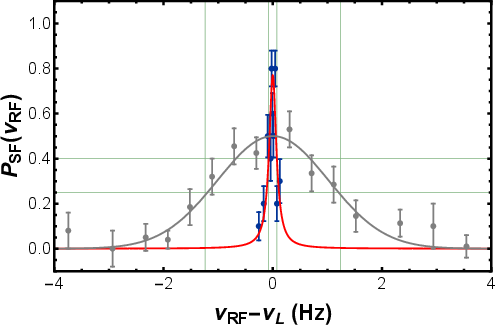
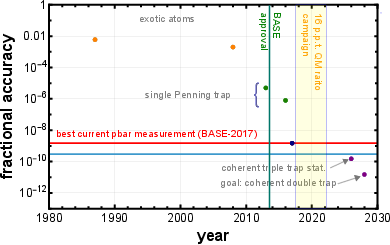
Figure 1: Magnetic resonance of a single antiproton spin, showing the evolution of resolution in antiproton magnetic moment measurements as a function of time.
enable sub-ppb-level comparative measurements between matter and antimatter. These results support CPT invariance, as magnetic dipole moments of particles and antiparticles are confirmed to be equal in magnitude and opposite in sign within current experimental uncertainties.
Electron g-factor determinations, relying on high-precision Penning trap experiments and atomic recoil measurements for the fine-structure constant α, show a relative agreement with Standard Model (SM) QED predictions within 0.7 parts per trillion, constraining substructure and spatial extent of the electron. Anticipated sensitivity increases will require incorporating hadronic corrections, currently subdominant.
Muon g-2: Probing Standard Model Completeness and BSM Physics
The muon anomalous magnetic moment, aμ=(gμ−2)/2, serves as a critical observable for SM and Beyond-Standard-Model (BSM) physics. Muon g-2 experiments at Brookhaven and Fermilab have achieved 127 ppb precision, utilizing storage ring techniques and exploiting the parity-violating angular correlations in muon decay.
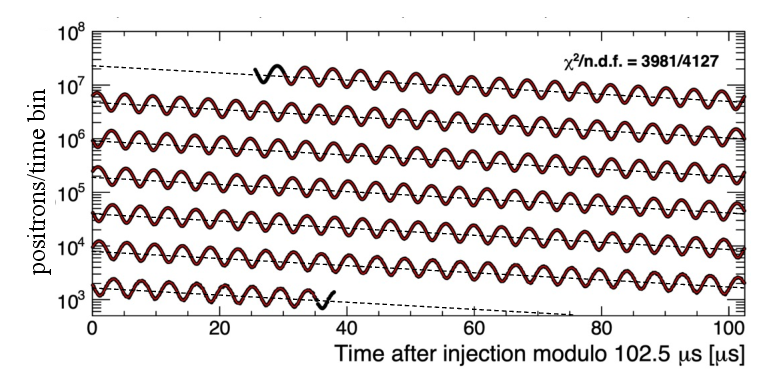
Figure 2: Wiggle-plot of positron decay detection provides direct visualization of spin precession and time-dilated muon decay.
The convergence between experiment and theory is dominated by uncertainties in hadronic vacuum polarization contributions. A persistent, but fluctuating, tension between theory (QED + EW + hadronic) and experiment is tracked as lattice-QCD approaches mature and CMD-3 data are reanalyzed. Systematic effects—magnetic field inhomogeneity, beam dynamics, and electric field corrections—limit further gains. Future initiatives, such as the JPARC muonium g-2 program, promise new avenues with different systematics and improved calibration strategies.
Electric Dipole Moments: Probes of CP and T Violation
Permanent electric dipole moment (EDM) searches constitute null tests of CP and g=20 invariance. Following the pioneering Ramsey and Purcell neutron EDM experiment, the field has grown to encompass a vast array of systems: ultracold neutrons (UCNs), diamagnetic and paramagnetic atoms, molecules, and charged particle storage ring proposals. Direct neutron and 199Hg atom EDM limits (g=21cm, g=22cm) and stringent electron EDM constraints (most sensitively g=23cm from HfFg=24) provide strong bounds on new sources of CP violation, vital for models of baryogenesis and strong CP problem resolutions.
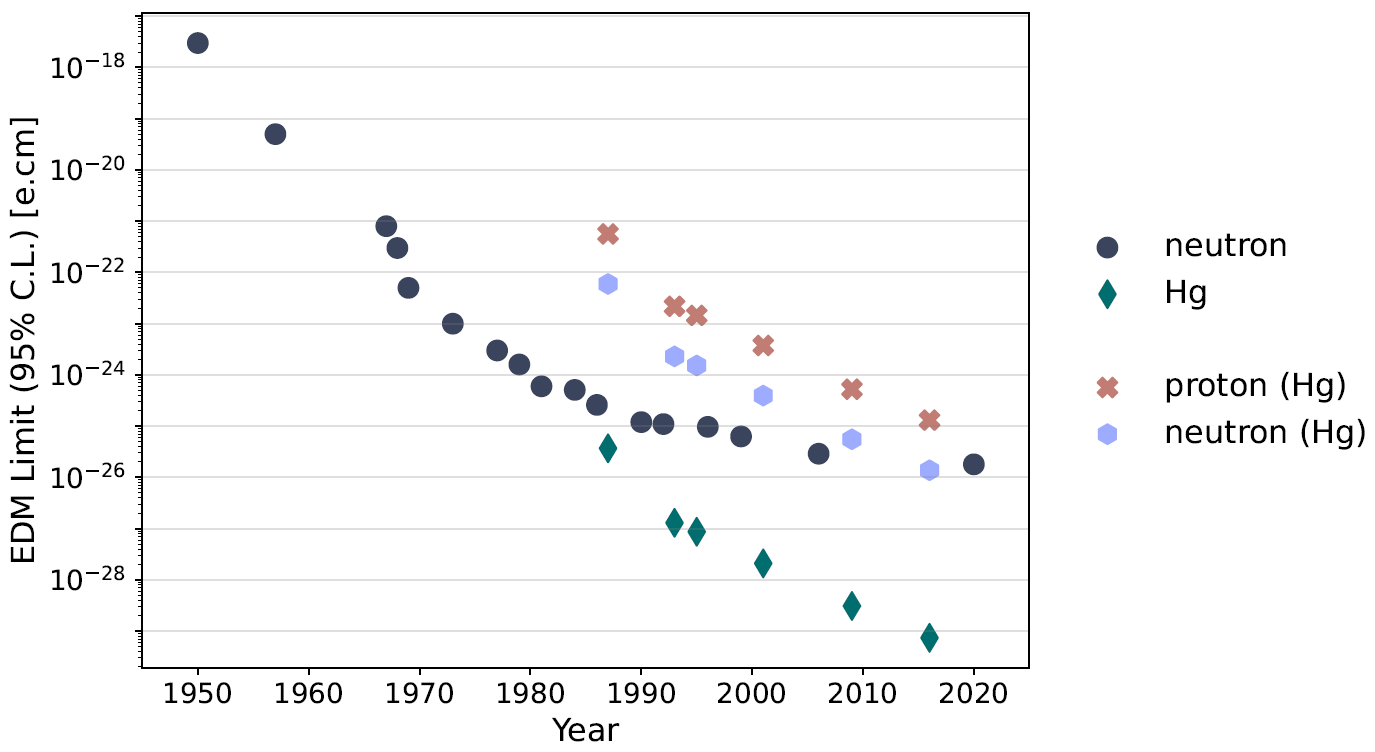
Figure 4: Historical progression of neutron and atomic EDM measurement sensitivity and associated theoretical implications.
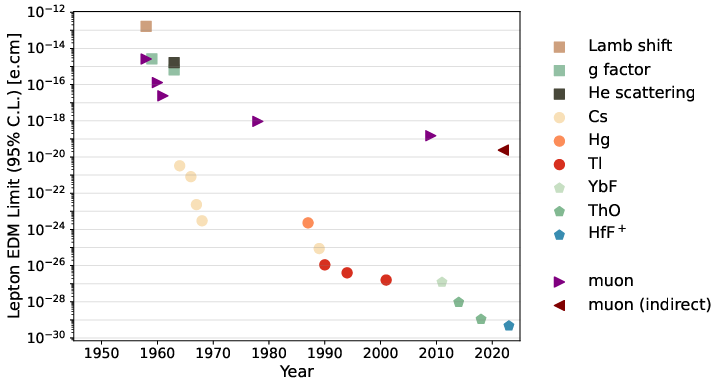
Figure 3: Contemporary and historical limits on the electron and muon EDMs; molecular systems provide multi-order amplification over atomic approaches.
The electron EDM is especially powerful for limiting BSM parameter spaces where CP violation enters at high scale. The diversity of systems enables multifaceted searches, exploiting amplification mechanisms (e.g., polar molecules for the electron EDM, Schiff moments in atoms for nuclear EDMs) and avoiding theoretical degeneracies.
Exotic Spin-Dependent Interactions and Spin-Gravity Responses
Experimental advances are enabling exploration of exotic, non-SM spin-dependent couplings, using optical magnetometry, torsion balances, and slow neutron spin-rotation. These efforts are guided by effective field theory classifications of single-boson exchange potentials for all Lorentz-invariant fermionic currents, allowing systematic constraint of new interaction regimes over a wide range of force carrier masses.
The precision measurement of the g=25 rotation phase for fermion spinors and tests of Lorentz/CPT invariance using trapped particle systems reveal deep connections between spin, statistics, and spacetime structure. Theoretical frameworks such as Einstein-Cartan gravity, and the analysis of local versus global Poincaré invariance, motivate continued study of the possible interplay between particle spin and spacetime torsion.
Spin in Dark Matter and Gravitational Wave Detection
Cosmological arguments concerning the phase-space density of galactic dark matter halos set constraints on the spin of ultralight DM candidates; sub-eV mass fermions are disfavored, motivating scalar (spin-0) or vector (spin-1) bosonic candidates. Spin-based sensors (alkali-noble gas comagnetometers, optically pumped magnetometers) form the backbone of axion and hidden-photon DM detectors, and novel proposals extend their application to gravitational wave searches via strain-induced spin-precession readout.
Macroscopic Manifestations and Practical Spin Technologies
Spin effects, despite their g=26 J·s scale, have decisive macroscopic consequences: the periodic table and chemistry are structured by the Pauli exclusion principle, positronium exhibits dramatically spin-dependent lifetimes, and cosmological matter-antimatter asymmetry is rooted in exquisite CP-violating spin observables. Technological implementations such as spin masers, atomic magnetometers, and trapped-ion systems continually push measurement sensitivity, augmenting our ability to probe foundational questions with ever greater precision.
Conclusion
In the past century, spin has provided a persistent, evolving vantage for interrogating the most fundamental laws of physics, from quantum field theory consistency to new physics searches. The continued refinement of spin-based measurement techniques—trapped particle systems, precision magnetometry, and EDM searches—ensures that spin will remain central to both practical applications and theoretical advances in the decades to come. The interplay between spin, symmetry, and the structure of spacetime underscores its unique role as a sensitive probe for both confirming the Standard Model and uncovering its limitations.