- The paper introduces an adaptively controlled fast–slow operator splitting method that rigorously quantifies local mean-square errors in biochemical stochastic simulations.
- It employs a PI-adaptive controller to dynamically adjust time steps and substeps, delivering significant improvements in both accuracy and computational efficiency compared to fixed-step methods.
- Empirical evaluations demonstrate order-of-magnitude error reductions and lower computational costs in stiff biochemical networks, enabling reliable sensitivity analysis and uncertainty quantification.
Adaptive Fast-Slow Operator Splitting for Multiscale Biochemical Stochastic Dynamics
Introduction and Motivation
Simulation of stochastic biochemical networks is fundamentally challenged by strong multiscale effects arising from disparate timescales and coupled nonlinearities. The Chemical Master Equation (CME) and its diffusion approximation—the Chemical Langevin Equation (CLE)—are canonical formalisms capable of capturing arbitrary stochastic fluctuations induced by molecular discreteness. However, practical simulation must efficiently resolve both fast, high-frequency modes (e.g., enzyme catalysis, small-molecule affinities) and slow, system-level modes (e.g., gene regulation, macroscopic metabolic flux). The resulting stiffness in the CLE generator imposes stringent stability and accuracy constraints on traditional explicit SDE solvers, prompting broad interest in operator splitting, hybrid, and adaptive methodologies.
Despite the prevalence of heuristic fast–slow partitioning for stiff network simulation, rigorous error analysis for stochastic operator splitting lags behind ODE/PDE methodologies, especially given the non-commutativity and multiplicative noise intrinsic to biochemical SDEs. This work addresses this gap with a modular, error-driven, adaptively-controlled fast-slow splitting scheme for multiscale CLE dynamics, delivering an explicit, term-wise mean-square error (MSE) expansion and a practical PI-adaptive controller for local error regulation.
Mathematical Framework and Error Decomposition
The authors formulate stochastic reaction networks as coupled Stratonovich SDEs, with both drift and diffusion decomposed into fast (f) and slow (s) components at the level of reaction channels and species stoichiometries. Given the state vector st∈RNs, the CLE reads:
dst=Cv(st)dt+[Cdiag(v(st))C⊤]1/2dWt,
where C encodes the reaction stoichiometry and v the propensities.
The reaction channels are partitioned into Ifast and Islow, yielding a natural operator splitting L=Lfast+Lslow. In the proposed Lie–Trotter scheme, the fast generator is integrated over N microsteps per macro time step s0, with adaptive choices for both.
The core technical contribution is a complete local MSE expansion for the splitting integrator, decomposing the total leading-order error by mechanism:
- (i) Stochastic-flow truncation from neglecting higher-order terms in Kunita’s logarithmic flow series;
- (ii) Fast–slow noncommutativity error, i.e., nonzero commutators s1 for s2;
- (iii) Fast substep discretization (order s3 effect);
- (iv) Slow subflow discretization.
The final expansion is:
s4
where s5 combines terms from (i), (ii), and (iv), while s6 quantifies (iii). The key innovation is an explicit, species- and state-dependent error structure suitable for dynamic estimation and adaptive timestep selection.
MSE-Adaptive Fast–Slow Splitting with PI Control
Leveraging the MSE decomposition, the authors design a proportional–integral (PI) adaptive control strategy that regulates both macro step size s7 and number of fast substeps s8 to ensure that the total one-step MSE stays below a user-specified tolerance s9. The PI controller adjusts st∈RNs0 based on real-time error estimates:
st∈RNs1
with st∈RNs2 chosen for stability under stochastic fluctuations. For the selected st∈RNs3, st∈RNs4 is computed as the minimal integer satisfying
st∈RNs5
enforcing hard safety constraints on st∈RNs6 growth and st∈RNs7 to guarantee robust behavior in stiff regimes.
This adaptive strategy dynamically allocates computational effort to stiff regions of the state space, where commutator or fast substep errors dominate, and allows more aggressive time-stepping in weakly coupled or slow regions.
Empirical Evaluation and Numerical Results
The adaptive fast–slow method is benchmarked on a canonical stiff biochemical network with three species and tunable stiffness parameter st∈RNs8. Performance is compared against:
- Fixed-step Euler–Maruyama (EM) discretization,
- PI-adaptive CLE method of Ilie & Morshed (“Ilie–PI”) [il ie2015adaptive].
Distributional accuracy is assessed via multiple metrics (Wasserstein-1, JS and KL divergence, mean/variance errors) against the SSA reference density over st∈RNs9 Monte Carlo runs.
Key quantitative results:
- For fast-sensitive species (dst=Cv(st)dt+[Cdiag(v(st))C⊤]1/2dWt,0, dst=Cv(st)dt+[Cdiag(v(st))C⊤]1/2dWt,1), the adaptive fast–slow method consistently achieves Wasserstein and divergence errors an order of magnitude smaller than fixed-step EM, and significantly better than Ilie–PI, even as stiffness increases.
- For slow species (dst=Cv(st)dt+[Cdiag(v(st))C⊤]1/2dWt,2), accuracy is competitive with Ilie–PI.
- The computational cost of the adaptive fast–slow method is consistently lower than Ilie–PI (by dst=Cv(st)dt+[Cdiag(v(st))C⊤]1/2dWt,3–dst=Cv(st)dt+[Cdiag(v(st))C⊤]1/2dWt,4), with the efficiency advantage increasing in stiffer regimes.
The empirical marginal distributions for all regimes (dst=Cv(st)dt+[Cdiag(v(st))C⊤]1/2dWt,5) demonstrate that the adaptive method preserves both the mean and higher-order moments accurately, including subtle tail behaviors and fluctuations missed by other integrators.
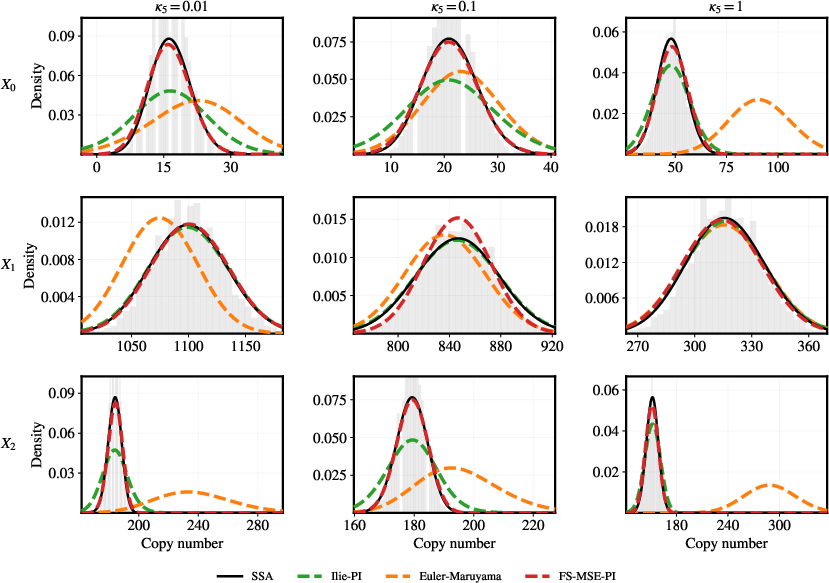
Figure 1: Empirical marginal distributions for species dst=Cv(st)dt+[Cdiag(v(st))C⊤]1/2dWt,6–dst=Cv(st)dt+[Cdiag(v(st))C⊤]1/2dWt,7 under increasing stiffness dst=Cv(st)dt+[Cdiag(v(st))C⊤]1/2dWt,8; the adaptive method matches the SSA density across all time-scale regimes, outperforming time-step-only or fixed-step alternatives.
Implications, Generalizations, and Future Directions
The rigorous error characterization and dynamic adaptivity addressed longstanding limitations of heuristic splitting and operator-splitting schemes for multiscale biochemical SDEs. The explicit identification and control of the stochastic commutator—absent in classical ODE/PDE splitting theory—addresses a fundamental issue in non-commuting fast–slow dynamics with multiplicative noise. This is directly relevant not only for biochemical cell and pathway modeling, but also for broader classes of multiscale stochastic simulation in physics and engineering, including molecular dynamics and hybrid kinetic models.
Practical implications:
- The framework enables efficient and reliable exploration of parameter regimes inaccessible to fixed-step or non-adaptive schemes, facilitating robust sensitivity analysis and uncertainty quantification in systems biology.
- The PI-adaptive approach is modular and general, extendable to other split-step or projection operator frameworks, and applicable in high-dimensional networks.
- The explicit MSE-based methodology provides a template for automated error-control pipelines in mechanistic SDE simulation.
Theoretical implications and directions:
- The approach sharpens understanding of the order and structure of splitting errors for SDEs with nonlinear, state-dependent multiplicative noise.
- It suggests directions for higher-order or symmetrized splitting integrators exploiting BCH expansions for stronger accuracy or weak error bounds.
- Future work may generalize to adaptive hybrid stochastic–deterministic simulation, online model reduction, and reinforcement learning in stochastic environments with stiff fast–slow components.
Conclusion
This paper introduces a rigorously analyzed, adaptively controlled, fast–slow operator splitting scheme for chemical Langevin SDE simulation. The explicit MSE decomposition provides both theoretical insight into error sources from stochastic flow noncommutativity and practical guidance for robust trajectory simulation. Empirical evaluation across stiff canonical networks confirms superior accuracy–efficiency tradeoffs relative to standard adaptive and fixed-step approaches. The methodology sets a quantitative standard for error-driven adaptive simulation in complex multiscale stochastic systems (2604.00140).