- The paper presents a systematic review of compact objects as natural laboratories for probing axions, ALPs, and high-frequency gravitational waves.
- It details theoretical frameworks, including the Peccei-Quinn mechanism and superradiance in black holes and neutron stars, supported by numerical simulations.
- It establishes new astrophysical constraints on axion and scalar couplings, highlighting the potential for multi-messenger searches in the coming decade.
Overview of "Lectures on Light Particles and Compact Objects"
The document provides an authoritative review of how compact astrophysical objects—particularly neutron stars (NSs), white dwarfs (WDs), and black holes—serve as natural laboratories for probing the existence and properties of weakly interacting slim particles (WISPs), including axions/ALPs and high-frequency gravitational waves (HFGWs). Theoretical foundations, astrophysical probes, recent developments, and practical observational implications are systematically surveyed, with particular emphasis on axion phenomenology in stellar environments.
Theoretical Motivation: Axions and WISPs
The analysis begins with a rigorous treatment of the strong CP problem in QCD, highlighting the role of the θ-parameter and its connection to the neutron electric dipole moment. The Peccei-Quinn mechanism—introducing a global U(1) symmetry and the QCD axion as its pseudo-Goldstone boson—dynamically relaxes θˉ to zero, thus solving the strong CP problem. The document details both QCD axion models (KSVZ, DFSZ) and more generic ALP scenarios, including string-theoretic axiverse extensions, noting their relevance as dark matter candidates.
CP-violating contributions to neutron observables are reviewed, alongside the implications of recent work challenging the existence of the strong CP problem under certain quantization schemes. Despite these discussions, the axion remains a theoretically compelling WISP.
Black Hole and Stellar Superradiance
The notes provide a technical overview of classical and quantum superradiance: the amplification of bosonic fields by rotating compact objects. In black holes (BHs), superradiant instabilities for massive light bosons create exclusion limits for boson masses based on the observed spins of BHs. Notably, supermassive and stellar-mass BHs probe ALP masses from 10−19 to 10−11~eV. The impact of field self-interactions and the challenges of modeling dissipation in stars are addressed.
For stars, especially NSs, superradiant amplification requires not only rotation but also dissipative couplings, as simple relativity is insufficient. The kinetic theory and non-equilibrium field theory approaches refine early phenomenological models, but recent work demonstrates that many-body effects and multiple scatterings suppress the superradiant growth rate, making previous constraint optimism unwarranted.
Neutron Stars: Axion/ALP and Scalar Searches
Neutron Star Structure and Cooling
A technical summary of NS microphysics is provided, including the stratification between core and crust, possible exotic phases, and magnetic field generation/amplification channels. The cooling of NSs proceeds initially via neutrino emission and then photon surface emission. NS magnetic fields can reach 1015~G, providing exceptional environments for WISP searches.
WISP Effects on NS Cooling
Additional energy-loss channels via WISP production in NS cores can modify the cooling curves observable in X-ray and thermal surface data. Nucleon bremsstrahlung (nn,np,pp→a), Cooper pair breaking (for superfluid phases), and more exotic processes contribute to axion/ALP and scalar production rates.
A critical result is the recent derivation of new bounds on light scalar-nucleon couplings, gϕN≳5×10⁻¹⁴ for mS≲1~MeV, which are the most stringent astrophysical constraints to date in the pico- to micrometer fifth-force regime, outperforming those from SN 1987A, red giants, and horizontal branch stars [Fiorillo:2025zzx]. This is directly visualized by anomalous accelerations in cooling light-curves:
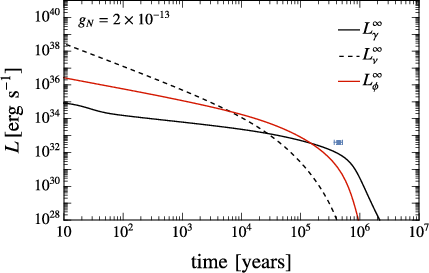
Figure 2: Photon, neutrino, and scalar cooling light-curves for NS J1605, demonstrating the accelerated cooling from scalar emission at gN=2×10⁻¹³.
Axion-Photon Conversion in Neutron Star Magnetospheres
The document surveys axion DM detection around NSs via axion-photon conversion in plasma-rich magnetospheres. Resonant conversion occurs when the axion mass matches the plasma frequency, generating distinctive radio signals accessible to current and next-generation radio telescopes. Recent theoretical advances provide a robust, general formalism for prediction of the conversion probability, resolving earlier modeling uncertainties regarding refraction and de-phasing. The impact of macroscopic plasma conditions, photon polarization, and magnetospheric geometry is detailed, based on both kinetic theory and numerical simulations. Observational campaigns are referenced, utilizing MeerKAT, GBT, Effelsberg, and VLA data.
The text notes an independent mechanism: axion emission in NS polar caps sourced by U(1)0 in charge-depleted regions, again yielding observable radio fluxes that can tightly constrain axion-photon couplings at frequencies below laboratory haloscope reach.
White Dwarfs: Axion/ALP and Scalar Signatures
The paper provides a detailed breakdown of WD interior structure, evolutionary phases, and the dynamical interplay between photon, neutrino, and possible axion/scalar emission during cooling. The variable WD population (DAVs, DBVs, DOVs) provides a multi-probe strategy: secular drift in pulsation periods, the observed WD luminosity function (WDLF), and anomalous X-ray flux from highly magnetized WDs all serve as sensitive observables.
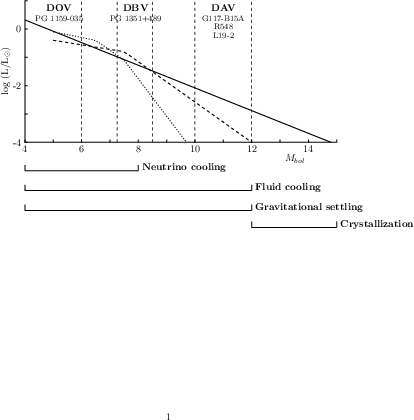
Figure 1: WD cooling schematic: photon (solid), neutrino (dotted), and axion (dashed) luminosity; variable WD types labeled across cooling epochs.
Pulsation drift measurements for select DAVs and DBVs show values exceeding standard model predictions, favoring axion-electron couplings in the range U(1)1. These values are currently in tension with red giant constraints, and refined WD cooling simulations from cluster data now exclude U(1)2, highlighting the need for resolution of stellar modeling degeneracies.
The WDLF provides an independent constraint: abnormal cooling at high luminosity disfavors large axion-electron or scalar-lepton couplings, with current data yielding U(1)3.
Finally, the conversion of thermal axions to X-rays in magnetized WD atmospheres provides the most stringent constraint on U(1)4 in the sub-U(1)5~eV mass range, as well as complementary polarization-based limits on U(1)6 from the lack of observed optical polarization in several high-field MWDs.
High-Frequency Gravitational Wave Searches with Compact Objects
The lecture notes review both experimental and indirect astrophysical probes of HFGWs above 10~kHz, an emerging high-priority frequency regime inaccessible to current interferometers. Compact objects, especially NSs, provide an environment where gravitons may convert resonantly into photons via the Gertsenshtein effect in strong magnetic fields, creating observable electromagnetic excesses or spectral distortions.
Recent studies using both individual pulsars and populations of NSs have placed preliminary limits on the stochastic HFGW background in bands up to U(1)7~Hz, with strain sensitivity U(1)8--U(1)9, relying on non-resonant and resonant conversion formalism respectively. Cosmological and galactic magnetic fields provide additional—but less sensitive, highly model-dependent—probes, through global radiative backgrounds such as ARCADE2 and EDGES.
Astrophysical detection of HFGWs remains limited by substantial uncertainties in cosmic magnetic field modeling and the microphysics of compact object magnetospheres. There is considerable future potential if these theoretical uncertainties can be systematically addressed.
Conclusion
This document delivers a rigorous, technically comprehensive synthesis of how compact objects underpin modern WISP and HFGW searches. It demonstrates:
- That neutron star cooling can set competitive or dominant bounds on scalar and axion-like couplings, with scalar-nucleon limits at the θˉ0 level for MeV masses and strong implications for laboratory searches for fifth forces and Higgs-portal scalars.
- That white dwarfs offer unique multi-channel diagnostics for axion-electron and axion-photon interactions, although conflicts between different stellar observables and systematics persist.
- That the general theory of axion-photon conversion is now robust in the context of NS magnetospheres, enabling systematic, quantitative use of radio observatory data in future axion DM searches.
- That the development of both HFGW theory and compact object-based detection strategies opens new directions for synergy between particle physics, general relativity, and observational astronomy.
The next decade will likely refine or resolve the interplay between compact object astrophysics and the fundamental parameter space of WISPs and exotic gravitational phenomena. Improvements in pulsar and WD survey data, multi-messenger astronomy, quantum sensor technology, and theoretical modeling will be essential to making the strongest use of these natural laboratories.