- The paper demonstrates that strong boundary-induced non-normality causes level repulsion, producing chaos-like spectral signatures in non-chaotic models.
- It employs both analytical constructions and numerical analyses on a driven quantum oscillator and an open tight-binding model to disentangle truncation artifacts from intrinsic dynamics.
- The study questions using Lindbladian level statistics as a standalone chaos diagnostic, suggesting that alternative dynamical observables are needed for robust analysis.
Non-Normality and the Breakdown of Level Repulsion as a Chaos Diagnostic in Open Quantum Systems
Introduction
The correspondence between spectral statistics and quantum chaos is a foundational paradigm in the study of complex quantum dynamics. In closed quantum systems, random matrix theory (RMT) robustly links the presence of level repulsion in the Hamiltonian spectrum to chaotic dynamics. This connection extends to open quantum systems via the widely-employed Grobe–Haake–Sommers (GHS) conjecture, which posits that dissipative quantum systems with classically chaotic counterparts should exhibit spectral level repulsion in the Lindbladian spectrum. In this framework, non-Hermitian RMT, specifically statistics derived from the Ginibre ensemble, provides an anticipated universal signature for chaotic Lindbladian generators.
This paper challenges the validity of this correspondence in open quantum systems, demonstrating that Lindbladian spectral statistics are not generically reliable indicators of quantum chaos—neither at intermediate nor long times, irrespective of the classical counterpart. Strong non-normality, a generic feature of Lindbladian generators, undermines the physical relevance of level repulsion for diagnosing chaotic dynamics. By explicit construction and numerical analysis, the authors expose that boundary-induced non-normality, and not dynamical chaos, is often responsible for the emergence of RMT-like level statistics in open quantum systems.
Lindbladian Level Statistics and the GHS Conjecture
Statistical analysis of Lindbladian spectra, via unfolded level spacing and complex spacing ratios, is a common chaos diagnostic in contemporary studies of dissipative quantum systems. The paradigmatic expectation is that chaotic Lindbladians exhibit cubic level repulsion, as in the Ginibre ensemble. This conjecture has proliferated following both theoretical and numerical validations in random and interacting many-body models.
The paper rigorously scrutinizes two models: (i) a driven quantum harmonic oscillator coupled to a thermal bath, and (ii) an open tight-binding model with incoherent tunneling. Both are analytically integrable, lacking any signatures of dynamical chaos or complexity growth. Nevertheless, upon imposing truncation (bosonic cutoff or open boundary conditions), their numerically-evaluated spectra exhibit pronounced level repulsion, nearly indistinguishable from Ginibre statistics.
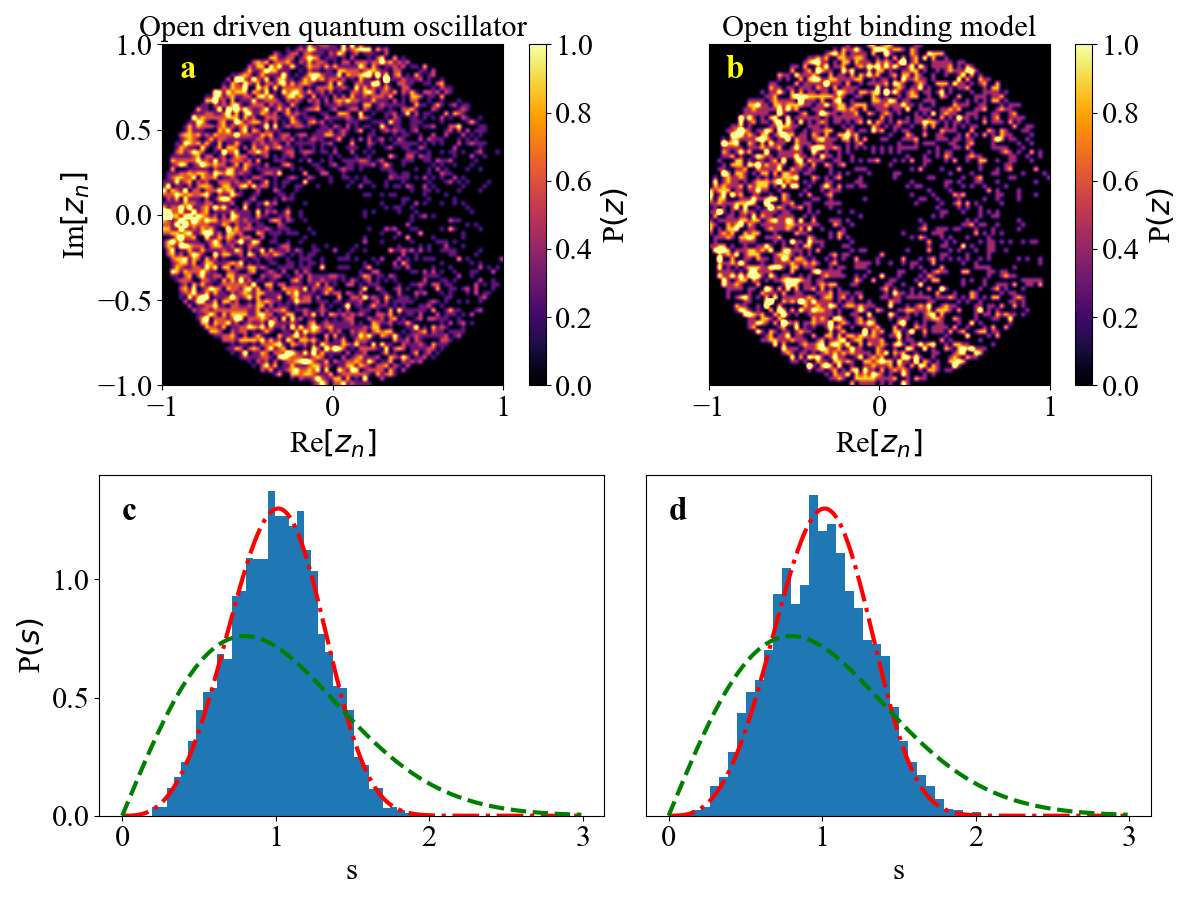
Figure 1: Density plots of complex spacing ratios for the driven oscillator and tight-binding models, showing characteristic “bitten-donut” distributions and unfolded spacing distributions matching the Ginibre prediction.
This apparent contradiction is resolved by disentangling the effects of truncation and non-normality from intrinsic dynamical properties.
Dynamical Regularity Versus Spectral Statistics
To robustly assess the connection between spectral and dynamical properties, the evolution of the Uhlmann fidelity is examined for various system sizes and truncations. The fidelity remains arbitrarily close to unity as long as the system size is sufficiently large relative to the time scale, confirming that the dynamics is completely regular—identical, up to finite-size effects, to the behavior of untruncated integrable models.
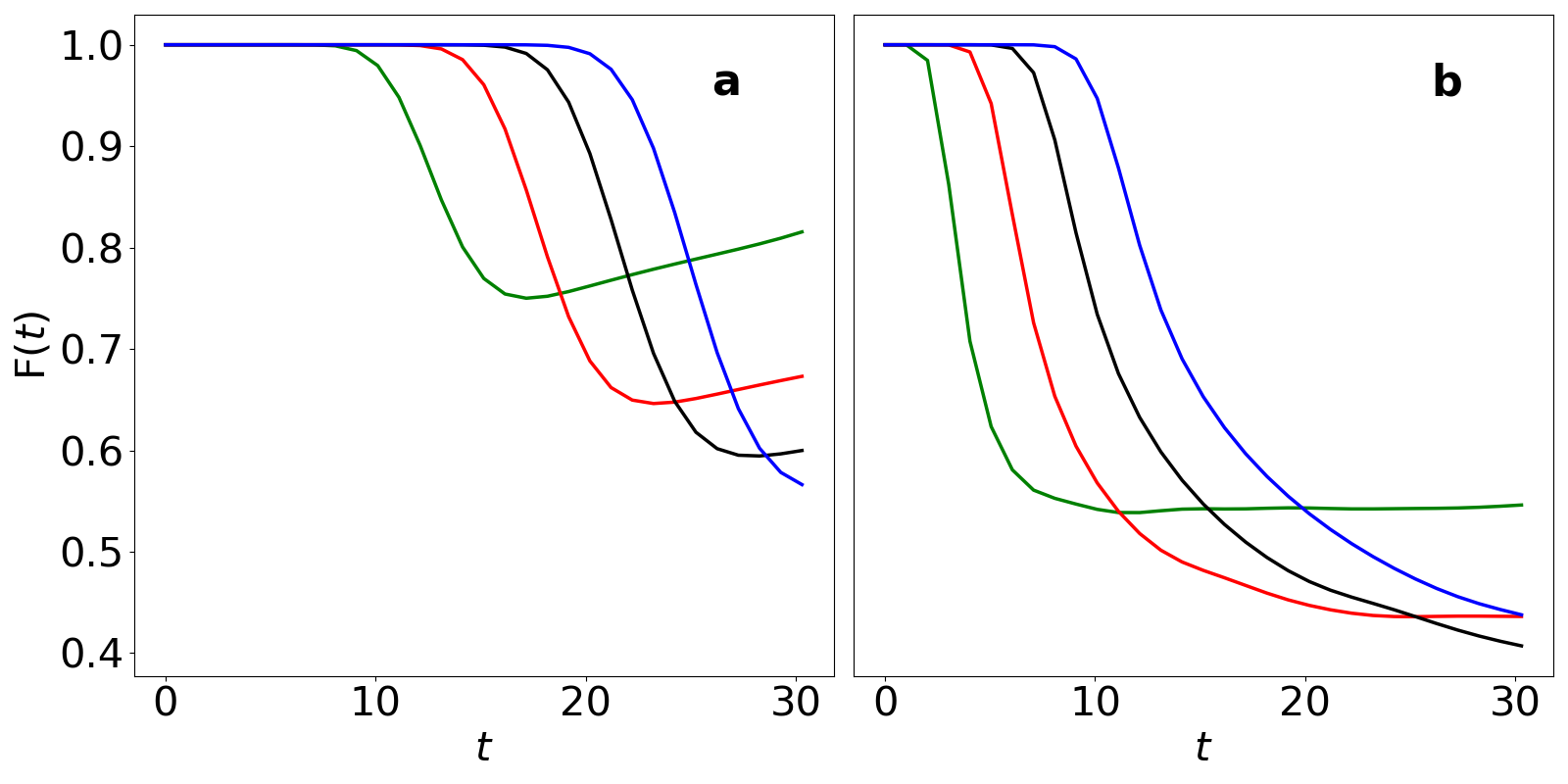
Figure 2: Time evolution of the Uhlmann fidelity in both models demonstrates that increasing system size postpones any deviation from unity, confirming regular, non-chaotic dynamics.
Thus, despite the emergence of strong level repulsion in the spectrum, no physical signatures of chaos manifest in state evolution, at any practical or asymptotic time scale.
Non-Normality, Spectral Instability, and the Liouvillian Skin Effect
The key to this decoupling lies in the fundamental non-normality of boundary-truncated Lindbladian generators. Non-normal operators possess left and right eigenvectors that are not orthogonal, and the condition number κ(λ) provides a direct measure of their spectral sensitivity. The paper shows that for both test models, the eigenvalue condition numbers associated with bulk (non-steady-state) eigenvalues grow exponentially with system size, reaching values where any numerically-irreducible perturbation (e.g., from floating-point precision limitations) induces random-matrix-like mixing in the spectrum.
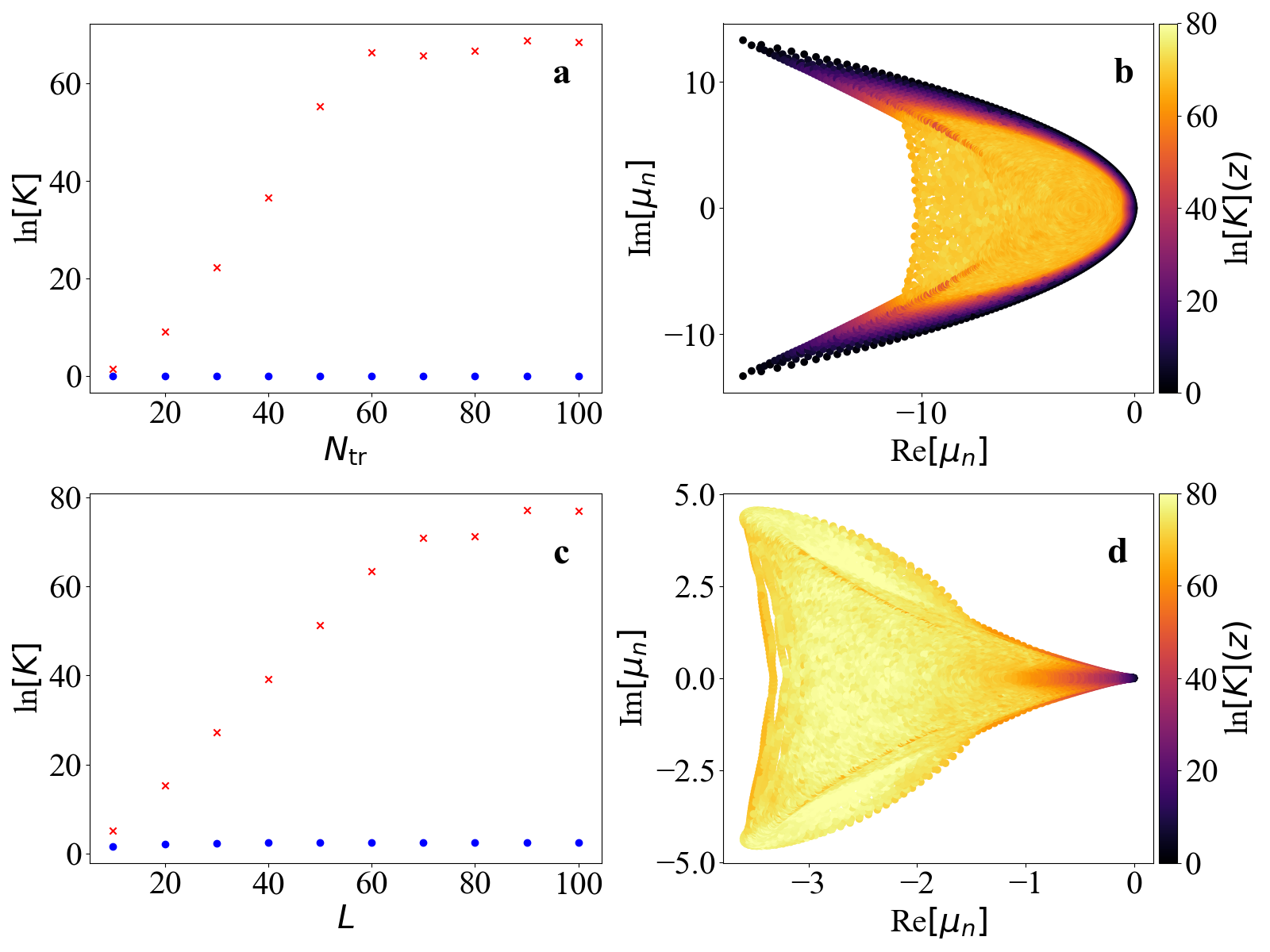
Figure 3: Logarithmic scaling of eigenvalue condition numbers for both models versus system size; spectra are overlayed with corresponding condition numbers, highlighting extreme instability for bulk eigenvalues.
This spectral instability is not an artifact of any particular numerical method, but a mathematical inevitability for non-normal matrices of the class considered. Strong non-normality is directly linked to the emergence of a non-Hermitian skin effect in Liouville space, with eigenvectors localizing near the imposed boundary. This localization effectively nullifies the physical content of most numerical eigenstates, as the predominant structural effects are dictated entirely by truncation and boundary conditions, not by intrinsic system dynamics.
Implications for the Diagnosis of Quantum Chaos
The findings have several concrete and theoretical implications:
- Failure of Level Repulsion as a Chaos Diagnostic: Level repulsion can—and routinely does—arise in the Lindbladian spectra of regular, non-chaotic models whenever strong non-normality is present. The GHS conjecture is shown not to be universally applicable, even at the level of transient dynamics.
- Truncation-Induced Artifacts: Any numerical scheme that relies on finite truncation in basis representations (Fock space cutoffs, open boundary conditions) in the analysis of non-normal generators risks exponential amplification of minor perturbations, producing spurious signatures of quantum chaos in the spectrum.
- Spectral Analysis Insufficiency: The presence (or engineered absence) of level repulsion is not reliably correlated with chaotic, complex, or regular behavior in open quantum systems. Only robust, perturbation-insensitive spectral features can support chaos diagnostics, and these are largely absent in strongly non-normal (i.e., most physically relevant, boundary-affected) Lindbladians.
- Impact on Simulation and Topological Analysis: Practices such as Krylov/Arnoldi algorithms, matrix-product techniques, and steady-state analyses in quantum information science must be re-evaluated with respect to non-normal amplification. Apparent spectral gaps and topological features may in fact be artifacts of boundary-induced non-normality rather than robust physical properties.
The work further generalizes these insights to show that Poisson statistics are similarly unreliable as indicators of regularity in non-normal systems, as infinitesimal perturbations will generically drive any fine-tuned spectrum to apparent RMT-like statistics, except under exponentially fine control.
Conclusion
This paper refutes the universality of spectral level repulsion as a diagnostic for quantum chaos in open quantum systems. Using analytically tractable models, comprehensive numerical experiments, and detailed analysis of non-normality and pseudospectral theory, it exposes the mechanism—boundary-induced non-normality and the associated Liouvillian skin effect—by which chaos-like spectral signatures arise independently of any underlying complex dynamics. As such, alternative chaos diagnostics insensitive to non-normal spectral amplification, ideally based on dynamical observables rather than fine spectral features, are imperative for meaningful characterization of open quantum systems.

