- The paper introduces a geometric framework using fiber density and drift to guide filtered ANN search, addressing navigability failures in filtered subgraphs.
- It presents a dual-phase search algorithm that alternates between fiber descent and full-graph exploration, outperforming traditional methods like FAISS HNSW.
- The approach significantly reduces zero-recall failures and offers a scalable, index-agnostic solution for dynamic, metadata-rich search applications.
A Geometric Framework for Filtered Approximate Nearest Neighbor Search
Introduction
"Fiber-Navigable Search: A Geometric Approach to Filtered ANN" (2604.00102) develops a new framework for filtered approximate nearest neighbor (FANN) search, addressing the core failure modes that arise when metadata constraints induce structural changes in standard proximity graphs. The approach abandons purely operational heuristics (e.g., post- or traversal-time filtering) and introduces a geometric methodology grounded in differential geometry. Central to the framework is the fibered view of the dataset: each filter predicate induces a subgraph, or fiber, whose local geometry can vary dramatically from the original graph. Two local signals—fiber density and drift—characterize and classify all observed failure regimes, guiding a search algorithm that dynamically alternates between filtered neighbor descent and full-graph exploration. Empirical evaluation on a 100k production dataset demonstrates the method's superiority over FAISS HNSW, particularly in scenarios where filtered regions are structurally or geometrically isolated.
Geometric Framework and Fiber Structure
The fibered approach models the dataset as a discrete fiber bundle: the base is the metadata space, and each point’s metadata tuple determines its fiber. A filter predicate selects a union of these fibers, yielding a filtered subgraph GS. Observation of GS reveals that the loss of nodes and edges—especially under selective filters—often destroys navigability, creating disconnected regions or sharp potential gradients that trap greedy search.
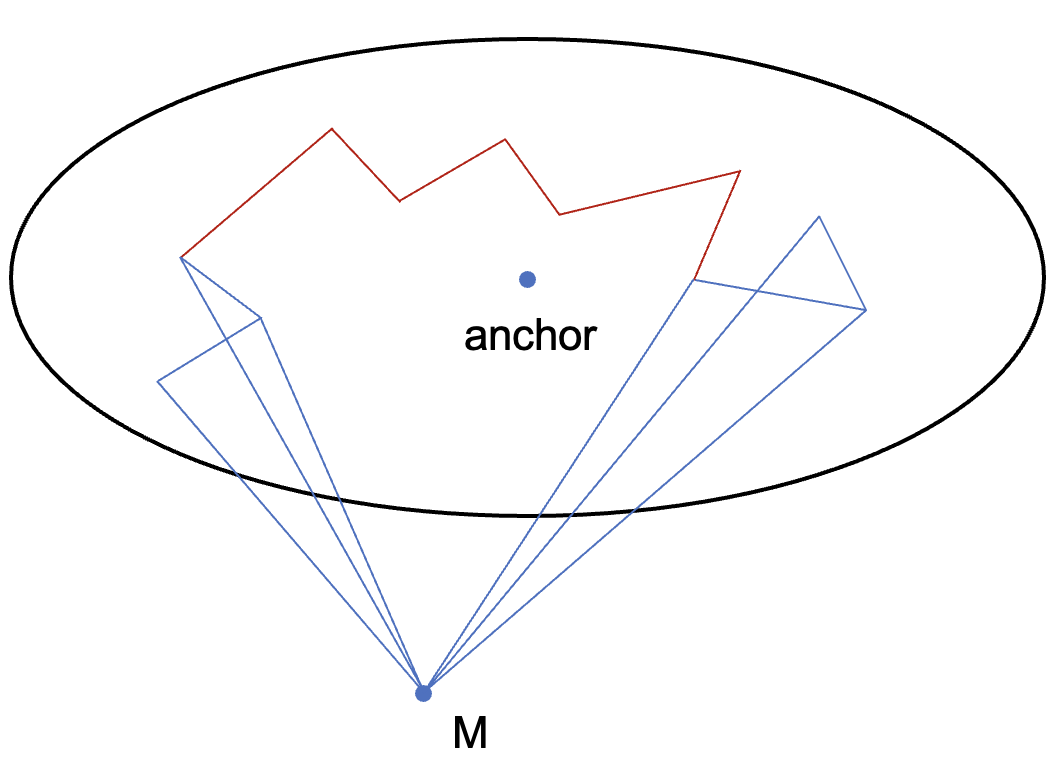
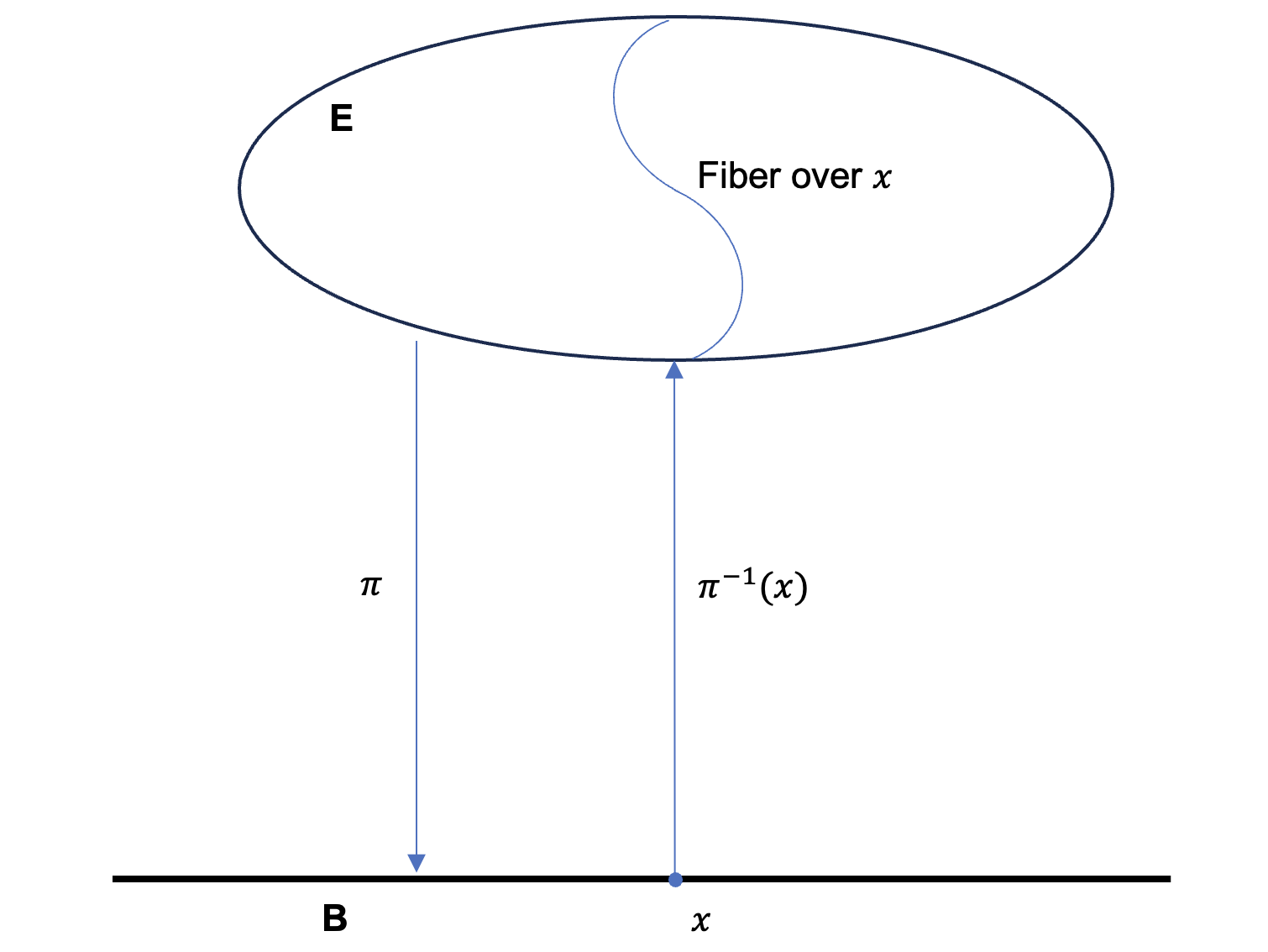
Figure 1: Discrete fiber over metadata inside a cluster, visualizing how each filter predicate selects a subset (“fiber”) of points within the embedding space.
Navigability on G does not imply navigability on GS. Standard greedy and beam search algorithms ignore the local geometry imposed by the filter, frequently resulting in local minima or unreachable neighbors. By treating filtered subsets as fibers, the framework generalizes across all combinations of graph construction and filter predicates.
Local Geometric Signals: Fiber Density and Drift
The algorithm leverages two local, computationally efficient signals:
- Fiber density ρS(x): the fraction of a node’s neighbors that survive the filter, quantifying local fiber connectivity. Low density indicates potential disconnection.
- Drift: the average potential difference between a node and its filtered neighbors, i.e., the discrete Laplacian of the distance-to-query potential restricted to the fiber. Negative drift signifies feasible descent in the fiber towards the query, while non-negative drift signals a local geometric bottleneck.
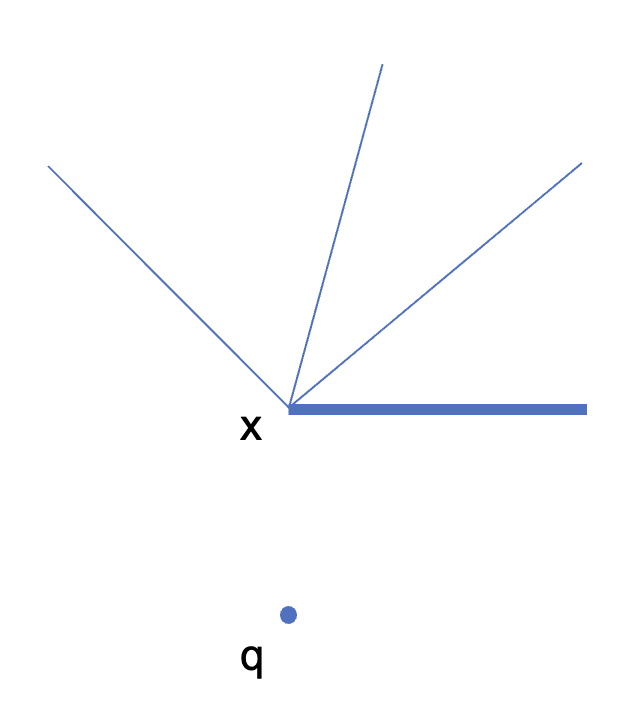
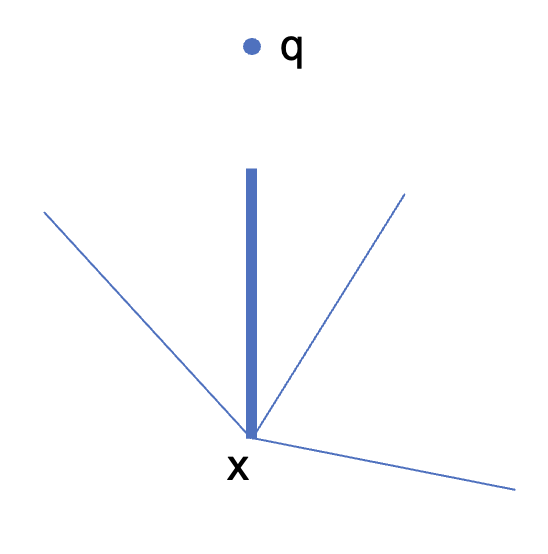
Figure 2: The drift signal at a node, reflecting the average descent direction and guiding when to continue fiber descent or to switch exploration modes.
These diagnostics drive both real-time traversal and failure classification, offering a unified explanation for several failure regimes that, in previous systems, were only partially and heuristically addressed.
Search Algorithm: Drift-Guided Two-Phase Navigation
The fiber-navigable search alternates dynamically between modes based on geometric local signals:
- Phase 1 – Fiber Descent: While drift is negative, the algorithm restricts expansion to filtered, descending neighbors, ensuring maximal efficiency in regions where filter connectivity and slope align with the query.
- Phase 2 – Full-Graph Exploration: On loss of favorable drift or local fiber sparsity, the algorithm switches to standard beam search in the full graph, passively collecting any matching (filtered) results. If newly discovered filtered neighbors with negative drift are encountered, the walk returns to Phase 1.
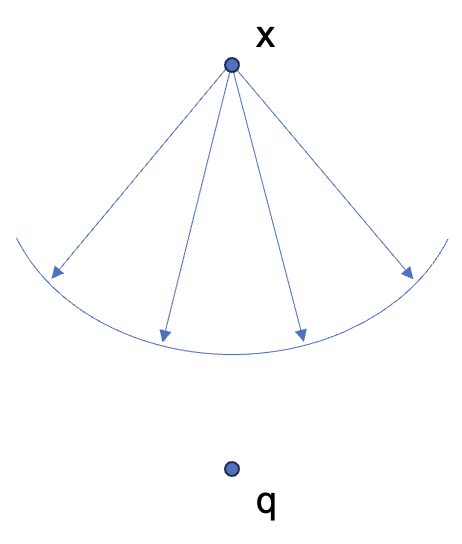
Figure 3: Local descent using filtered neighbors, exploiting negative drift to pursue efficient in-fiber descent toward the query.
To address all geographical and topological failures uniformly, the method employs an anchor atlas—a clustering-based structure that, using per-cluster metadata statistics, allows restarts in fiber-present regions near the query. This transition is structurally analogous to changing charts on a manifold in differential geometry.
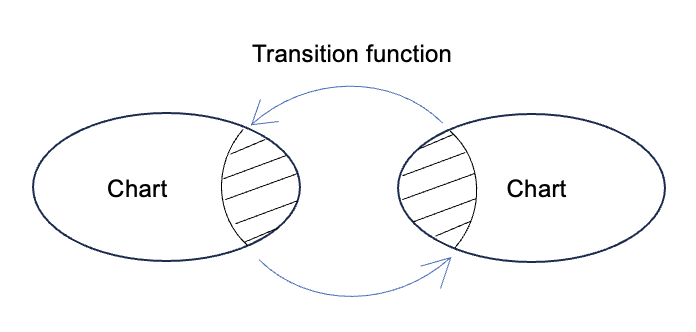
Figure 4: Transition function gluing together local charts (clusters) akin to switching coordinate patches in differential geometry. Here, cluster transitions provide robust restart mechanisms for search.
Failure Taxonomy: Stall Regimes
The framework provides a rigorous taxonomy for search failures, classifying stalls into three distinct regimes:
- Topological cuts: The filtered fiber is locally absent; low fiber density. Search cannot proceed without a substantial jump.
- Geometric folds: The fiber is present but locally slopes away from the query due to filter-induced geometric misalignment. Descent via the fiber is blocked by off-fiber, lower-potential neighbors.
- Genuine basins: The fiber is fully present and well-aligned, but a true (local) minimum is reached for the potential function within the filtered subgraph.
All three are resolved via the same mechanism: anchor-based restart in a new, nearby fiber-present region. Empirical stall analysis demonstrates that each regime can be diagnosed unambiguously using fiber density and drift.
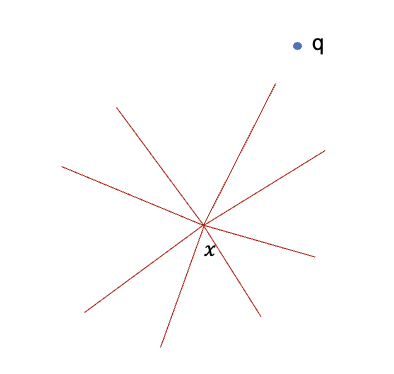
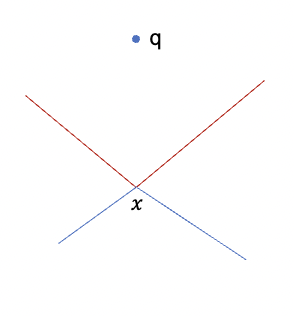
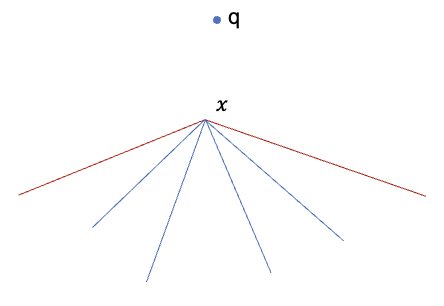
Figure 5: Topological cut, visualizing how filtering can create disconnected regions, preventing local traversal even when the full graph would allow continued descent toward the query.
Empirical Results
Evaluation is conducted on 105,100 product embeddings (2048-dim) with 24 metadata fields, using 10,000 filtered queries across filter selectivities ranging from <0.01% to >20%. The method is compared with FAISS HNSW (post-filter and traversal-filter modes) and baseline beam search.
- Guided search with a 20× lower beam width outperforms baseline beam search and both HNSW strategies.
- Recall@25 is 0.781 for guided search (α-GS0NN, GS1), compared with 0.717 for beam search and GS20.5 for HNSW traversal-filter. Zero-recall failures (complete misses) drop from over 25% (HNSW traversal-filter) to GS30.1\%.
- Failure mode analysis reveals regime shifts as filter selectivity increases: rare filters primarily induce topological cuts (over 90% for selectivity GS40.1%), while higher selectivities transition to geometric folds and finally to genuine basins as the dominant failure regime.
Notably, even when restricted to the base layer of HNSW (no custom graph construction), the proposed drift-guided + anchor approach eliminates nearly all zero-recall failures observed in prior work.
Implications and Future Directions
Practical Impact
The presented method provides a robust, index-agnostic algorithmic framework for filtered ANN search, removing the need for expensive, filter-aware graph constructions. By decoupling filter navigability from index building, it is particularly suited for dynamic, multi-attribute environments (e.g., real-time product search with user-driven filters), and is likely to generalize to other vector retrieval tasks leveraging rich metadata.
The anchor atlas remains lightweight: clustering (via GS5-means) has sublinear or fixed overhead, and inverted indices for filter predicates are GS6, making the solution scalable to GS7 points and adaptable to distributed environments. The interpretability and modularity of the local signals (fiber density, drift) mean that similar structures could be readily incorporated into commercial search pipelines or vector databases.
Theoretical Significance
The geometric perspective (fiber bundles, discrete Laplacian for drift, manifold chart analogy for anchor restarts) clarifies the precise nature of filtered search failures—unifying cases that were previously treated with separate ad hoc remedies. This unification paves the way for principled extensions: e.g., range predicates, set-valued filters, or continuous-valued fiber bundles, which can be handled by generalizing the anchor structure and drift computations.
An open theoretical direction is the study of graph construction families that maximize fiber navigability under arbitrary filtering. The presented framework suggests that locally dense, symmetrized graphs (such as GS8-GS9NN) support fiber descent better than structures optimized for unfiltered greedy walks but remain robust under induced subgraph sparsification.
Conclusion
"Fiber-Navigable Search" formalizes the filtered ANN search problem in geometric terms, introducing drift and fiber density as core signals for both local navigation and failure diagnosis. The resulting drift-guided, anchor-augmented search achieves high recall and extremely low failure rates across a spectrum of filter selectivities, outperforming leading production baselines and illuminating the structural challenges of filtered search. The geometric methodology instantiated herein has direct implications for building robust, metadata-driven retrieval systems and serves as a blueprint for further algorithmic and structural advances in vector search over hybrid data.
References
All discussion based on "Fiber-Navigable Search: A Geometric Approach to Filtered ANN" (2604.00102).

