- The paper demonstrates that unimodular gravity supports regular black string and BTZ black hole solutions with Maxwell fields via a dynamic, position-dependent cosmological constant.
- It details analytic models where Bardeen- and Hayward-type black strings achieve global regularity using the geometric function H(r) to ensure physical viability.
- The work reveals that conventional Maxwell electrodynamics, when paired with unimodular gravity, can source regular black geometries without resorting to nonlinear matter.
Regular Black Strings and BTZ Black Hole in Unimodular Gravity Supported by Maxwell Fields
Unimodular Gravity: Differential Structure and Cosmological Term
The paper formulates regular black string and BTZ black hole solutions within unimodular gravity, an alternative to general relativity that restricts diffeomorphism invariance to volume-preserving transformations via the constraint det(gμν)=g0. This leads to the cosmological constant arising as an integration function, Λ(x), which can be position-dependent. The study demonstrates that this altered symmetry structure enables the non-conservation of the energy-momentum tensor, producing a dynamical vacuum contribution Λ(r) that absorbs part of the matter sector. Notably, the trace-free field equations in unimodular gravity reveal a fundamental correspondence between the geometric and matter sectors, allowing for novel source configurations and nontrivial cosmological profiles.
Construction of Black String and BTZ Solutions in Unimodular Gravity
The vacuum black string with cylindrical symmetry and the (2+1)-dimensional BTZ black hole are explicitly constructed using the unimodular gravity field equations. In this formulation, the metric functions f(r) are derived such that their asymptotic structure matches AdS backgrounds, and the integration constants are interpreted as the cosmological constant, consistent with their counterparts in GR. For charged solutions, the BTZ extension incorporates an additional −2q2ln(r) term, introducing central singularities in general relativity.
Non-Conservative Framework and Electromagnetic Sources
The analysis is further extended by supplementing gravity with nonlinear electrodynamics (NED), permitting non-conservation of the energy-momentum tensor, which is essential for the emergence of a radial-dependent cosmological term Λ(r). The authors establish that such framework is only tenable for electric-type solutions due to the structure of the electromagnetic tensor components. The revised field equations show that Λ(r) can effectively act as an electromagnetic source, eliminating the need for complex matter contributions often required in GR.
The geometric function H(r), derived from the mass function and metric, is used as a diagnostic to ensure the physical validity of Maxwell-sourced solutions, with the requirement H(r)≥0 for real electric fields.
Regular Solutions: Bardeen and Hayward-Type Black Strings
Two classes of regular solutions with cylindrical symmetry are investigated: Bardeen-type and Hayward-type black strings. For both, the mass functions and electromagnetic field profiles are constructed such that H(r) is strictly positive everywhere—a key requirement for Maxwell electrodynamics as a viable source across the entire spacetime.
- Bardeen-type Black String: The electric field exhibits Λ(x)0 near the origin and Λ(x)1 asymptotically. The vacuum profile Λ(x)2 remains finite at Λ(x)3 and recovers Λ(x)4 as Λ(x)5.
- Hayward-type Black String: The electric field behaves as Λ(x)6 at small Λ(x)7 and Λ(x)8 at large Λ(x)9. The effective cosmological constant is regular at the origin and asymptotically approaches Λ(r)0.
These constructions provide explicit analytic regularization of black string geometries sourced by linear Maxwell fields, bypassing the necessity for exotic nonlinear matter.
Regular Charged BTZ Black Hole: Critical Support by Maxwell Fields
A regular BTZ black hole solution sourced by NED is analyzed. The mass function Λ(r)1 includes a regularizing parameter Λ(r)2. However, Maxwell electrodynamics supports the geometry only for Λ(r)3, where Λ(r)4 is the critical radius defined by the vanishing of Λ(r)5.
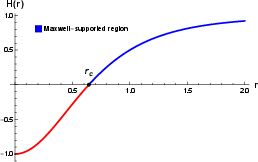
Figure 1: Behavior of Λ(r)6 for the regular BTZ metric, with Λ(r)7; Maxwell regime is valid for Λ(r)8 only.
Near the origin, Λ(r)9; thus, alternative sources must be invoked in this regime. Asymptotically, the spacetime always returns to the standard AdS cosmological constant.
Dynamical Vacuum Contribution and Consistency across Regimes
For all solutions, the dynamical vacuum profile f(r)0 exhibits negative pressure in the core, enforcing regularity and averting singularities. For Bardeen and Hayward cases, this vacuum profile is strictly regular and globally Maxwell-supported. In the BTZ regular solution, the support is limited to f(r)1, underscoring the necessity of NED or additional matter sources for full regularity in the Maxwell regime.
Implications and Future Directions
The results challenge the prevailing belief that regular black objects require nonlinear electrodynamics or exotic matter. Within unimodular gravity, Maxwell fields—usually insufficient in standard GR—are sufficient to source regular black strings and, partially, regular BTZ black holes, given the vacuum's dynamical role. The geometric function f(r)2 provides a robust criterion for physical field support; its role is crucial for identifying bounds of applicability for standard linear sources.
The implications are manifold: the study provides explicit analytic models of regular black strings and BTZ black holes with Maxwell sources, suggests a new interpretation of the cosmological constant as a dynamical entity, and motivates ongoing research into quantum effects within unimodular gravity—where the symmetry reduction could alter vacuum fluctuation contributions and the cosmological constant problem.
Future exploration may involve:
- Systematic classification of regular black objects sourced by Maxwell fields in higher dimensions and exotic topologies.
- Quantum extensions of unimodular gravity to probe vacuum energy and regularity beyond classical regimes.
- Observational consequences for shadow, lensing, and thermodynamics of regular (string and BTZ) solutions in AdS backgrounds.
Conclusion
This work establishes that unimodular gravity, with its position-dependent cosmological term enabled by reduced symmetry, allows Maxwell electrodynamics to source regular black string and BTZ black hole solutions. The geometric diagnostic f(r)3 clarifies the domain of validity for Maxwell sources, showing global applicability for Bardeen- and Hayward-type black strings, but a bounded regime for the BTZ case. The dynamical vacuum term is crucial for regularity and prevents matter collapse at the origin, asymptotically restoring AdS structure. This approach offers a technically transparent route to regular black geometries with standard fields, inviting further investigation into quantum corrections and phenomenological applications in gravitational theory (2604.00078).