- The paper demonstrates the nonlinear instability and collapse of Ellis–Bronnikov wormholes via full 3D numerical-relativity simulations.
- It employs the CCZ4 formulation and moving-puncture gauge to analyze compressive instabilities and extract gravitational-wave signals.
- Results reveal distinct gravitational-wave signatures, including a broadband burst and quasi-normal ringing, with implications for exotic compact object detection.
Wormhole Dynamics: Nonlinear Collapse and Gravitational-Wave Emission
Overview
"Wormhole Dynamics: Nonlinear Collapse and Gravitational-Wave Emission" (2604.00071) presents the first full 3D numerical-relativity simulations of the unstable Ellis–Bronnikov wormhole, explicitly evolving the coupled Einstein–phantom-scalar field equations in the GRTeclyn framework. The work investigates the nonlinear dynamical fate of topological wormholes and quantifies associated gravitational-wave emission during catastrophic collapse, injecting controlled perturbations to break spherical symmetry and trigger a compressive instability.
Physical Setup and Numerical Methodology
The simulations adopt exact isotropic initial data for the Ellis–Bronnikov geometry, representing a traversable, horizonless wormhole supported by a massless phantom scalar field. The spatial topology is R×S2, mapped via conformal regularization to avoid coordinate singularities at the throat and compactified origin. Evolution utilizes the CCZ4 formulation of general relativity for robust handling of constraint violations and adapts the moving-puncture gauge for singularity management. Perturbations are introduced by globally reducing phantom stress-energy support (Ssupport=0.5) and superimposing a quadrupolar scalar-field deformation (Aϕ=0.02, σϕ=0.5) to force the collapse branch and seed radiative multipoles.
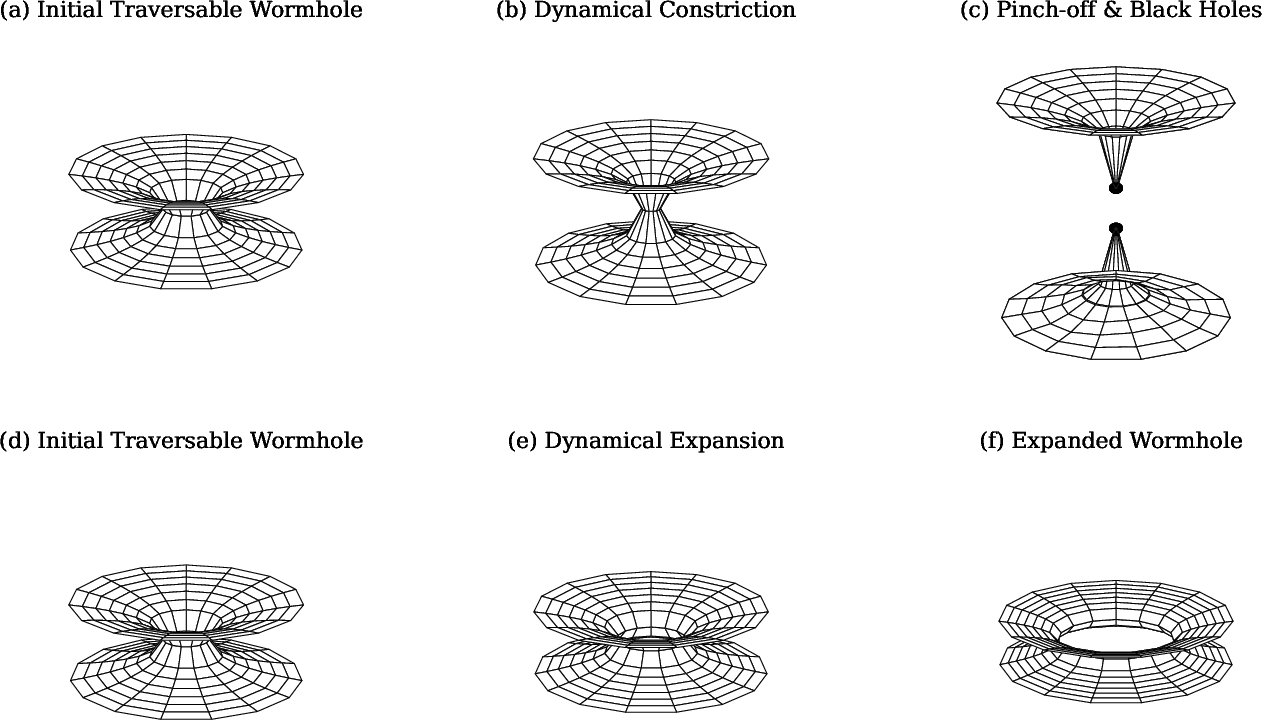
Figure 1: Embedding diagram illustrating compressive collapse and rarefactive expansion pathways for wormhole instability.
Instability Pathways and Collapse Diagnostics
The paper confirms the bifurcation of wormhole evolution previously demonstrated in 1D: rarefactive perturbations produce runaway throat expansion, while compressive triggers result in catastrophic collapse and trapped-surface formation. The unperturbed, noise-driven case remains static for t≲1.5M before truncation noise initiates inflationary expansion, with the throat expanding exponentially (λ≈9.012M−1). In contrast, the perturbed configuration rapidly forms an apparent horizon proxy and generates strong aspherical curvature variations, characterized by dynamic throat contraction (Rareal,min≈0.14 at t≈2M), rebound due to negative phantom pressure (phantom bounce), and subsequent outward-propagating shock.
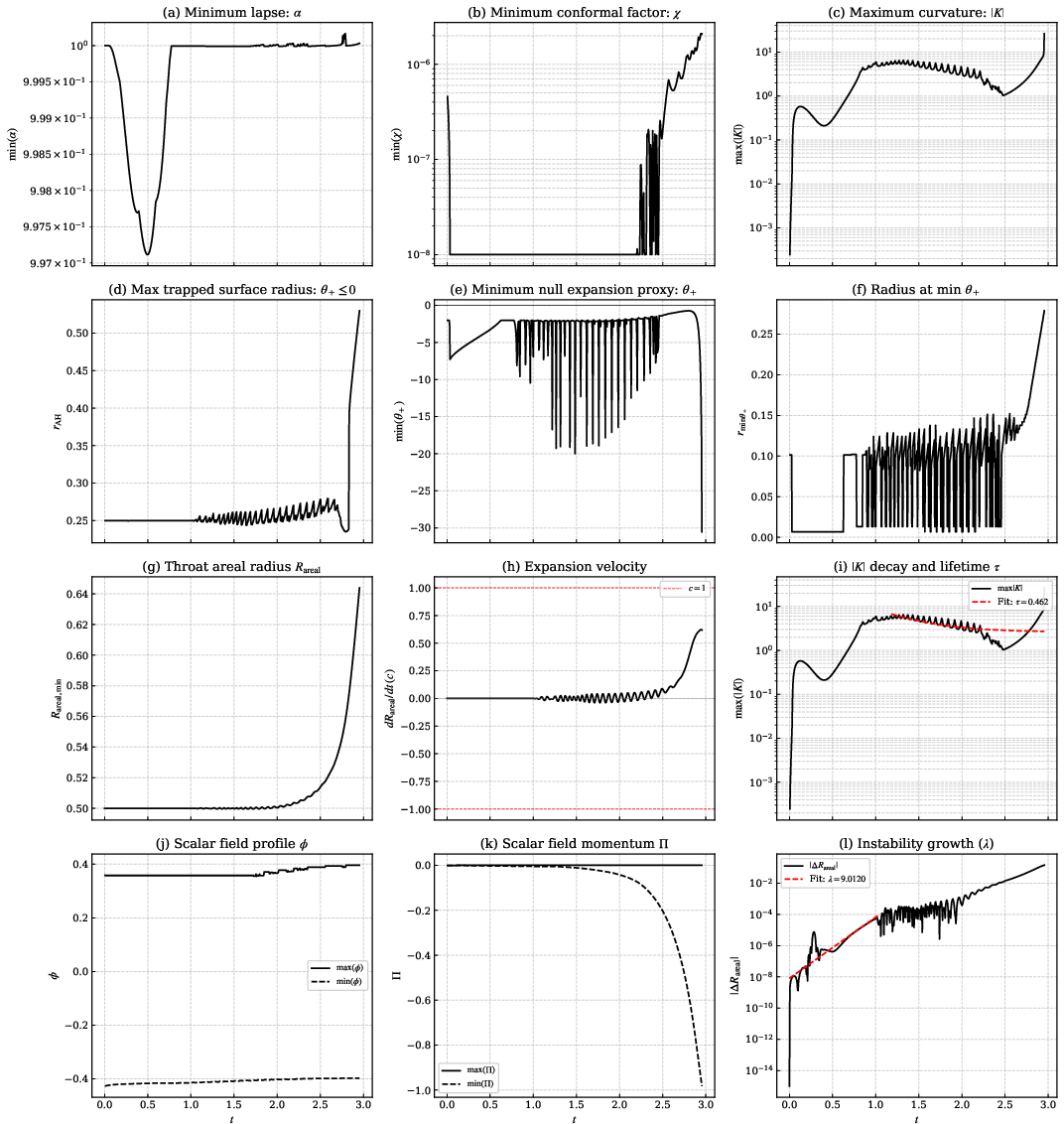
Figure 2: Diagnostics of the unperturbed, noise-driven evolution with exponential throat expansion after saddle-point equilibrium is broken by numerical noise.
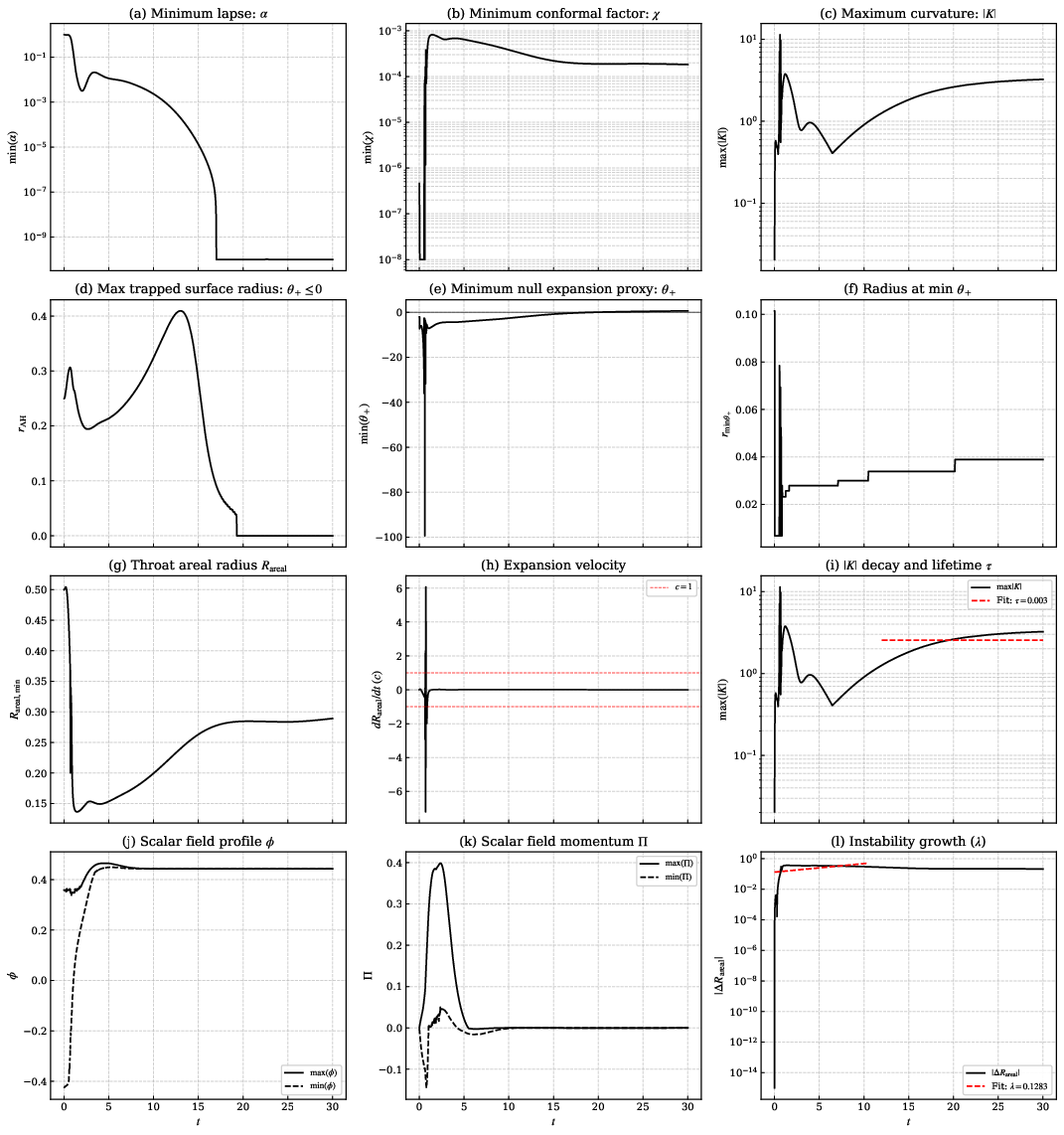
Figure 3: Perturbed collapse diagnostics; throat radius plunges followed by phantom bounce and outward curvature shock.
Gravitational radiation is diagnosed using the Weyl scalar Ψ4, decomposed into spin-weighted spherical harmonics. The dominant (ℓ,m)=(2,0) mode exhibits a coherent outgoing ringdown, with waveform alignment in retarded time (Ssupport=0.50) confirming propagation speed Ssupport=0.51 between extraction radii and thereby distinguishing physical radiation from superluminal CCZ4 constraint modes. The extracted signal peaks at Ssupport=0.52, with a time-frequency spectrogram revealing a burst morphology followed by quasi-normal mode ringing.
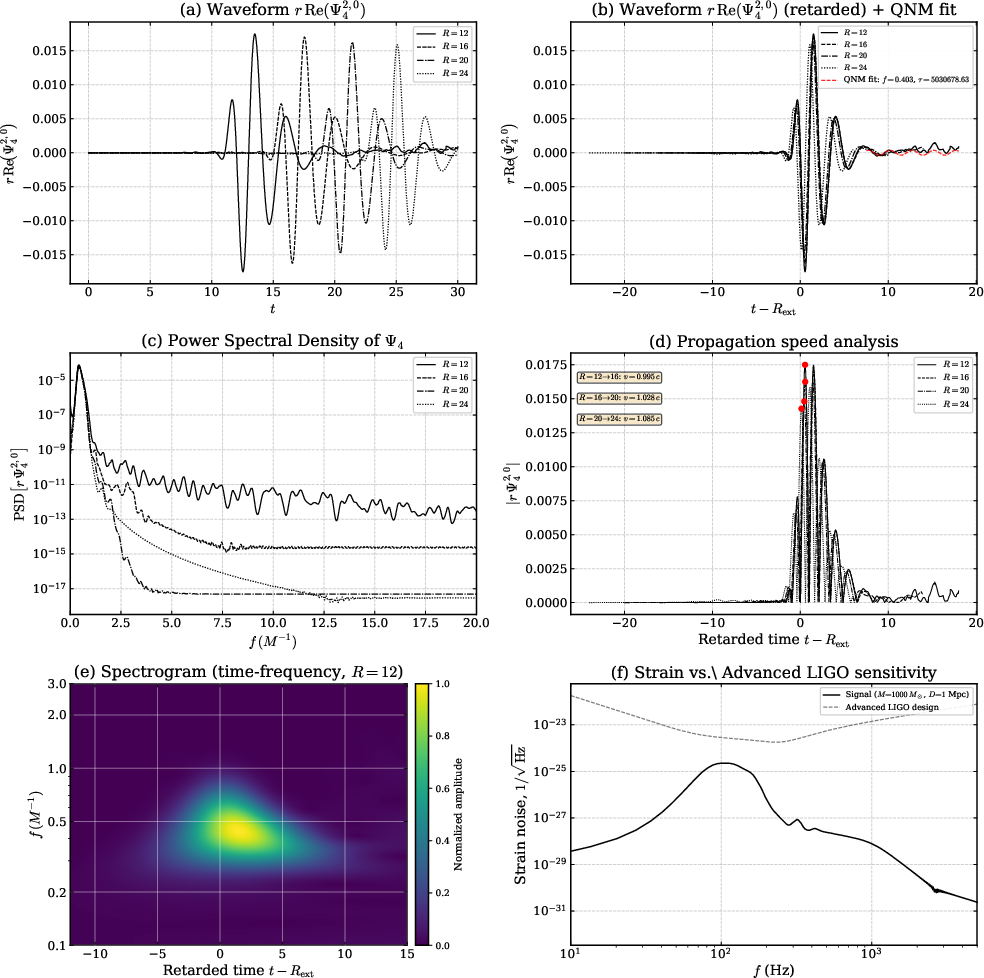
Figure 4: Gravitational-wave signal for perturbed collapse, showing coherent ringdown, PSD, and characteristic strain projection relative to Advanced LIGO sensitivity.
Importantly, an intermediate-mass (Ssupport=0.53) wormhole at Ssupport=0.54~Mpc produces a strain signal in the Ssupport=0.55–Ssupport=0.56 Hz band, but falls slightly below the Advanced LIGO design sensitivity for the simulated perturbation amplitude. Stronger asymmetries or reduced source distance would yield detectable transients.
Spatial and Temporal Evolution
The evolution of extrinsic curvature Ssupport=0.57 demonstrates direct spatial propagation of the phantom bounce, with an expanding shockwave originating from the compactified origin and propagating outward, eventually disrupting trapped surfaces and exhausting adaptive mesh refinement.
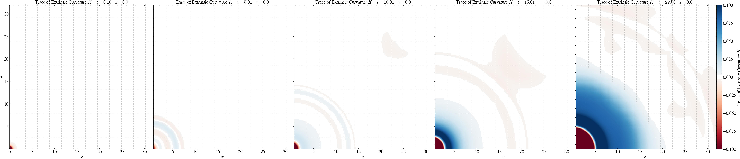
Figure 5: Snapshots of extrinsic curvature (Ssupport=0.58) in the Ssupport=0.59 plane, showing propagation of phantom bounce-driven shockwave.
Numerical Validation and Convergence
The results exhibit strong constraint satisfaction and high-order convergence prior to late-time coordinate disruption by the expanding phantom shock. The CCZ4 formulation combined with AMR enables long-term stability and successful singularity management, though late-phase shock gradients degrade convergence to first order in the Hamiltonian constraint.
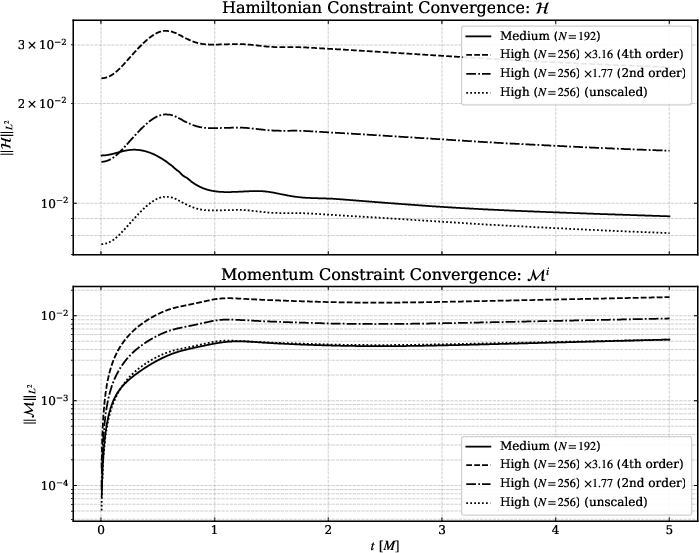
Figure 6: Constraint convergence analysis; initial second-order convergence degrades as shock-like gradients emerge.
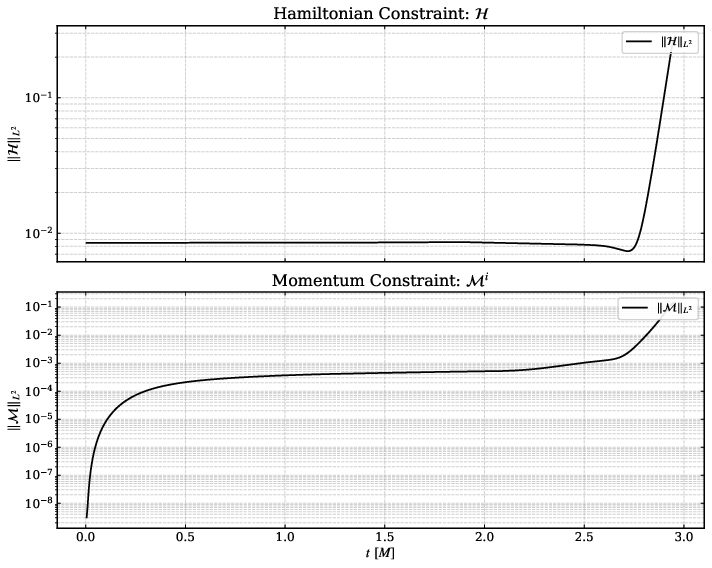
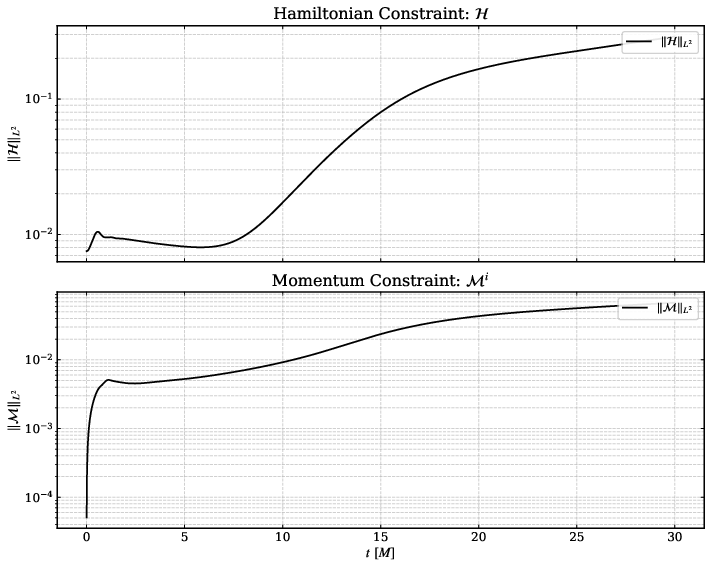
Figure 7: Global constraint norms in unperturbed and perturbed evolutions; constraint violations remain bounded during physical emission.
Physical and Astrophysical Implications
The instability timescale is governed by the throat light-crossing time (Aϕ=0.020), implying that macroscopic Ellis–Bronnikov wormholes are dynamically unstable to perturbation and cannot persist in the universe without active phantom-energy stabilization. Collapse yields black-hole formation and prompt gravitational-wave emission; rarefactive expansion dilutes the phantom energy, potentially restoring the null energy condition and invoking singularity theorems for eventual pinch-off in cosmological settings.
The gravitational-wave morphology is highly distinct: characterized by a broadband burst during throat collapse followed by quasi-normal ringing, these signatures are orthogonal to the canonical "chirp" templates from compact binary coalescence. The waveform templates provided can be directly utilized for targeted searches in public GW datasets and inform detection strategies for exotic compact objects. Rotating wormholes or highly aspherical primordial defects are expected to produce even more pronounced signals, with implications for next-generation terrestrial (e.g., Einstein Telescope) and space-based (LISA) detectors.
Computational Feasibility
GPU-accelerated AMR enables cost-effective simulation of these extreme topological dynamics, with good performance scaling and manageable memory requirements except during late-time shock expansion. The GRTeclyn framework and associated analysis tools are fully open source and support reproducibility and further exploration.
Conclusion
This study establishes the 3D nonlinear instability of Ellis–Bronnikov wormholes and provides authoritative gravitational-wave emission templates from collapse driven by physically motivated phantom field perturbations. The physical nature of the extracted signal, constraint satisfaction, and propagation analysis collectively validate the methodology. The results carry direct implications for wormhole survivability, cosmological evolution, and gravitational-wave detectability of exotic compact objects. Future developments—including constraint-satisfying high-amplitude studies, cosmological slicing, asymptotic waveform extraction, and exploration of rotating or higher-dimensional wormhole dynamics—will further advance the understanding and observational prospects of topological defects in general relativity.