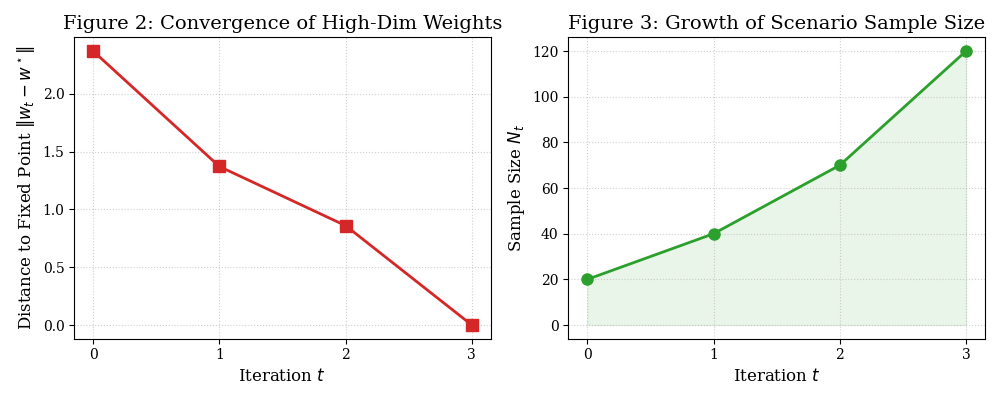
- The paper introduces a novel framework that formalizes decision-dependent uncertainty via performative feedback, establishing existence and convergence of self-consistent solutions.
- It employs a scenario-based, model-free approximation wherein iterative fixed-point updates with logarithmically growing sample sizes guarantee convergence to the optimal decision.
- Empirical results in LLM security demonstrate the framework’s practical efficacy in adapting guardrails against adversarial prompt distribution shifts.
Introduction
The paper "Performative Scenario Optimization" (2603.29982) presents a novel approach to decision-dependent stochastic optimization, wherein the deployed decision actively shapes the underlying data distribution through a performative feedback loop. This research addresses the computational and theoretical challenges arising from environments where adversaries or other agents adapt in response to deployed controls, leading to endogenous and evolving uncertainty. The authors introduce a model-free, scenario-based method equipped with rigorous convergence theory, and demonstrate the practical impact in LLM safety against adversarial prompt distribution shifts.
Classical stochastic optimization assumes exogenous uncertainty, failing to capture the performative feedbacks prevalent in strategic or adversarial settings. The authors define a decision-dependent chance-constrained problem where the probability law Px governing system uncertainty is itself a function of the chosen decision x. A decision x must satisfy
Px(g(x,ξ)≤γ)≥1−ε,
where g(x,ξ) encodes constraints or performance thresholds. Critically, the feasible set depends on x in both direct evaluation and through its influence on Px, necessitating a fixed-point—termed a "performative solution"—characterized by self-consistency.
Leveraging Kakutani’s fixed point theorem, the paper establishes existence conditions for performative solutions under standard compactness and continuity assumptions. The best-response operator is defined as
Φ(x)=argy∈Xεγ(x)minf(y),
where Xεγ(x) is the set of decisions feasible under the distribution induced by x. The equilibrium is then x0.
Scenario-Based Algorithmic Approximation and Convergence
Explicit computation of x1 is typically intractable, especially under unknown adversarial dynamics. The authors substitute model specification with a scenario-based, data-driven approximation. At each iteration, the decision-maker deploys a candidate x2, samples scenarios from the observed, environment-adapted distribution x3, and optimizes empirically over these samples.
The stochastic fixed-point iteration is formulated as
x4
where x5 is the scenario-based best response over x6 i.i.d. samples. Under appropriate conditions—strong convexity, Lipschitz continuity in x7, uniform scenario approximation—the authors prove almost sure convergence to the unique performative solution, provided the sample size schedule x8 grows logarithmically.
Game-Theoretic Microfoundation
The feedback between decisions and distributions is microfounded by a two-player game-theoretic model: the optimizer selects x9, and strategic agents (potentially adversaries) adapt via action x0 that induces a new probability measure x1. The agent’s adaptation is governed by utility tradeoffs balancing constraint violation and cost (e.g., semantic drift in adversarial examples), with KL-regularized objectives providing interpretability and tractability. The Nash equilibrium of this game is shown to be equivalent to the performative fixed point of the scenario optimization procedure.
The practical import of the framework is demonstrated in the context of LLM security, where deployed guardrails against malicious prompts induce adversarial adaptation of the input distribution. The model operates in the high-dimensional embedding space standard in industrial LLM security layers. A linear classifier x2 acts as the guardrail, and the post-deployment adversarial prompt distribution is implicitly determined by strategic transformations that maximize evasion while penalizing excessive deviation from typical (benign) semantics.
This closed-loop, performative update process can be visualized as follows:
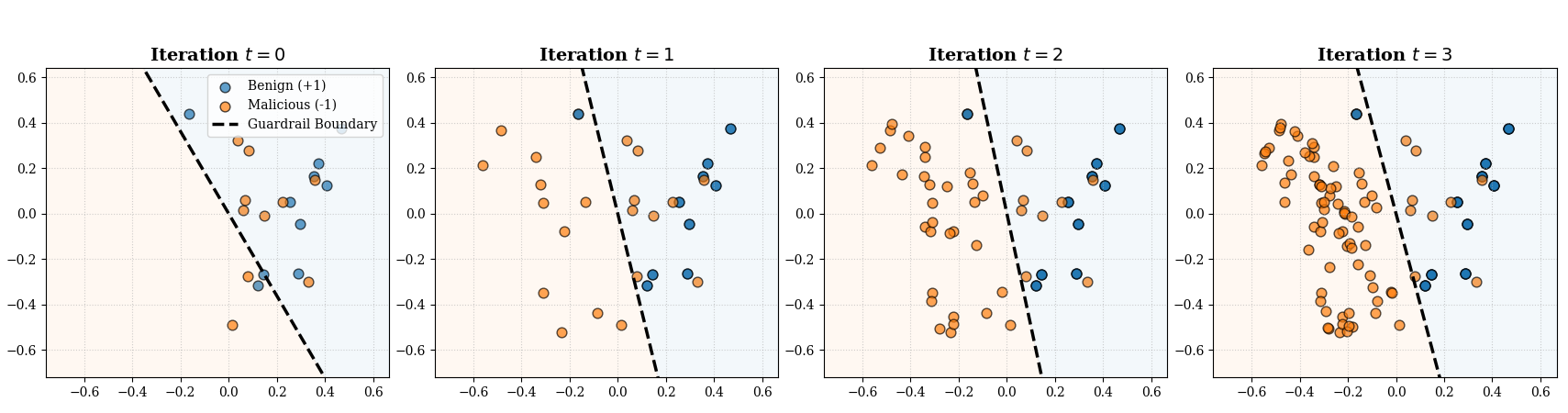
Figure 1: The evolution of the performative classifier and the distribution shift in embedding space. The dashed line is the dynamic classifier x3; blue points are benign prompts, orange points are adversarially mutated malicious prompts.
Critical numerical findings include:
Theoretical and Practical Implications
This work places scenario-based performative optimization on a rigorous footing, enabling adaptive decision-making when the underlying uncertainty is itself an artifact of the deployed decision. Theoretically, the paper bridges stochastic optimization, scenario methods, and performative prediction/game theory, offering novel convergence results under minimal distributional assumptions.
Practically, this framework is robust to distributional misspecification and adversarial adaptation, making it highly relevant for dynamic security settings, algorithmic marketplaces, content moderation, and any application characterized by strategic agent behavior. The black-box, model-free approach circumvents failure modes arising from agent model misspecification, a frequent practical bottleneck in adversarial domains.
Outlook and Future Directions
Further development may focus on relaxing convexity assumptions, extending to infinite-dimensional function spaces, and integrating advanced sample-efficient or robust learning techniques. Moreover, coupling performative scenario optimization with reinforcement learning policies or hierarchical control schemes could further enhance adaptivity and resilience in complex, multi-agent systems.
Conclusion
The performative scenario optimization framework rigorously formalizes and algorithmically solves decision-dependent chance-constrained problems where the deployed action alters the uncertainty process. Through scenario-based fixed-point iteration and convergence guarantees, the approach yields robust, self-consistent solutions without explicit modeling of adversarial or agent behavior. Empirical results in LLM safety substantiate the framework’s practical efficacy for designing adaptive defenses in adversarial, evolving environments.
References: "Performative Scenario Optimization" (2603.29982)