- The paper establishes that vibrationally-mediated inelastic transitions in biased nanojunctions can induce negative electronic friction, causing deterministic energy pumping.
- It employs numerically exact HEOM simulations and compares with Markovian EFLD and Ehrenfest approaches to quantify vibrational excitation and cooling across different energetic configurations.
- Frequency-resolved analyses reveal significant non-Markovian spectral features where the friction sign reverses, highlighting the limitations of standard Markovian approximations.
Negative Electronic Friction and Non-Markovianity in Nonequilibrium Molecular Nanojunctions
Overview and Motivation
Understanding nonadiabatic vibrational dynamics in molecules interfacing with metallic substrates is crucial for modeling a range of phenomena in surface chemistry, molecular electronics, and nanophysics. The continuum of metallic electronic states facilitates frequent transitions beyond Born-Oppenheimer dynamics, even when vibrational motion is slow and coupling is weak. The paper "Negative Electronic Friction and Non-Markovianity in Nonequilibrium Systems" (2603.29951) establishes the generic mechanisms leading to negative Markovian electronic friction (EF) in such out-of-equilibrium regimes and demonstrates the centrality of non-Markovian effects arising from vibrationally-mediated inelastic transitions.
Electronic Friction Framework and Nonequilibrium Langevin Dynamics
Electronic friction and Langevin dynamics (EFLD) constitute a primary mixed quantum-classical (MQC) method to capture vibrational–electronic interplay. By integrating out quantum electronic degrees of freedom, the vibrational motion is described via a stochastic Langevin equation whose most common implementation is in the Markovian limit. Under these conditions, EF acts as a first-order nonadiabatic correction, with the Markovian friction spectrum, γ~(x,0), encoding dissipation via electron-hole pair (EHP) excitation and allowing the stochastic term to satisfy the fluctuation-dissipation theorem (FDT) in equilibrium.
Out-of-equilibrium, however, EF can acquire negative values, manifesting deterministic energy pumping into vibrations—contrasted with stochastic Joule heating. Negative Markovian EF arises generically when vibrational modes directly modulate inelastic electronic transitions biased by an external voltage.
Donor–Acceptor Model and Energetic Configurations
The authors investigate these effects using a donor–acceptor model nanojunction where the vibrational coordinate linearly couples the hopping between donor and acceptor. Electron transport is governed strictly by vibrationally-mediated inelastic tunneling processes. Three distinct configurations arise:
Numerically exact hierarchical equations of motion (HEOM) simulations reveal pronounced vibrational excitation for Δ>0, suppression for Δ<0, and Joule heating for Δ=0, consistent with the physical schematic.
Quantitative Assessment: Electronic Friction and Vibrational Excitation
Quantum results (HEOM) are benchmarked against Markovian EFLD and Ehrenfest approaches. For Δ>0, Ehrenfest dynamics closely matches HEOM at high bias, confirming the deterministic vibrational pumping mechanism. At low bias, stochastic contributions dominate, and EFLD outperforms Ehrenfest. However, Markovian EFLD systematically underestimates quantum vibrational excitation at high bias, indicating missing non-Markovian effects. For Δ<0, Markovian EFLD increasingly diverges (unstable at high bias), producing unphysically large excitations absent in quantum theory, again signaling the breakdown of the Markovian approximation.
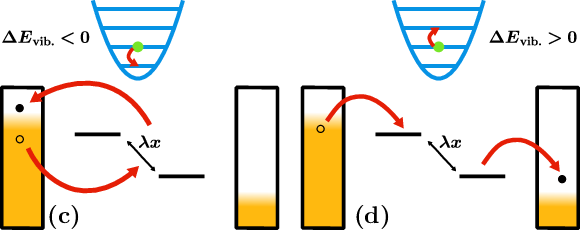
Figure 2: Markovian friction coefficients (equilibrium and nonequilibrium components) as functions of vibrational coordinate x at finite bias (Δ>00 V), demonstrating negative EF in targeted regions and its origins in biased inelastic EHP transitions.
Partitioning EF into equilibrium and nonequilibrium components, the sign and magnitude of nonequilibrium friction Δ>01 are controlled by voltage polarity and the sign of Δ>02. Negative friction (energy pumping) is observed for Δ>03 at Δ>04, while friction reverses for Δ>05 in thermodynamically favorable configurations.
Non-Markovianity and Spectral Structure
The paper advances the analysis by dissecting the frequency dependence of EF via its spectral density Δ>06. Markovian approximations hold only in cases where Δ>07 dominates the friction spectrum (e.g., Δ>08). For Δ>09, non-Markovian spectral structure appears around Δ<00, and in multiple regions, non-zero frequency components significantly exceed the Markovian (Δ<01) contribution, sometimes with reversed sign.
(Figure 3)
Figure 3: Frequency-resolved electronic friction spectrum evidences dominant non-Markovian peaks near Δ<02, indicating critical corrections to Markovian dynamics and periods where deterministic vibrational driving is reversed or amplified.
EFLD’s tendency toward instability in negative EF regions is identified as a breakdown of the Markovian assumption. The true dissipative/driving character must be drawn from the full spectral landscape rather than the single zero-frequency Markovian coefficient.
Implications and Prospects
The findings imply that negative Markovian friction is neither universally indicative of deterministic vibrational energy gain nor a robust predictor of nanojunction stability. Non-Markovian spectral structures—arising generically in any nonequilibrium system with vibrationally coupled electronic transitions—can dominate and invert the local dynamics. This extends well beyond electronic molecular junctions, including light-driven surface processes, current-driven nanomechanical systems, and nuclear or impurity dynamics in driven Fermi systems. The theoretical framework indicates that relying solely on coarse-grained Markovian friction coefficients can misrepresent actual vibrational behavior and stability, necessitating frequency-resolved analyses.
Conclusion
The paper rigorously establishes that vibrational coupling to biased inelastic electronic transitions produces negative Markovian electronic friction, but the sign and effect of friction are fundamentally frequency-dependent and highly non-Markovian. Accurate prediction of vibrational excitation or damping requires full spectral characterization of EF, challenging the conventional adequacy of Markovian MQC techniques. Future AI-driven simulations of nanoelectronic transport, surface chemistry, and quantum impurity dynamics will require incorporation of frequency-resolved friction kernels to faithfully model energy transfer and stability under nonequilibrium conditions.
