- The paper’s main contribution is to reveal a gap between high explicit risk awareness and deficient context-specific risk recognition among AI practitioners.
- The study employs a cross-sectional mixed-method survey with scenario-based evaluations and behavioral measures to assess risks across diverse student groups.
- The findings imply that AI literacy curricula should integrate realistic scenarios and targeted interventions to counteract overconfidence and gender disparities in adoption.
Rethinking AI Literacy Education: Bridging Risk Perception and Responsible Adoption
Study Rationale and Context
The increasing integration of AI across social sectors has foregrounded the critical need to align technical capability with risk-aware, ethically grounded decision making. However, both the literature and institutional practice have lagged in developing and empirically validating curricula capable of achieving robust transfer from abstract risk awareness to context-specific, responsible adoption behavior among future AI practitioners. This study (2603.29935) systematically interrogates technology students’ risk perception dynamics using explicit and scenario-based instruments, complemented by behavioral adoption measures and demographic cross-sections. The resulting analysis exposes nontrivial gaps and paradoxes in current AI literacy attainment, directly informing pathways for curricular and institutional reform.
Methodological Overview
A cross-sectional mixed-method survey was implemented, targeting students and recent graduates from Computer Science (CS), Data Science/Data Analytics (DS/DA), and a comparison group of miscellaneous disciplines. The quantitative analysis comprised explicit risk ratings for twelve AI harm domains, scenario-based assessments for ten realistic applications (each probed for perceived risk and willingness to adopt), plus demographic and background variables. Reliability of the instruments was high (α>0.85 across scales), and the final sample (N=139) was balanced by gender, ethnically diverse, and predominantly AI-specialized.
Key Empirical Findings
Specialization Drives Explicit Awareness but Not Applied Sensitivity
Explicit risk awareness was significantly higher in CS and DS/DA students compared to others:
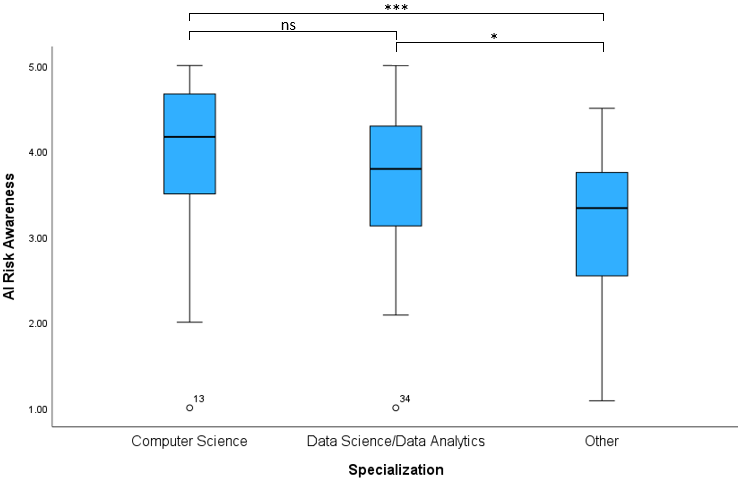
Figure 1: CS and DS/DA students exhibit elevated explicit AI risk awareness relative to non-technical peers.
Despite this, scenario-based risk judgments—i.e., within concrete application contexts—showed minimal specialization-dependent differentiation, indicating deficient transfer from abstract to applied risk recognition.
Adoption Willingness is Inversely Coupled to Perceived Contextual Risk
Scenario-level analysis confirms a strong inverse relationship: as perceived scenario-based risk increases, willingness to adopt declines. This relationship is robust across all ten tested application domains.
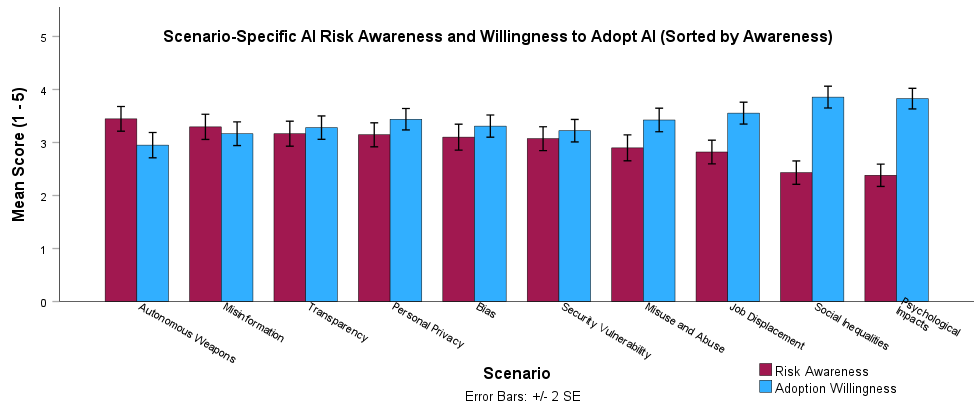
Figure 2: Higher risk assessment in scenarios consistently predicts lower AI adoption willingness across applications.
This empirical pattern mandates that AI risk education cannot remain domain-general; calibration between context-dependent risk appraisal and adoption intent is critical.
Technical Specialization and Gender Differences in Adoption
Both CS and DS/DA students reported not only higher explicit risk awareness but also—counterintuitively—higher willingness to adopt AI in applied scenarios. The “Other” group, with lower explicit awareness, were less willing adopters even when risk perception was matched. This suggests a confidence/overconfidence dynamic, consistent with literature on risk normalization and diminished harm salience among domain “insiders.”
Furthermore, while technical education closed gender disparities in explicit and scenario-based risk evaluation, it failed to equalize behavioral adoption willingness—male students consistently reported greater readiness to deploy AI systems.
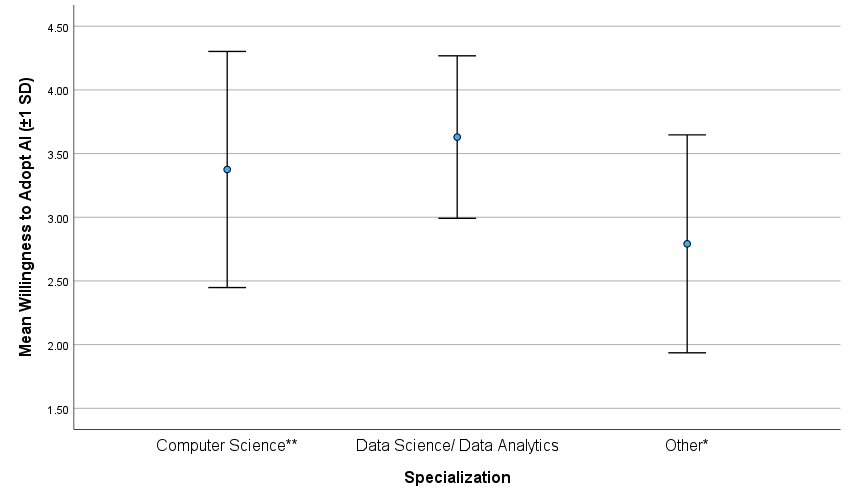
Figure 3: Technology majors, especially CS and DS/DA, report higher willingness to adopt AI in realistic application scenarios.
Explicit Risk Knowledge Outpaces Contextual Risk Recognition
Across nearly all risk domains, students’ stated concern for the abstractly labeled risk was significantly higher than recognition of the same risk when presented in applied, unlabeled format. This “missed transfer” effect was largest in domains such as psychological/cognitive impacts and social inequalities.
Implications for AI Education and Institutional Practice
The findings expose a systematic “awareness-action” divide in current AI literacy outcomes, particularly among technology majors. Domain familiarity heightens abstract awareness but is simultaneously associated with underappreciation of practical context risks and elevated adoption enthusiasm—an alignment with risk homeostasis and overconfidence models in technology acceptance, as observed in both AI and other high-reliability fields.
The study’s results suggest several prescriptive recommendations:
- Integration of scenario-based analysis: Curricular design should embed risk-identification tasks within realistic, unlabeled scenarios as a central feature, going beyond norm-driven, domain-general ethical discourse.
- Reflective behavioral calibration: Technical programs must foster not only awareness but also metacognitive reflection and calibration on the limits of expertise, counteracting overconfidence effects.
- Targeted interventions for group disparities: Persistence of adoption willingness gaps (notably by gender) indicates the necessity for psychological and sociocultural support structures alongside technical content.
- Cross-disciplinary AI literacy: Non-technical students require foundational exposure that demystifies AI and fosters confidence, avoiding both disengagement and uninformed skepticism.
- Institutional frameworks: Static, “one size fits all” AI ethics modules are insufficient; periodic, feedback-driven curriculum adaptation and cross-program scenario-based benchmarking are essential.
Theoretical implications extend to AI risk perception models, learning transfer research, and technology acceptance theory; the results empirically ground the argument that scenario salience, context-aware reasoning, and domain identity interlock in shaping real-world risk behavior.
Limitations and Future Research Directions
Generalizability is limited by single-institution sampling and relatively small non-technical comparators. Self-report further constrains inference on real-world adoption. Future work should employ longitudinal and experimental designs, performance-based assessments, and more diverse, larger samples—particularly targeting “Other” disciplines.
More granular mapping of the mechanisms underlying the expertise/adoption paradox—potentially involving trust calibration, uncertainty tolerance, and perceived controllability—will be critical for next-generation AI literacy research.
Conclusion
This study delineates a complex, sometimes contradictory picture of AI risk education in higher learning. While AI-focused students achieve high explicit risk literacy, this does not consistently convert to contextual harm recognition or calibrated adoption. Responsible AI education must thus pivot from didactic, content-centric paradigms to experiential, scenario-driven, and reflective designs—explicitly targeting transfer, behavioral calibration, and the nuanced interplay of specialization and gender. Such reforms are essential for aligning the technical advance of AI with socially responsible, risk-sensitive institutional practice.