- The paper establishes that optimal feedback control decouples measurement scheduling from physical actions, leveraging a POMDP reduced to an LQG framework.
- It demonstrates finite-time protocols where threshold-based measurements collapse belief variance, leading to phenomena like deadline-induced blindness and physical starvation.
- The study maps universal thermodynamic phase boundaries as a function of driving velocity and measurement cost, setting benchmarks for energy extraction in nanodevices.
The paper "Optimal Control of a Mesoscopic Information Engine" (2603.29804) rigorously addresses the finite-time optimal control problem in a minimal feedback-driven mesoscopic system: the overdamped Brownian particle confined in a harmonic optical trap, where information about the particle's position is costly to acquire. By formulating the engine as a discrete-time POMDP, it unifies the interplay between control and measurement into a single optimization task.
Key to the analytic tractability is the system's reduction to an LQG regime. Exploiting the linearity of system dynamics and the quadratic, measurement-independent form of extracted thermodynamic work, the paper demonstrates that the optimal measurement scheduling and optimal physical control decouple. The Riccati recurrence governing the physical cost is shown to reduce to a one-dimensional scalar iteration, circumventing the need for multidimensional dynamic programming typical of partial observability with control.
Finite-Time Optimal Protocols and Measurement Trigger
For a prescribed transport task (trap center from λ0=0 to λf over finite tf), the optimal feedback is expressed in closed form. The optimal trap position at time step k is
λk∗=μk++n(1−α)+1+α1(λf−μk+)
where μk+ is the controller's belief mean after possible measurement, n is the remaining steps, and α the relaxation factor. This protocol linearly interpolates between the real-time uncertainty-laden state estimate and the target, interpolated by an explicit time-to-deadline weighting.
Simulations verify that for binary, perfect measurements (cost C per measurement), the belief variance follows a sawtooth trajectory: passive diffusion grows uncertainty until a threshold triggers a costly measurement, instantly collapsing the variance, after which the process repeats. As the deadline approaches, the profit that could be extracted from further measurements decreases rapidly—a regime the paper terms "deadline-induced blindness," where all measurements halt since information is no longer energetically profitable.
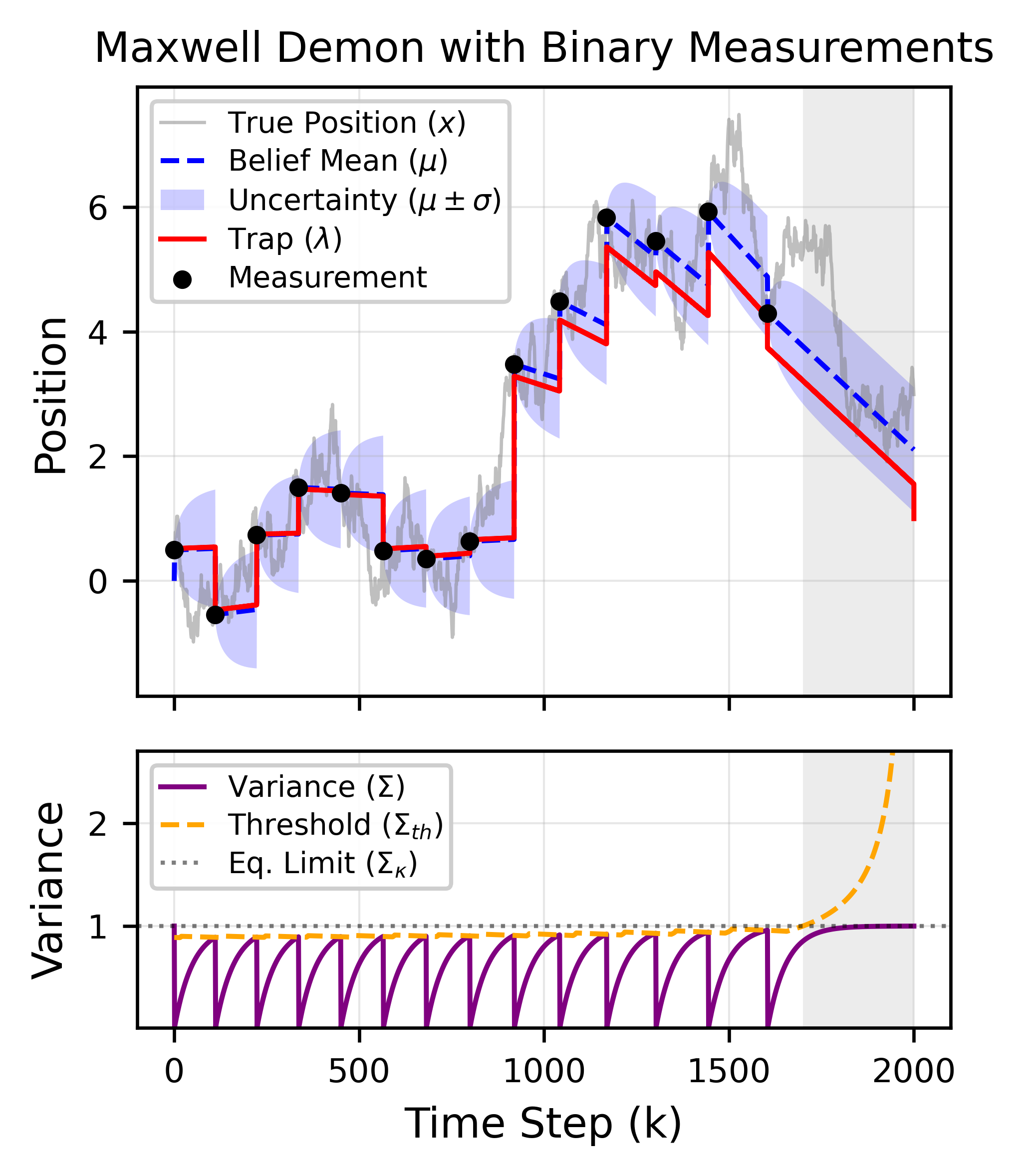
Figure 1: Finite-time trajectory of belief, trap, and measurements for binary sensor, with the emergence of deadline-induced blindness.
Optimal measurement scheduling thus corresponds to a threshold rule: observe if and only if the current belief variance exceeds a computable, time-dependent threshold Σth(n). The paper derives these thresholds, confirming that as the measurement cost approaches λf0, optimal operation ceases—"physical starvation." No control action can extract more energy than the information costs to acquire.
Steady-State Regimes and Phase Boundaries
In the infinite-horizon steady-state limit (λf1, λf2 at finite velocity λf3), the paper computes the global operational phase space as a function of velocity and measurement cost.
The optimal measurement frequency is periodic and derived as
λf4
where λf5 is the lower branch of the Lambert λf6 function. The active (net-positive) regime is mapped by comparing the maximal thermodynamic fluctuation-extraction power to the macroscopic viscous drag power, delineated analytically as the velocity envelope λf7. For each pair λf8, the measurement protocol (frequency) and net extractable power are explicitly computed.
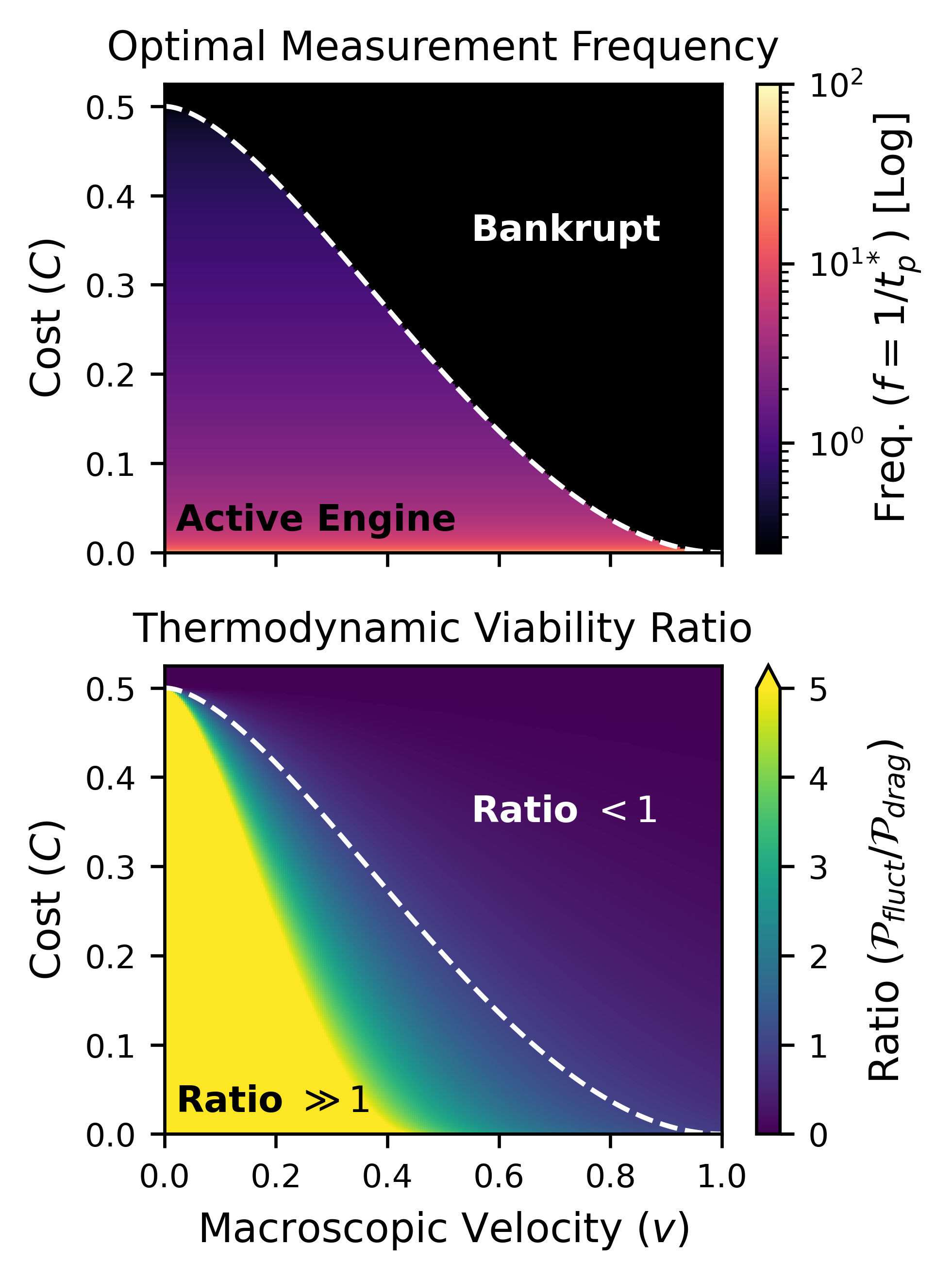
Figure 2: Thermodynamic phase diagrams for binary measurement engines: measurement frequency and viability as functions of driving velocity and cost.
Above λf9, measurements become energetically bankrupt at any protocol. At velocities exceeding tf0, the engine cannot overcome viscous drag even with zero measurement cost, resulting in a sharp operational boundary.
Generalizing beyond binary measurements, the analysis considers sensors with tunable measurement precision, where the cost (per step) scales with the attained variance reduction as tf1. Here, the optimal policy at each step is to set the posterior belief variance to a time-dependent target tf2 if the current prior exceeds this value, or do nothing otherwise.
For finite time, tf3 tracks a calculated optimal trajectory, but as the deadline approaches, the precision target diverges, and measurement is switched off—realizing a kinetic "deadline blindness."
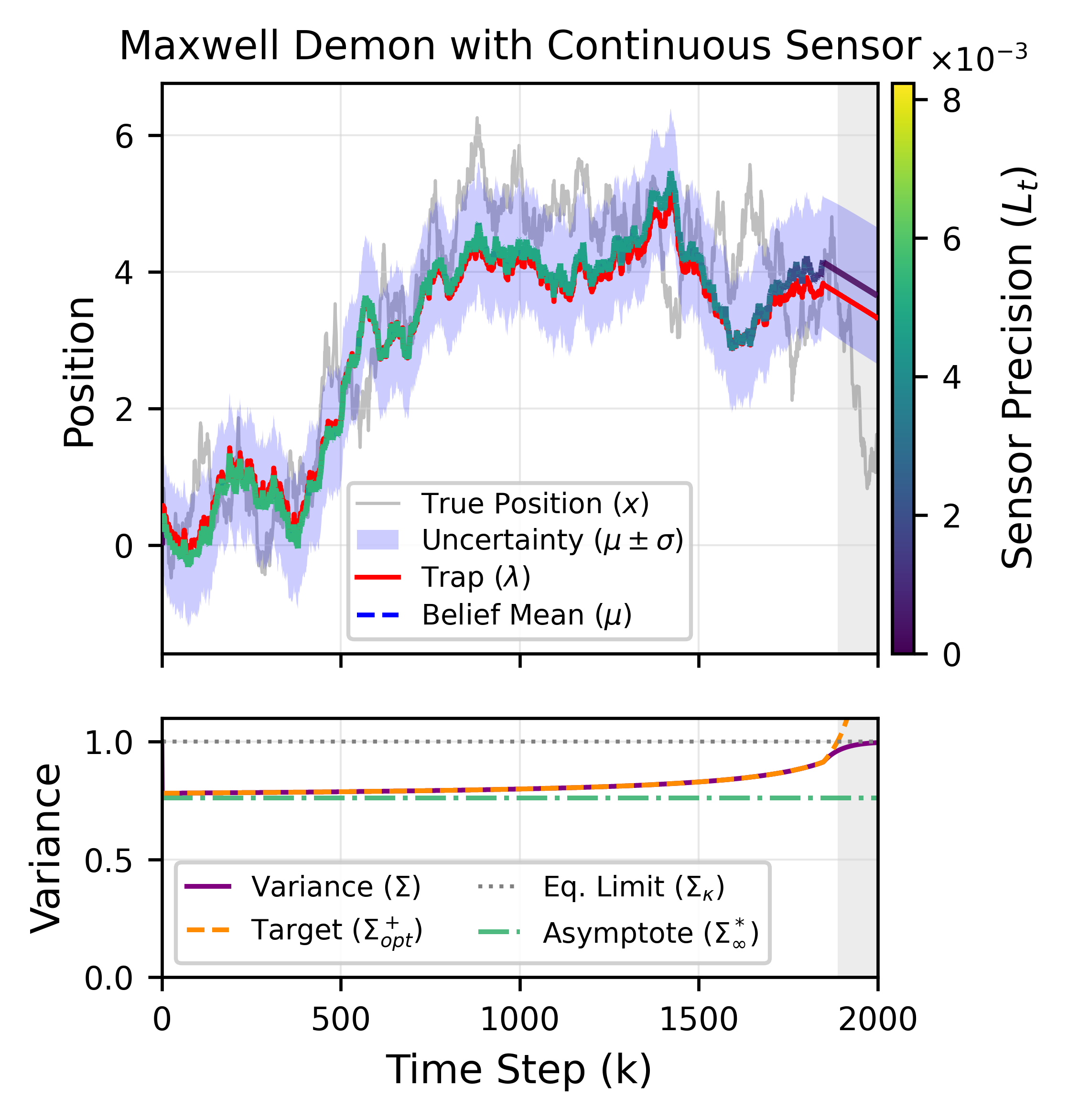
Figure 3: Trajectories under optimal continuous-precision measurement: belief mean, trap, and variance; continuous adjustment of measurement precision and regime shift to blindness.
In the steady-state, the measurement precision, Kalman gain, and measurement energy investment all lock into constant values set by a cubic equation relating them to cost. The analytical solution yields the optimal steady-state variance
tf4
and a fully explicit parametrization of the active phase boundary tf5, as a function of granularity cost and driving velocity.
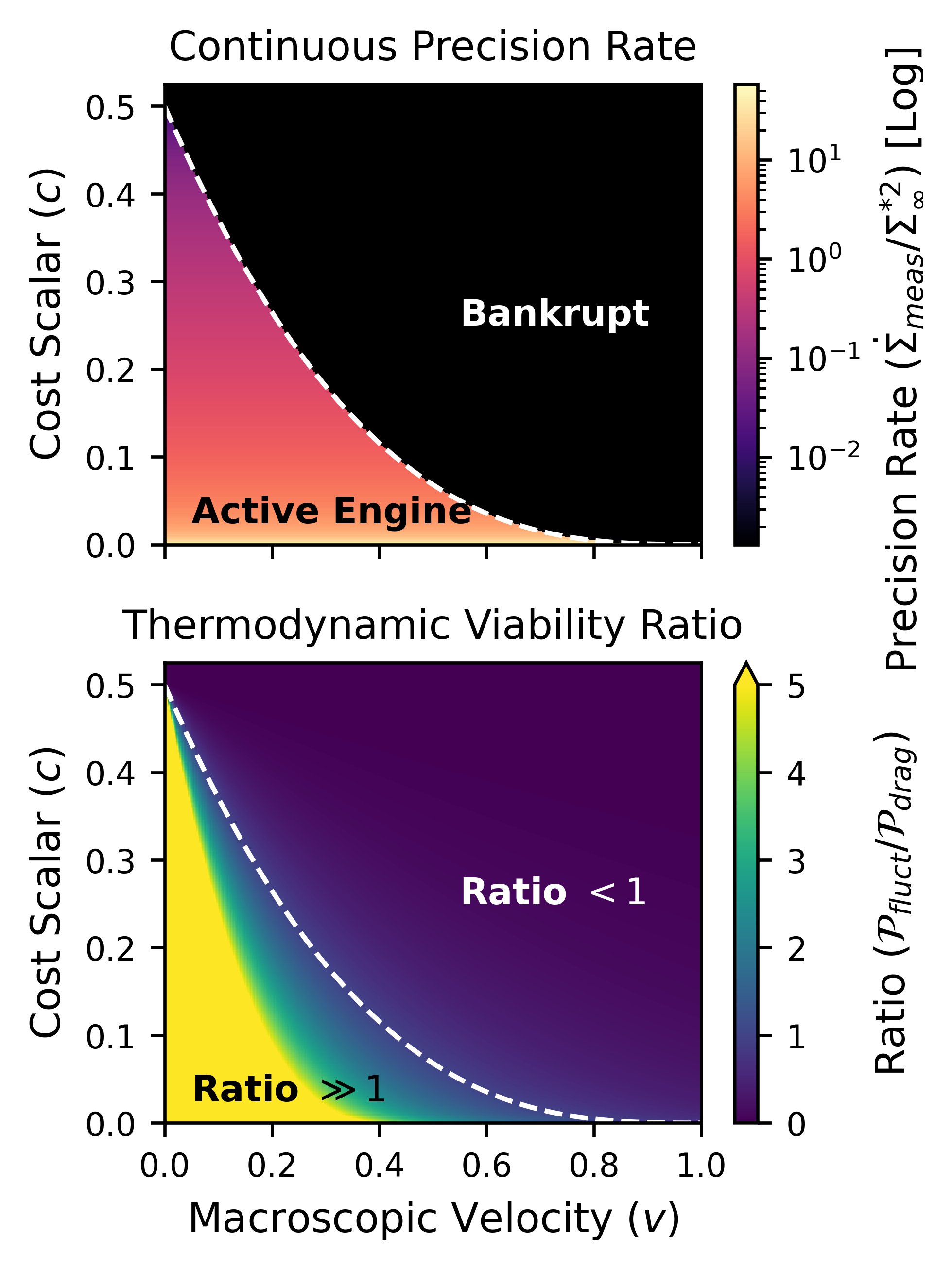
Figure 4: Steady-state phase space for variable-precision engine: precision rate and viability as a function of velocity and precision cost.
Notably, distinct from the binary sensor regime (periodic, non-constant uncertainty), the variable-precision sensor implements an "information thermostat:" measurement precision is constantly and minimally tuned such that the residual uncertainty precisely counterbalances thermal diffusion with the minimal energetic expenditure.
Fundamental Results, Implications, and Outlook
Several strong statements emerge:
- The optimal control and measurement scheduling for the POMDP in harmonic potentials decouple, enabling exact analytic solutions for finite-time, steady-state, and both discrete and continuous observation cost models.
- There exist universal thermodynamic phase boundaries for these mesoscopic engines. Operation—i.e., positive net energy extraction from fluctuations—is physically forbidden outside a sharply defined region in the tf6 parameter space, independent of measurement protocol sophistication.
- Deadline-induced blindness is a generic consequence of the decaying marginal value of information near protocol horizons, leading to a terminal cessation of measurements independent of their cost if the time-to-completion is sufficiently short.
- The analytical structure and operational boundaries derived here extend baseline results for mesoscopic engines, providing stringent benchmarks for any approximate or heuristic control/learning protocols. They also generalize previously known protocols, unifying open-loop, perfect-periodic, and fully continuous measurement regimes.
Practically, these insights set lower bounds on the energetic overhead for information-driven control of nanodevices, and theoretically they delineate the domain of validity of LQG/POMDP analytic solubility. Deviations—such as for anharmonic traps or non-Markovian (e.g., viscoelastic) baths—will break decoupling, requiring joint optimization and likely numerical solutions.
Conclusion
The analytic results obtained provide a rigorous foundation for understanding and benchmarking the thermodynamics of information-driven control at the mesoscale. The explicit phase boundaries, dynamic protocols, and modularity between control and measurement detail the ultimate limits and structure of classical information engines. Extensions to nonlinear, active, or non-Markovian systems constitute clear directions for future research, with the analytic framework here serving as a reference for the optimality gap in more complicated scenarios.

