- The paper introduces QTAM, a novel invertible CQT method that uses amplitude demodulation to separate signal envelopes from high-frequency carriers for lossless decimation.
- It achieves an order-of-magnitude compression and dramatic speedup while maintaining phase coherence and fidelity required for downstream ML and Bayesian analyses.
- The method improves gravitational wave signal denoising and disentanglement, enabling robust performance in real-time, GPU-accelerated, low-latency detection pipelines.
Introduction
QTAM (Q-Transform Amplitude Modulation) introduces a discrete, invertible implementation of the Constant-Q Transform (CQT) optimized for gravitational wave (GW) data analysis and scalable to next-generation observatories. Conventional overcomplete transforms provide shift-invariance yet result in redundant, voluminous data that hinders real-time low-latency analysis and efficient ML integration. Critically sampled transforms trade shift-invariance and morphological robustness for computational tractability, rendering them ill-suited for advanced TF feature extraction and ML applications.
QTAM bridges this dichotomy by leveraging AM demodulation to separate the slowly varying signal envelope from high-frequency carrier oscillations in CQT tiles. This enables lossless, aggressive decimation, effectively compressing the data volume to the true information density imposed by spectral bandwidth while preserving exact invertibility, linearity, and phase coherence required for downstream ML and time-domain analyses.
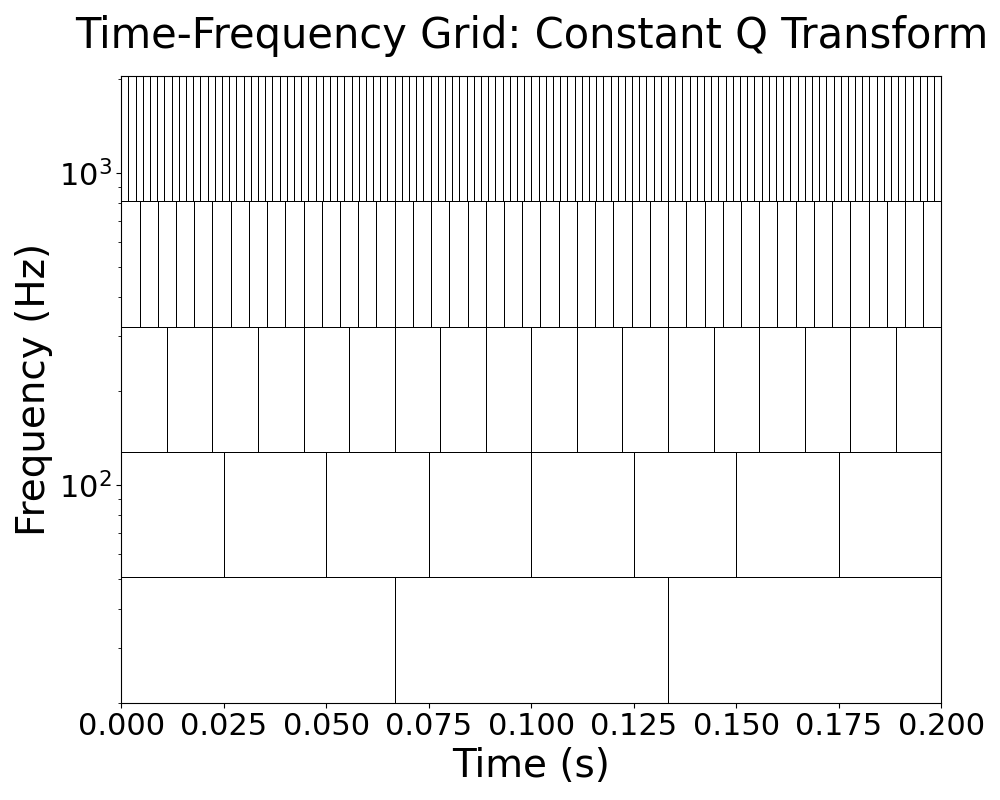
Figure 1: The TF plane on which the CQT is computed, showing geometrically tiled frequency bands, each with distinct temporal resolutions.
Mathematical Foundations and Algorithmic Design
CQT and Its Invertibility Constraints
The standard CQT convolves the input with windowed complex exponentials of geometrically progressing bandwidth, indexed by central frequency fk and Q-factor Q:
T(τ,fk,Q)=∫x(t)w(t−τ,fk,Q)e−2πifktdt
Despite suitability for chirping signal morphology localization, current implementations (GWpy, ml4gw) either discard complex phase or invoke lossy interpolation, precluding exact time-domain reconstruction. Only the Wavelet Q-transform (WQT) retains phase and enables reconstruction via specialized inversion, yet at prohibitive computational cost due to redundancy and lack of modern vectorization.
Spectral Demodulation: The QTAM Solution
QTAM exploits the fact that each CQT coefficient consists of a slow-varying envelope modulated by a deterministic high-frequency carrier:
Tk(t)=Yk(t)⋅ej2πfkt
Rather than retaining the carrier, which dictates a high sampling rate (≳2fk by Nyquist), QTAM circularly shifts each CQT channel to baseband, compressing its support to its intrinsic bandwidth. This transformation is both energy-preserving and reversible, enabling lossless downsampling and minimal-volume representations.
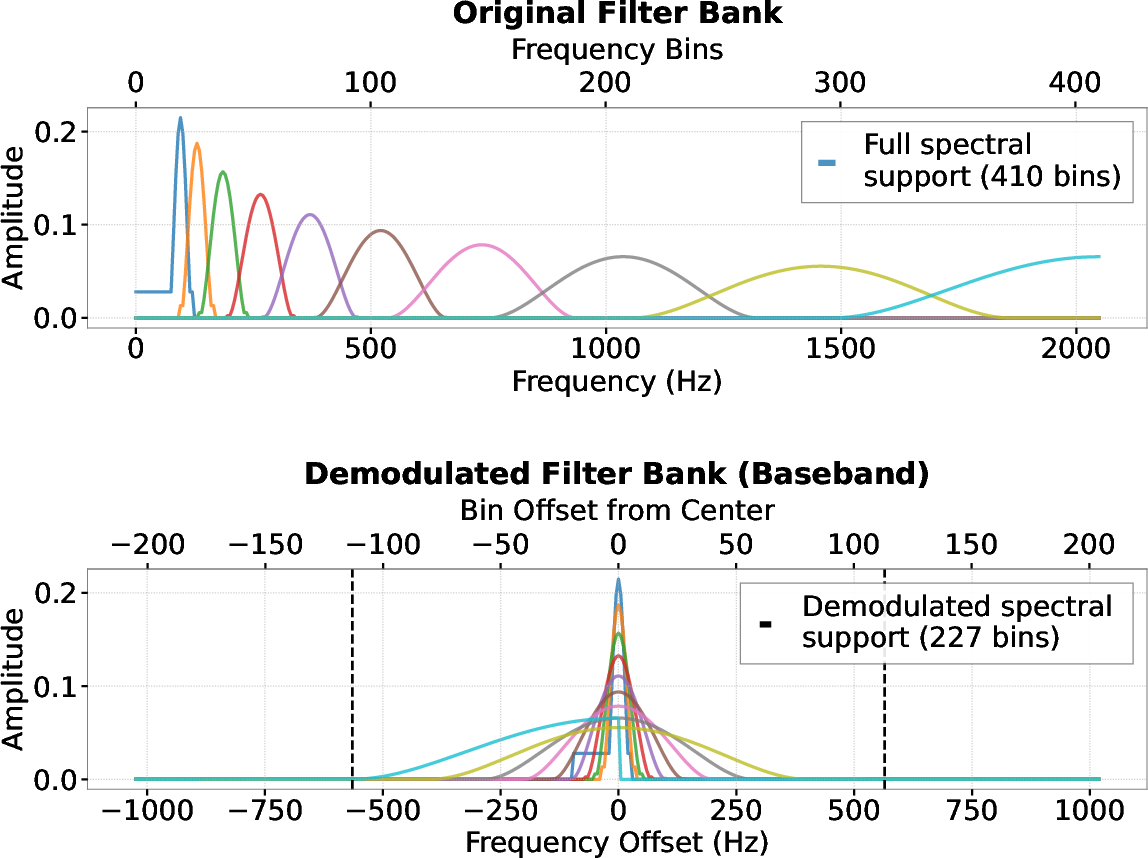
Figure 2: Spectral demodulation schematic. Top: standard carrier-centered CQT filterbanks with wide spectral support. Bottom: carrier offset removed, compressing spectral support to true signal bandwidth for lossless decimation.
Output compression is quantitatively dramatic; temporal resolution for each channel is reduced to the minimum consistent with its bandwidth, resulting in matrices an order of magnitude smaller with negligible (O(10−14)) reconstruction error.
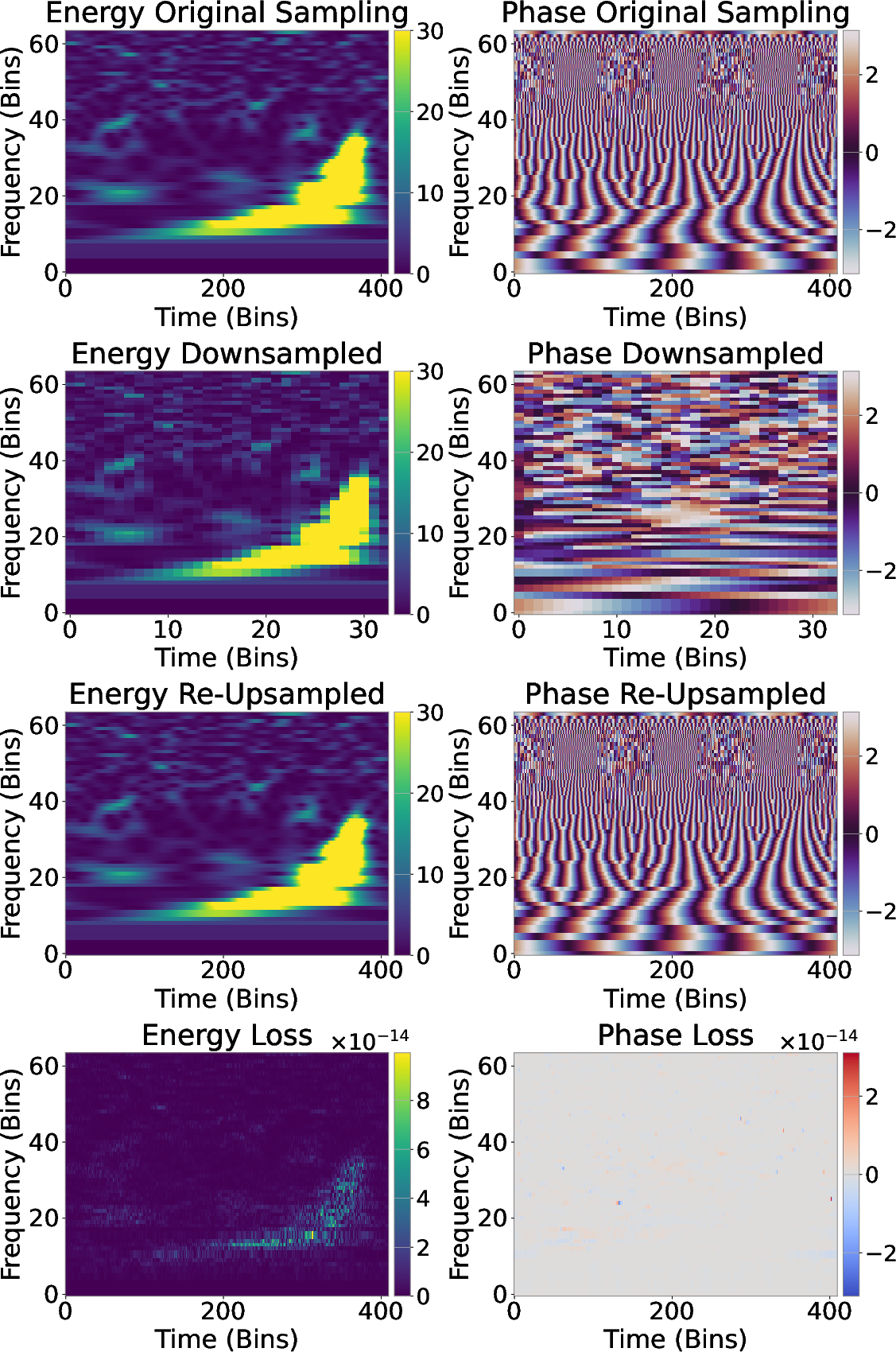
Figure 3: Information preservation post-compression. Compressed (64×33) representations reconstruct the original (64×410) CQT to numerical precision.
Inversion and Frame-Theoretic Guarantees
Invertibility is rigorously established via discrete frame theory. Provided the window family spectrally covers the input bandwidth without gaps, perfect reconstruction is achieved through canonical dual frame synthesis:
x[n]=F−1{∑k∣W~k[f]∣2∑kT~k[f]W~k∗[f]}
The demodulation and downsampling steps are unitary and preserve frame invertibility, unlike classic magnitude/interpolation-based compressions which irreversibly modify the frame operator.
QTAM is implemented as a fully differentiable PyTorch module, enabling efficient batch vectorization and exploiting both GPU and CPU resources. Window shapes (Bisquare, Tukey, Kaiser, Planck-taper) and frequency tiling are fully configurable. Hybrid operation (CQT at low, STFT at high frequencies) maximizes spectral coverage and sampling rate constraints.
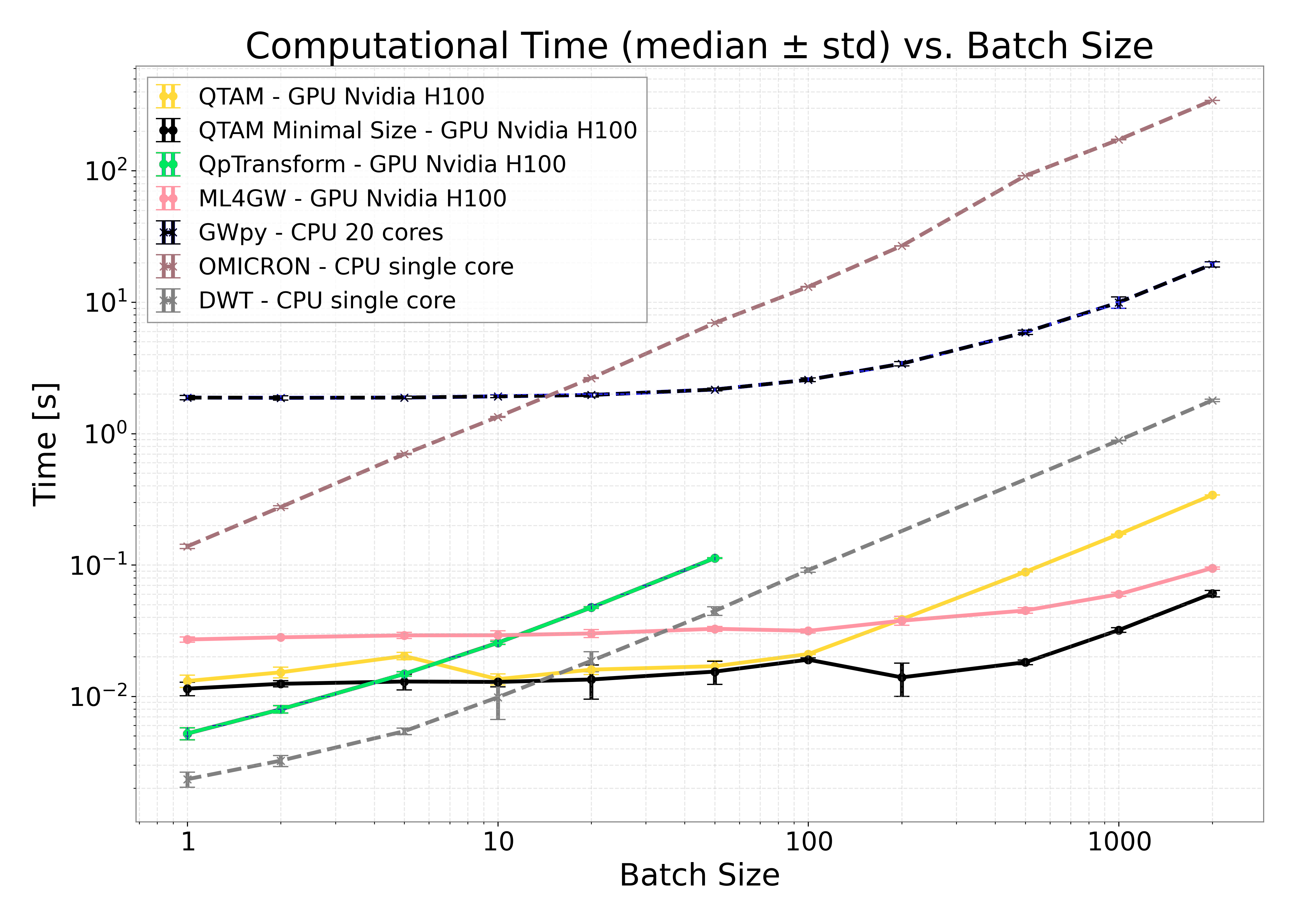
Figure 4: GPU benchmarking: QTAM achieves median processing an order of magnitude faster than Omicron, GWpy, and WQT, meeting low-latency batch throughput requirements for next-generation GW pipelines.
Empirical Validation and Application
Fidelity Under Compression and Inversion
Tests on GW150914 in Hanford data demonstrate that even under a 12× compression factor, time-domain reconstructions yield residuals indistinguishable from machine precision.
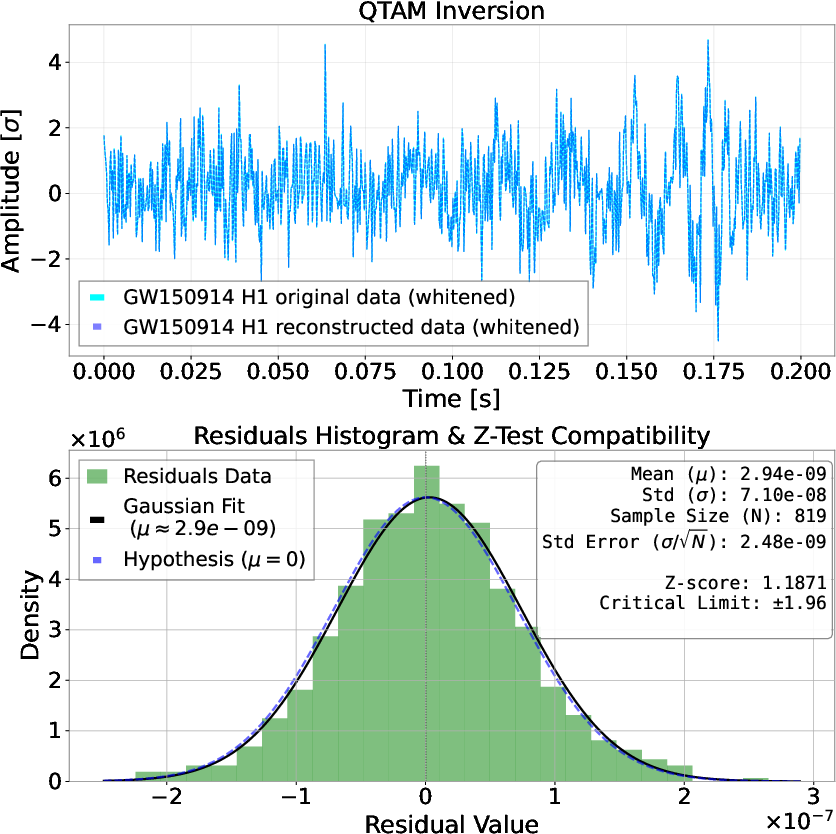
Figure 5: Overlay of original and QTAM-inverted GW150914 data; residuals are Gaussian with Q0.
Enhanced Physical Interpretability
Phase demodulation directly exposes the instantaneous frequency content of chirping signals, explicitly revealing physical morphology in a compressed baseband representation—beneficial for downstream ML interpretability and robust feature extraction.
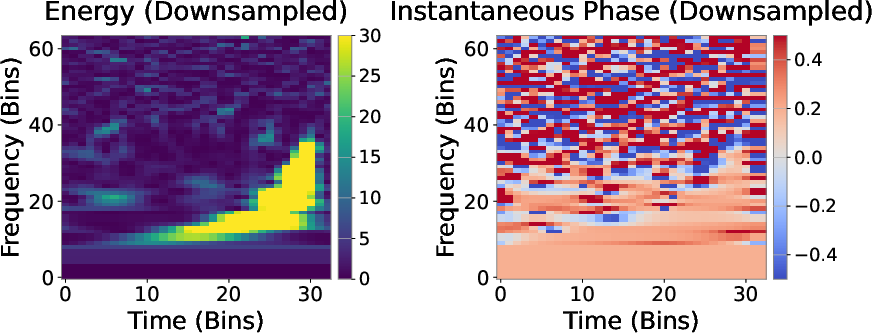
Figure 6: Baseband energy and instantaneous frequency of GW150914; demodulation removes carrier, clarifying chirp structure.
GW Signal Denoising and Disentanglement
Overlapping astrophysical and instrumental events, especially in third-generation data with higher event rates and longer durations, require TF-based separation. QTAM delivers robust denoising and signal disentanglement by clustering in TF space, masking coherent regions, and applying invertible synthesis.
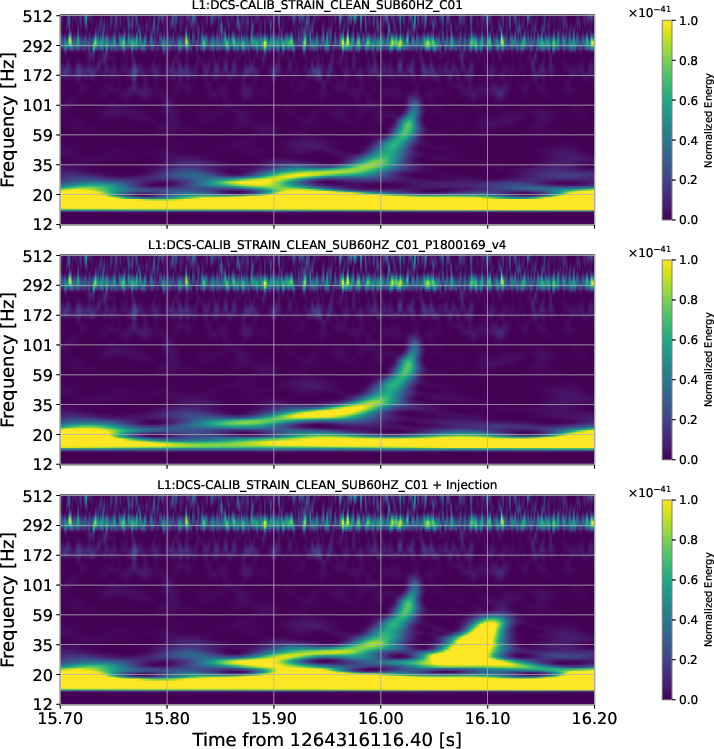
Figure 7: Q-TF spectrograms of GW200129_065458 event: raw, glitch-cleaned, and signal-injected views for benchmarking.
In evaluating overlapping signals and glitches (e.g., GW200129_065458) with synthetic injections, QTAM-based masking and inversion accurately recover target signals (Pearson Q1) even under severe glitches.
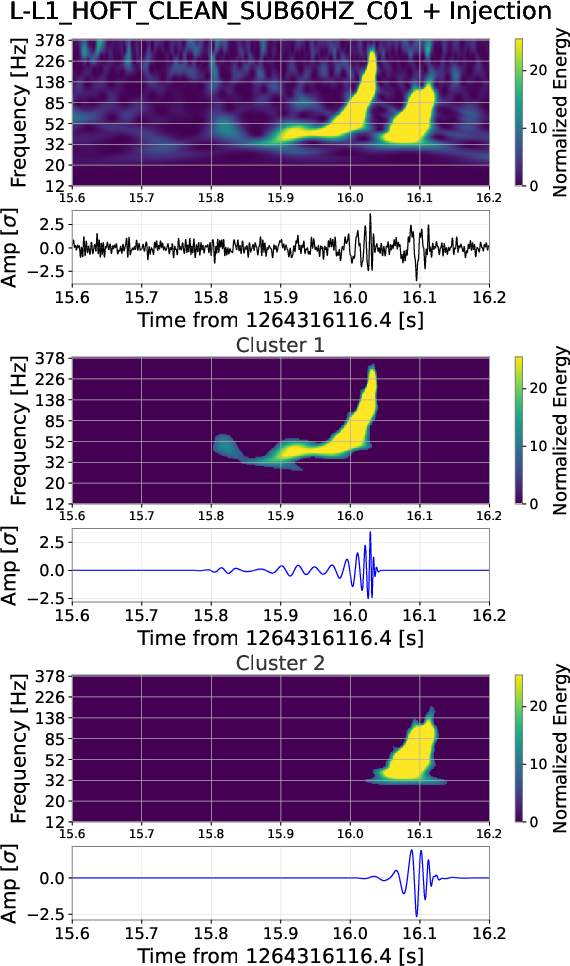
Figure 8: Attention clustering and inversion yield time-localized reconstructions for each TF-identified event.
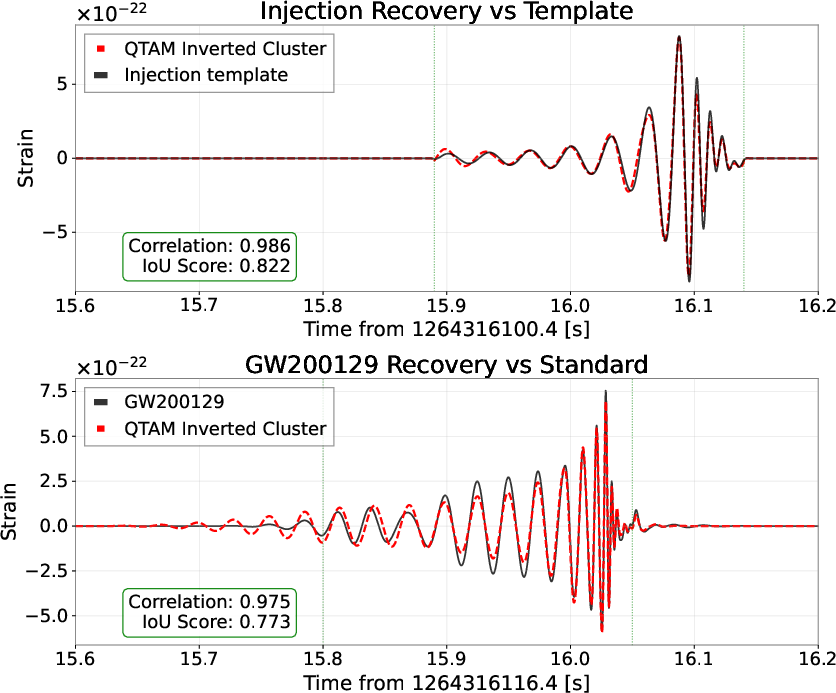
Figure 9: Top: injected vs. recovered waveform with high fidelity; Bottom: comparison of real event recovery under different denoising methods.
Implications for Bayesian Inference
Comprehensive Bayesian parameter estimation across data treatments—raw, BayesWave-cleaned, QTAM, and BW+QTAM hybrid—indicates that QTAM reconstructions maintain intrinsic parameter consistency and phase coherence. Notably, hybrid BW+QTAM narrowing of posteriors (by Q2) demonstrates improved precision with minimal bias, even for parameters most sensitive to phase errors (e.g., Q3, sky localization).
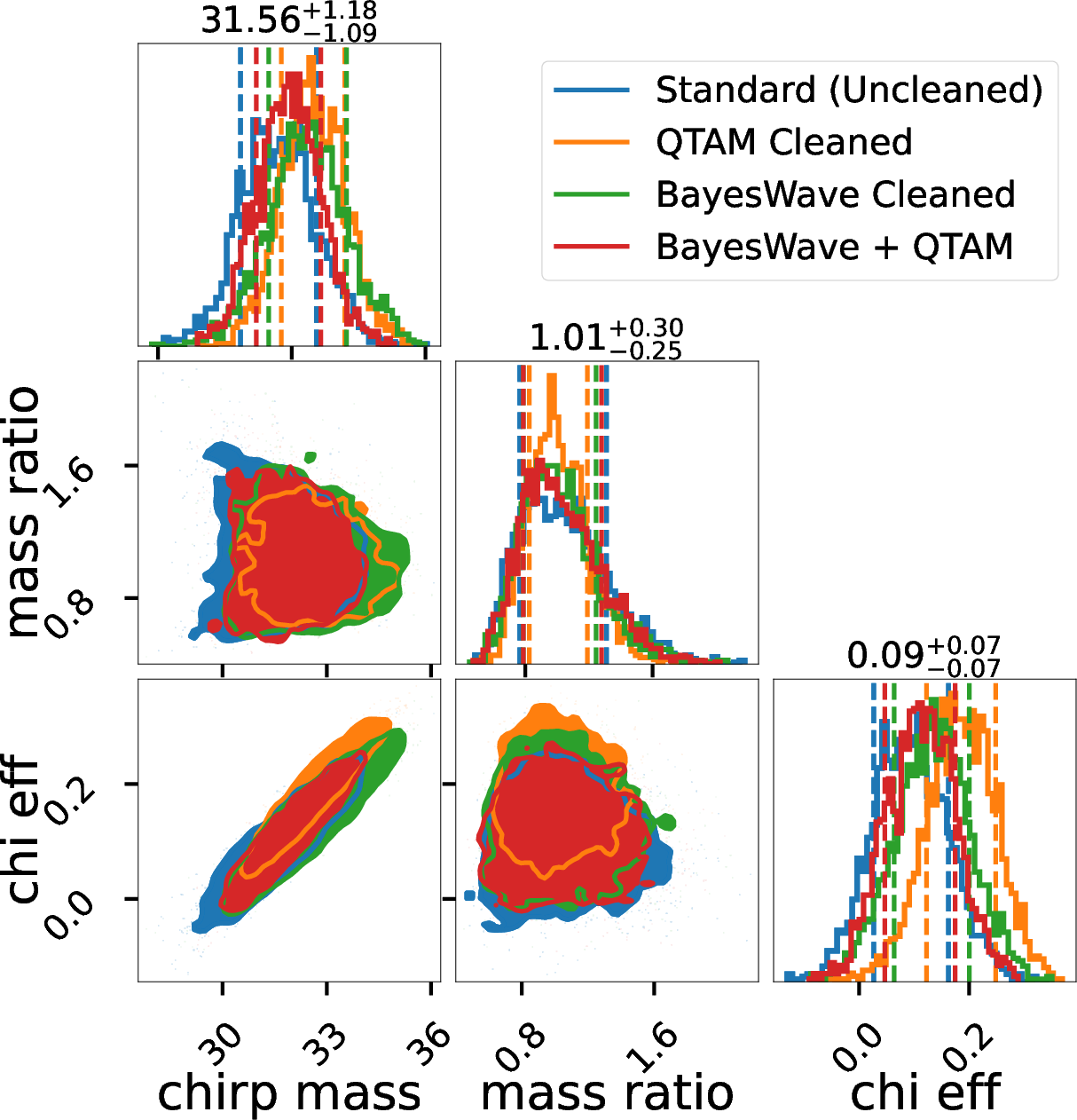
Figure 10: Posterior distributions for binary black hole intrinsic parameters—QTAM recovers clean, overlapping posteriors.
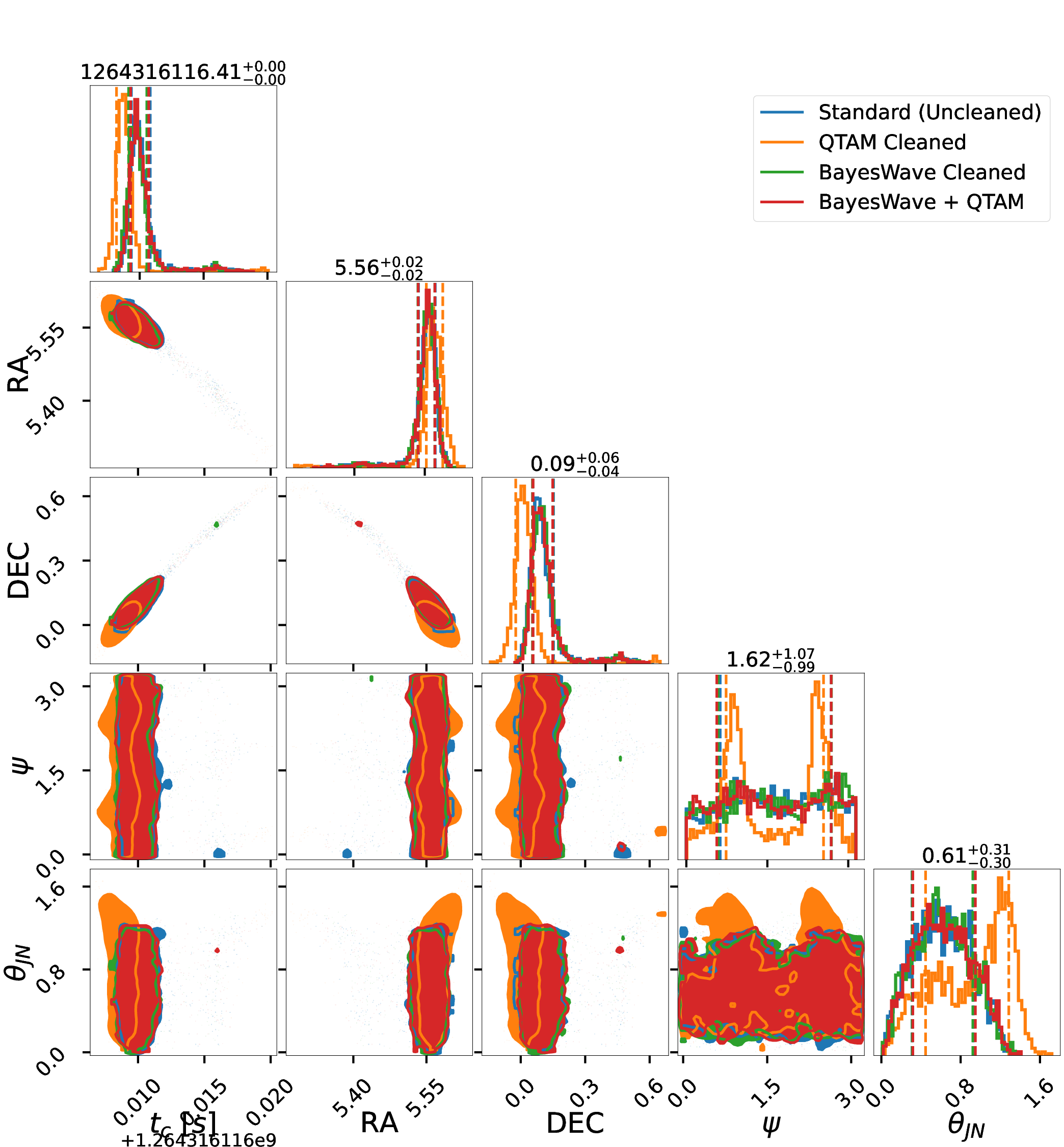
Figure 11: Posterior distributions for extrinsic parameters—QTAM and BW+QTAM yield narrower, consistent localizations.
Theoretical and Practical Implications
QTAM provides an AM-based demodulation approach that resolves the trade-off between representational fidelity, phase preservation, and computational tractability. This enables lossless compression compatible with real-time GPU-accelerated inference, offering shift-invariance and high morphological fidelity for ML models—particularly relevant in the upcoming era of ultra-high-throughput GW detectors with overlapping, long-duration signals and complex noise environments.
Integrating QTAM with established, signal-agnostic denoising methods (e.g., BayesWave) delivers superior joint performance, suggesting that hybrid architectures—combining precise TF morphological selection with robust statistical models—will underpin future real-time GW detection and parameter estimation pipelines.
Conclusion
QTAM establishes a rigorously invertible, computationally efficient, and phase-coherent CQT variant tailored to the demands of GW data analysis and ML pipelines. Its demodulation and decimation paradigm achieves order-of-magnitude compression and speedup over existing solutions, enabling full utilization of overcomplete TF representations in practical low-latency workflows. The applicability to denoising, TF disentanglement, and unbiased parameter estimation establishes QTAM as a foundational component for third-generation astrophysical GW analysis and AI-based detection pipelines.
Further research will focus on the development of advanced, robust TF clustering strategies and systematic integration into ML-driven joint inference frameworks in preparation for high event rate, high overlap detection regimes.

