- The paper demonstrates that QCD-induced little inflation via chiral density wave phases fails to generate sufficient latent heat for viable baryon dilution and gravitational wave signals.
- It employs a nucleon-meson effective field theory to model the emergence and stability of inhomogeneous CDW phases in the high baryon density region of the QCD phase diagram.
- The findings challenge the feasibility of explaining PTA-scale gravitational waves solely with standard QCD transitions, suggesting a need for new physics or additional mechanisms.
Revisiting the Cosmological Implications of the QCD-Induced "Little Inflation" Scenario with Chiral Density Wave Phases
Introduction and Motivation
The paper "Revisiting QCD-induced little inflation with chiral density wave state and its implications on pulsar timing array gravitational-wave signals" (2603.29772) rigorously examines the feasibility of the "little inflation" scenario induced by QCD phase transitions in the early Universe, particularly focusing on its potential to generate observable nanohertz stochastic gravitational wave (GW) signals as detected by pulsar timing array (PTA) collaborations. The work addresses the inherent tension in reconciling the requirements for strong supercooling during a first-order QCD phase transition with established features of QCD thermodynamics, given robust lattice and heavy-ion data that favor a crossover or, at moderate chemical potential, a critical end point (CEP) structure.
The analysis breaks new ground by explicitly studying the role of inhomogeneous QCD phases, specifically the chiral density wave (CDW) phase, in the cosmological context. The CDW phase is characterized by spatially modulated chiral condensates, and may emerge at high baryon chemical potentials (μB) and low temperatures, an area notoriously inaccessible to lattice QCD due to the sign problem.
The Little Inflation Scenario and Its Challenges
The "little inflation" model posits an early Universe with an anomalously large pre-transition baryon-to-photon ratio, followed by a period of strong supercooling and a first-order QCD transition, during which latent heat release generates both observable GWs (PTA-scale) and a large entropy dilution, producing the observed small baryon asymmetry. Quantitative implementation of this mechanism requires:
- Strongly first-order QCD transition at substantial μB, persisting down to extremely low T and μB, to achieve the necessary dilution of baryon number.
- Survival of a metastable high-density phase (supercooling) over many Hubble times.
- Sizable latent heat production to reheat the Universe post-transition.
The paper demonstrates, by explicit calculation, that in conventional homogeneous QCD transition scenarios, these conditions are incompatible with the established QCD phase structure. The location of the CEP at μB/T≳2 (supported by lattice QCD and heavy-ion constraints) precludes the persistent barrier required for extensive supercooling. This is illustrated in the schematic (T,μB) phase diagram presented in (Figure 1).
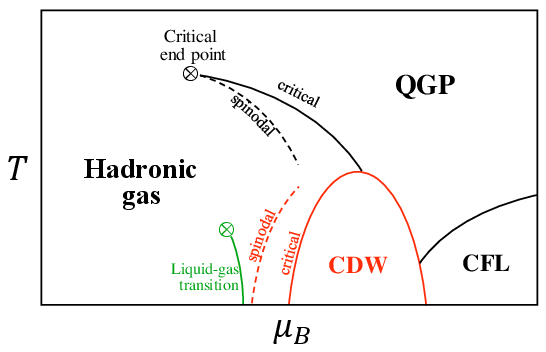
Figure 1: The schematic QCD phase diagram in the T−μB plane proposed in this work.
Modeling the Chiral Density Wave Phase
To investigate whether exotic phase structure can circumvent this limitation, the authors employ a nucleon-meson effective field theory with isoscalar vector mesons, calibrated to empirical nuclear matter properties but with some parameter freedom. The CDW phase is modeled via a spatially modulated ansatz for the scalar and pseudoscalar meson mean fields: σ(x)=ϕcos(2q⋅x),π3(x)=ϕsin(2q⋅x),
with ϕ and q=∣q∣ the order parameters. Thermodynamic equilibria (minimization of the grand potential μB0) at fixed μB1 determine stability and metastability regions.
The key theoretical result is that for large enough nucleon effective mass at saturation (μB2) and strong vector-meson self-interaction, the CDW phase persists to lower μB3 and μB4, potentially supporting the required supercooling. The energetic structure of the potential and the location of metastable minima are summarized by representative contour maps and reduced potential analyses:
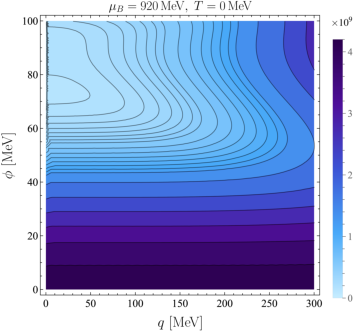
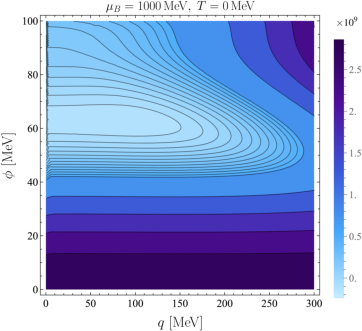
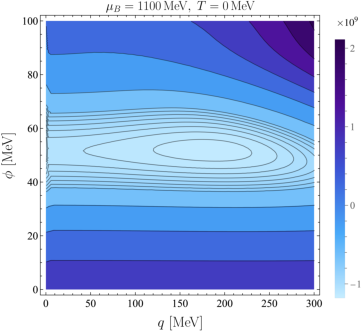
Figure 2: Contour plots of the thermodynamic potential μB5 in the μB6 plane illustrate emergence of local minima at nonzero μB7 signaling CDW formation.
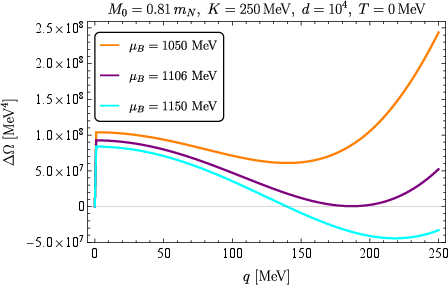
Figure 3: The reduced effective potential μB8 versus μB9 for different T0; the formation and disappearance of the CDW minimum with growing T1 is apparent.
Phase Diagram and Transition Structure
Mapping out the T2 phase diagram, the authors determine the locations of critical and spinodal lines for the CDW phase. CDW stability at low T3 and high T4 is enhanced by the isoscalar vector meson term. However, as temperature increases, the CDW domain shrinks; increasing T5 (vector-meson quartic self-coupling) widens the CDW region, but physical parameter values are needed for nuclear matter consistency.
Notably, the CDW phase transitions to the homogeneous chiral condensate (hadronic phase) via a first-order line that, for some parameter choices, approaches the nuclear liquid-gas transition at low T6. The phase structure is depicted in (Figure 4) and (Figure 5):
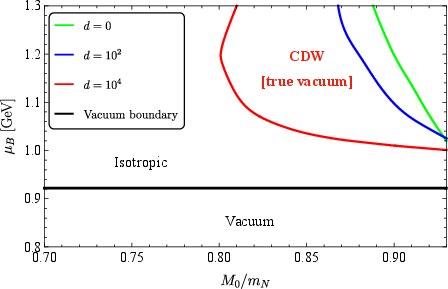
Figure 4: Zero-temperature CDW stability region as a function of T7 and T8; increasing T9 expands the stable/metastable region.
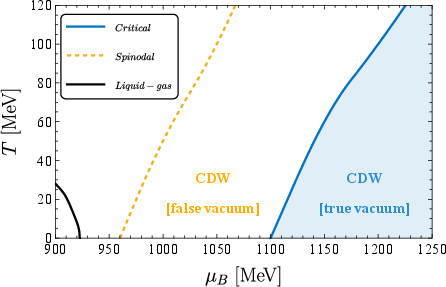
Figure 5: Phase diagram in μB0, showing the CDW, liquid-gas, critical, and spinodal boundaries; the CDW phase can be metastable down to near the onset of nuclear matter.
Implications for Cosmology and Gravitational Waves
Despite the existence of a metastable CDW phase with a sizeable region of supercooling, the critical factor is the amount of latent heat released during the CDWμB1hadronic transition. The analysis reveals that, due to the nature of the nuclear liquid-gas transition, supercooling dilutes the baryon number, but the entropy injection from the latent heat is either insufficient or occurs at such low μB2 that it is incompatible with Big Bang Nucleosynthesis (BBN) and CMB constraints.
The paper reports that the quantitative baryon dilution and GW energy release are too small: "the released latent heat is too small to realize a viable QCD-induced little inflation scenario and its associated PTA-scale gravitational-wave signal." Consequently, the final post-transition temperature required to deliver the observed baryon-to-photon ratio is below the eV scale—orders of magnitude too low for cosmological viability.
This result undermines the association of QCD-driven first-order transitions—even when including inhomogeneous CDW phases—with the PTA GW signal. Even more, scenarios invoking further dilution mechanisms (e.g., early matter domination) would also suppress the GW signal, leaving little motivation for explaining the nano-hertz stochastic background with QCD physics.
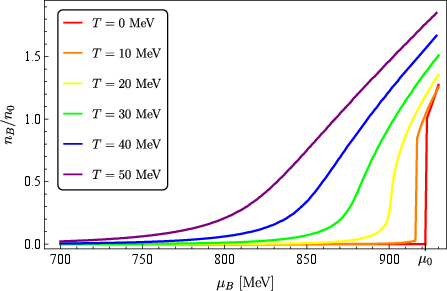
Figure 6: Baryon number density μB3 as a function of chemical potential for different temperatures, showing the first-order nature of the nuclear liquid-gas transition at low μB4.
Conclusion
The results provide a comprehensive, model-based constraint on the possibility of realizing "little inflation" via QCD phase transitions, whether homogeneous or mediated by CDW order. Theoretical exploration of parameter space, including nonstandard values for the nucleon effective mass and vector-meson interactions, demonstrates that even maximally supercooled inhomogeneous QCD matter fails to generate the required entropy or GW signature without conflicting with cosmological data.
Practical implications are clear: explanations for PTA-scale GW backgrounds cannot rely solely on first-order QCD transitions, at least within the Standard Model and physically motivated parameter regimes. Theoretically, while the presence of CDW-like structures remains a possible feature at high baryon density, their cosmological impact is fundamentally limited. Future progress may require either new fundamental sectors or more exotic QCD phases beyond those considered here.
Outlook
Progress in this area will likely need new theoretical input, possibly from improved lattice simulations at finite density, phenomenological modeling with more general order parameter structures, or entirely new physics beyond the Standard Model. To account for the observed PTA GW background, scenarios involving cosmic strings, domain walls, or physics operating at energy scales and phase structures unrelated to QCD should be further scrutinized.
References
- (2603.29772): "Revisiting QCD-induced little inflation with chiral density wave state and its implications on pulsar timing array gravitational-wave signals"

