- The paper introduces a continuum of Lq-norm tests that detect nonzero alphas in high-dimensional pricing models, blending performance between dense and sparse alternatives.
- It develops explicit asymptotic variance expressions and finite-sample corrections to ensure accurate calibration even under weak cross-sectional dependencies.
- An adaptive Cauchy combination test is proposed, demonstrating near-optimal power across different sparsity regimes in both simulation studies and empirical CAPM analysis.
High-Dimensional Alpha Testing for Linear Factor Pricing Models Using Lq-Norms
Introduction and Motivation
This work introduces an adaptive framework for hypothesis testing in high-dimensional linear factor pricing models, focusing on the presence of nonzero pricing errors (alphas) when the cross-sectional asset dimension N is large and potentially exceeds the time dimension T—a regime characteristic of modern empirical finance. The paper reformulates the classical alpha test as a global hypothesis test on the intercept vector α in models such as the CAPM and APT, with H0:α=0.
Conventional methodologies, including the GRS test and average t-statistics, become unreliable as N increases due to covariance matrix estimation instability. Recent approaches tailored for high-dimensions typically deploy L2-type (quadratic/sum-of-squares) or L∞-type (maximum) test statistics, each being optimal in distinct sparsity regimes. However, the actual sparsity of mispricing signals in empirical settings is unknown, motivating robust tests capable of power enhancement across a continuum of alternatives.
Methodological Innovations
Lq-Norm Test Family
The central innovation is a continuum of tests indexed by an even integer N0, interpolating between dense (N1) and ultra-sparse (N2) alternatives. The N3-statistic is defined via standardized OLS intercept estimates: N4
where N5 is the studentized intercept and N6 is the N7-th central moment of a N8-distribution. For N9, the corresponding T0, T1, and T2 statistics capture deviations due to alternative sparsity levels.
The authors derive asymptotic normality and explicit variance expressions for these statistics under general weak cross-sectional dependence, leveraging independent component models (ICM) for idiosyncratic errors. Finite-sample variance corrections are provided to ensure calibration accuracy.
Adaptive Test Combination via Cauchy Aggregation
A key theoretical result is the asymptotic independence between T3 (max-type extreme value) and the finite-T4 T5 statistics under the null, enabling the construction of combination rules. The paper proposes a four-way Cauchy combination test (CC), which aggregates T6-values from T7, T8, T9, and α0, producing a test with null distribution approximated by the standard Cauchy law: α1
This mechanism adaptively borrows power from whichever underlying test is optimal for the unknown sparsity pattern.
Power Analysis
Analytic power calculations show that, for dense signal alternatives, the α2 statistic is optimal; as sparsity increases, α3 and then α4 increase in relative power, overtaking α5 in extreme sparsity. The Cauchy combination is numerically demonstrated to maintain maximal or near-maximal power across all regimes.
Simulation Results
A comprehensive simulation study considers realistic factor structures, latent omitted factors, heavy-tailed idiosyncratic errors, and spatial cross-sectional dependence. Nominal Type I error rates are well-maintained across all six methods (α6, α7, α8, α9, minP, and CC), and the power investigation substantiates the theoretical power ordering:
- Very sparse alternatives: H0:α=00 and H0:α=01 deliver highest power.
- Moderate sparsity: H0:α=02 and the Cauchy combination are most competitive.
- Dense alternatives: H0:α=03 dominates.
Notably, the adaptive Cauchy combination test achieves close-to-optimal power throughout, with a marked advantage over the minP rule in moderately sparse regimes.
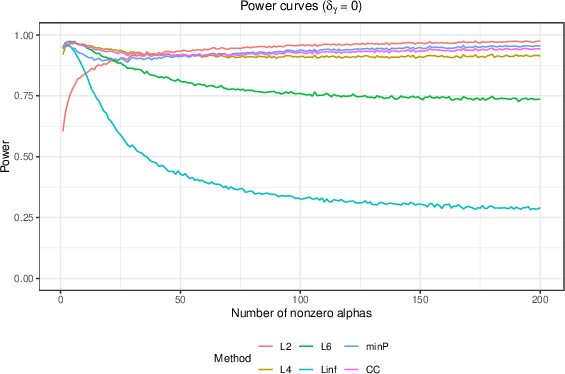
Figure 1: Power curves of six methods with H0:α=04 and H0:α=05.
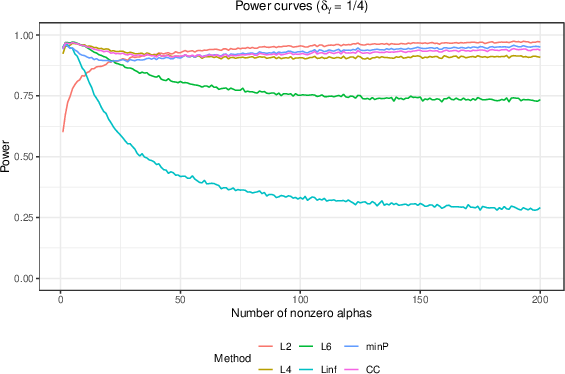
Figure 2: Power curves of six methods with H0:α=06 and H0:α=07.
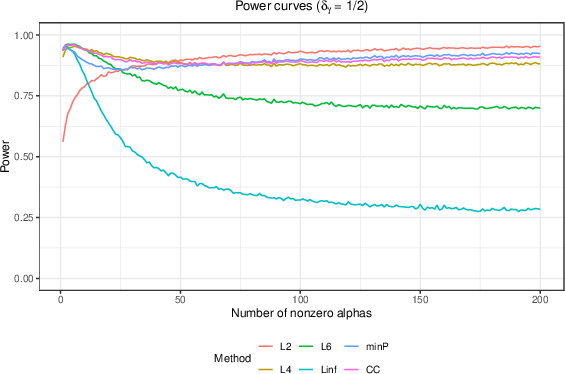
Figure 3: Power curves of six methods with H0:α=08 and H0:α=09.
Empirical Application: CAPM on S&P 500
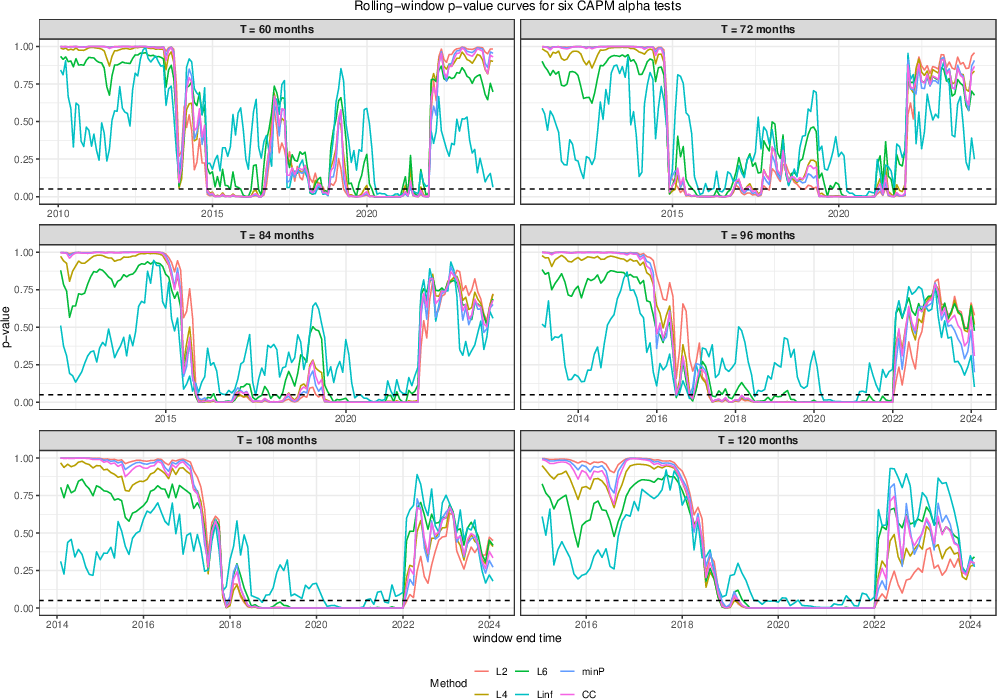
The empirical study applies these tests to time-rolling CAPM regressions for S&P 500 constituents, using a roughly 20-year monthly panel. Rolling-window t0-value paths reveal:
Implications and Future Directions
The main practical implication is that practitioners in high-dimensional asset pricing environments should favor t5-based or combination procedures over single-regime statistics. The t6-test, in particular, emerges as a robust, non-combinatorial option.
From a theoretical perspective, the framework suggests that critical value calibration for global testing in high dimensions can be greatly enhanced by leveraging norm-indexed test statistics with adaptive combination methodology, without intensive resampling or reliance on parametric sparsity assumptions.
Future research avenues include extending this framework to temporally dependent observations and conditional factor models with time-varying loadings and risk premia, which are characteristic of dynamic financial markets.
Conclusion
This paper provides a comprehensive, rigorously justified, and empirically validated foundation for high-dimensional alpha testing in linear factor pricing models using a unified t7-norm-based methodology and adaptive combination tests. The approach offers substantial improvements in robustness and power across unknown alternative regimes, establishing new best practices for econometric asset pricing hypothesis testing (2603.29764).