- The paper introduces a driven dressed master equation that systematically incorporates the driving phase into the system-bath interaction for accurate nonequilibrium energy transport predictions.
- It benchmarks the dDME against both Floquet and traditional master equations, showing quantitative agreement in models like the spin-boson and Kerr resonator.
- The study demonstrates how tuning drive parameters can enhance energy currents, reverse current direction, and reveal nonlinear suppression effects in quantum transport.
Nonequilibrium Energy Transport in Driven-Dissipative Quantum Systems
Introduction
The paper "Nonequilibrium energy transport in driven-dissipative quantum systems" (2603.29754) addresses a persistent challenge in quantum thermodynamics: the accurate and efficient description of energy transport in open quantum systems subject to both coherent periodic driving and thermodynamic bias. Traditional quantum master equation (QME) formalisms often omit the explicit effect of the driving phase within system-bath coupling, which can lead to erroneous or qualitatively misleading predictions for nonequilibrium steady states, especially near resonance and in the presence of strong driving.
This work introduces a driven dressed master equation (dDME), derived within the rotating frame, which systematically incorporates the phase and frequency of the drive into the system-bath interaction. The approach is benchmarked against numerically exact Floquet master equations (FME) and contrasted with conventional phenomenological master equations. Theoretical implications are established through its application to several paradigmatic models—most notably the nonequilibrium spin-boson model, a two-qubit coupled system, and the Kerr resonator—all relevant for quantum thermodynamic engines, quantum information processors, and engineered quantum materials.
The starting point is a generic quantum system subject to periodic driving, coupled to multiple bosonic baths at distinct temperatures. The rotating frame transformation is implemented such that the nonstationary system Hamiltonian is mapped to a static form, while the bath coupling terms acquire explicit time dependence that encodes the drive frequency.
The key innovation lies in retaining the driving phase within the transition rates of the system-bath interaction when constructing the quantum master equation. This yields dissipation superoperators where energy-conserving transitions are offset by the drive frequency, resulting in transition rates of the form
Γ±μ(ωd+Emn),
where ωd is the driving frequency and Emn the system energy difference. This inclusion breaks the local detailed balance condition in general, synchronizing incoherent transitions with the external drive and substantially modifying steady-state populations and currents.
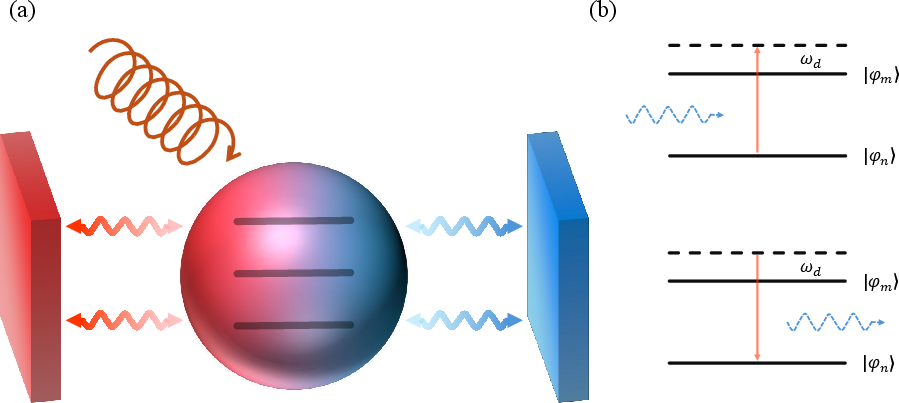
Figure 1: Schematic of the driven-dissipative quantum system, showing the quantum system, two thermal reservoirs, system-bath couplings, and the external driving field.
The formalism is systematically compared with the Floquet master equation, which exactly treats time-periodic Hamiltonians but is often computationally more intensive and less physically transparent.
Spin-Boson Energy Transport: Validation and Analysis
Application to the driven nonequilibrium spin-boson model serves as a stringent validation of the dDME. The energy current into a target reservoir is shown to be in quantitative agreement with the FME across a wide range of driving amplitudes and frequencies, validating the formalism outside the strictly adiabatic or weak-coupling limit.
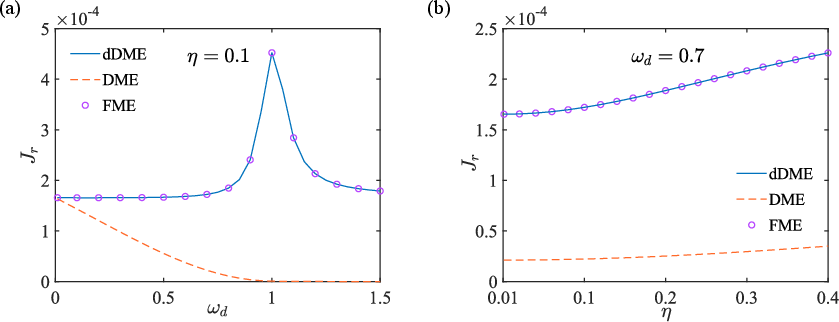
Figure 2: Comparison of energy currents via dDME, traditional DME, and FME in the nonequilibrium spin-boson model as functions of the driving frequency and amplitude.
Crucially, the conventional DME, which omits the driving phase, yields energy currents with either qualitative errors or quantitatively large discrepancies, exemplifying the necessity of incorporating the drive phase for accurate predictions.
A systematic survey of the parameter space elucidates several regimes:
- At weak driving frequency, transport is dominated by thermal bias with negligible drive-induced pumping.
- In the resonant or near-resonant regime (ωd≃ε), steady-state energy currents are dramatically enhanced and exhibit significant nonreciprocal (direction-reversed) behavior, with the drive assisting transitions otherwise suppressed by detailed balance.
- Multiple energy exchange channels appear, corresponding to the various possible drive-modulated transitions between system eigenstates, each weighted by the steady-state populations and drive frequency.
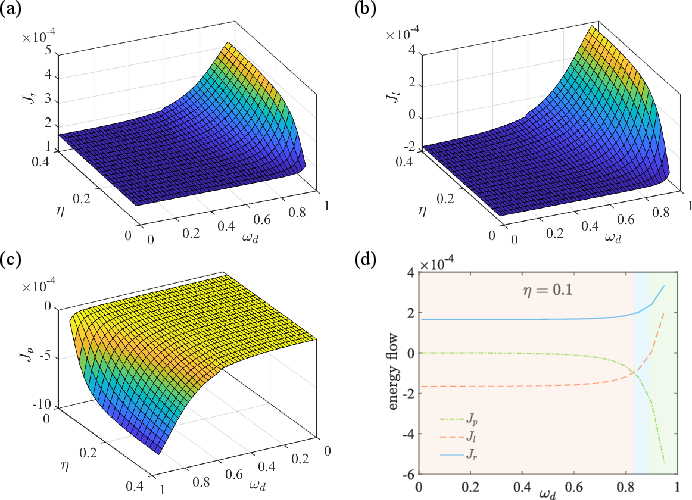
Figure 3: Steady-state energy currents into the right (Jr), left (Jl), and pump reservoirs (Jp) as functions of driving parameters, revealing drive-induced enhancements and qualitative shifts in transport regimes.
Analytical results clarify how, in the limit of high drive frequencies, the effective Fermi’s golden rule rates become dominated by ωd, leading to robust drive synchronization and pumping phenomena.
Extension to Coupled Qubits and Bosonic Kerr Resonator
The methodology is shown to generalize to higher-dimensional Hilbert spaces and other physical platforms. For a two-qubit coupled system driven at a single site, dDME results are fully consistent with the FME, capturing subtle cross-resonances and amplitude-dependent energy redistribution. The capability to reverse current direction and selectively enhance energy output by tuning drive parameters is especially pronounced.
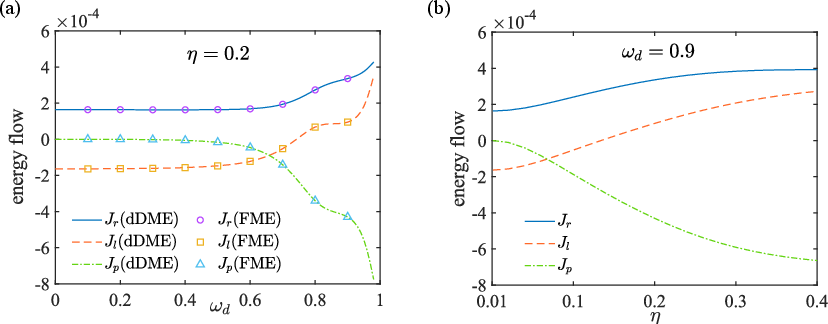
Figure 4: Comparisons of energy flows in the coupled-qubit system as derived from dDME and FME, demonstrating accurate matching and revealing the role of driving in current control.
For the driven Kerr resonator model, which inherently possesses bosonic nonlinearity, the transition rates involve multiphoton processes and intensity-dependent spectral weights. Again, dDME and FME are in precise agreement, while the phenomenological DME fails as drive strength increases.
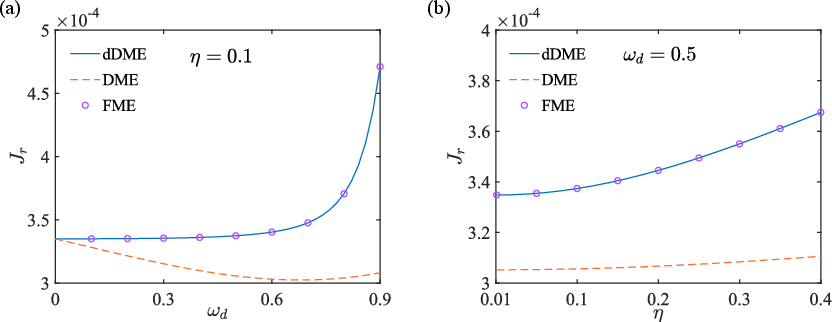
Figure 5: Energy current into the reservoir in the nonequilibrium Kerr resonator model under variations of drive frequency and amplitude, contrasting dDME and traditional DME.
Exploration of the Kerr nonlinearity χ evidences suppression of energy currents at strong nonlinearity in the resonant regime, demonstrating how nonlinear optical effects interplay with nonequilibrium energy pumping.
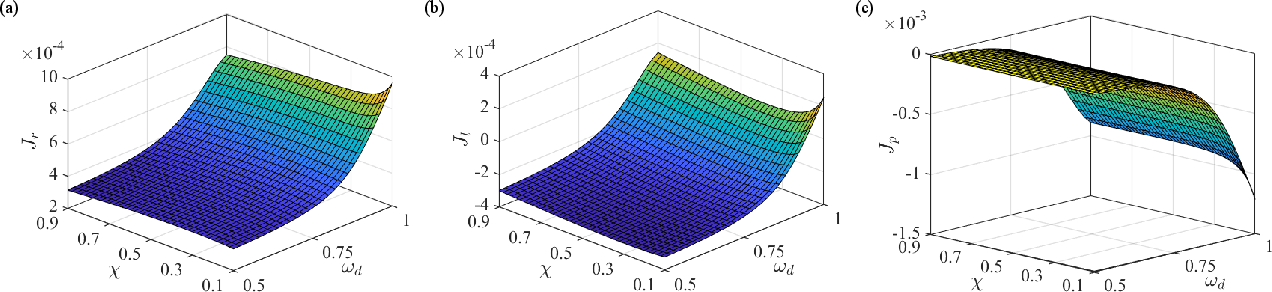
Figure 6: Influence of Kerr nonlinearity and drive frequency on all reservoir and pump currents, indicating tunability and nonlinear suppression of transport.
Implications and Future Directions
The driven dressed master equation formalism provides a physically transparent, computationally tractable, and broadly applicable framework for quantum energy transport in driven-dissipative platforms. The approach resolves significant discrepancies previously observed between phenomenological QME methods and more exact treatments, rendering it suitable for engineered quantum devices, quantum thermal machines, and quantum optical systems.
Importantly, the method is not limited to steady states; it is potentially extendable to time-dependent observables, enabling studies of transient dynamics, nonequilibrium quantum phase transitions (e.g., dissipative criticality and time crystals), and charging protocols for quantum batteries.
The robust, drive-controlled enhancement and directionality of energy currents demonstrated here suggest new paradigms for thermodynamic control in quantum nanodevices and quantum information processing, where modulation of system-environment coupling via external drives can be the basis for optimized energy conversion and dissipation engineering.
Conclusion
The paper establishes the driven dressed master equation as an efficient and accurate method for studying nonequilibrium energy transport in periodically driven quantum systems coupled to multiple baths. By systematically incorporating driving-induced phase effects into dissipative transition rates, the approach captures strong and nontrivial modifications to steady-state transport that are inaccessible via traditional master equations. Its agreement with the Floquet master equation across spin and bosonic models underscores its applicability and reliability. This formalism is poised to facilitate theoretical and experimental advances in quantum thermodynamics, quantum control, and the engineering of thermodynamic functionalities in quantum platforms.

