- The paper derives an empirical relation for the M dwarf cosmic shoreline using a combined Milky Way and extragalactic planetary census.
- It employs a linear support vector machine classifier in log–log space to robustly separate planets with atmospheres from airless ones.
- The study introduces an ARM metric, quantifying atmospheric retention and prioritizing high-value targets for JWST and ELT follow-up.
Introduction
The delineation between planetary bodies possessing atmospheres and those that are airless, often referred to as the "cosmic shoreline," is pivotal for understanding atmospheric retention and loss across diverse exoplanet populations. In particular, the atmospheric outcomes for terrestrial planets orbiting M dwarfs remain ambiguous due to the interplay of heightened XUV irradiation and stellar activity, which may dramatically strip primordial and secondary atmospheres. The study "New Constraints on the M Dwarf Cosmic Shoreline from a Galaxy Far, Far Away" (2603.29743) integrates both Milky Way and extragalactic datasets to empirically constrain the M dwarf cosmic shoreline. This approach leverages not only exoplanetary catalogs but also a unique extragalactic planetary census to break longstanding degeneracies and provide new empirical constraints relevant for prioritizing atmospheric follow-up with facilities like JWST.
Data Compilation and Methodology
The authors assemble a composite sample of terrestrial-size exoplanets (R<2R⊕) hosted by M dwarfs, compiling statistical inferences regarding their atmospheric status—differentiating between planets with confirmed or strongly suspected atmospheres and those that are bona fide airless rocks. The primary source is the NASA Exoplanet Archive for Milky Way planets, complemented by literature analysis for atmospheric characterization. A notable addition is the incorporation of planets from a single extragalactic survey carried out by the "Galactic Senate" (Figure 1), which provides the only robust detections of atmospheres around terrestrial M dwarf planets and critically enables an empirical separation in the irradiation–escape velocity parameter space.

Figure 1: The Galactic Senate, circa 19 BBY, colourized.
The authors define the cumulative XUV irradiation and escape velocity for each planet, following established methods (cf. Zahnle & Catling 2017), and represent planets in this space to empirically assess the cosmic shoreline.
Empirical Shoreline Derivation
The combined galactic and extragalactic sample allows, for the first time, a well-defined empirical fit for the M dwarf cosmic shoreline. The authors employ a linear support vector machine classifier in log–log space to demarcate the populations, obtaining the "Kamino–LTT 1445A b" (K-L) shoreline:
log10IXUV=6.04log10vesc−5.35
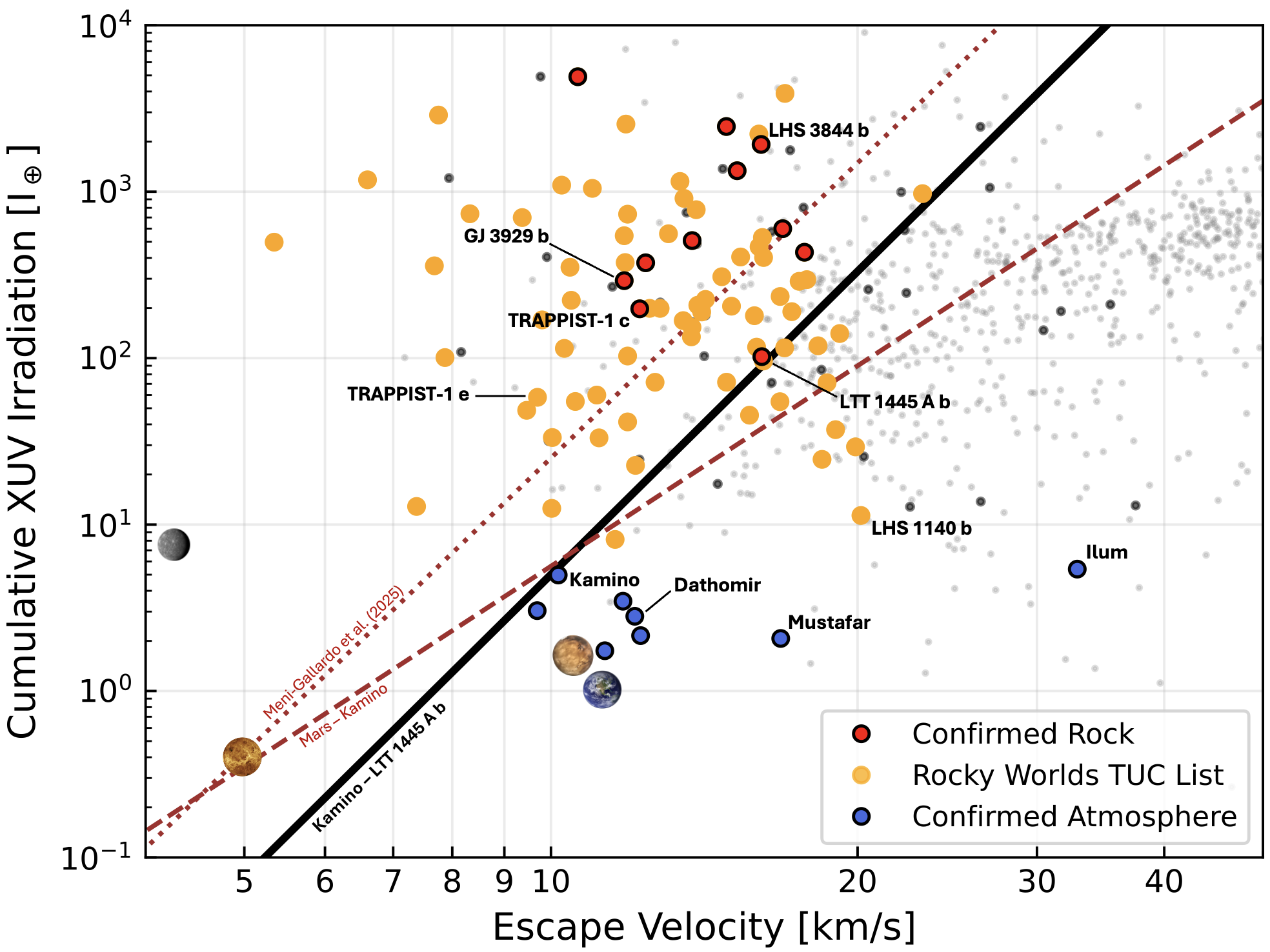
Figure 2: The M dwarf cosmic shoreline in XUV irradiation and escape velocity space, highlighting atmospherically-endowed and airless planets, with empirical shorelines indicated.
A second shoreline is defined by including Solar System planets, resulting in the "Mars–Kamino" (M-K) shoreline:
log10IXUV=4.02log10vesc−3.21
Comparative analysis with the Sun-like star shoreline derived by Meni-Gallardo & Pallé (2025) (Meni-Gallardo et al., 18 Aug 2025) reveals the K-L slope (6.04) is closely matched to their result (5.89), but with an offset indicating greater atmosphere loss efficiency for M dwarf hosts.
Implications for Planetary Atmosphere Retention
The congruence in slope between the M dwarf and Sun-like shorelines substantiates the hypothesis that analogous physical processes control atmosphere retention across diverse stellar hosts, though the normalization offset suggests atmospheric erosion is more effective for planets orbiting M dwarfs, attributed to higher sustained XUV output and prolonged pre-main-sequence phases [Wheatley et al. 2017]. The substantial y-intercept offset quantifies the higher instellation threshold required for M dwarf planets to retain atmospheres, consistent with recent inferences from JWST emission and transmission spectroscopy, which have largely failed to detect atmospheres on M dwarf terrestrials [kreidberg_absence_2019, zieba_no_2023, xue_jwst_2024, weiner_mansfield_no_2024].
The paper introduces an Atmosphere Retention Metric (ARM), defined as the signed distance of a planet from the empirical shoreline in log–log space. Positive ARM indicates probable atmospheric retention. Application to JWST Rocky Worlds DDT targets identifies LHS 1140 b and several other planets, even those lacking robust mass constraints, as high-priority candidates for future atmospheric follow-up.
Context in the Exoplanet Literature
The shoreline formalism, first introduced by Zahnle & Catling (2017), has grown in relevance as JWST and other observatories provide thermal emission and transmission spectra for the low-radius exoplanet regime. Previous empirical efforts to define the shoreline have suffered from a lack of atmospheric "successes" on the M dwarf side, resulting in boundary conditions that were not robust. The integration of the extragalactic sample in this paper partially addresses this, though whether the empirical separation carries over to all galaxies or is subject to local environmental stochasticity remains an open theoretical question.
The paper's ARM-based prioritization framework, consistent with approaches by Pass et al. (2025) [pass_receding_2025] and Meni-Gallardo & Pallé (2025), serves a practical function for target selection as large time allocations on JWST and upcoming ELTs are distributed.
Future Directions
The results outline multiple pathways for advancing the empirical understanding of atmospheric retention:
- Refined Stellar XUV Histories: Incorporation of detailed, system-specific XUV evolutionary tracks (including flare rates and high-energy outputs) for individual M dwarfs is essential for reducing the dominant uncertainties in IXUV.
- Expanded Atmospheric Census: Additional robust atmosphere identifications, particularly on the "retention" side for M dwarf systems, are required to test the generality of the derived shoreline.
- Unification Across Stellar Types: Adjusting the parameterization of the shoreline (e.g., normalizing the Y-axis by saturated XUV lifetime or fractional XUV output) could allow the merging of datasets across spectral classes, enabling a universal cosmic shoreline description.
Conclusion
This analysis marks a significant empirical advance in the delineation of the cosmic shoreline for terrestrial planets around M dwarfs by integrating both local and extragalactic data, deriving a robust empirical relation with a slope consistent with Sun-like stars but an offset supporting enhanced atmospheric loss for late-type hosts (2603.29743). The ARM applied to ongoing and future atmospheric targets enables prioritized observational efforts and theoretical scrutiny. Further empirical expansion and theoretical refinement will clarify the universality of atmospheric mass loss processes and inform strategies for biosignature-focused target selection in the era of JWST and ELTs.