- The paper introduces GS-OFDM, a multi-gear framework that adapts waveform processing based on dynamic mobility conditions.
- It employs legacy OFDM for low mobility, DD-a-OFDM for moderate speeds, and DDW-OFDM to maintain throughput under extreme velocities.
- Extensive simulations validate throughput recovery, PAPR tunability, and enhanced ISAC integration for advanced 6G applications.
Mobility-Adaptive Multi-Gear OFDM for 6G: The GS-OFDM Framework
Introduction
The transition to 6G wireless systems demands robust physical layer solutions to enable reliable communications across a heterogeneity of mobility regimes, including high-speed railways, vehicular networks, low-altitude UAVs, and non-terrestrial links. While the 3GPP has confirmed CP-OFDM and SC-FDMA as the baseline waveforms for 6G, legacy OFDM is fundamentally challenged by severe Doppler spreads which induce debilitating intercarrier interference, eroding its canonical single-tap equalization benefit. This paper introduces GS-OFDM, a mobility-adaptive, multi-gear physical layer architecture that generalizes OFDM operation along three dynamic signal processing “gears,” bridging classical time-frequency (TF) and delay-Doppler (DD) domains while preserving spectral efficiency and hardware compatibility.
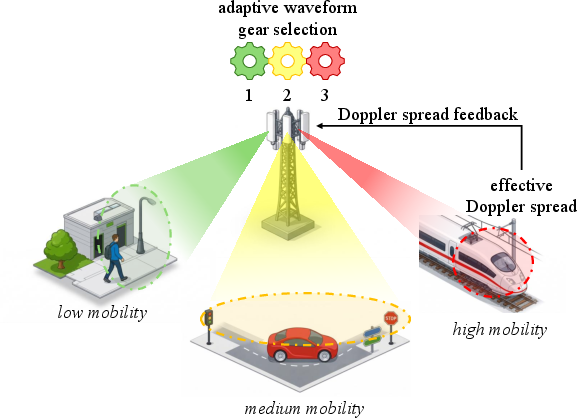
Figure 1: The GS-OFDM framework: the BS adaptively selects among three operating gears based on the mobility conditions and Doppler spread feedback from the UEs. Gear 1 is used for low mobility (quasi-static), Gear 2 for medium mobility (time-varying), and Gear 3 for high/extreme mobility (fast-varying) scenarios.
Motivation: Limitations and Requirements
Under high mobility, OFDM experiences a rapid loss of channel coherence, fundamentally compromising the validity of quasi-static channel assumptions. Tuning SCS (subcarrier spacing) offers limited benefit due to intrinsic trade-offs between delay spread tolerance and ICI resilience. Extensive simulation results show that, for typical C-V2X and 6G mmWave/sub-THz configurations, the number of coherent OFDM symbols drops below 10 for even moderate-to-high speeds (e.g., HSR or UAV), necessitating a paradigm shift in receiver signal processing: simple TF-domain interpolation is no longer sufficient. Furthermore, 6G is architected as an ISAC-native system, demanding waveforms with desirable DD ambiguity profiles that classical OFDM cannot provide.
GS-OFDM Architecture
GS-OFDM implements an adaptive selection among three processing gears:
- Gear 1 (Legacy OFDM): Single-tap, frequency-domain equalization with standard TF-pilot based LS/MMSE channel estimation; compatible with 5G NR; optimal for low mobility, quasi-static channels.
- Gear 2 (DD-a-OFDM): DD-domain parameter extraction using TF pilots (potentially denser in time), with subsequent per-path channel parameterization and IMFC or MMSE equalization; moderate receiver complexity; backward compatible on the transmitter side.
- Gear 3 (DDW-OFDM): Superimposed DD-domain pilot across the entire TF resource grid, enabling full DD-domain channel estimation without explicit TF pilots and using high-complexity iterative equalization; maximizes throughput under high Doppler spread by leveraging high PDR values and provides tunable PAPR characteristics.
The selection is driven by online estimation of Doppler spread (fed back by UEs), with BS-side clustering for users under similar channel conditions. The adaptive gear switching is governed by coherence time thresholds, with hysteresis to prevent flapping.
Numerical Results
Figure 2 presents a comparative evaluation in a C-V2X scenario at 5.9 GHz (SCS = 15 kHz) under exponentially decaying Rayleigh multipath conditions.
(Figure 2)
Figure 2: Throughput comparison across the three gears as a function of velocity in a C-V2X system. Gear 1 dominates at low speeds, Gear 2 bridges medium mobility, and Gear 3 achieves stable high-rate operation at extreme velocities.
Key observations include:
- Throughput Degradation and Recovery: Gear 1 throughput declines rapidly above 200 km/h due to increased pilot overhead and irreducible ICI. Gear 2 extends reliable performance into the 200–600 km/h range via DD-domain processing, but is ultimately limited by pilot density constraints. Gear 3 with sufficiently high PDR (e.g., 25 dB) maintains near-constant throughput up to 1000 km/h.
- PAPR Control: Figure 3 shows the CCDF of PAPR, illustrating that Gear 3 enables tunable PAPR by adjusting the pilot/data power ratio, significantly reducing instantaneous PAPR compared to legacy OFDM at appropriate system settings.
(Figure 3)
Figure 3: PAPR CCDF for Gear 1/2 (OFDM/DD-a-OFDM) and Gear 3 (DDW-OFDM) at different PDR levels, demonstrating PAPR tunability in DDW-OFDM.
ISAC and Sensing Integration
GS-OFDM enables native ISAC by supporting improved DD ambiguity functions, directly benefitting both BS-side monostatic and UE-side distributed sensing. Gear 3 dramatically increases DD resolution via wideband DD pilots, enhancing range/Doppler discrimination for both communications and radar applications. This is particularly effective when the DD pilot is permitted to expand beyond nominal bandwidth allocations with proper power scaling, further refining spatial situational awareness. The framework lays the groundwork for network-cooperative ISAC, where sensing data fusion across BSs can improve Doppler spread prediction and streamline gear switching.
Practical Considerations and Future Directions
Extensive MIMO/beamforming, especially at mmWave/sub-THz, naturally reduces effective Doppler spread via directional selectivity, thereby shifting gear switching thresholds to higher velocities and improving channel coherence relative to isotropic propagation scenarios.
Energy Consumption in Gear 3
Operating over the full downlink bandwidth increases UE digital baseband and RF chain energy demands. Optimization of burst durations and pilot duty-cycling must be explored to minimize energy costs while maintaining necessary DD resolution.
Uplink Extension and Standardization
Uplink multi-gear adaptation, including DD-domain channel estimation in SC-FDMA and potential extension of DDW-OFDM, introduces new challenges in pilot multiplexing and power allocation. Device-centric energy scaling and fair resource partitioning will be critical.
Multi-User Clustering and Gear Granularity
Balancing per-UE and per-cluster gear assignments in the presence of heterogeneous mobility profiles presents open problems in resource allocation, energy/rate optimization, and receiver architecture co-design.
Conclusion
This work presents GS-OFDM, a comprehensive, mobility-adaptive physical layer framework for 6G systems that unifies legacy OFDM and advanced DD-domain processing within a dynamically reconfigurable architecture. The multi-gear approach maximizes spectral efficiency and robustness across all mobility regimes, preserves backward compatibility where possible, and enables straightforward integration of advanced ISAC functionalities. Critical avenues for further development include energy-efficient DD pilot design, uplink multi-gear adaptation, and tight integration with MIMO and network-driven ISAC mechanisms. GS-OFDM is positioned as a foundational enabler for both reliable high-mobility communications and native 6G sensing.