- The paper presents Symphony, a multi-agent system that transforms clinical coding through modular steps including evidence extraction and code reconciliation.
- It achieves high performance with F1 scores up to 0.74 on restricted code spaces and robust cross-ontology generalization without retraining.
- Its modular design enables seamless integration into clinical workflows and supports human-in-the-loop audits for regulatory compliance.
Symphony for Medical Coding: Agentic, Ontology-Aware, and Explainable Automation for Clinical Coding
Motivation and Problem Statement
Medical coding underpins clinical research, hospital billing, regulatory compliance, and quality measurement by mapping unstructured clinical narratives to standardized codes from ontologies like ICD-10-CM, ICD-10-PCS, and CPT. Current practice remains predominantly manual, incurring significant cost, delay, and high error rates, with systematic reviews reporting median primary diagnosis accuracy as low as 80% and extensive inter-coder variability. Existing ML-based approaches, ranging from multi-label classifiers to LLMs, are constrained by fixed code sets and opaqueness in predictions. They lack adaptability to new codes or evolving ontologies, require full retraining for annual taxonomy changes, and provide poor or no justifications for code assignments. This precludes deployment in safety-critical or regulatory environments where explainability and rapid adaptation to taxonomy drift are imperative.
System Architecture: Agentic Reasoning with Ontology Integration
Symphony for Medical Coding is built on the CLH framework, which deconstructs the coding process into a multi-agent workflow that mirrors expert human coders with full access to the coding guidelines. The architecture comprises four LLM-driven agentic components:
- Evidence Extraction: Identification of text spans supporting potential code assignment.
- Index Navigation: Retrieval and alignment of candidate codes via the alphabetic index, locating each concept within the hierarchical structure.
- Tabular Validation: Determining the most precise, valid code by traversing the hierarchy and referencing official conventions.
- Code Reconciliation: Final consensus and constraint-based filtering to produce a coherent, non-redundant code set.
This modular system is ontology-agnostic; by decoupling code prediction from any one dataset, Symphony directly leverages full, up-to-date classification systems and associated coding guidelines. This enables zero-shot onboarding of new ontologies and rapid adaptation to guideline drift without supervised retraining. Each step's intermediate outputs are well-structured, facilitating integration into multi-agent clinical software ecosystems and supporting human-in-the-loop audit or override scenarios.
Explainability: Span-Level Evidence Attribution
Symphony's evidence extraction mechanism grounds each predicted code in one or more text spans. These spans are made available to the end-user for validation, audit, or regulatory substantiation.
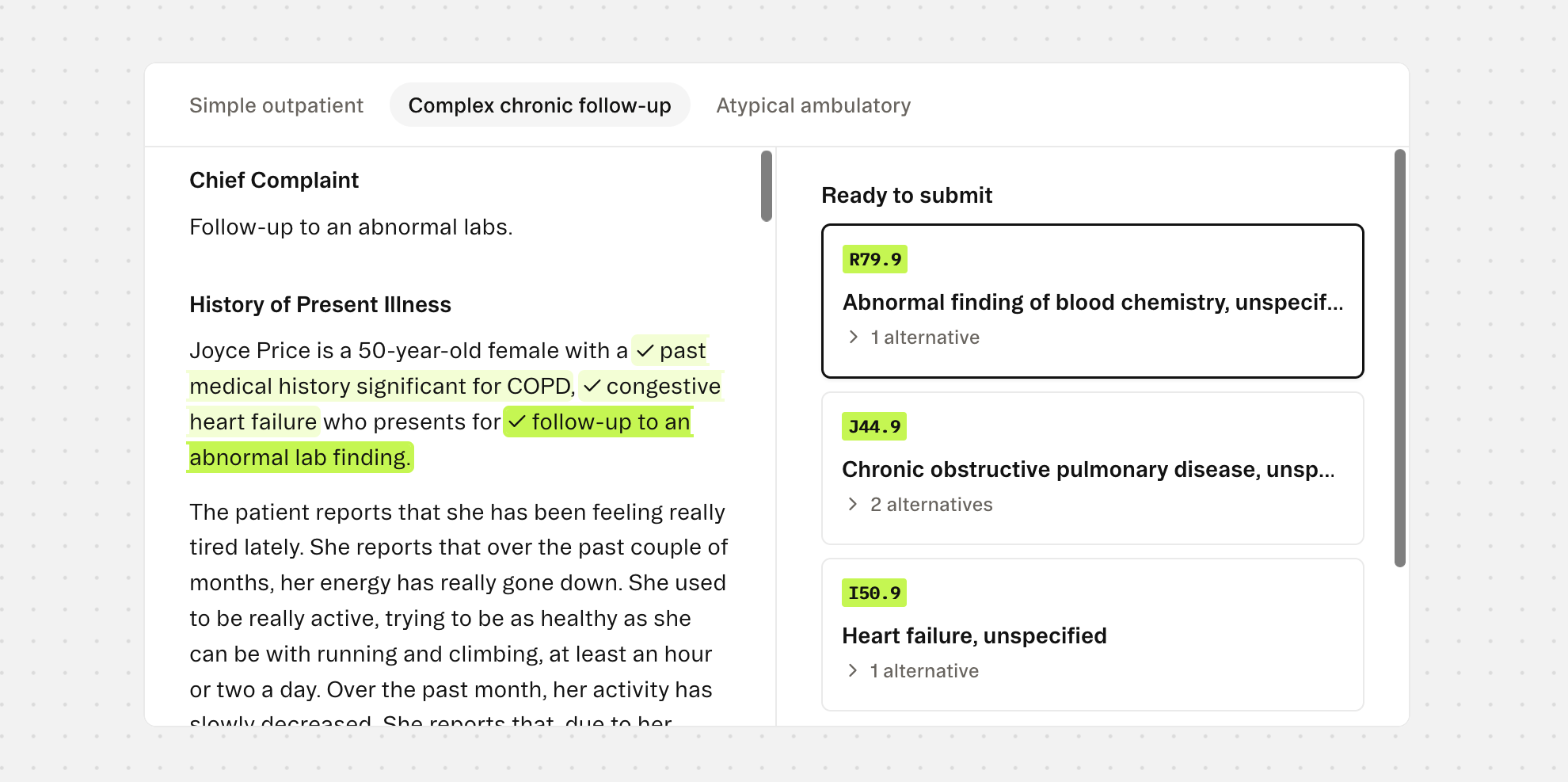
Figure 1: A sample user interface showing the evidence spans provided by Symphony for Medical Coding.
On benchmarks containing human-annotated code evidence (MDACE), Symphony achieves 98.9% coverage for providing at least one evidence span per code, with a 73.7% hit rate on any overlap with expert annotations (42.5% at IoU > 0.5). Character-level F1 and ROUGE-L F1 are 0.459 and 0.506, demonstrating that the model's notion of evidence largely aligns with domain experts, though some mismatch is attributed to annotation granularity and sentence boundary decisions. This evidence-centric explainability positions Symphony to support both algorithmic transparency and regulatory compliance, addressing long-standing shortcomings of prior neural approaches.
Empirical Results: Benchmarking Across Ontologies and Real-World Data
Restricted Code Space Benchmarks: On academic datasets (ACI, MDACE), Symphony outperforms MedDCR (Oracle + GPT-4), Claude (AWS + Anthropic), and all baselines, delivering F1 scores of 0.74 (ACI) and 0.62 (MDACE). Gains are achieved through balanced improvement in both recall and precision, whereas prior LLM-centric workflows typically experience sharp trade-offs favoring one at the expense of the other.
Full Code System Evaluation: Symphony is systematically compared with general-purpose LLMs (Claude, GPT, Gemini) operating both with and without coding tools (e.g., MCP integration). On all datasets and ontologies—including proprietary large-scale ambulatory (2.2M notes, 17.5k codes), emergency department (563k notes, 11.1k codes), and a UK NHS neurology set (distinct code hierarchy)—Symphony establishes a new upper bound for F1, with robust, low-variance performance across code space complexity (see below).
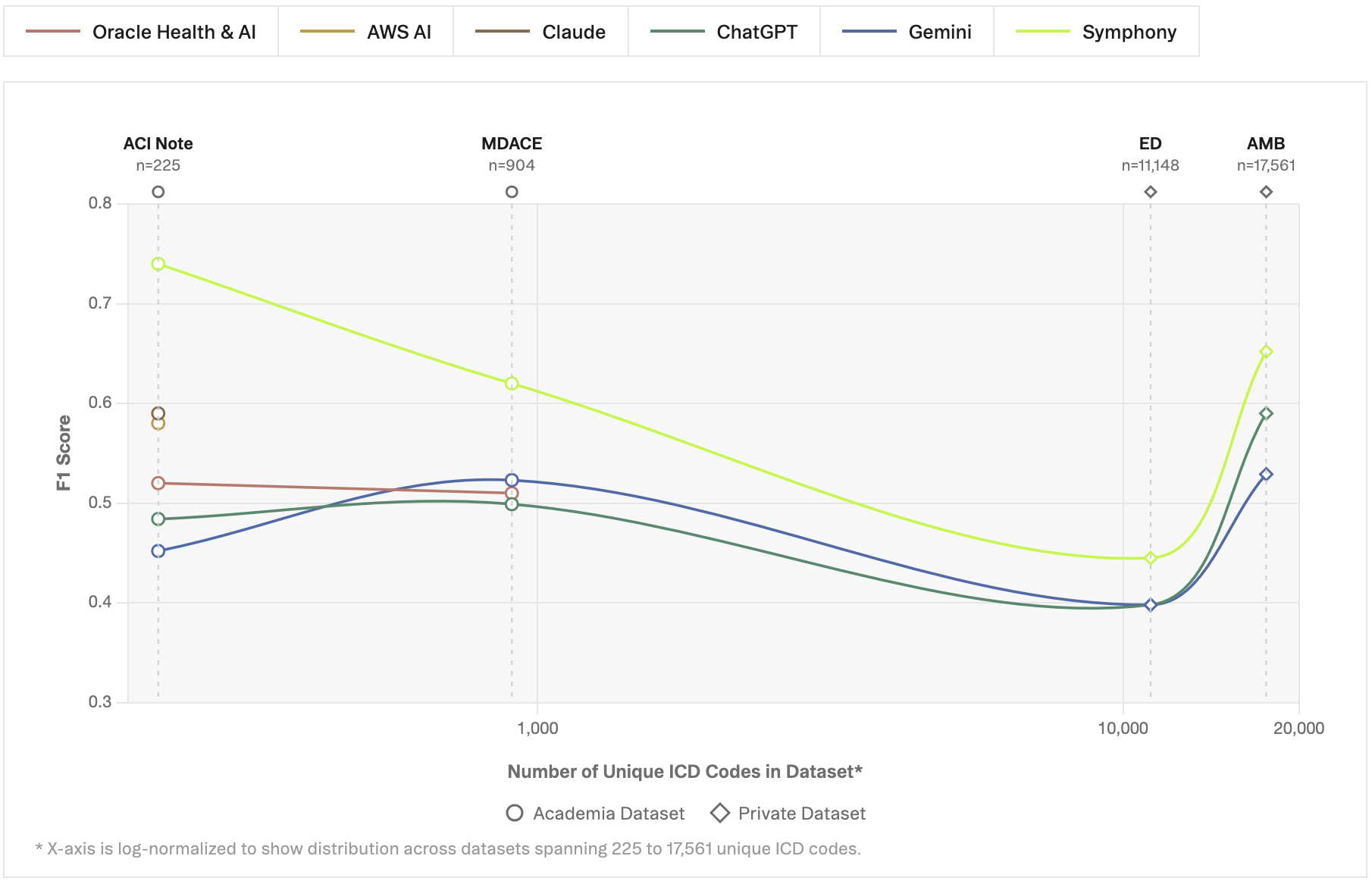
Figure 2: F1 performance as a function of code space size (log-scaled), demonstrating Symphony's superiority and stability across increasing label set cardinality.
For example, on the full ICD-10-UK task, Symphony achieves 32.9 F1 versus ChatGPT's 18.1, without any retraining or tuning for the new taxonomy—underscoring its capacity for cross-ontology generalization. Procedure coding (ICD-10-PCS and CPT) is also addressed, with Symphony surpassing GPT-based models, particularly on high-variance, sparsely labeled tasks.
Precision remains significantly higher than for agentic and end-to-end LLM competitors, a critical requirement for deployment in billing and clinical research, where false positives precipitate downstream analytic and operational errors.
Practical Design and Deployment Considerations
This agentic architecture is exposed via a stable, production-grade API and can be deployed as a standalone service or plugged into more comprehensive clinical agent ecosystems. The system's inherently modular design, with explicit intermediate representations, not only enables flexible integration but also supports composability—permitting, for instance, long-running or cross-document reasoning patterns beyond a single encounter.
Symphony is evaluated on five distinct datasets spanning U.S. and U.K. health systems, multiple specialties, public and proprietary sources, and various encounter types. Coverage of both curated benchmarks and real production data, together with comprehensive precision/recall/F1 analysis, provides strong evidence of external validity and readiness for deployment.
Implications, Limitations, and Future Directions
Ontology-aware, modular, multi-agent approaches represent a fundamental shift away from closed-set statistical classification towards systems that are robust to taxonomic evolution, transparent for audit, and adaptable to diverse regulatory and healthcare delivery environments. By achieving high-precision, span-justified, fully ontology-aligned coding, Symphony bridges the translation gap between free-text narrative and downstream operations in billing, analytics, and research.
A key limitation noted is the inherent label noise and disagreement among professional human coders, which places a practical ceiling on achievable F1 and makes outputs sensitive to gold standard uncertainty. Furthermore, while Symphony's span attribution is well-validated, ultimate deployment in settings with different clinical note styles or novel ontologies may still necessitate continuous review and enhancement of evidence extraction under domain shift.
Future technical research will likely extend the system's agentic capabilities to complex, longitudinal clinical coding scenarios; refine evidence attribution with enhanced NER and assertion detection integration; and more deeply explore self-explaining neural architectures for further gains in transparency and regulatory acceptance. Expansion to additional clinical ontologies and integration with active learning for human-in-the-loop quality assurance are natural directions. Beyond coding, the agentic, structured reasoning paradigm adopted in Symphony has direct applicability to other knowledge extraction and mapping tasks throughout healthcare AI.
Conclusion
Symphony for Medical Coding—through its agentic, ontology-aware, and explainable design—provides a robust foundation for scalable, transparent, and high-fidelity automated medical coding. Its empirical superiority over both supervised and LLM-based agentic systems across restricted and full-label settings, support for real-world deployment, and strong evidence-grounded explainability address longstanding bottlenecks in clinical informatics. The system exemplifies the practical benefits of explicit, modular reasoning workflows in safety-critical AI, offering both a concrete solution and a blueprint for broader adoption of agentic architectures in medical AI (2603.29709).