- The paper presents a rigorous quasiparticle framework that uses many-body quantum field theory to model sock behavior in a washing machine.
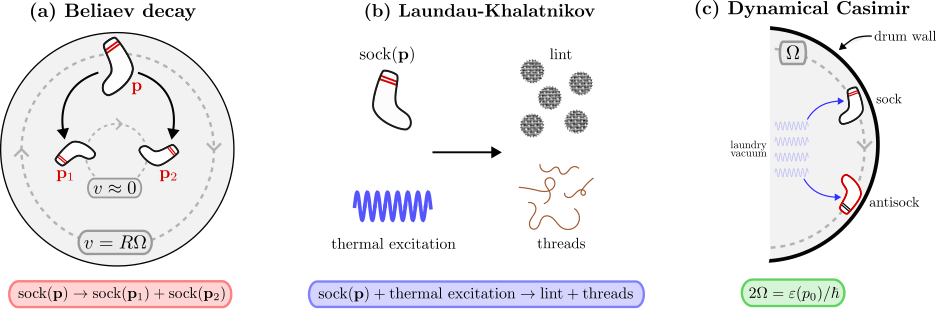
- It details unique decay mechanisms such as Beliaev decay, Landau–Khalatnikov scattering, and dynamical Casimir effects tied to material properties.
- Results indicate that material-dependent dispersion relations influence sock shrinkage and loss, offering practical guidelines for minimizing unpaired socks.
Quasiparticle Theory of Sock Dynamics in Nonequilibrium Laundry Systems
Introduction and Motivation
"Non-Equilibrium Sock Dynamics: Spontaneous Symmetry Breaking in the Agitated Wash" (2603.29650) presents a rigorous theoretical framework for analyzing sock dynamics within agitated laundry systems, utilizing many-body quantum field theory. The authors identify individual socks as bosonic quasiparticle excitations emerging from the collective behavior of the laundry condensate. By establishing a material-dependent quasiparticle dispersion, the paper opens a route to systematize phenomena such as sock shrinkage, pair creation and annihilation, and the emergence of unpaired socks. Empirical data supporting the universality of unpairing mechanisms across brands and fiber types are provided as a touchstone for generalizing the framework.
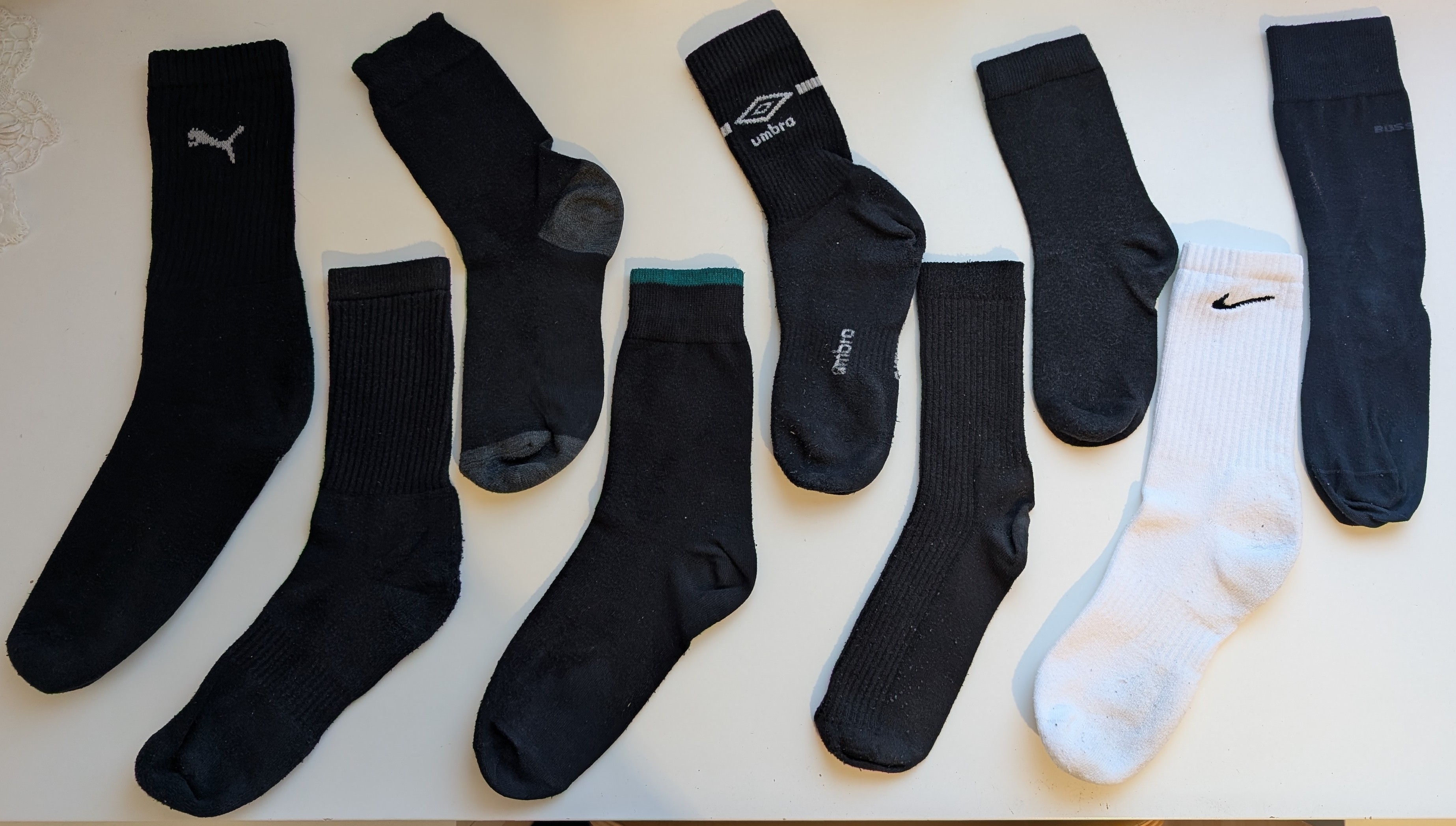
Figure 1: Nine unpaired sock quasiparticles recovered from a domestic laundry system, exhibiting broad diversity in material, size, and color.
Many-Body Hamiltonian and Sock Quasiparticles
The system is formalized with a many-body Hamiltonian in the rotating reference frame of the washing machine, incorporating garment interactions via contact potentials and angular momentum coupling through the drum’s rotation. The mean-field reduction yields a noninteracting bosonic quasiparticle Hamiltonian where socks become the principal low-energy excitations. The dispersion relation of these excitations, ε(p), is materially dependent and central to predicting dynamical behaviors. Beyond mean-field effects mediate decay and creation channels.
Material-Dependent Dispersion and the Sockton Minimum
The sock quasiparticle spectrum exhibits gapless behavior complying with the Goldstone theorem, due to the spontaneous breaking of continuous symmetries in the laundry condensate. For synthetic fibers (e.g., polyester, nylon), the spectrum is nondispersive and linear: ε(p)≈cs∣p∣, yielding invariant spatial profiles and empirical resistance to shrinkage. Natural fibers (cotton, wool) exhibit a strongly dispersive spectrum with a sockton minimum at a characteristic wavevector (inverse sock length), analogous to the roton minimum in superfluid 4He. Increased spatial curvature in these dispersive sectors gives rise to finite effective mass and shrinkage susceptibility.
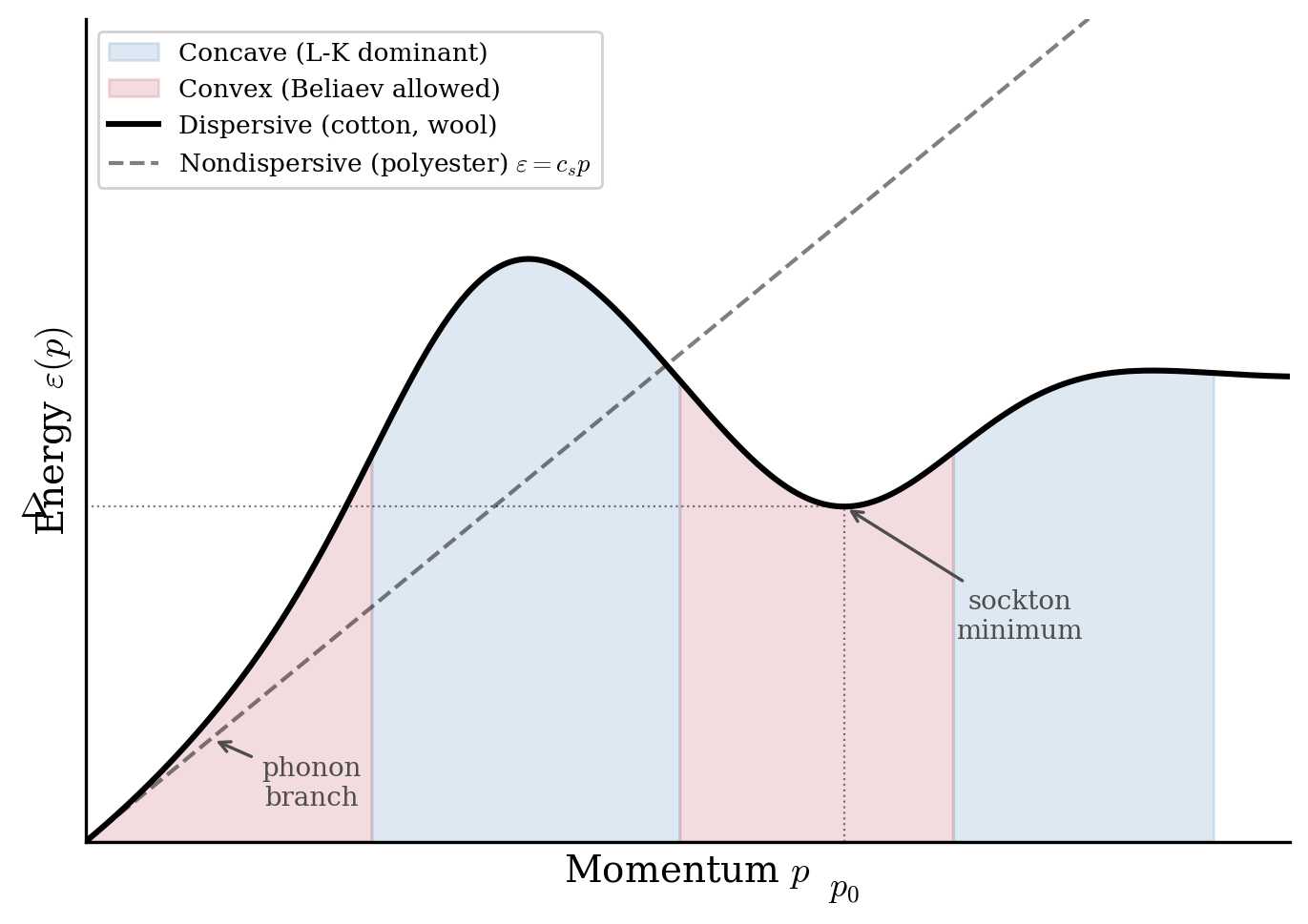
Figure 2: Sock quasiparticle dispersion relations for dispersive and nondispersive materials, highlighting decay-allowed convex and destruction-prone concave regions.
Decay Mechanisms and Creation–Annihilation Ambiguity
Three fundamental mechanisms, dictated by the dispersion profile, govern sock population dynamics in a wash cycle:
The observable—appearance of unpaired socks—is fundamentally ambiguous, as it may equally reflect partner destruction or spontaneous pair creation. Census-based parity monitoring is requisite for disentangling these outcomes, but is rarely executed in practical settings.
Experimental Predictions and Practical Implications
Strong claims are made regarding experimentally testable predictions:
- Synthetic socks should exhibit immunity to shrinkage and decay, supported by their linear, nondispersive spectrum.
- The destruction rate via Landau–Khalatnikov process scales with laundry medium temperature, explaining accelerated sock loss at higher settings.
- Resonant enhancement of sock pair creation occurs above a critical spin frequency (2Ω=ε(p0)/ℏ), suggesting that low spin speeds suppress unpairing rates.
These insights support practical care guidelines: favor synthetic socks, use low temperatures, and avoid high spin speeds to minimize sock loss.
Theoretical Implications and Future Directions
Several theoretical avenues are proposed for advancing the model:
- Investigate the physical nature of the antisock: its parity-inverted (inside-out) representation and annihilation signatures.
- Analyze sock color dependencies, motivated by the predominance of dark socks in unpaired populations, possibly attributed to color-dependent coupling constants.
- Engineer dispersion relations for topologically protected socks, immune to Landau–Khalatnikov degradation but susceptible to proliferation via Beliaev decay.
- Examine sock hole formation as excitonic phenomena within this quasiparticle paradigm.
Conclusion
This paper delivers a comprehensive quantum field theoretic analysis of sock dynamics in agitated laundry systems, connecting material dispersion relations to observable phenomena including shrinkage, sock loss, and pair creation. Three dominant mechanisms—Beliaev decay, Landau–Khalatnikov scattering, and dynamical Casimir pair production—are systematically dissected with explicit dependence on material and drum parameters. The creation–annihilation ambiguity is framed as a fundamental obstacle for empirical resolution of sock population changes. The theoretical framework is generalizable, experimentally grounded, and invites further exploration in the direction of engineered dispersion, color interactions, and excitonic defect dynamics.