Finite Blocklength Covert Communication over Quasi-Static Multiple-Antenna Fading Channels
Published 31 Mar 2026 in cs.IT | (2603.29645v1)
Abstract: The white book released by the International Telecommunications Union (ITU) calls for extremely high-security and low-latency communication over fading channels. Under the low-latency requirement, the corresponding fading model is quasi-static fading while high-security can be achieved via covert communication. In response to the call of ITU, we study the finite blocklength performance of optimal codes for covert communication over quasi-static multi-antenna fading channels, under the covertness metric of Kullback-Leibler (KL) divergence. In particular, we study all four cases regarding the availability of channel state information (CSI) for legitimate transmitter and receiver, and assume that the warden knows perfect CSI for the channel from the legitimate transmitter to itself. Specifically, we show that, when the blocklength is $n$, the first-order covert rate satisfies the square root law, scaling as $Θ(n{-\frac{1}{2}})$ with the coefficient determined by the traces of the channel matrices of the legitimate users and the warden, and the second-order rate vanishes. In contrast to the non-covert result of Yang et al. (TIT, 2014), we show that CSI availability at the legitimate users does not affect the finite blocklength performance for covert communication. Furthermore, we reveal the significant spatial diversity gain provided by multiple-antenna systems for covert communication. For the covertness analysis, we extend the quasi-$η$-neighborhood framework to fading channels and address challenges arising from the random channel matrices. For the reliability analysis, due to the vanishing power imposed by the covertness constraint, we refine the non-covert analysis by Yang et al. (TIT, 2014), by carefully controlling higher-order terms and exploiting the properties of covert outage probability.
The paper establishes a finite blocklength covert rate scaling of Θ(√n) under quasi-static MIMO fading using KL divergence for covertness constraints.
The analysis reveals that increased antenna diversity significantly enhances covert throughput, while channel state adaptation offers no covert rate benefit.
Non-asymptotic bounds demonstrate rapid convergence to asymptotic performance, providing actionable design guidelines for 6G and URLLC systems.
Finite Blocklength Covert Communication over Quasi-Static Multiple-Antenna Fading Channels
Problem Formulation and Methodology
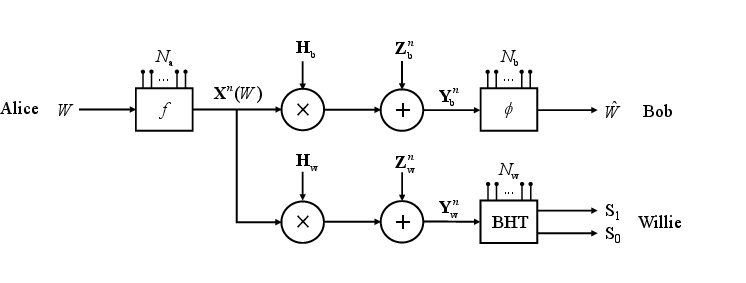
The paper "Finite Blocklength Covert Communication over Quasi-Static Multiple-Antenna Fading Channels" (2603.29645) rigorously addresses the problem of optimal covert communication under blocklength limitations in the presence of quasi-static MIMO fading. The setting involves a legitimate transmitter (Alice), a legitimate receiver (Bob), and an adversarial warden (Willie), with all entities potentially equipped with multiple antennas. The analysis is anchored in practical constraints emphasized by ITU for 6G and URLLC scenarios—namely, ultra-low latency (small n), high reliability (low ε), and strong security (covertness).
The covert metric adopted is the Kullback-Leibler (KL) divergence between the distribution of Willie's observations under transmission and no-transmission, following established statistical security principles. The communication system is modeled so that channel state information (CSI) may be variably available to Alice and/or Bob, but the warden always knows the channel from Alice to himself perfectly—a strong adversarial assumption. The legal and warden channels are drawn as full-rank random matrices, capturing practical Rayleigh/Rician/Nakagami fading phenomenology.
The explicit objective is to characterize the maximum achievable covert rate R∗(n,ε,δ) (where n is blocklength, ε is error probability, and δ is the KL divergence constraint) for all CSI configurations, to second order in the finite blocklength regime, and to extract the structural role of MIMO (number of antennas), fading, and CSI. The results are constructed by first deriving achievability using random coding with a truncated complex Gaussian ensemble, then proving converse bounds using arguments based on channel resolvability and statistical hypothesis testing under vanishing power.
Figure 1: System model for covert communication over quasi-static MIMO fading channels.
Principal Results and Theoretical Insights
Asymptotic Expansion and the Square Root Law
The central result is a tight expansion:
R∗(n,ε,δ)=κεnδ+O(nlogn)
where the explicit form of κε depends on the statistical properties (traces) of the legitimate and warden channel matrices. The derivation confirms that the square root law governs covert operation even over quasi-static MIMO fading: the number of reliably and covertly transmittable bits scales as Θ(n).
A highly non-trivial feature is that the second-order (dispersion) term strictly vanishes—i.e., the finite blocklength penalty from statistical fluctuations, dominant in AWGN and most ergodic fading, does not appear. This is shown for all four canonical CSI scenarios (neither party, Alice, Bob, or both knowing the legal channel). The authors meticulously demonstrate that water-filling or power-adaptive strategies, valuable in non-covert or regular communication, offer no benefit under covertness constraints, because non-uniform signaling would be more easily detected by Willie.
Role of the MIMO Structure and Outage
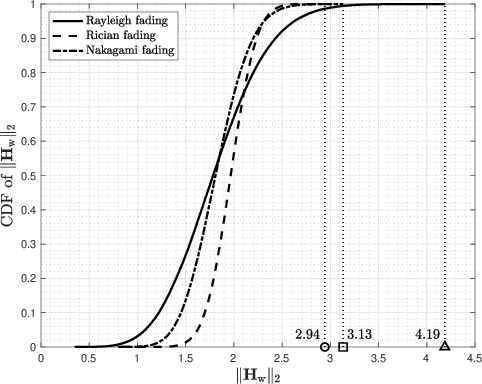
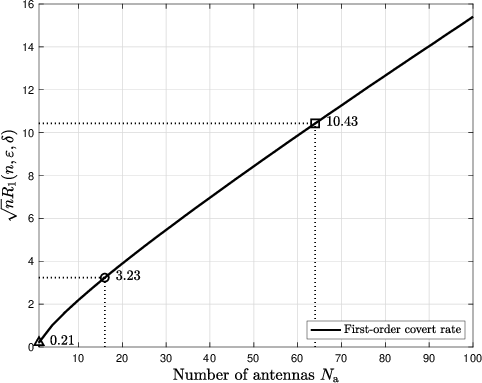
The coefficient in the square root law is shown to depend strongly on the number of transmit/receive antennas and the effective warden SNR upper bound. Numerically, scaling the antenna number from 1 to 16 or 64 yields multiplicative improvements in achievable covert rate (e.g., by factors of ~15 and ~50, respectively, for 2×2 channels).
Figure 2: Empirical CDFs for maximal singular value under Rayleigh and Rician fading; tight outliers confirm the existence of practical spectral norm upper bounds for covert design.
Non-Asymptotic Bounds and Reliability
The achievability bound is based on codes with vanishingly small per-codeword power, constructed as truncated complex Gaussian signals located on thin spherical shells. The achievability proof leverages angle threshold decoding, invoking principal angles in Grassmann manifolds between subspaces generated by codewords and received signals—a natural approach for scenarios lacking (full) CSI.
For the converse, the paper carries out a careful meta-converse using generalized likelihood ratio tests and shows, through explicit calculation, that no code ensemble with higher power, or employing more advanced signaling, escapes the warden's detection constraint.
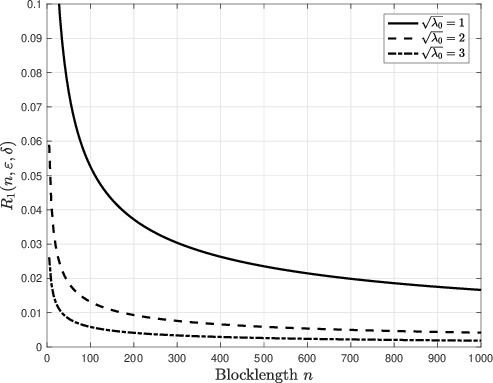
Figure 3: First-order asymptotics ε0 versus blocklength ε1 for a ε2 Rician MIMO channel; the inverse SNR effect of increasing Willie's spectral norm upper bound is manifest.
Figure 4: First-order covert rate ε3 versus antenna number ε4; demonstrates dramatic MIMO-induced gain in covert transmission.
Rapid Finite Blocklength Convergence
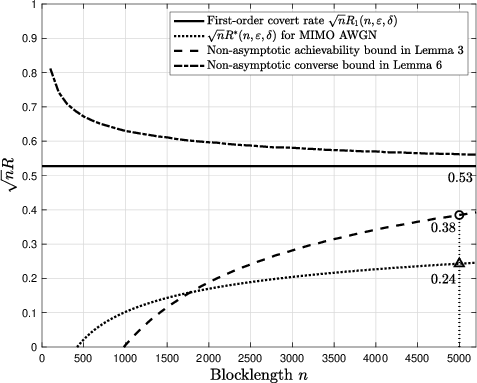
Due to outage-limited performance in quasi-static fading, the finite blocklength rate converges much more rapidly to its first-order limit compared to non-fading AWGN channels. For example, at ε5 in a ε6 MIMO Rician setting, the achievable rate is already ε7 of the asymptotic limit (vs. ε8 for pure AWGN, under identical covertness).
Figure 5: Non-asymptotic achievable and converse bounds for ε9 under Rician fading and AWGN; fading accelerates the convergence to asymptotic rate.
Novel Technical Approaches
Covertness Analysis: The extension of the quasi-R∗(n,ε,δ)0-neighborhood technique, previously used for deterministic channels, is adapted to random matrix settings; the required power scaling for covertness is analytically determined through Taylor expansion of the log-determinant, harnessing the explicit statistics of the random channel.
Reliability and Converse: Analyses under vanishing power (imposed by covertness) require a reworking of finite blocklength approaches; the Berry-Esseen or normal approximations, standard in non-covert settings, are shown to overcount finite-R∗(n,ε,δ)1 penalties for this regime. The paper establishes that, structurally, the outage behavior of quasi-static fading suppresses all higher-order penalty in rate.
CSI Independence: The result that CSI (at Alice and/or Bob) does not affect the achievable covert rate is nontrivial and sharply distinguishes covert from both secure and reliable communications, where transmitter-side adaptation is typically valuable.
Implications and Future Directions
Practical
The explicit characterization of the covert capacity in quasi-static MIMO fading provides immediately actionable guidelines for 6G/URLLC system designers: the only way to increase covert throughput is via increased spatial diversity (more antennas), reduction in the warden's SNR/singular norm, or relaxation of the required covertness. Adaptation to the legal channel state offers no covert rate gain. In realistic deployments where the blocklength R∗(n,ε,δ)2 is moderate (R∗(n,ε,δ)3–R∗(n,ε,δ)4), the results directly enable system designers to benchmark maximum possible covert throughput.
Theoretical
The demonstration that finite blocklength penalties vanish, and MIMO gains are multiplicative and explicit, constitutes a core contribution with consequences for physical-layer security and the emerging direction of covert multi-user networks. The analysis might extend to other fading and adversarial channel models and suggests that integrating spatial diversity is essential to practical low-latency covert links.
Research Outlook
Several challenges remain for future research:
Multi-user Extension: The present framework is single-user. Extensions to multiple-access and broadcast scenarios (e.g., as studied in [soltani2018covert, tan2018time]) are open and non-trivial due to interference and cooperation among legitimate users.
Finite Secret Key and Complexity Constraints: While the analysis assumes unlimited shared key capacity and unbounded computation, practical covert systems may be key-limited, and code design with polynomial encoding/decoding is an open problem. There is value in studying joint key-rate and covert-rate tradeoffs [tahmasbi_first-_2019, wang_covert_2021].
Machine Learning for Practical Coding: Approaches leveraging neural architectures for low-complexity covert codes (e.g., turbo autoencoders, neural JSCC) are promising avenues [jiang2019turbo, choi2019neural, ozyilkan2025learning].
Imperfect Adversarial CSI: Realistic adversaries may not possess instantaneous or perfect CSI. Understanding the sensitivity of covert capacities to the warden's precise estimation abilities is an active research direction [soltani2018covert, he2017covert, sobers2017covert, hayashi2023covert].
Conclusion
This work establishes the finite blocklength fundamental limits of covert communication over quasi-static MIMO fading channels, confirming the universality of the square root law, documenting vanishing dispersion, and demonstrating dramatic spatial diversity gains for covert operation. The analysis provides robust, non-asymptotic benchmarks and clarifies the irrelevance of CSI under covertness, simplifying the system design space for next-generation secure wireless networks. The theoretical developments open the door for further exploration of practical coding, multi-user confidentiality, and the role of adversarial knowledge in spatially structured wireless communication.
“Emergent Mind helps me see which AI papers have caught fire online.”
Philip
Creator, AI Explained on YouTube
Sign up for free to explore the frontiers of research
Discover trending papers, chat with arXiv, and track the latest research shaping the future of science and technology.Discover trending papers, chat with arXiv, and more.