- The paper’s main contribution is the introduction of ARCOL, which directly integrates aspect ratio constraints into the layout optimization process for improved display adaptability.
- Methodologically, ARCOL employs variance-based normalization during stress minimization and an aspect ratio-aware tree attachment to achieve balanced and precise layouts.
- Empirical evaluations demonstrate that ARCOL delivers lower stress and enhanced node resolution, ensuring efficient and visually coherent layouts for dashboards and mobile screens.
ARCOL: Aspect Ratio Constrained Orthogonal Layout
Introduction
The paper "ARCOL: Aspect Ratio Constrained Orthogonal Layout" (2603.29618) introduces ARCOL, the first orthogonal graph layout algorithm that enables direct control over the aspect ratio (AR) during layout optimization. Traditional orthogonal layout algorithms primarily optimize for area, edge length, bend minimization, and grid alignment but have not addressed the explicit global aspect ratio of the output, resulting in layouts that frequently fail to adapt efficiently to the target display region. This limitation is increasingly problematic with heterogenous visual environments, such as dashboards, multi-panel displays, and mobile devices with varying aspect ratios.
ARCOL integrates aspect ratio constraints deeply into the orthogonal layout pipeline through modifications to both the stress minimization and tree attachment phases. The approach employs a soft, variance-based normalization to iteratively guide the node distribution toward a target AR without compromising layout compactness or visual clarity. The result is a method capable of producing well-proportioned, aesthetically coherent layouts that match specified aspect ratios, outperforming post-processing approaches that distort completed layouts.
Methodological Framework
ARCOL extends the Human-like Orthogonal Layout Algorithm (HOLA) [Kieffer et al., 2016], which decomposes the input graph into a biconnected core and peripheral trees. Orthogonalization and tree reattachment occur after initial force-directed placement. ARCOL's modifications occur primarily in two stages:
- Variance-based Normalization during Stress Minimization: After each iteration of stress minimization, ARCOL measures the horizontal and vertical variances of node positions and applies multiplicative corrections based on the deviation of the current AR from the target. The scaling factors are computed via the fourth root to ensure soft, stable corrections without oscillations or spatial discontinuity.
- Aspect Ratio-aware Tree Attachment: In the tree reattachment phase, a novel cost function combines local expansion costs with a global AR deviation penalty, weighted by the relative size of the reattached tree. This approach enables large trees to exert proportionally greater influence to steer the overall AR, while limiting the impact of small trees and ensuring stability.
The main architectural stages of the ARCOL pipeline, including its aspect ratio-specific interventions, are visualized below.
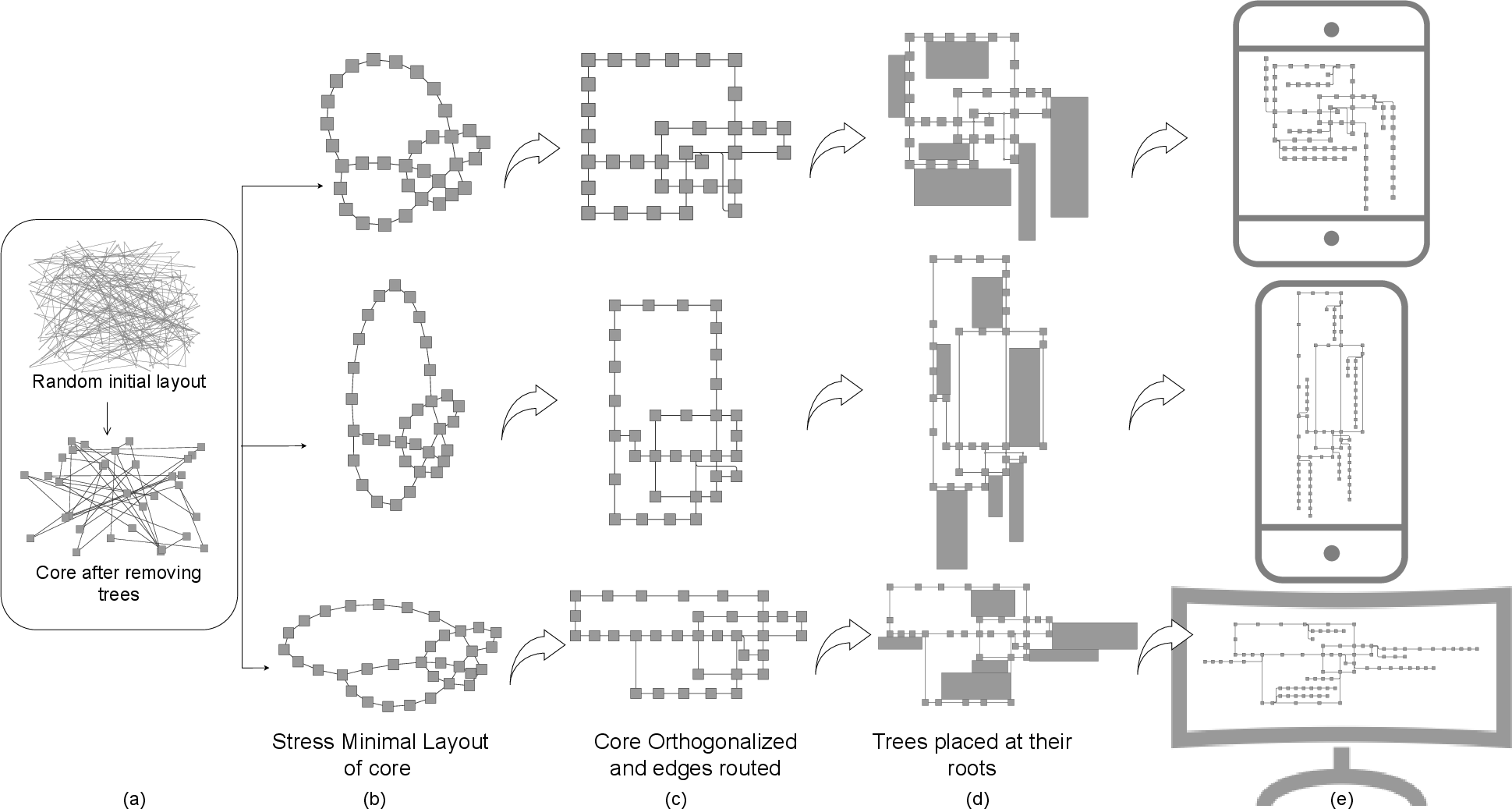
Figure 1: The ARCOL pipeline stages demonstrate initial layout initialization, aspect-ratio-aware stress minimization, core orthogonalization, tree attachment, and final fitting to the target aspect ratio.
These innovations ensure that AR control is achieved as an integral part of layout optimization, unlike post-hoc scaling, which introduces edge distortions and loss of geometric quality.
Comparative Analysis
Qualitative and quantitative evaluation demonstrates the superior performance of ARCOL across a comprehensive set of metrics derived from the universal graph drawing quality metric framework [Mooney et al., 2025]. ARCOL maintains favorable stress, edge-length deviation, node resolution, and uniformity scores across all AR targets, resulting in more legible and compact outputs, particularly for extreme aspect ratios.
Visual comparison with post-scaled HOLA layouts on sample graphs demonstrates ARCOL's ability to preserve proportion and grid-like regularity without the edge-length artifacts and inconsistent spacing that arise from naive post-processing.
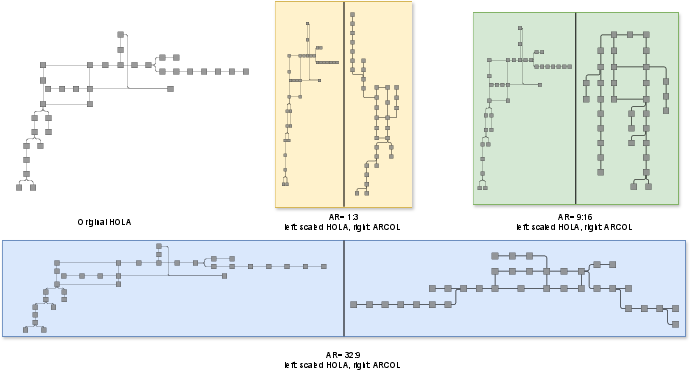
Figure 2: ARCOL vs. post-scaled HOLA for a Rome dataset graph across various aspect ratios, illustrating ARCOL’s preservation of geometric consistency.
For real-world graphs such as metro maps, ARCOL produces layouts that align closely with the target AR, achieving balanced whitespace distribution and maintaining schematic readability.
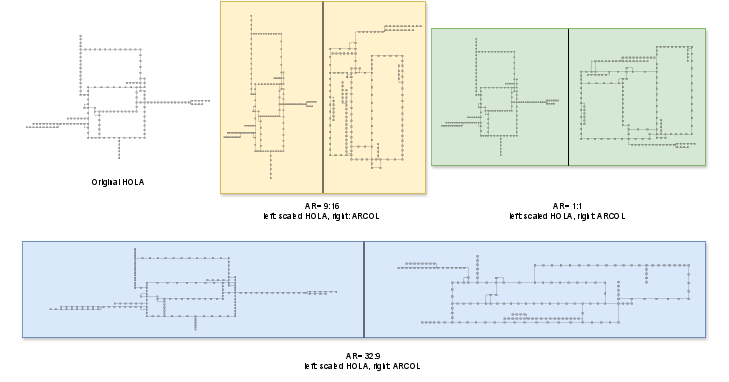
Figure 3: ARCOL yields balanced layouts on the Sydney metro graph for different aspect ratios, avoiding the excessive stretching seen in post-scaled HOLA.
The metrics—Kruskal Stress and Node Resolution—show negligible reductions in median scores compared to unconstrained HOLA for square ARs, and significant improvements in wide and tall ARs, establishing ARCOL's effectiveness for non-square deployment contexts.
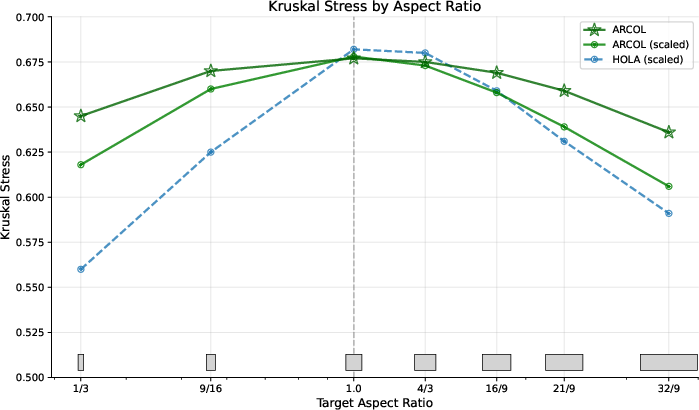
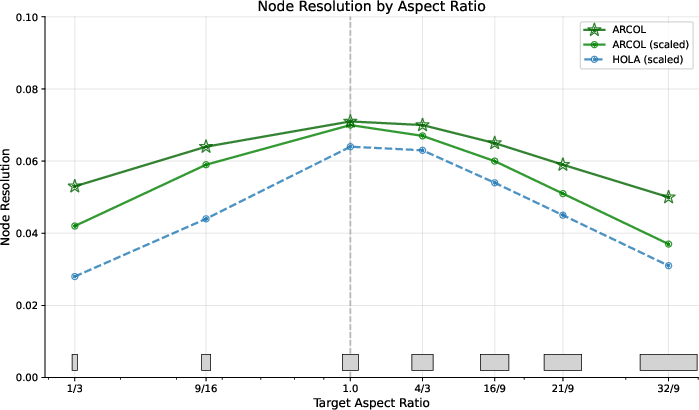
Figure 4: Kruskal Stress and Node Resolution scores comparing ARCOL to HOLA, with ARCOL outperforming HOLA or matching it for extreme aspect ratios.
Empirical Evaluation
ARCOL's practical utility was evaluated through both user and expert studies:
- User Studies: Task-based assessments with 20 participants showed ARCOL yielding both statistically significant faster completion times and higher accuracy in path-length identification tasks versus HOLA at non-matching ARs. In preference-based studies, 49.1% of ratings favored ARCOL, and preference strength correlated with subject expertise and the extremity of the target AR.
- Expert Feedback: Interviews with domain experts confirmed that aspect ratio control is absent from existing orthogonal layout pipelines. Experts emphasized the practical need for such functionality, especially in applications with fixed display regions, and independently attested to the reasonableness of ARCOL's tradeoffs between AR control and layout aesthetics.
Implications and Future Directions
ARCOL fills a longstanding methodological gap by treating aspect ratio as a first-class optimization target in orthogonal layouts. The separation of aspect ratio enforcement into both stress minimization and tree attachment stages provides an extensible template for multi-objective layout optimization. Continuous, soft AR adjustment—rather than hard constraints—proves to be both effective and stable, leading to layouts that simultaneously match target proportions and maintain aesthetic quality.
Theoretical implications arise from the observation that ARCOL's normalization-driven optimization does not induce instability or oscillations, but rather locates appropriate minima in the layout objective function landscape. This suggests that similar variance-based normalization techniques could be systematically explored for other layout properties or high-level diagram constraints.
On the practical side, ARCOL provides a deployable tool for automated graph layout in information visualization environments where space efficiency and aspect-ratio coherence are critical, such as multi-panel dashboards, mobile screens, urban-style network diagrams, and technical schematics.
Future extensions could include:
- Joint optimization for compactness, bend minimization, and aesthetic uniformity, balancing user-definable weights for competing objectives.
- Integration of tree placement within early-stage stress minimization for additional flexibility.
- Continuous, real-time layout adaptation as display container shapes change (responsive orthogonal layout).
- Extending the ARCOL paradigm to handle dense graphs, hypergraphs, or multi-layer/compound graph structures.
Conclusion
ARCOL establishes aspect ratio as a tractable and effective soft constraint within the orthogonal layout pipeline, providing direct global control without subverting underlying geometric or aesthetic quality. Through methodological innovations and extensive empirical validation, ARCOL is shown to deliver space-efficient, high-quality layouts across arbitrary aspect ratios, satisfying both objective and subjective requirements identified by end-users and domain experts. Its framework suggests new directions for constraint-integrated, multi-objective layout optimization in graph drawing.