Rapid axial loading of a grating MOT with a cold-atom beam
Published 31 Mar 2026 in physics.atom-ph | (2603.29580v1)
Abstract: Laser-cooled atoms are increasingly being used to realise practical quantum devices, motivating the development of compact and robust atom sources. Grating magneto-optical traps (gMOTs) simplify the cold-atom source architecture but are typically vapour-loaded and provide limited atomic flux. Here we explore the loading of gMOTs from cold-atom beams. We numerically simulate loading to show that unbalanced diffracted beams deflect incoming atoms away from the trap centre, thereby strongly constraining radial loading. In contrast, axial loading injects atoms directly into the trapping volume and largely avoids these effects. We experimentally demonstrate rapid axial loading of a gMOT, achieving loading rates of $2.1 \times 109$ atoms~s${-1}$ using a moving optical molasses to transfer atoms from a 2D MOT into the gMOT. These results establish axial loading as a robust route to high-flux gMOT operation for portable cold-atom systems.
The paper demonstrates efficient axial loading in a grating MOT using an on-chip aperture to inject a cold-atom beam, achieving maximum loading rates of 2.1×10^9 atoms/s.
The experimental methodology contrasts axial versus radial loading, showing that axial injection offers broader parameter tolerance and improved trapping efficiency.
The study integrates a compact 3D-printed titanium apparatus to minimize magnetic cross-talk and enhance performance for portable quantum sensors.
Rapid Axial Loading of a Grating Magneto-Optical Trap with a Cold-Atom Beam
Introduction
This paper details the development and experimental realization of an axially loaded grating magneto-optical trap (gMOT) for cold atoms, facilitated by a cold-atom beam derived from a 2D+MOT. The core innovation is the axial injection of atoms through an on-chip aperture, avoiding deleterious effects of diffracted-light-induced deflections that compromise traditional radial loading in gMOTs. The research provides comprehensive simulation, experimental validation, and systematic characterization of the loading process and demonstrates high atomic flux and equilibrium atom number in a compact, portable-friendly geometry.
Numerical Simulation of gMOT Loading Dynamics
The study initiates with a detailed force model for atomic trajectories in a gMOT, contrasting the behavior of atoms loaded radially versus axially in the presence of unbalanced diffracted beams. In a six-beam MOT, atoms traverse into the trapping volume without significant perturbation; however, the diffractive geometry of a gMOT introduces unbalanced radiation pressure outside the trap center, which either pushes slow atoms away or results in overfly by fast atoms depending on their velocity.
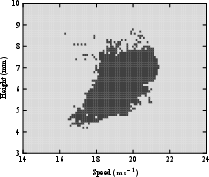
Simulations for a QUAD-style gMOT chip elucidate a narrow window of successful radial loading, requiring precise control over incident velocity (window width ≈ 5 m/s) and trajectory (±1.5 mm in height, see Fig. 2). In contrast, axial loading through a central aperture yields robust trapping over a broader parameter space, relatively insensitive to variation in detuning, intensity, or alignment.
Figure 1: Binary greyscale maps show trapping success (dark: trapped) versus atom speed and input height for radially loaded gMOTs, quantifying the narrow acceptance region for radial loading.
This pronounced asymmetry between loading geometries is traced to the interaction with outward-diffracted beams in the gMOT, which deflect atoms that are too slow, while only those with optimal initial velocities are capturable. Axial loading, implemented through a 3 mm hole in the grating optic, bypasses these adverse effects, allowing the use of a push beam and moving molasses to transfer atoms into the trap center with high fidelity.
Compact Integration and Apparatus Architecture
The apparatus consists of a two-chamber vacuum system—high-pressure (HP) for the 2D MOT and low-pressure (LP) for the 3D gMOT—separated by a differential pumping tube integrated into a monolithic 3D-printed titanium structure that also supports in-vacuum gMOT coils and the diffractive optic. The statistical model for atom transmission through the fixed aperture, based on Maxwell-Boltzmann velocity distributions, guides the spatial design to maximize atomic flux retention for typical beam divergences and velocities.
Key engineering considerations include minimizing cross-talk between overlapping quadrupole fields and ensuring maximal cold-atom flux through geometric optimization of the chamber layout and coil architecture.
Experimental Characterization of Axial gMOT Loading
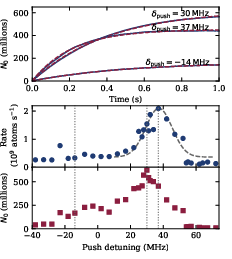
The core results are measurements of the atom number N and the initial loading rate dN/dt as a function of system parameters, notably the push-beam detuning and power. Atom number calibration employs direct fluorescence detection, while loading dynamics are fit to an exponential approach to equilibrium.
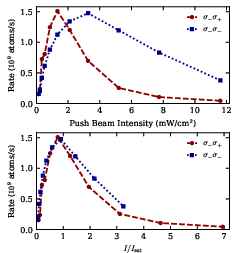
Figure 2: (a) gMOT loading curves for selected push-beam detunings, (b) peak loading rate versus detuning, and (c) equilibrium atom number showing distinct optima; (d, e) push-beam intensity dependence for two polarisation configurations.
The achieved maximum loading rate is 2.1×10⁹ atoms/s, realized at a push-beam detuning of +37 MHz from the cooling transition, where equilibrium atom number peaks at 6.2×10⁸ at a slightly lower detuning. Notably, the optimal velocity for atom transfer, realized via moving-molasses configuration, is approximately 20 m/s.
The study systematically varies push-beam polarization, observing that the core loading dynamics are robust to changes from linear to circular polarization, after accounting for differences in effective fluorescence rates. This is consistent with an efficient polarization-gradient cooling mechanism—rather than relying on simple optical lattice effects—that remains effective under practical variations in polarization.
Implications for Atom Source Development and Quantum Technologies
The demonstrated axial gMOT loading surpasses the flux and atom numbers typical of vapor-loaded traps by over an order of magnitude and matches or exceeds previous radially loaded cold-atom beam gMOTs, but with substantially greater insensitivity to alignment or operational parameter variation. This operational robustness, achieved without spatial access complications or increased vacuum pressure, positions the architecture as an optimal candidate for integrated and portable cold-atom quantum sensors and devices.
Axial loading minimizes magnetic cross-talk as system footprints shrink, simplifies alignment, and utilizes the intrinsic symmetry of in-vacuum coil configurations. The high flux and equilibrium atom numbers directly enhance the signal-to-noise ratio and sensitivity of quantum sensors (e.g. clocks, atom interferometers) via improved Ntotal scaling. Furthermore, increased achievable optical density broaches the requirements for efficient quantum memories and light–matter interfaces, and supports advanced cold-atom architectures that rely on high optical access and low thermal background, including applications in quantum communication and neutral-atom quantum computing.
Future Directions
Further progress could be realized by employing flat-top beam profiles for the gMOT cooling light, as shown in related work, which suggests an order-of-magnitude improvement in atom number is achievable. Monte Carlo extensions of the heuristic capture model could improve quantitative matching to measured flux transfer rates. Additionally, internal state and stochastic force modeling would enable design optimization for atomic species beyond rubidium and adaptation to ultracold or sub-Doppler regimes.
Conclusion
The research establishes axial loading of a gMOT via a cold-atom beam from a moving-molasses 2D+ MOT as a high-performance, robust method for compact cold-atom sources. The combination of strong numerical loading rates, operational tolerance, and intrinsic compatibility with miniaturized architectures addresses critical requirements for next-generation quantum technologies and portable quantum sensors. The approach is broadly extensible to a variety of atomic species and platform configurations, representing a substantive advancement in deployable cold-atom technology.
“Emergent Mind helps me see which AI papers have caught fire online.”
Philip
Creator, AI Explained on YouTube
Sign up for free to explore the frontiers of research
Discover trending papers, chat with arXiv, and track the latest research shaping the future of science and technology.Discover trending papers, chat with arXiv, and more.