- The paper establishes rigorous mean-field convergence for the ground state energy of the Bose–Hubbard model in the high-coordination limit using a novel de Finetti theorem.
- It employs Gutzwiller variational methods paired with a core-shell decomposition to derive both upper and lower energy bounds.
- The findings rigorously justify DMFT and offer transferable tools for analyzing impurity–bath systems in strongly coupled bosonic lattices.
Ground State Energy of the Bose–Hubbard Model in the High-Coordination Number Limit: Mean-Field Convergence via a Polaron-Type Quantum de Finetti Theorem
Introduction and Model Setting
The analysis establishes rigorous mean-field behavior for the ground state energy of the Bose–Hubbard model in the limit of large, homogeneous coordination number z. The Bose–Hubbard Hamiltonian is considered on a family of graphs with vertex set Vz and coordination number z, with local on-site interaction U and hopping term J scaled as J/z. The main result consists of proving that, as z→∞, the ground state energy per site converges to the minimum of an effective mean-field functional. Unlike typical mean-field approaches where the interaction is rescaled, here the interaction is kept at fixed strength (strong coupling), and only the hopping term is averaged, reflecting a "weak-hopping" regime.
Physically, the Bose–Hubbard model interpolates between Mott insulator (MI) and superfluid (SF) quantum phases, with a transition controlled by the ratio J/U and chemical potential μ. At large coordination, mean-field theory becomes exact, justifying analysis based on Gutzwiller product states and enabling rigorous identification of the effective phase diagram for high-dimensional lattices.
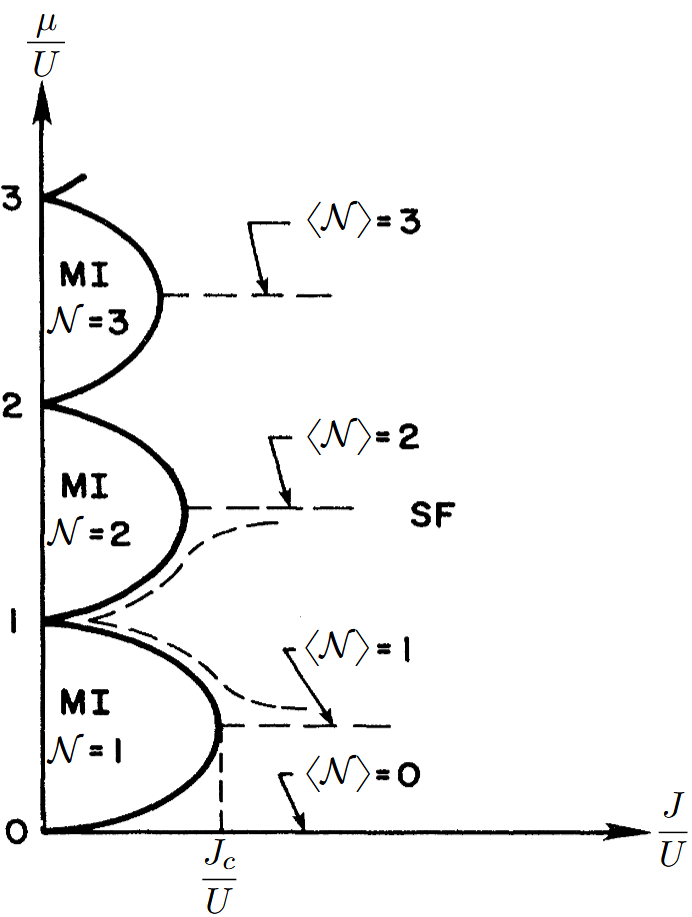
Figure 1: Mott insulator (MI) / Superfluid (SF) phase diagram for the Bose–Hubbard model, showing lobes of insulating phases at commensurate filling surrounded by the superfluid region. Phase boundaries are determined by minimizing the mean-field functional.
Main Theorem and Approach
The principal claim establishes that for U>0 and Vz0: Vz1
where Vz2 is a nonlinear operator incorporating mean-field hopping and unscaled on-site interaction: Vz3
This convergence result is substantiated by two key steps:
- Upper bound: Direct variational estimation using Gutzwiller factorized states (on-site product states).
- Lower bound: A nontrivial reduction to a "core plus symmetric shell" problem and application of a polaron-type quantum de Finetti theorem, which generalizes standard quantum de Finetti structure to tensor products of a distinguished core Hilbert space with a symmetric (bosonic) Fock space.
Mathematical Innovations: The Polaron-Type Quantum de Finetti Theorem
Standard quantum de Finetti theorems yield structural decompositions for bosonic density matrices (symmetrization over modes/particles). In the Bose–Hubbard setting, the lack of site-exchange symmetry prevents direct application. The authors overcome this by identifying a reduction to a model where a "core" site is coupled to a symmetric "shell" of neighbors (mirroring polaron models with an impurity in a bosonic bath), and then developing a novel de Finetti-type structure in mixed (core, symmetric shell) Hilbert spaces: Vz4
Here, Vz5 is the joint core + Vz6 shell marginal, Vz7 the sphere in the shell Hilbert space, Vz8 a one-site state depending on shell order parameter Vz9, and z0 the rank-one shell projector.
The proof proceeds via a sequence of finite-rank projections (z1), Fock space localization, and diagonalization—a methodology reminiscent of mean-field derivations in the continuum, but here adapted to systems lacking full permutation symmetry and involving infinite dimensionality.
Implications for the Bose–Hubbard Model and Phase Diagram
The convergence theorem rigorously justifies the dynamical mean-field theory (DMFT) reduction for bosonic lattice systems with high coordination, placing the mean-field phase diagram on firm mathematical footing in this limit. As illustrated in Figure 1, this diagram captures the loci of MI/SF phases and reproduces the expected "lobe" structure as a function of z2 and z3, with MI phases demarcated by vanishing condensate order parameter (z4) and SF phases by nonzero z5. The scaling analysis clarifies that the mean-field prediction is already qualitatively accurate for moderately large z6 (e.g., cubic lattice in z7).
The result covers the strong coupling regime (z8 unscaled), distinguishing it from weak coupling mean-field limits (Kac/van der Waals-type), which cannot account for such quantum phase transitions. This distinction is critical for the theoretical understanding of lattice quantum matter at strong coupling and provides a mathematical underpinning for commonly adopted mean-field and DMFT treatments in high-dimensional systems.
Technical Highlights
- Lower bounds: Achieved via localization to the core+shell Hamiltonian and the new de Finetti decomposition. The lower semicontinuity of the energy functional is handled with Schatten-class and operator-ideal techniques adapted for occupation number growth.
- Upper bounds: Standard variational arguments, as symmetry-breaking Gutzwiller states are energetically optimal in the mean-field limit.
- Applications of the theorem: The construction subsumes previously studied permutationsymmetric or particle-symmetric cases as limits, generalizing standard de Finetti results (Størmer, Hudson-Moody, Fannes-Lewis-Verbeure) and unifying the mean-field analysis for a class of impurity–bath (polaron-type) quantum systems.
Outlook and Future Directions
This work opens the path for further investigations into quantum many-body lattice models, notably:
- Dynamics: Extension of the technique to full time-dependent dynamics and nonequilibrium phase transitions, as well as rigorous derivations of DMFT for time evolution.
- Other Lattice Models: Application of the polaron-type de Finetti theorem for composite or impurity models, including Bose-Fermi mixtures, extended Hubbard models, and systems with disorder or long-range interactions.
- Precision in Finite Dimensions: Quantitative convergence rates, corrections to mean-field theory, and rigorous characterization of fluctuations and bosonic long-range order in three and higher spatial dimensions.
- Universality of the Theorem: Adaptations to more general settings, e.g., multi-species systems and models with additional symmetry or disorder, beyond the Bose–Hubbard paradigm.
Conclusion
The rigorous derivation of the mean-field ground state energy for the Bose–Hubbard model at large coordination, via a novel polaron-type quantum de Finetti theorem, firmly establishes the validity of the mean-field approach in high-dimensional bosonic lattice systems. The methodology not only clarifies the mathematical status of the DMFT/mean-field description but also introduces transferable tools for analyzing composite quantum systems with both symmetric and nonsymmetric degrees of freedom, with anticipated applications in the broader analysis of quantum impurity and composite systems.

