- The paper establishes sharp phase transitions in accessibility percolation by identifying the critical threshold θ_c using multi-type branching processes and spectral analysis.
- Key methods include explicit combinatorial enumeration and innovative multi-scale bricklayer lattice coupling applied to both BGW trees and n-dimensional lattices.
- The results offer concrete insights for evolutionary models by linking deterministic fitness drift with probabilistic graph structures.
Accessibility Percolation with Rough Mount Fuji Labels
Introduction and Model Definition
The paper "Accessibility Percolation with Rough Mount Fuji labels" (2603.29561) rigorously investigates the existence and structure of infinite accessible paths on various graph structures under the Rough Mount Fuji (RMF) fitness landscape. In this stochastic model, each vertex v receives a label Xv=Uv+θd(ρ,v), where Uv are i.i.d. Uniform(0,1) random variables, ρ is a distinguished root, d is a distance metric, and θ imposes a deterministic linear drift corresponding to selective advantage. A path is accessible if the sequence of labels is strictly increasing. Accessibility percolation occurs if there exists an infinite accessible path from the root.
The core focus is the identification of critical parameter θc as a function of the graph topology and its implications for percolation. The work delineates explicit characterizations, non-trivial bounds, and phase transition phenomena, advancing both probabilistic combinatorics and biological modeling of evolutionary fitness.
Critical Thresholds on Trees
For infinite, locally finite trees—especially Bienaymé-Galton-Watson (BGW) trees—the authors deliver exact and asymptotic characterizations of the accessibility percolation threshold θc. Leveraging a refined multi-type branching process approach and spectral analysis, the paper establishes that θc is the unique value ensuring the largest real eigenvalue of a natural associated operator crosses unity.
The main theoretical result states that for a BGW tree with mean offspring number Xv=Uv+θd(ρ,v)0,
an accessible path exists with positive probability if and only if Xv=Uv+θd(ρ,v)1, where Xv=Uv+θd(ρ,v)2 solves a specific polynomial equation: Xv=Uv+θd(ρ,v)3
The analysis extends to arbitrary trees by exhibiting a general lower bound: for any infinite locally finite tree Xv=Uv+θd(ρ,v)4 with branching number Xv=Uv+θd(ρ,v)5,
Xv=Uv+θd(ρ,v)6
with upper bounds closely matching, ensuring the phase transition is sharp up to Xv=Uv+θd(ρ,v)7 asymptotics as Xv=Uv+θd(ρ,v)8. The proofs utilize precise combinatorial enumeration (first moment methods), as well as a spectral theory argument involving compact operators and the Krein–Rutman theorem for positivity of the leading eigenfunction.
Phase Transitions and Geometry on Xv=Uv+θd(ρ,v)9
Transitioning to the Uv0-dimensional integer lattice Uv1, the percolation threshold becomes sensitive to both the allowed path constraints and the metric Uv2. The study distinguishes between non-backtracking paths (always moving strictly farther from the origin) and simple paths (including backsteps). For each regime, the authors establish that Uv3, the critical value with metric Uv4 (Uv5), satisfies Uv6, i.e., the phase transition is always non-trivial.
Explicit lower bounds on Uv7 are obtained using tree embeddings, yielding
Uv8
The proof for percolation at large Uv9 employs an innovative coupling with oriented percolation and, for Uniform(0,1)0, a hierarchical "bricklayer" percolation construction with inhomogeneous dependencies (visualized below). This construction shows that for all Uniform(0,1)1 and Uniform(0,1)2, accessibility percolation occurs for some Uniform(0,1)3.
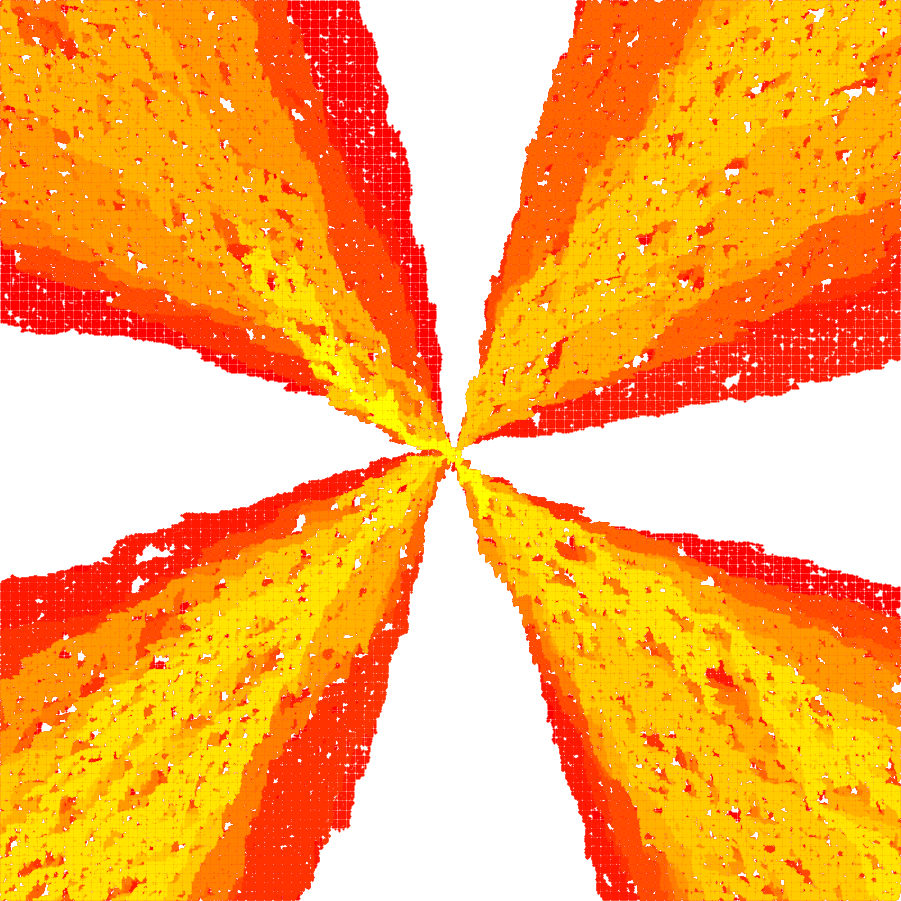
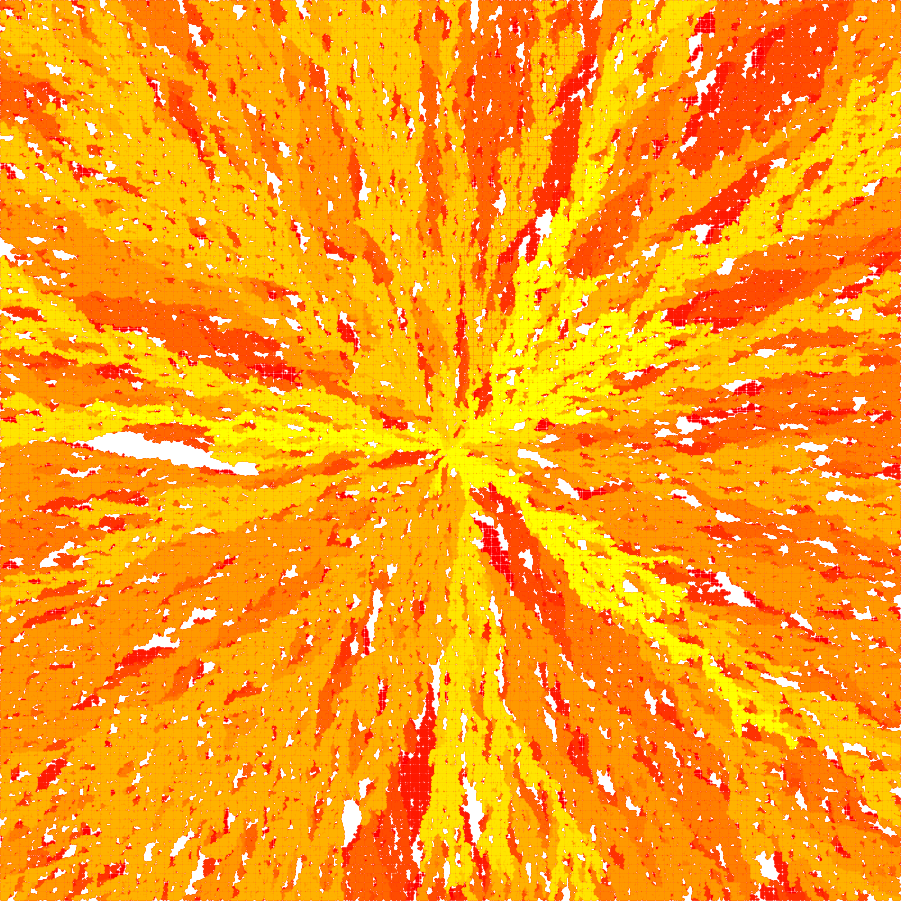
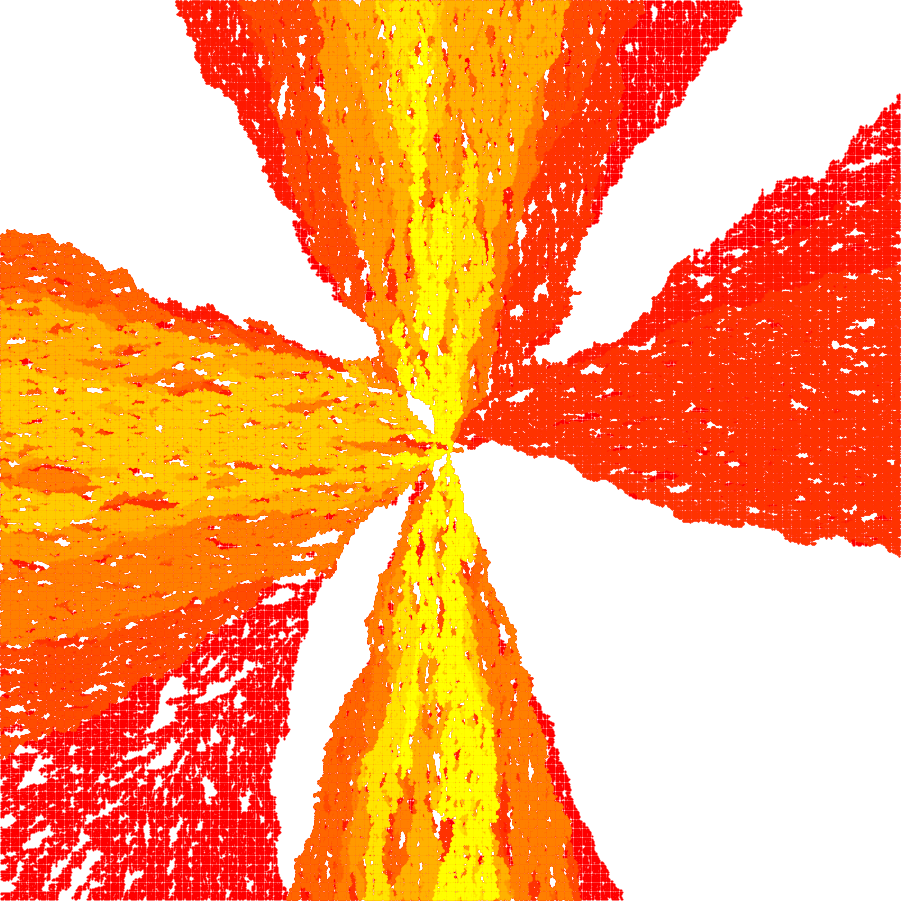
Figure 1: Accessible paths from the origin with backsteps under different Uniform(0,1)4 distances; path geometry preferences manifest as Uniform(0,1)5 varies.
Further, by analyzing the influence of the metric, the authors reveal that the geometry of accessible paths varies: with Uniform(0,1)6 distance, accessible paths concentrate near the diagonal, whereas for higher Uniform(0,1)7 paths track the axes (see Figure 1). Without backsteps, both accessible region and critical threshold are further constrained, and the difficulty of accessing paths near diagonals becomes pronounced as Uniform(0,1)8 increases.
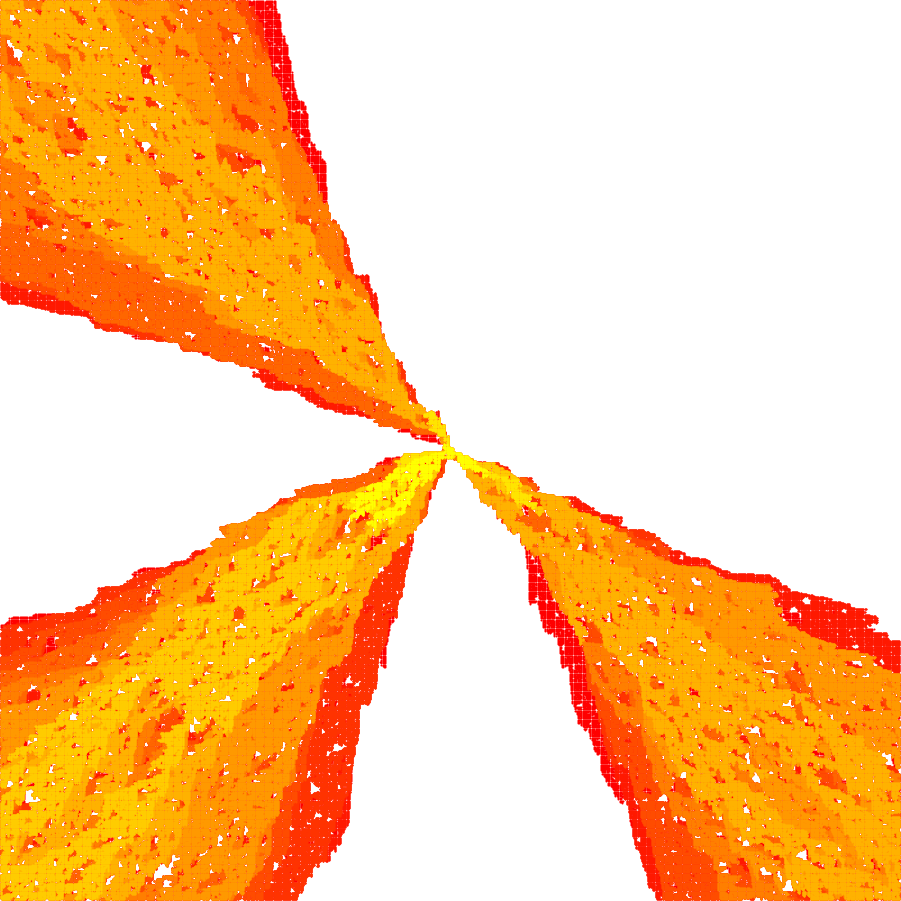
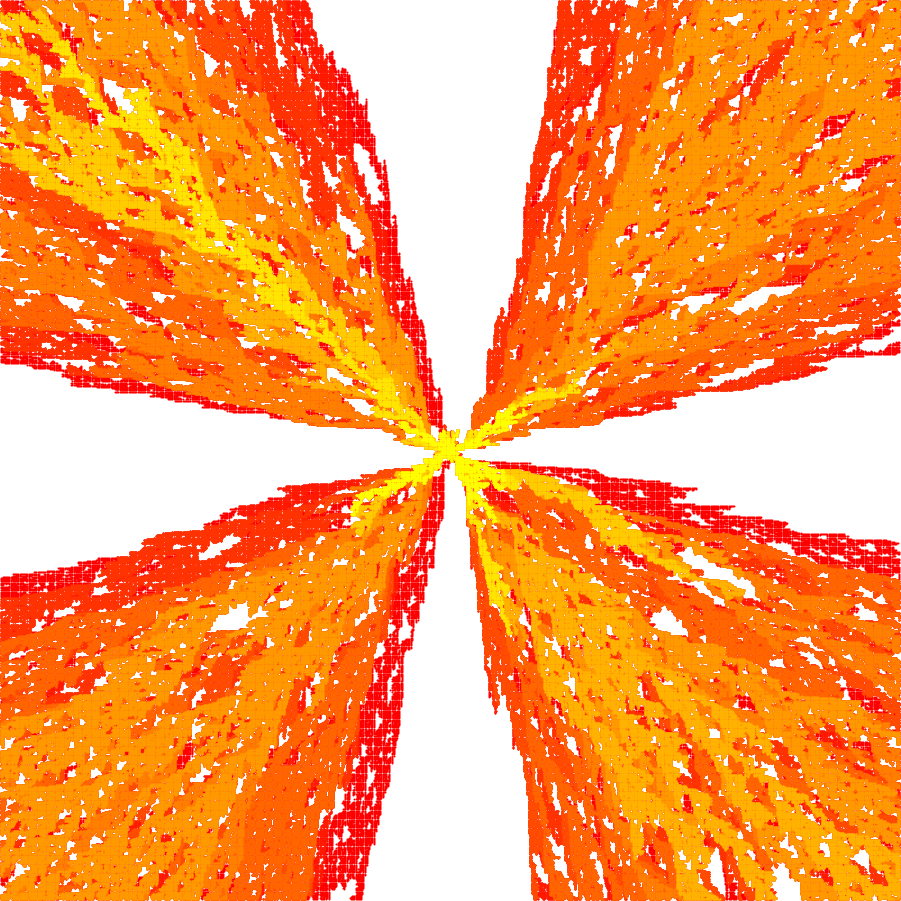
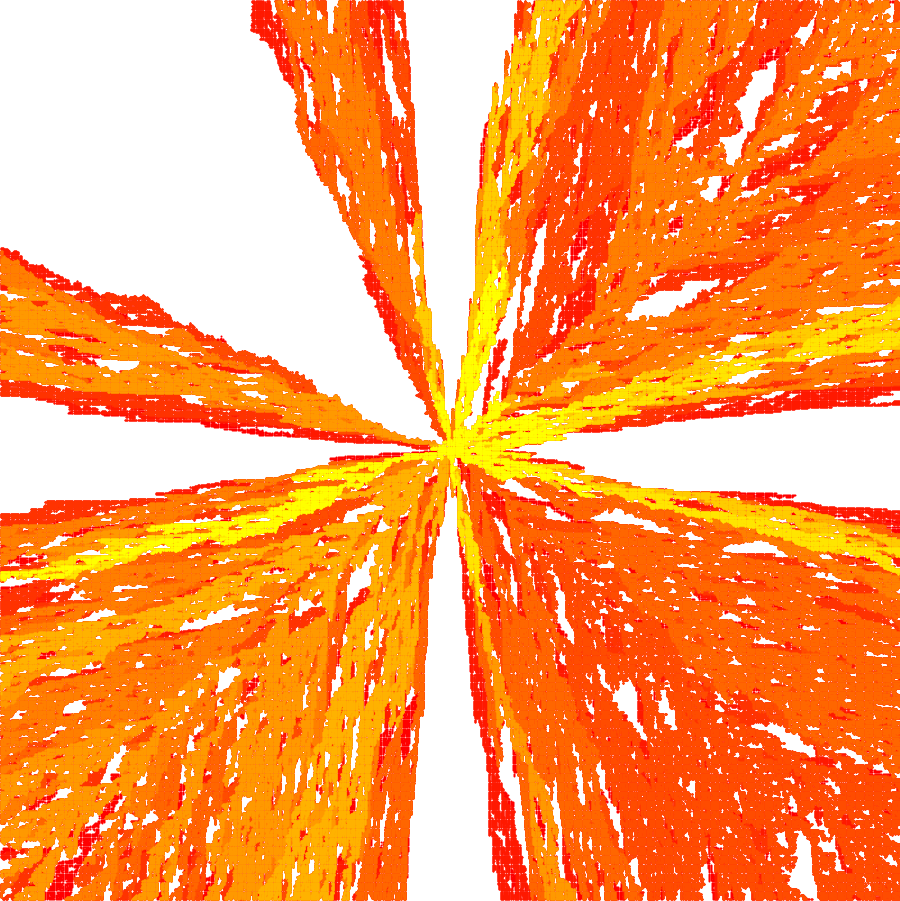
Figure 2: Accessible paths from the origin without backsteps; increasing Uniform(0,1)9 makes diagonals less accessible, axes always remain inaccessible.
The Bricklayer Lattice and Two-Scale Percolation
For general ρ0 metrics (ρ1), the classical coupling to oriented percolation fails due to small distance increments near the axes. To overcome this, the paper introduces the bricklayer lattice, segmenting the lattice into bricks—a local subgrid where open paths are constructed by probabilistic selection of horizontal and vertical "good" edges. Within each brick, the coupling to percolation is handled with high probability, and bricks are then coupled macroscopically to an oriented percolation process.

Figure 3: Visualization of an individual brick, elucidating the edge structure involved in the two-scale coupling.

Figure 4: Segment of the bricklayer lattice, with green (good) and red (bad) bricks. An infinite green path ensures RMF accessibility percolation.
This multi-scale construction ensures that, for sufficiently large ρ2 (depending on ρ3 and the brick size parameter), an infinite accessible path exists via concatenation of good bricks. The percolation phase transition on the lattice thus inherits non-triviality from the high-level percolation on the bricklayer lattice.
Biological and Theoretical Implications
The analysis applies directly to models of genotype accessibility under fitness landscapes with deterministic drift, a key abstraction in evolutionary theory for understanding selective sweeps and evolutionary trajectories. The explicit and asymptotic characterization of thresholds elucidates the interplay between selection strength (quantified by ρ4) and population "branching" (tree growth or lattice dimension), generalizing and solidifying results for RMF landscapes used in evolutionary biology.
Practically, the insights into path geometry may inform computational heuristics for navigating high-dimensional fitness landscapes, while the two-scale bricklayer approach could be generalized to analyze other dependent oriented percolation models on lattices with non-standard metrics or local inhomogeneities.
Conclusion
The paper presents a comprehensive and rigorous treatment of accessibility percolation with Rough Mount Fuji labeling, establishing both explicit and asymptotically sharp thresholds for the existence of infinite accessible paths on trees and high-dimensional lattices. The phase transition analysis via multi-type branching processes and multi-scale percolation couplings marks a significant technical advance. The geometric characterizations and the introduction of the bricklayer percolation method will likely inform further research into phase transitions and accessible path problems on structured random graphs and related mathematical models in evolution and statistical physics.