- The paper demonstrates that exact covering of K33 with cliques of orders 3, 4, or 5 cannot be achieved with fewer than 59 blocks.
- It introduces a novel layered search pipeline combining symmetry reduction, arithmetic filtering, geometric tests, SAT verification, and audit processes.
- Comparative analysis shows that traditional approaches like ILP and DLX are outperformed by the SAT-based method in managing complex unsatisfiability cases.
SAT-based Filtering and Exact Covering of K33 by Cliques: Methodological Analysis and Results
Introduction
The paper addresses the problem of exactly decomposing the complete graph K33 into cliques of orders $3$, $4$, or $5$, aiming to minimize the number of covering cliques without excess (i.e., every edge is covered exactly once). The theoretical lower bound is $57$ for the required number of blocks, but the paper demonstrates algorithmically that such a decomposition is infeasible, advancing the lower bound to $59$. The authors introduce a layered search pipeline leveraging symmetry reduction, signature enumeration, arithmetic filtering, geometric tests, SAT verification, and decoding/audit processes. This approach outperforms standard monolithic ILP, DLX, and SAT encodings for unsatisfiable large mixed-clique covering instances.
Computational Paradigms for Clique Coverings
Three main computational paradigms are analyzed: Integer Linear Programming (ILP), Dancing Links (DLX), and Boolean Satisfiability (SAT). ILP formulations yield feasible configurations and relaxations, but become computationally prohibitive post-arithmetic reduction (e.g., (α,β,γ)=(6,0,51) for K33 still gives $242,792$ variables). DLX excels in smaller instances, but suffers from symmetric search space explosion and lacks informative infeasibility diagnostics. Modern SAT solvers efficiently handle reduced instances but face combinatorial bottlenecks with full-size unsatisfiable cases, as evidenced by millions of clauses and variables with no results after hours.
The layered approach systematically narrows the combinatorial search space before invoking any solver, in contrast to a monolithic encoding that immediately faces enormous symmetry and branching.
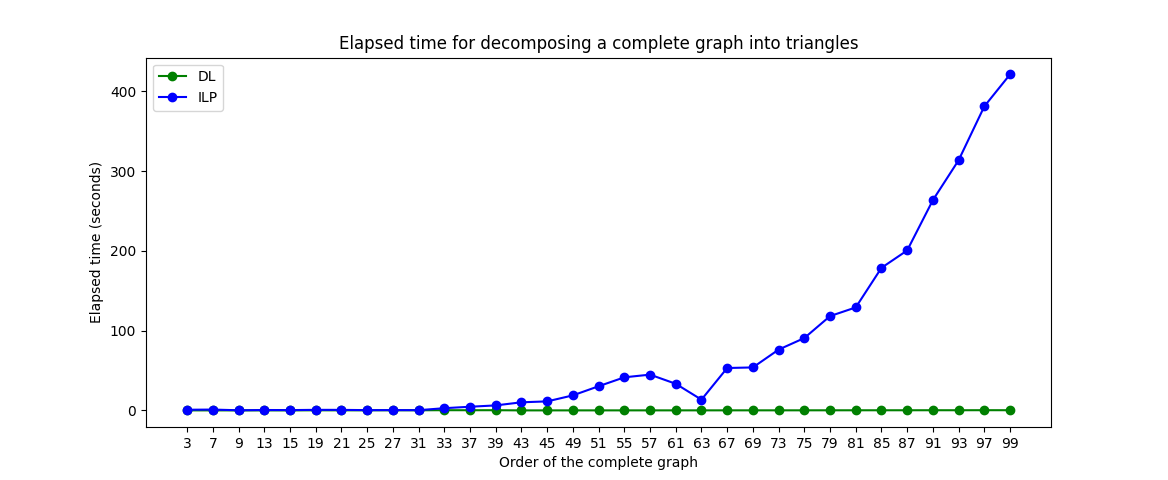
Figure 1: Comparison of the dancing links (1 solution) with integer linear programming, highlighting superior efficiency of DLX in triangle decompositions for small K330.
Combinatorial Reductions: Warmup via K331 and K332
The paper begins with decompositions of K333 and K334 by cliques of order K335 and K336, utilizing degree congruence and local profile analysis to isolate uniquely structured residues. ILP is used only as the final check. For K337, the minimum realization is K338; for K339, $3$0. These cases demonstrate that pre-solver local reduction is more substantial than solver-based brute force, laying the methodological foundation for the larger $3$1 instance.
Main Instance: $3$2 and Mixed Cliques
For coverings by $3$3, combinatorial arithmetic restricts possible decompositions for $3$4 to two cases, $3$5 and $3$6. The first is excluded by prior theoretical results, leaving $3$7 as the unique candidate. Monolithic ILP, DLX, and SAT formulations are benchmarked, all timing out with no feasible incumbent or certificate, confirming the inefficacy of single-layer approaches.
Layered Exact Filtering: Algorithmic Exclusion Pipeline
The layered search pipeline for $3$8 operates as follows:
- Fix triangle patterns (grid or prism) on a $3$9 distinguished subgraph.
- Enumerate admissible local signatures for outside vertices.
- Assemble signature combinations matching precise arithmetic distributions.
- Apply geometric filters ensuring compatibility of type-0 quintuples.
- Invoke SAT solvers on filtered branches.
- Decode the SAT solution and audit for edge-disjointness.
- In rare surviving cases, complete the assignment with remaining type-1 quintuples.
This stepwise reduction compresses the search space significantly, with each filter removing infeasible branches based on structural, arithmetic, or geometric constraints rather than global exhaustive search.
Detailed Case Analysis: Prism Pattern with $4$0
The prism pattern with $4$1 is the mantle for the main representative case. Two orbits are generated through automorphism group actions, with local signatures cataloging possible incidences with type-2 and type-3 $4$2 quintuples. Arithmetic stage narrows to $4$3 and $4$4 global signature distributions per orbit. Sharp geometry filters further cull infeasible distributions, SAT solvers address the remaining filtered branches, and audits reject all remaining survivors due to edge overlap. The remaining branches are eliminated via combinatorial and SAT-based completion checks. All $4$5 main cases (across grid and prism patterns and possible $4$6 values) are shown infeasible, either through SAT impossibility or residual edge coverage contradictions.
Exclusion of $4$7-Block Decompositions
A supplementary counting argument excludes decompositions with $4$8 cliques, demonstrating arithmetically that both $4$9 and $5$0 compositions fail due to local degree and clique incidence compatibility. This establishes the new lower bound $5$1.
Implications for Packing Number $5$2
The covering result constrains possibilities for the open packing number $5$3, known to lie between $5$4 and $5$5. Each hypothetical packing with $5$6 $5$7's would leave a $5$8-regular graph on $5$9 vertices. The algorithmic exclusion presented here eliminates two natural candidate leave structures (grid and prism patterns), narrowing the set of possible solutions for this outstanding problem in combinatorial design theory.
Theoretical and Practical Implications
The paper's framework proves highly effective for large, symmetric, unsatisfiable combinatorial search spaces, emphasizing the value of progressive exact filtering—a methodology applicable to clique cover, design theory, and combinatorial optimization. While monolithic encodings provide global feasibility certificates, progressive filtering exposes structured infeasibility and scaling strategies. SAT is used as a local feasibility verifier rather than the global engine, marking a methodological departure from one-shot exhaustive approaches.
Conclusion
The layered SAT-based filtering strategy definitively excludes the existence of exact $57$0 covering by $57$1 or $57$2 blocks of orders $57$3, $57$4, or $57$5, elevating the minimal covering number to $57$6. By combining symmetry reduction, signature enumeration, local profile filtering, geometric constraints, and SAT verification within a pipeline, the approach circumvents combinatorial explosion and reveals deep structural infeasibility unaccessible to monolithic computational methods. The framework is extensible to other combinatorial decomposition and packing problems where arithmetic and local structure drive global search impossibility. The exclusion impacts ongoing research into packing numbers and clique decompositions, and offers a practical protocol for complex design-theoretic questions.