- The paper shows that sequential wide and narrow jets naturally form circum-jet rings in core-collapse supernovae, emulating observed remnant structures.
- High-resolution 3D FLASH simulations reveal detailed jet-shell interactions, turbulence, and instabilities that drive ring formation.
- Parameter studies confirm that circum-jet rings robustly emerge across varied jet energies and opening angles, challenging classical neutrino-driven models.
Simulating Circum-Jet Rings in the Jittering-Jets Core-Collapse Supernova Explosion Mechanism
Introduction: Context and Motivation
This study provides a comprehensive hydrodynamical analysis of the jittering jets explosion mechanism (JJEM) as a pathway to core-collapse supernova (CCSN) explosion morphology. The authors address a long-standing issue in supernova theory: the inability of classical neutrino-driven explosion models to explain the complex, often point-symmetric and ring-like morphologies observed in numerous core-collapse supernova remnants (CCSNRs). Previous theoretical frameworks have hypothesized that intermittent, stochastically-precessing accretion disks around newborn neutron stars can launch multiple pairs of energetic jets not aligned with a single axis. This jittering jet paradigm predicts a diverse range of ejecta morphologies, but its detailed hydrodynamical implications—especially for ring-like structures—require further investigation.
Through high-resolution three-dimensional (3D) FLASH simulations, the paper demonstrates that the interaction of two pairs of jets—one wide, followed by a narrower, more collimated pair—can produce a set of opposite circum-jet rings. These features are shown to closely match structures imaged in specific CCSNRs, particularly SNR G46.8−0.3 and G11.2−0.3.
Numerical Simulation Framework
The simulation setup utilizes a stripped-envelope, 15 M⊙ core derived from a combination of MESA and previous hydrodynamical post-bounce profiles. Due to computational constraints, jets are injected from radii much larger than the physical launching site, and both gravity and further fallback/late-time jet activity are neglected. The approach focuses on the morphology of the outer ejecta, i.e., the dense shell and surrounding regions, after the initial, most energetic phases of the explosion.
The key jet-parameter space is as follows:
- The first pair of jets is wide (αwide,1=60∘), high velocity (8×10⁴ km s−1), and energetic (Ewide=3×1051 erg) with a half-second duration.
- The second pair (narrow jets) is launched along the same axis at later times, with half-opening angles as small as 5∘ and energies varying between 3.3×1049 and 3×1050 erg.
Adaptive mesh refinement (AMR, up to level 8) ensures sufficient resolution to capture jet-shell interaction and instability development.
The evolution of the density structure in the meridional plane elucidates the sequential action of wide and narrow jets. The initial, wide pair forms a dense, expanding shell. The subsequent narrower jets puncture this shell, channeling their energy along the axis before deflecting material laterally to compress it into opposite rings.
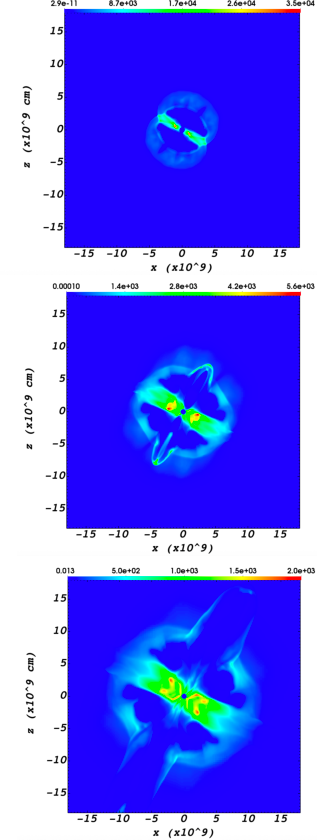
Figure 1: Time evolution of the density in the −0 plane indicating the transition from shell compression by wide jets to ring formation as narrow jets interact with the shell material.
3D equidensity surface visualizations confirm the existence of pronounced circum-jet rings, with Rayleigh-Taylor (RT) instability-induced clumpiness and fragmentation that closely resembles the observed filamentation in several young CCSNRs.
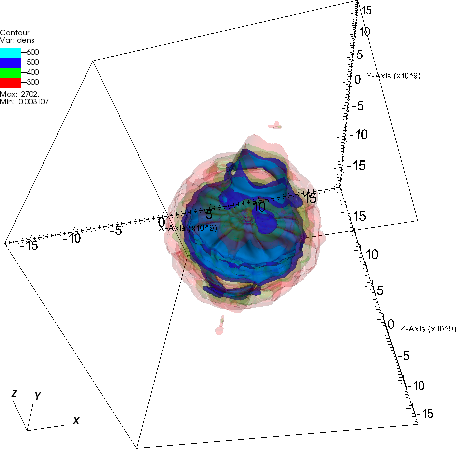
Figure 2: Three-dimensional rendering of gas density, highlighting equidensity surfaces and the emergence of circum-jet rings and nozzle breakout regions.
The velocity field diagnostics reveal highly supersonic outflows inside the jet channels and fast-moving lateral fronts as material is swept into rings. Vorticity and RT analyses show that turbulence and instabilities are primarily concentrated in narrow shearing envelopes around the jets, suggesting localized mixing and potential implications for nickel and other element transport.
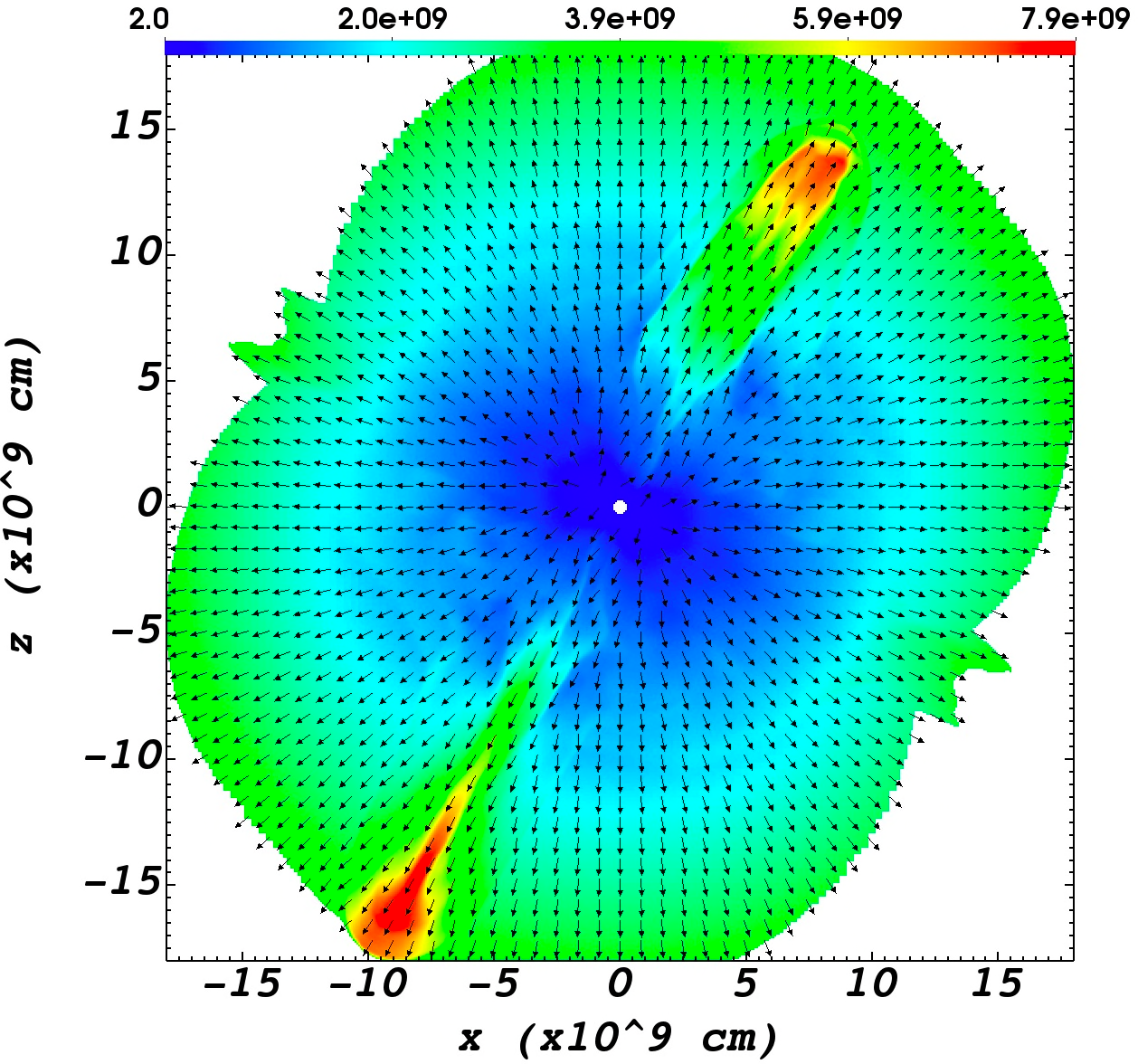
Figure 3: Velocity structure in the −1 plane, illustrating directional flow and fast expansion in jet and shell regions.
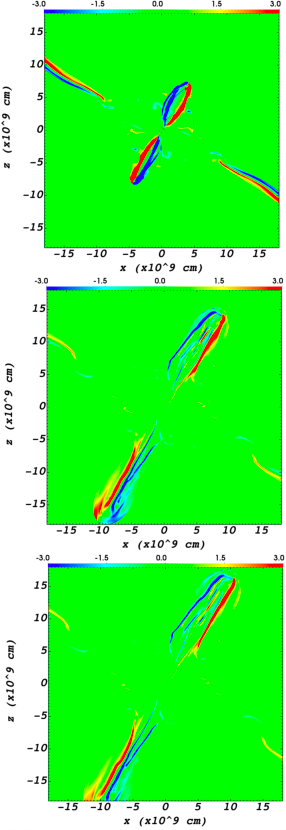
Figure 4: Meridional vorticity, emphasizing narrow zones of strong turbulence and efficient mixing at the jet-shell interface.
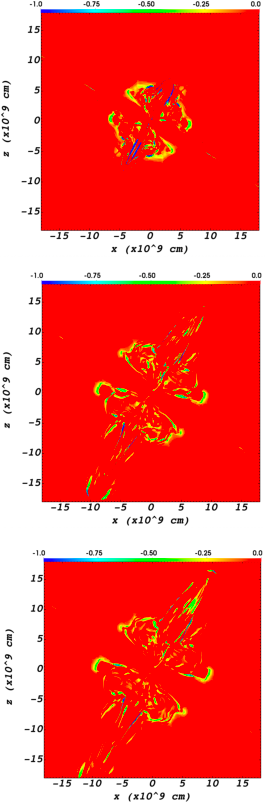
Figure 5: RT instability diagnostic −2, with negative regions denoting rapid instability growth in ring-forming envelopes.
Emission Integral Diagnostics and Projection Effects
The emission integral (EI, −3) is computed to provide synthetic observational maps for direct comparison with multi-wavelength images of supernova remnants. By varying the angle between the observer’s line of sight and the jet axis, the simulations reproduce the range of ring projections—from bright, localized zones at high inclination (when ring arcs cross the plane of the sky) to fully resolved elliptical rims at lower inclinations.
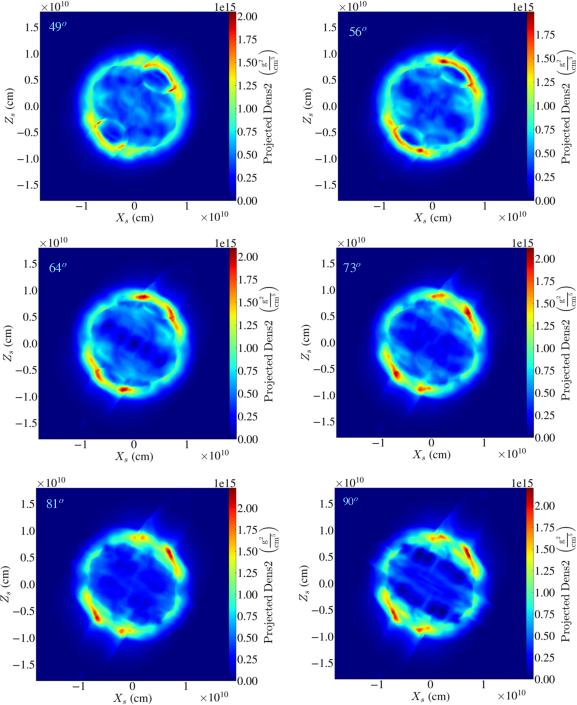
Figure 6: Emission integral maps for various viewing angles, demonstrating the appearance of circum-jet rings and bright projected zones.
Systematic parameter studies (jet energy, opening angle, timing, alignment) reveal that circum-jet rings are robust to order-of-magnitude variations and mild misalignments, and eccentricity/asymmetry grows in more extreme cases.
Comparison with Observed Remnants
The morphologies derived from these hydrodynamical simulations match the distinctive features in remnants such as SNR G46.8−40.3 and G11.2−50.3, which display pairs of bright diametric regions and/or ring structures inconsistent with CSM/ISM interaction alone.
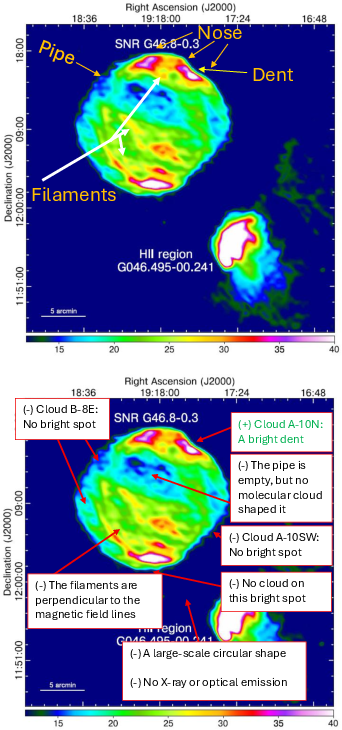
Figure 7: Radio image of SNR G46.8−60.3 at 1.4 GHz, showing "nose" and bright zone pairs, with annotated morphological features.
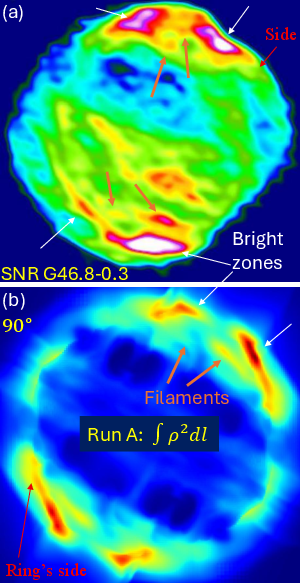
Figure 8: Overlap of observed radio features with simulation emission integral projections, highlighting correspondence of bright zones and filaments to synthetic circum-jet rings.
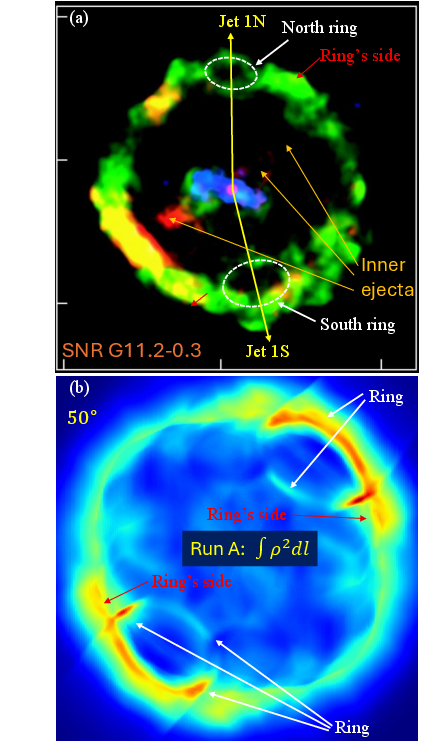
Figure 9: Left: X-ray/radio composite image of G11.2−70.3 with ring identifications and jet axes; Right: synthetic emission map at −8 inclination, showing outer-shell ring features.
This correspondence strengthens the claim that the JJEM—not only the canonical neutrino mechanism—is essential to the dynamical shaping of CCSN ejecta. In particular, the formation of paired circum-jet rings does not require fine tuning and cannot be explained by spherically-symmetric or single-axis jet models. The analysis of SNR G46.8−90.3 demonstrates that morphological features such as bright spots, pipes, nose extensions, and filaments are not reconcilable with environmental interaction alone, but emerge naturally from stochastic jet episodes interacting with previously ejected shells.
Implications and Outlook
This work provides quantitative simulation evidence that supports the JJEM as the dominant physical process driving the diversity of CCSN morphologies, especially for objects with clear ring-like or point-symmetric features. The high density contrast, turbulence, and instability development accompanying ring formation have implications for mixing, elemental yields (in particular the distribution of M⊙0Ti and M⊙1Ni), and late-time radiative signatures.
The robustness of ring formation across a wide jet parameter space indicates that future high-resolution imaging surveys and spectral diagnostics of CCSNRs can directly constrain the history and angular distribution of jet activity during explosion. There is scope for extending the work to include additional jet episodes, fallback, and the inclusion of gravity to refine inner ejecta morphology, which will become tractable with next-generation computational resources.
Conclusion
The 3D FLASH simulations conducted in this study demonstrate that the sequential action of wide and narrow jets along quasi-random axes naturally produces pairs of circum-jet rings in the ejecta of stripped-envelope CCSNe, matching characteristic structures in several observed remnants. These results provide strong evidence that jet-driven explosions—rather than spherically symmetric neutrino heating—are responsible for a significant fraction of observed CCSNR morphologies. The systematic exploration of projection effects and parameter robustness reinforces the predictive potential of the JJEM, opening avenues for direct observational falsification and constraining explosion physics via resolved remnant structure.