- The paper introduces the dressing field method as a systematic approach to extract invariant observables in general‐relativistic gauge theories.
- It formulates dressed fields by replacing gauge parameters, providing a clear alternative to traditional gauge‐fixing and spontaneous symmetry breaking.
- The study unifies various symmetry reduction techniques in gravity and gauge theories, with implications for quantum gravity and supersymmetry.
Symmetry Reduction in General-Relativistic Gauge Field Theory via the Dressing Field Method
Introduction and Theoretical Context
The lecture notes "Lecture Notes on Symmetry Reduction via the Dressing Field Method" (2603.29505) provide a systematic and technically rigorous overview of the Dressing Field Method (DFM) as a formalism for symmetry reduction in general-relativistic Gauge Field Theory (gRGFT). Both the Standard Model (SM) and General Relativity (GR) are predicated upon the existence of local symmetries—internal gauge symmetries for SM and four-dimensional diffeomorphism invariance for GR. Physical observables and genuine degrees of freedom (d.o.f.) must be invariant under these symmetry groups: the extended local symmetry group $\Diff(M) \ltimes H$ in the general-relativistic gauge context.
Historically, the challenge lies in extracting experimentally accessible, relational (i.e., gauge- and diffeomorphism-invariant) quantities from field theories possessing large local symmetry groups. Approaches such as BRST-BV quantization and various explicit symmetry reduction schemes have been widely used. In this context, the DFM emerges as a versatile and conceptually transparent framework, allowing the construction of invariant field variables (dressed fields) by leveraging group-valued field-dependent maps (“dressing fields”) extracted directly from the original field content. The DFM mechanism differs fundamentally from gauge-fixing and spontaneous symmetry breaking, providing manifestly relational variables that implement the point-coincidence argument—a cornerstone of GR’s interpretative structure.
Conceptual Foundation: The Hole and Point-Coincidence Arguments
The first substantive section addresses the philosophical and mathematical underpinnings of relational observables in GR. The hole argument exposes the apparent indeterminism of the Einstein field equations due to their $\Diff(M)$ covariance: multiple solutions in the same diffeomorphism orbit represent the same physical state unless observables are constructed as $\Diff(M)$-invariant quantities. Einstein’s subsequent point-coincidence argument formulates the claim that physical content resides only in coincidences (relations of field values), not in the manifold points themselves. The DFM is presented as a technical realization of this idea, implementing relationality through field-dependent constructions.
The DFM is formulated first for internal gauge symmetries. Given a gauge field A and matter content φ transforming under a compact Lie group H, a dressing field is a field-dependent smooth map u:M→H satisfying uγ=γ−1u, with u extracted from the existing fields (u=u[ϕ]). Dressed fields $\Diff(M)$0 and $\Diff(M)$1 are then constructed by formal substitution of the gauge parameter in transformation laws with the dressing $\Diff(M)$2, yielding manifestly gauge-invariant variables.
This procedure applies both at the finite and infinitesimal levels. Analogously, the curvature $\Diff(M)$3 and covariant derivatives acquire dressed forms. The approach is generalized to dynamics: the dressed Lagrangian $\Diff(M)$4 is strictly invariant, and the field equations for dressed fields are deterministic and physically meaningful, eschewing the ambiguities of gauge orbits.
The DFM also categorizes residual gauge transformations (if the dressing field reduces only a subgroup of the original symmetry) and transformations of the second kind (ambiguities stemming from non-uniqueness in the dressing construction), providing a transparent framework for tracking remaining covariances.
Visualization: Gauge-Fixing Versus Dressing in Field Space
DFM distinguishes itself from gauge-fixing both conceptually and formally. While gauge-fixing selects a local section in the field space bundle (depicted as a slice, see Figure 1), dressing constructs an isomorphic copy of the reduced field space, coordinatizing the invariant content without restriction to a submanifold or loss of covariance.
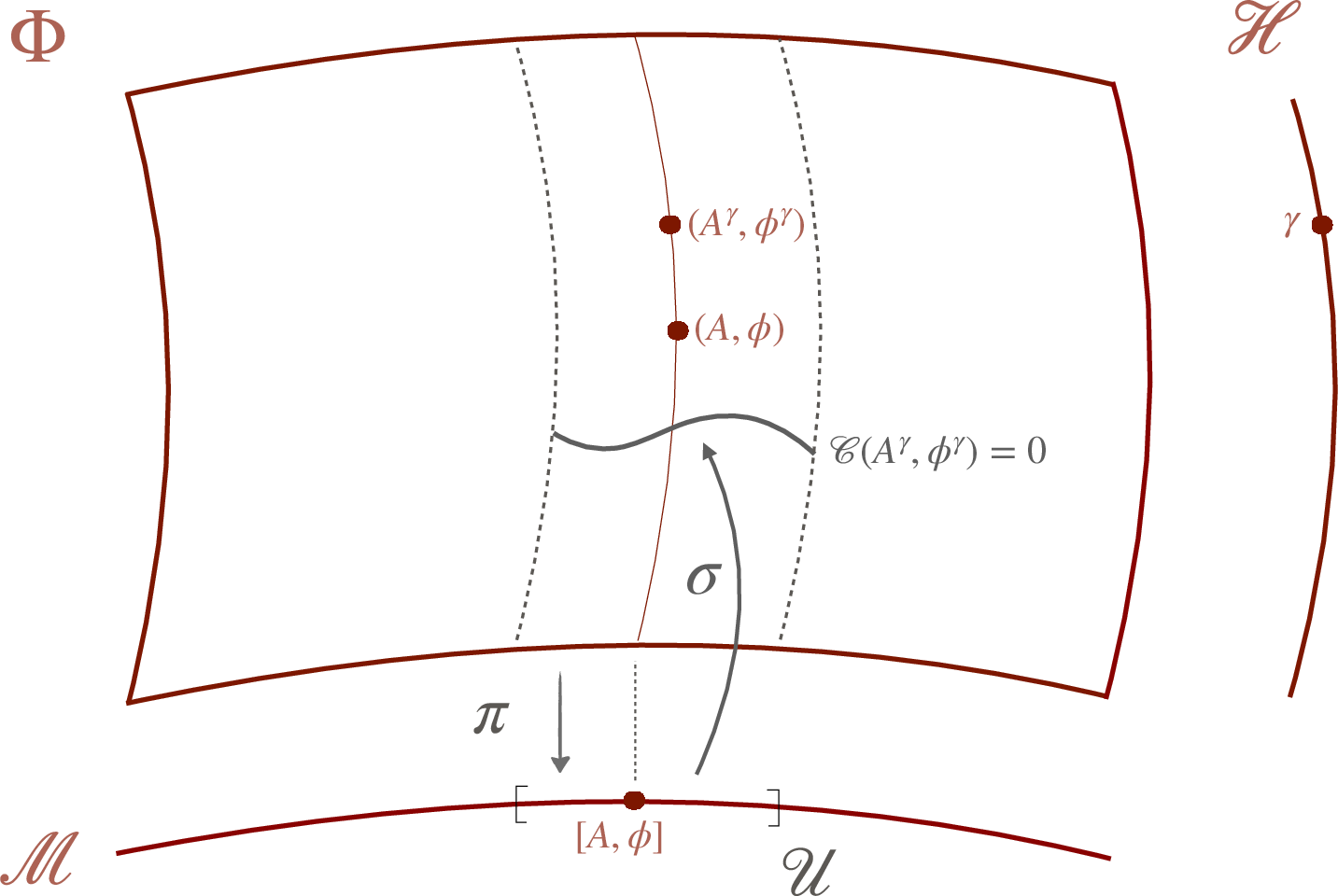
Figure 1: Gauge-fixing in $\Diff(M)$5, i.e., a choice of local section $\Diff(M)$6 of field space. The gauge-fixing slice is the image of $\Diff(M)$7.
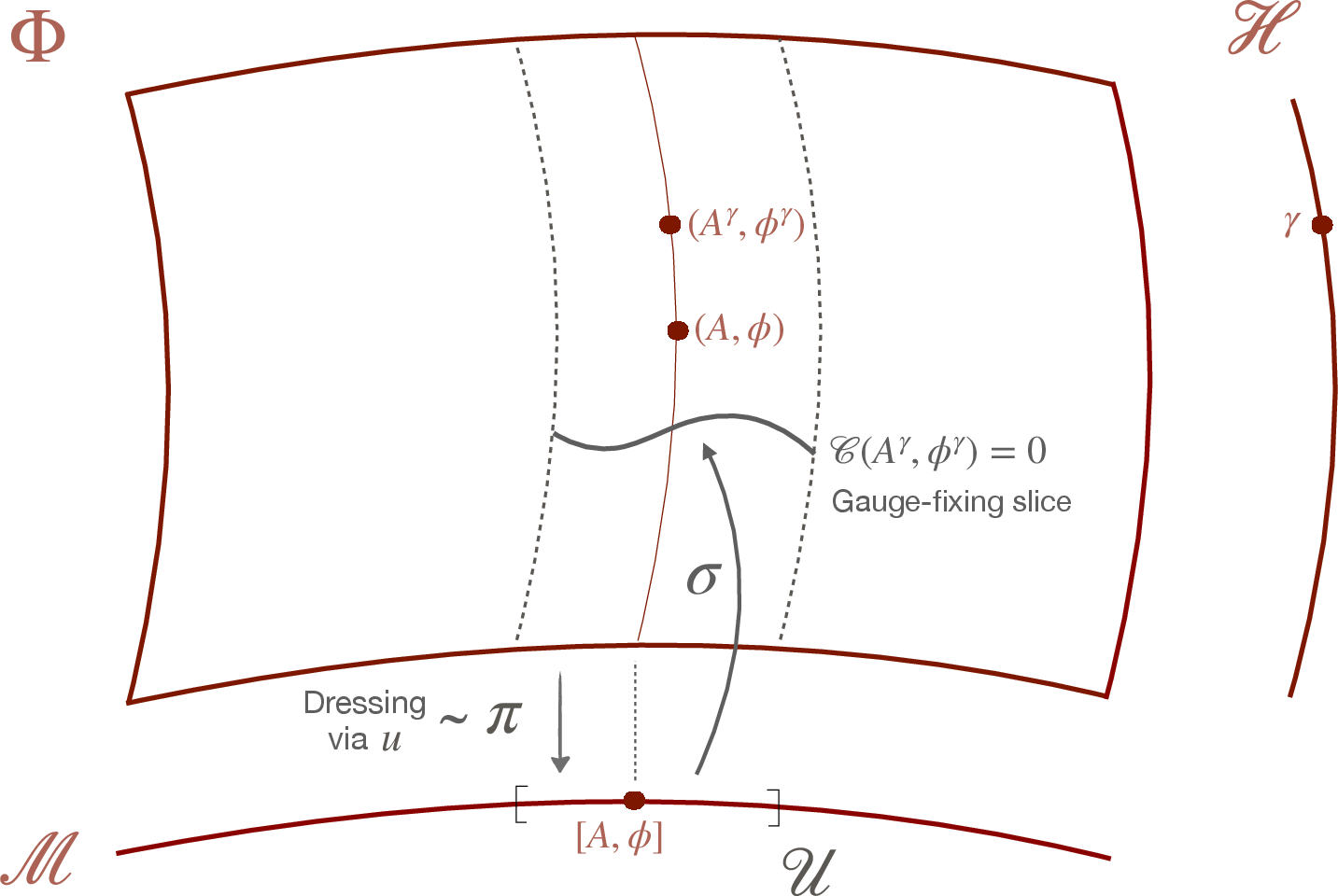
Figure 2: Difference between dressing as done via DFM (which maps to the space of manifestly invariant fields) and gauge-fixing in field space $\Diff(M)$8.
Applications of the Dressing Field Method
Chern–Simons and Abelian Higgs Models
In three-dimensional non-Abelian Chern–Simons theory, DFM constructs gauge-invariant variables $\Diff(M)$9, $\Diff(M)$0 and strictly invariant Lagrangians. For Abelian models (Maxwell, Higgs), DFM formalizes standard gauge conditions (e.g., Lorenz or axial gauges) as extractions of dressing fields, turning constraints often used in gauge-fixing into identities for invariant variables. In particular, DFM provides an alternative to the conventional interpretation of the Higgs mechanism in terms of spontaneous symmetry breaking, achieving mass generation and symmetry reduction by dressing the scalar field phase—thus avoiding ambiguities about the physical reality of SSB in gauge theories.
Lorentz Dressing and Geometric Gravity
DFM reinterprets the passage from vielbein/spin connection to metric/Christoffel variables in gravity as a Lorentz dressing. The tetrad itself is a dressing field for local Lorentz invariance, and the resulting metric connection is a dressed, Lorentz-invariant variable. This provides a unified perspective on geometric and gauge-theoretic formulations of gravity, and clarifies the residual coordinate covariance from the dressing viewpoint.
In supersymmetric field theories, DFM identifies nonlocal self-dressings for the Rarita-Schwinger field, showing that gamma-trace “gauge-fixings” are in fact dressings yielding supersymmetry-invariant, relational field variables. This insight enables new frameworks, such as the Matter–Interaction Supergeometric Unification (MISU), where both gauge and matter fields arise as components of a superconnection, eschewing the need for a matching of bosonic and fermionic d.o.f. The construction is naturally compatible with BRST quantization: dressed BRST algebras are trivialized for fully reduced symmetries, revealing kernels composed of invariant observables.
DFM in General-Relativistic Field Theories and Scalar Coordinatization
For diffeomorphism invariance, DFM introduces field-dependent maps $\Diff(M)$1 (with $\Diff(M)$2 a model manifold), extracted from scalar field distributions or the metric itself, to construct dressed fields living on “dressed regions” $\Diff(M)$3—genuine, $\Diff(M)$4-invariant subsets furnishing a fully relational spacetime picture. Integration theory justifies that actions and observables rewritten in terms of dressed fields are strictly invariant. This resolves longstanding debates about the “boundary problem” in gravity (the alleged breaking of gauge invariance at boundaries): boundaries of dressed regions are invariant, rendering ad hoc edge mode constructions unnecessary. Moreover, techniques such as scalar coordinatization (Kretschmann-Komar-Bergmann, DeWitt, Brown–Kuchar) are unified as cases of the DFM, supplying invariant and relational coordinates from matter fields or the geometry itself.
Implications and Future Prospects
The DFM enables a mathematically precise extraction of relational content in classical and quantum field theories with local symmetries, systematically avoiding the pitfalls of gauge-fixing. Its clean separation between physical and unphysical d.o.f. makes it applicable to a wide range of contexts: gauge, gravitational, and supersymmetric field theories, Cartan-geometric and conformal constructions, and even quantum settings.
Outstanding theoretical consequences include:
- Clarification of the status of gauge and diffeomorphism symmetries: DFM determines which symmetries are substantive (nontrivial dressings required, resulting in nonlocal invariant variables) and which are artificial (local dressings render invariant variables locally constructed).
- Resolution of boundary and observability issues: By working entirely with dressed fields and regions, questions about “broken” symmetries at boundaries are dissolved, and the relational, experimental content is transparently encoded.
- Refinement of the Higgs mechanism and SSB: Invariant variables can be constructed without appealing to explicit SSB, recasting mass generation as a geometric feature of symmetry reduction.
- Foundational advances in supergeometry and unified descriptions of matter/interaction: DFM’s application to superconnections and non-matching d.o.f. settings (MISU) provides new avenues for model-building beyond the MSSM and standard field-theoretic assumptions.
Future developments are expected to focus on deeper integration of DFM with modern methods in quantum gravity, precise geometric and cohomological aspects (e.g., cocyclic geometry), and applications to machine learning and emergent symmetries in non-field-theoretic domains.
Conclusion
The lecture notes (2603.29505) consolidate the Dressing Field Method as a robust, geometrically motivated, and operationally sound framework for symmetry reduction in gauge and gravitational field theories. DFM not only yields a clear account of physical, relational observables but also unifies a multitude of approaches from diverse areas within theoretical and mathematical physics. Its implications extend beyond formal considerations, directly impacting practical calculations, the formulation of initial/boundary value problems, and the conceptual interpretation of fundamental theories.