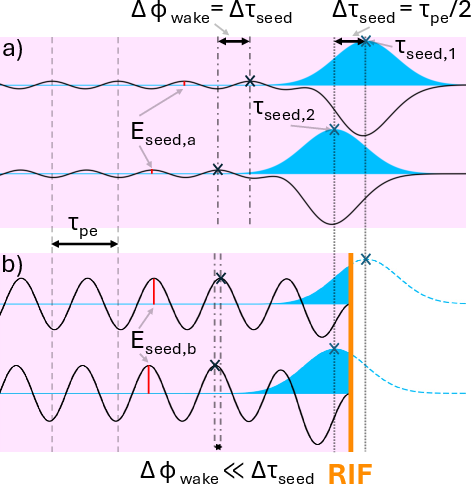
- The paper introduces teSSM, a method that truncates the electron seed bunch via a relativistic ionization front to overcome dephasing and jitter in plasma wakefield acceleration.
- Experimental results from AWAKE demonstrate that teSSM yields clear micro-bunch periodicity and accelerated self-modulation at a plasma density of 7×10^14 cm⁻³.
- The technique enhances seed field amplitude and reproducibility, paving the way for deterministic injection and scalable high-gradient accelerator designs.
Seeding of Self-Modulation Using Truncated Seed Bunches for High Gradient Acceleration
Introduction and Context
Plasma wakefield acceleration (PWFA) stands out for its potential to yield GV/m-scale accelerating fields at high plasma electron densities (npe≳1014cm−3), making it particularly suitable for future high-energy linear colliders and secondary sources. Achieving high-gradient acceleration with presently available driver beams, typically long and of comparatively low peak density (nb<npe), presents several challenges due to insufficient wakefield amplitudes and the stochasticity associated with self-modulation instability (SMI).
The AWAKE experiment at CERN has pioneered the use of long proton drivers to explore these regimes, leveraging self-modulation (SM)—whereby long bunches break into trains of micro-bunches resonant with the plasma period (τpe)—as a route to resonant excitation of wakefields. Controlled, reproducible seeding of SM is essential for deterministic injection and efficient energy transfer to witness beams, but traditional techniques such as electron bunch seeding (eSSM) and relativistic ionization front (RIF) seeding have critical limitations, especially at higher densities relevant for maximizing gradients.
This work introduces and experimentally validates truncated electron seed bunch seeding of SM (teSSM), a technique wherein an electron seed bunch is truncated by a coincident RIF to overcome the above constraints and enable robust, reproducible acceleration in plasma at npe=7×1014 cm−3.
Seeding Methods: Limitations and teSSM Approach
Reproducible seeding of SM demands meeting stringent requirements on three fronts:
- Dephasing: The relativistic γ factor of the seed and driver must closely match to avoid rapid phase drift between the two over the seeding distance Lseed.
- Amplitude: The initial seed wakefield amplitude Eseed must greatly exceed background noise Enoise for rapid SM onset and to limit the saturation length.
- Reproducibility: Temporal jitter in seed arrival translates directly to phase fluctuations in the wakefields; such jitter must be much smaller than τpe for reliable injection.
Traditional approaches—such as RIF seeding with a short-pulse laser to create a sharp plasma onset, or eSSM with standalone electron seeds—either sacrifice use of the full driver, limit nb<npe0, or fail at higher plasma densities due to aggravated dephasing and reproducibility constraints as nb<npe1 decreases.
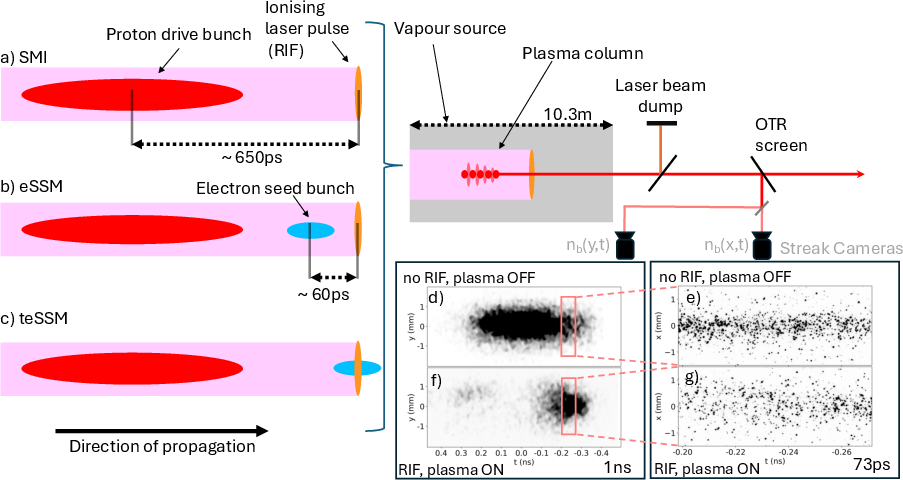
The teSSM technique strategically positions a RIF inside the electron seed to truncate it, so that only a controlled portion of the seed bunch enters the plasma. This solution affords several advantages:
Experimental Validation: AWAKE at CERN
Experiments were conducted using AWAKE's 400 GeV proton drivers (RMS duration nb<npe4 ps) propagating through a 10.3 m rubidium vapor source, ionized by a nb<npe5100 mJ, 120 fs laser pulse to form plasma at the baseline nb<npe6. Electron seed bunches (17.8 MeV, nb<npe7 ps) were timed for spatial and temporal overlap with the RIF, optimizing the truncation point for maximal charge participation and minimal dephasing.
Three configurations were compared:
Time-resolved proton bunch charge density measurements (nb<npe8 and nb<npe9) were acquired downstream of the plasma with dual streak cameras, capturing both the micro-bunch structure and the evolution of transverse defocusing.
Observations and Quantitative Results
Summed time-aligned τpe0 measurements (averaged over multiple events) reveal dramatic differences in micro-bunch reproducibility between the three cases:
(Figure 3)
Figure 3: Summed streak camera micro-bunch density profiles along the proton bunch for SMI, eSSM, and teSSM configurations, demonstrating periodic longitudinal modulation only for teSSM.
- For SMI and eSSM, the micro-bunch structure averages out due to shot-to-shot phase randomness, producing no discernible periodic modulation.
- For teSSM, a clear periodic modulation emerges, with the observed period matching the plasma period τpe1 to within measurement uncertainty (τpe24.2 ps predicted, τpe34.3 ps measured).
Frequency-domain analysis via FFT further corroborates this, showing a prominent, statistically significant peak at τpe4 for teSSM, absent for both SMI and eSSM.
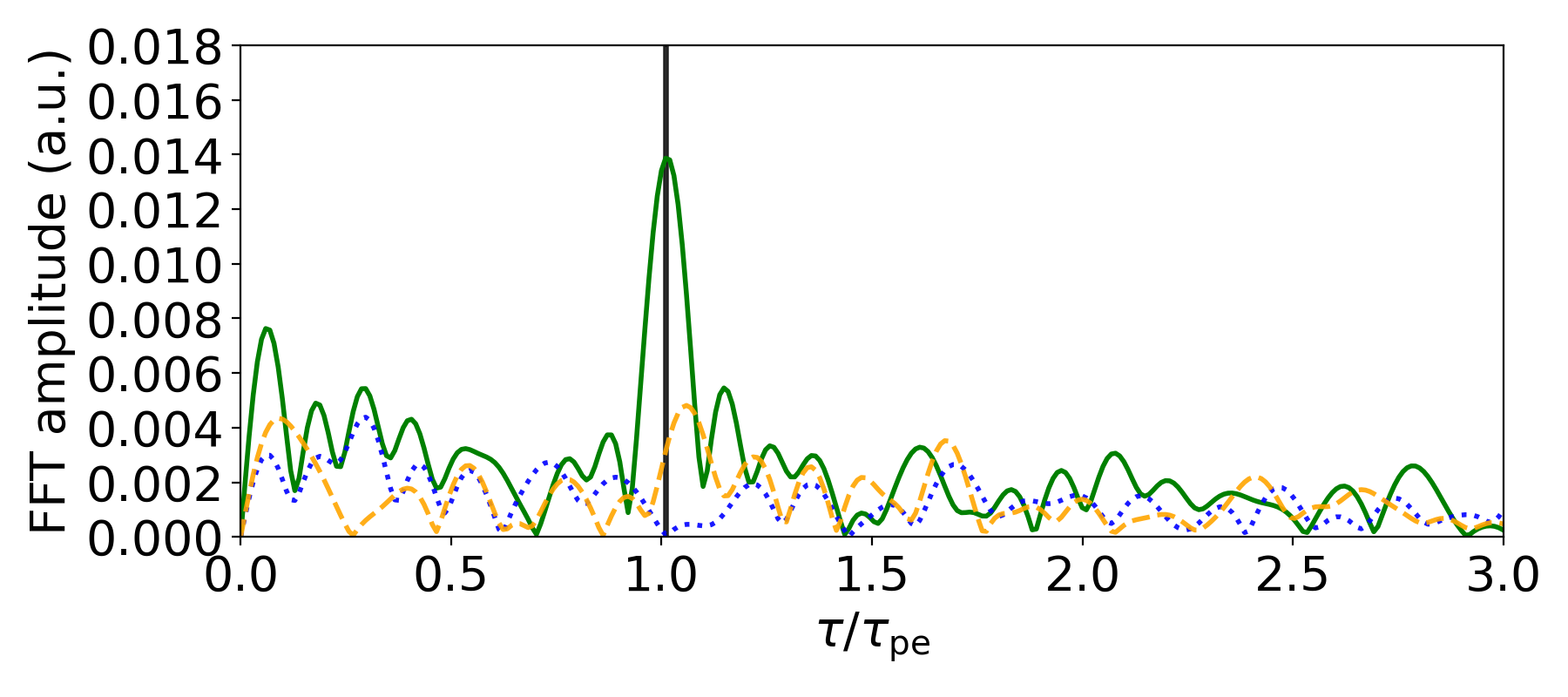
Figure 4: FFT amplitude of the micro-bunch profiles, exhibiting a sharp peak at plasma frequency only under teSSM conditions.
On the nanosecond scale, τpe5 measurements demonstrate that SM develops in all configurations, but with notable distinctions in evolution speed and spatial extent. The rapidity with which the proton density falls and the transverse beam size evolves is fastest for teSSM, consistent with its higher seed field amplitude (τpe6). Quantitatively, the time at which the transverse size reaches τpe7 mm occurs earliest for teSSM, confirming accelerated SM growth and earlier saturation.
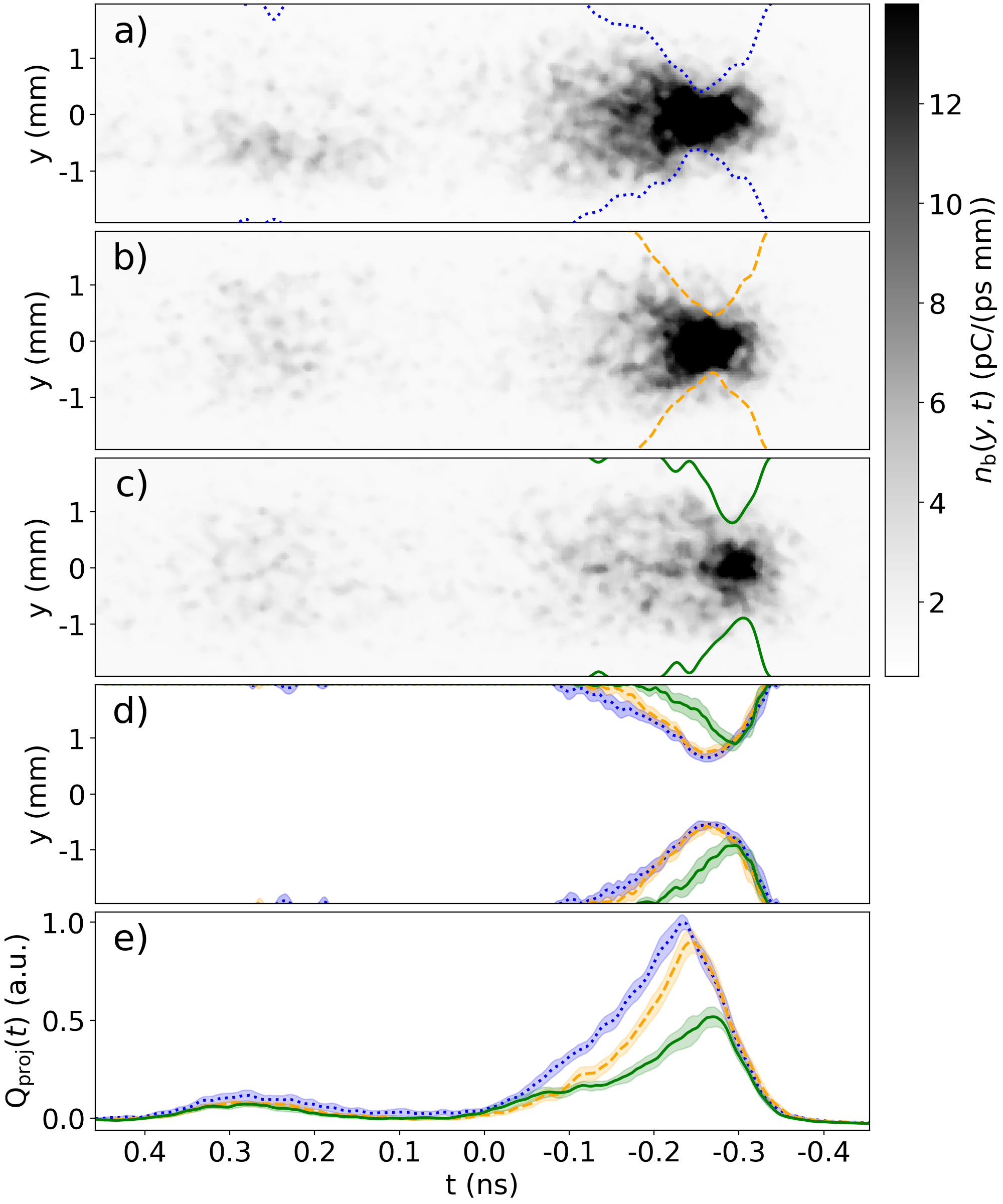
Figure 5: Single-shot and statistical summaries of τpe8 and transverse beam sizes, highlighting the accelerated self-modulation and reduced variance for teSSM relative to eSSM and SMI.
Theoretical and Practical Implications
This work establishes that teSSM enables reproducible, high-amplitude seeding of SM at plasma densities an order of magnitude higher than previously achievable with available electron seed parameters. Critically, this supports control of SM in regimes required for GV/m-scale acceleration, without the limitations of RIF or eSSM, and with the added advantage of utilizing the full driver for wakefield generation.
From a theoretical standpoint, teSSM:
- Ensures deterministic phase for witness injection, removing stochasticity from SMI.
- Minimizes seed/driver dephasing by exploiting control of the RIF location relative to the seed.
- Amplifies seeding efficiency by removing longitudinal energy transfer losses via optimal seed truncation.
- Shortens SM saturation length and fosters dominance over competing collective effects (e.g., hosing instability).
Practically, teSSM paves the way for staged high-energy plasmas and application to future multi-stage collider designs, where seeding fidelity and amplitude are paramount. It decouples seed amplitude control from driver parameters and circumvents RIF limitations at stage interfaces, significantly broadening the operational envelope for scalable plasma-wakefield devices.
Future Perspectives
The teSSM method should motivate further studies examining:
- Extension to alternate driver types (e.g., positron or heavy ion beams) and energy regimes.
- Detailed mapping of seed bunch parameter tolerances as plasma density is increased further, with implications for accelerator stability and operational flexibility.
- Systematic integration into multi-stage or staged-injection PWFA concepts where both phase control and amplitude maximization are critical.
High-gradient, reproducible PWFA enabled by teSSM has high relevance not only for high-energy physics but also for compact secondary radiation sources and pulsed neutron sources.
Conclusion
The truncated electron seed bunch seeding mechanism (teSSM) constitutes an experimentally validated solution for deterministic self-modulation at high plasma density, overcoming dephasing and reproducibility bottlenecks found in conventional seeding. The technique delivers enhanced seed field amplitude, strict reproducibility, and optimal exploitation of available drivers within the AWAKE program's operational envelope. This advances the practical feasibility of high-gradient plasma wakefield accelerators and establishes new paradigms for controlled, scalable particle acceleration in intense plasma environments.
Reference: "Seeding of Self-Modulation using Truncated Seed Bunches as a Path to High Gradient Acceleration" (2603.29472)