- The paper introduces a dissipaton-based DEOM framework that models nonequilibrium heat transport and local thermal probing in a 1D vibrational chain.
- The method avoids density-matrix propagation by using c-number dissipaton moments, capturing both anharmonic and nonlinear probe-chain interactions.
- Simulations show that increased local anharmonicity notably suppresses heat currents, offering practical insights for nanoscale thermal device design.
Dissipaton-Based Quantum Approach to Local Thermal Probing in 1D Chains
Model Setup and Hamiltonian Structure
The study formulates a quantum model of an infinite one-dimensional vibrational chain locally coupled to a thermal probe. The chain consists of harmonic oscillators with nearest-neighbor coupling, and the probe is modeled as a thermal bath of oscillators coupled locally—specifically at site 1—potentially via nonlinear (anharmonic) interactions and onsite energy modification. The chain–probe Hamiltonian explicitly allows onsite energy shifts and non-bilinear coupling forms, facilitating the analysis of anharmonic and many-body effects absent in standard bilinear-system+bath constructs.
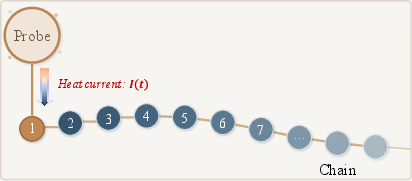
Figure 1: Schematic of a 1D chain probed locally via heat current arising from a local chain–probe interaction and onsite energy modification.
The chain is diagonalized in momentum space (excluding the zero mode), yielding an analytic chain spectral density with a finite bandwidth (cutoff 2Ω). Both the probe and the chain are in general at different temperatures, resulting in nonzero steady-state heat currents and permitting nonequilibrium quantum-thermodynamical analysis.
The core computational innovation is a dissipaton-based equation-of-motion framework, which generalizes the standard Gaussian-environment DEOM to arbitrary coupling order. The approach decomposes both system and bath operators into modewise dissipaton quasi-particles. The central objects are the dissipaton moments Mmn(t), c-number quantities encoding all relevant operator moments, organized hierarchically by the number of dissipatons present.
The DEOM in this formulation:
- Yields a set of first-order coupled ODEs for dissipaton moments, with cross-tier connections to account for higher-order chain–probe nonlinear couplings.
- Avoids density-matrix propagation entirely, working at the level of ordinary variables and thus enabling high computational efficiency even in the presence of strong coupling and non-Markovianity.
- Is nonperturbative and exact for Gaussian and certain non-Gaussian environments, and reproduces analytic results in the bilinear case.
With the probe characterized by a Brownian oscillator spectral density, the DEOM formalism supports practical implementation via exponential-series decomposition of environmental correlation functions; the time-domain Prony expansion and optimized Padé decomposition are adopted for maximal fitting precision.
Heat Transport and Numerical Analysis
The nonequilibrium heat current from probe to chain is evaluated using the established dissipaton algebra and the DEOM-propagated moments. The analysis includes the effects of varying the temperature gradient, probe spectral density, onsite energy modification, and, critically, higher-order (anharmonic) coupling at the site of probe-chain contact.
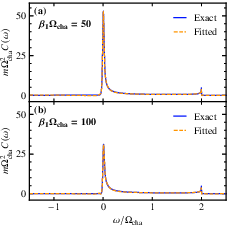
Figure 2: Chain correlation spectra C(ω) at different temperatures, showing the accuracy of the DEOM-based Prony-fitted expansion against the exact analytic form.
Transient and steady-state heat currents reflect strong sensitivity to the presence of higher-order nonlinear coupling and energy bias. An explicit suppression of heat current arises with increasing anharmonicity, consistent with the expectation that additional inelastic scattering channels diminish coherent transport.
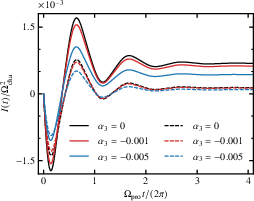
Figure 3: Transient heat currents for various α3 (strength of higher-order coupling) and probe temperatures, illustrating the nonlinear suppression of heat current and temperature dependence.
Additional simulations (not shown in the excerpted figures but described in the text) explore dependency on probe parameters and onsite energy shifts. Increasing the local site energy leads to reduced steady-state heat currents and an increased oscillatory response in the transient regime, highlighting the competition of local mode energy and transport efficiency.
Theoretical and Practical Implications
This work establishes a systematically extensible quantum framework for analyzing local, nonequilibrium thermal transport in one-dimensional and potentially higher-dimensional systems with strong, nonlinear, or even many-body probe-system couplings. By recasting the DEOM in terms of c-number variables (dissipaton moments) and accommodating non-Gaussian features, the method enables access to regimes (strong coupling, non-Markovian, anharmonic) where classical or perturbative approaches are ineffective.
Practical significance includes:
- Direct modeling and interpretation of experiments employing local thermal probes in mesoscopic and molecular chains, ultracold atom arrays, and nanostructures.
- Natural extensibility to simulate local quantum electronic transport under strong many-body effects.
- Insight into the role of anharmonicity and nonlinear coupling in engineering and controlling local heat flow, phononic devices, and quantum thermodynamic engines.
The strong suppression of heat currents with increasing local anharmonicity constitutes an explicit, quantitative prediction verifiable in controlled settings.
Conclusion
The dissipaton-based DEOM framework developed in this work provides a nonperturbative, computationally efficient, and hierarchically extensible method for simulating and understanding local quantum thermal transport in one-dimensional chains with nonlinear probe interactions (2603.29458). It offers a practical formalism for modeling nonequilibrium thermodynamics, including cases with strong system–probe interaction and environments far from the Markovian or Gaussian regime. The results indicate robust sensitivity of the heat current to anharmonic and local energy modifications, with direct implications for the design of nanoscale thermal and energy transfer devices.
Future directions include extension to multi-site probes, strong correlation (e.g., quantum phase transitions), and application of these hierarchical dissipaton-based approaches to electronic and spin systems in condensed-matter and atomic, molecular, and optical platforms.