- The paper demonstrates that brick wall quantization combined with spectral and Krylov complexity diagnostics reveals robust markers of quantum chaos in curved spacetimes.
- It shows that level-spacing distributions evolve from sharply peaked (Dirichlet) to Poisson regimes as brick wall fluctuations increase, modifying the spectral landscape.
- The study finds that in Schwarzschild–de Sitter setups, the superposition of independent spectra preserves long-range chaos features despite deviations in short-range statistics.
Cosmological Brick Walls and Quantum Chaotic Dynamics of de Sitter Horizons
Introduction and Context
The paper "Cosmological brick walls & quantum chaotic dynamics of de Sitter horizons" (2603.29443) presents a comprehensive spectral and quantum information-theoretic analysis of quantum fields in the presence of cosmological and black hole horizons in asymptotically de Sitter spacetimes. Extending the brick wall model of ’t Hooft, which provides an ultraviolet regulator for quantum field theory in curved spacetimes, the work probes quantum chaos diagnostics for both pure de Sitter and Schwarzschild–de Sitter backgrounds. The focus is on three principal spectral indicators: level-spacing distributions (LSD), spectral form factors (SFF), and Krylov complexity (KC). The study systematically assesses the implications of having multiple horizons, the effects of fluctuating brick wall boundary conditions, and the structure of the spectra associated with quantum normal modes.
Brick Wall Model and Spectral Diagnostics
The central technical framework is the brick wall quantization of probe scalar fields, imposed by Dirichlet (and general Gaussian-random) boundary conditions at regulated “stretched horizons” a proper distance from the null horizons—either cosmological or black hole type. The spectrum and quantum chaos diagnostics are then extracted from the normal mode data. For spectral analysis, the study leverages unfolding to generate the LSD, evaluates the SFF at infinite and finite temperature, and computes KC for thermofield double (TFD) initial conditions.
The key diagnostics and their physical interpretations are as follows:
- Level-Spacing Distribution (LSD): Measures short-range spectral correlations; Wigner–Dyson statistics imply level repulsion; Poisson statistics imply integrability; intermediate or mixed statistics, such as Berry–Robnik type, arise in presence of multiple independent spectral sequences.
- Spectral Form Factor (SFF): Encodes long-range correlations; a linear late-time “ramp”—the dip-ramp-plateau structure—is associated with spectral rigidity and quantum chaos.
- Krylov Complexity (KC): Quantifies the operator/state spread in Krylov subspaces; a rapid growth and pronounced peak reflects chaotic evolution.
Pure de Sitter: Logarithmic Spectral Growth and Spectral Correlations
The study begins by considering the static patch of pure de Sitter. Analytic solutions to the Klein–Gordon equation are found, and the normal modes exhibit slow, logarithmic growth with respect to the angular quantum number l, while remaining linear in the principal quantum number n. This structure is inherited from the universal near-horizon Rindler kinematics, and underpins the area law entropy signal in the brick wall model.
The level-spacing statistics for modes with fixed n and varying l depend strongly on the variance σ02 associated with brick wall fluctuations:
- For σ02→0 (Dirichlet case), the spectrum is highly regular, and the LSD is sharply peaked (delta-like).
- As σ02 increases, the LSD evolves through Wigner–Dyson-like (GUE/GOE/GSE) to Poisson, never realizing exact RMT statistics but instead remaining close in a finite spectral window.
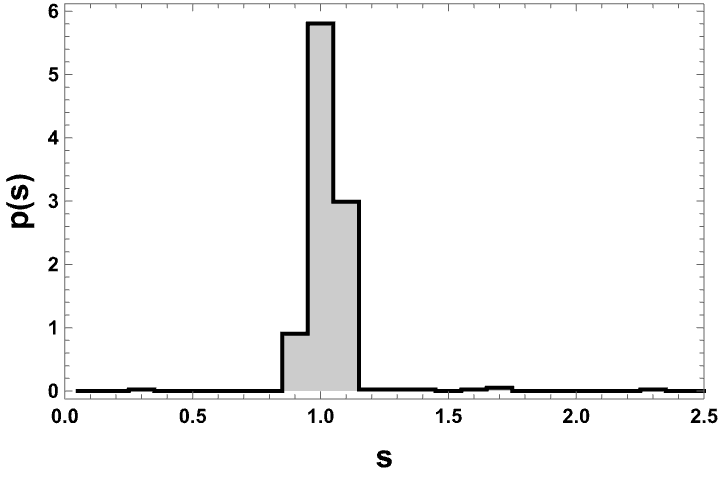
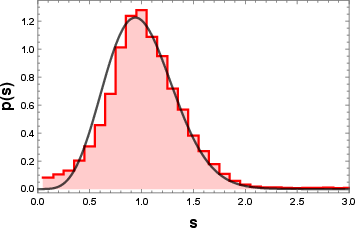
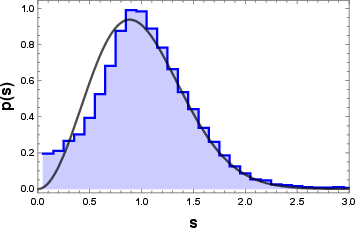
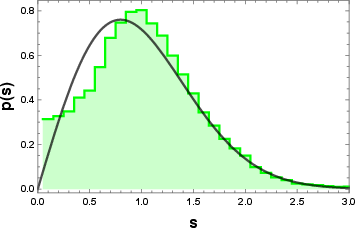
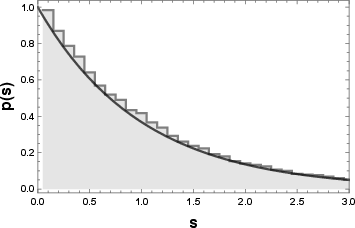
Figure 1: Level-spacing distribution interpolates between delta-like (Dirichlet) and Poisson as brick wall fluctuation variance increases.
The SFF for the de Sitter normal mode spectra presents a robust linear ramp for small but nonzero variances, even when the LSD is only Wigner–Dyson-like. The ramp shrinks and disappears as the variance increases toward the Poisson regime.
The KC for the TFD initial state displays the characteristic growth–peak–plateau structure, with the peak height maximized for the noiseless Dirichlet wall and suppressed as fluctuations introduce Poissonian components.
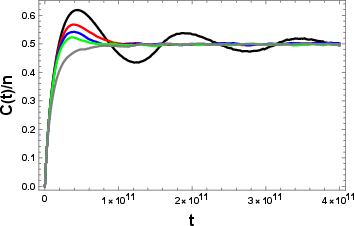
Figure 2: Ensemble-averaged Krylov complexity of normal modes in pure de Sitter, demonstrating the transition from pronounced chaos (black, red) to ergodicity loss (grey) with increasing wall fluctuation.
Schwarzschild–de Sitter: Spectral Superposition and Multi-Horizon Effects
The Schwarzschild–de Sitter background presents new qualitative phenomena due to the existence of two independent horizons: the black hole and the cosmological horizon. The probe scalar quantization proceeds by imposing brick walls near both horizons, and a WKB analysis is performed for normal mode quantization. The presence of two classically allowed regions leads to the physical spectrum being a statistical superposition of two largely uncorrelated subsequences.
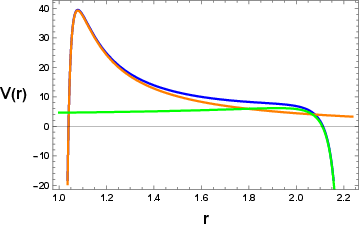
Figure 3: Effective WKB potential in Schwarzschild–de~Sitter exhibits two classically allowed regions separated by a potential barrier.
For the superposed spectrum, several departures from single-sequence black hole or cosmological horizon spectral statistics are observed:
- The LSD for the combined spectrum generically exhibits a nonzero p(s=0), in clear violation of strict level repulsion, even when each constituent sequence is Wigner–Dyson-like. This is attributed to statistical superposition, in agreement with the Berry–Robnik paradigm.
- The SFF, however, robustly exhibits a linear ramp over a broad parameter range, as do the constituent spectra, indicating the persistence of long-range quantum-chaotic behavior despite the short-range breakdown of RMT statistics in the union.
- KC retains a pronounced growth–peak–plateau structure for small to moderate brick wall fluctuations, with the peak attenuated as Poissonian noise increases.
An explicit demonstration of spectral dependence on the relative brick wall distances is made by varying se/sc (the ratio of proper distances from the walls to horizons), revealing various patterns of dominance between the black hole and cosmological subsectors.
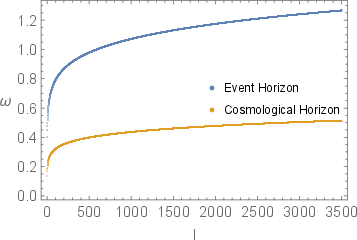
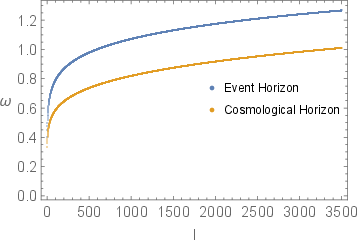
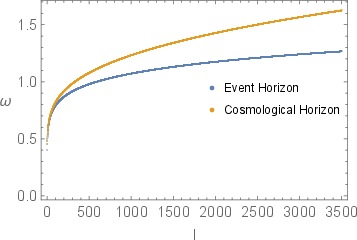
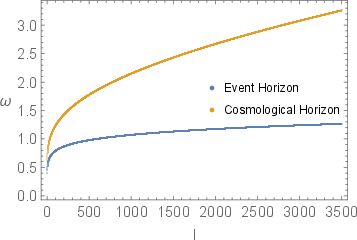
Figure 4: Normal modes versus angular quantum number for Schwarzschild–de~Sitter; blue (event horizon localized), yellow (cosmological horizon localized); se/sc=1.
For ensembles with brick wall fluctuations, the LSD and SFF interpolate as expected, with KC remaining more robust against noise than SFF. The study quantifies the precise ranges of fluctuation variances that maintain the physically relevant, chaos-diagnostic-dominated regime.
Theoretical and Practical Implications
The analysis reveals that robust features of quantum chaos, as seen in the SFF ramp and KC peak, persist for de Sitter horizons and multi-horizon black holes even when the short-range LSD deviates strongly from Wigner–Dyson universality. Importantly, the loss of strict level repulsion n0 in the presence of independent superposed spectra does not signal a breakdown of long-range chaos signatures—contradicting the unwarranted inference sometimes drawn from nearest-neighbor statistics alone. In gravitational systems with multiple horizons, careful interpretation of spectral chaos diagnostics is necessary: the SFF and KC serve as unambiguous chaos indicators, while LSD can be contaminated by kinematical mixtures.
This insight informs both quantum gravity and holography, where probe sector diagnostics—though only indirectly reflecting quantum gravitational degrees of freedom—nonetheless reveal universal scrambling and chaotic structure with potential implications for entropy accounting, quantum information processing near horizons, and the architecture of dual field theory descriptions.
Conclusions
This work rigorously establishes that the brick wall quantization strategy, augmented with spectral chaos diagnostics and Krylov analysis, provides a robust probe of quantum chaos in de Sitter and multi-horizon spacetimes. The spectrum’s logarithmic growth in angular momentum, the coexistence of Berry–Robnik LSD with robust SFF ramps and KC peaks, and the resilience of chaos signatures to moderate probe-induced fluctuations map out the quantum spectral landscape of cosmological and black hole horizons.
The results suggest two key avenues for further research: analytic control of WKB quantization in the full multi-horizon and mixed-tunneling regime, and the extension to more general fluctuating/absorptive boundary conditions to bridge the closed-system normal modes and open-system quasinormal mode domains. These will clarify both the holographic encoding of scrambling and the structure of quantum information in cosmological gravitational systems.
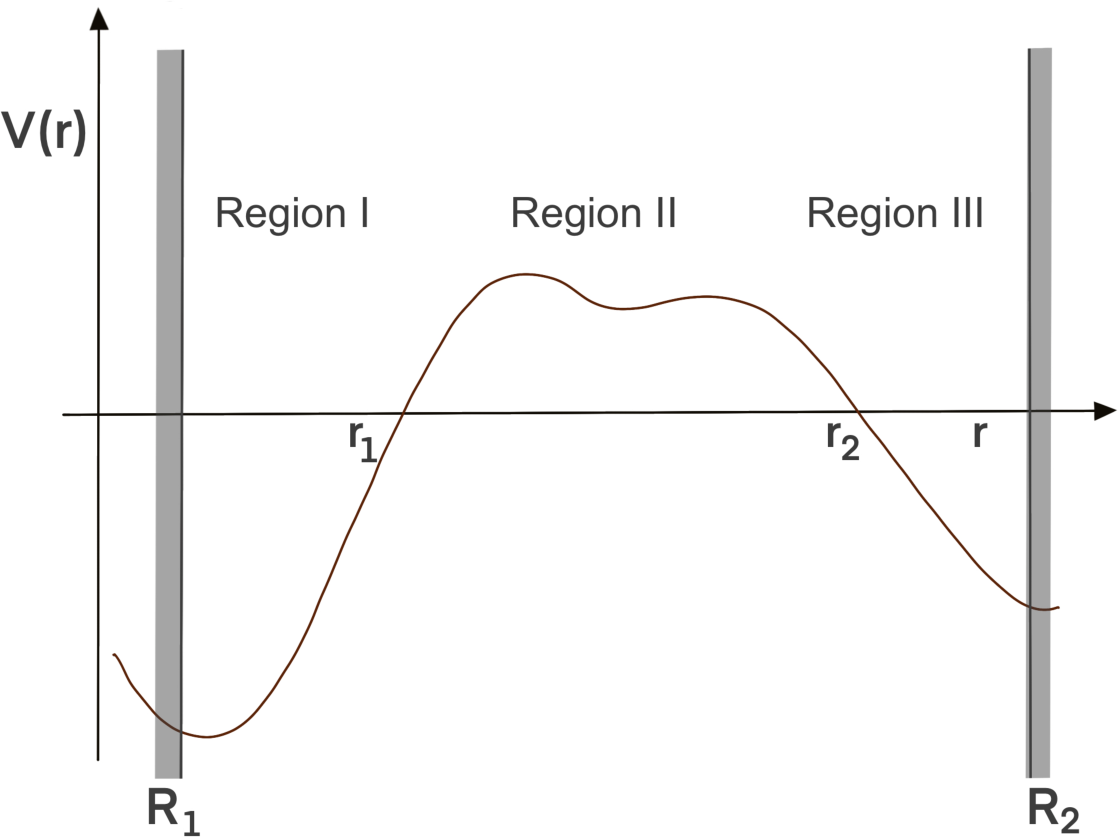
Figure 5: Schematic WKB potential with two turning points and brick wall boundaries, central to the analysis of Schwarzschild–de~Sitter normal modes and spectral superposition phenomena.

