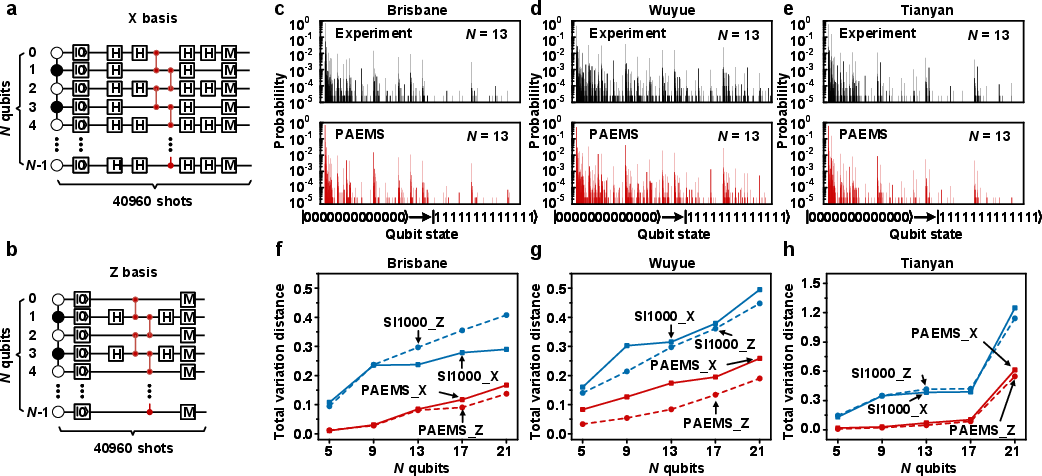
- The paper demonstrates that PAEMS significantly reduces timelike, spacelike, and spacetime error correlations by up to 19.5× compared to existing models.
- It employs a qubit-wise, data-driven calibration approach with evolutionary optimization, aligning modeled errors with real hardware behavior.
- PAEMS offers scalable O(n²) simulation, enabling high-fidelity synthetic datasets that improve the performance of quantum error correction decoders.
PAEMS: Precise and Adaptive Error Model for Superconducting Quantum Processors
Motivation and Problem Statement
Superconducting qubit-based quantum processors (QPUs) underlie much of modern progress in quantum error correction (QEC), yet existing hardware limits the production of large, statistically significant datasets crucial for training high-performance QEC decoders. Canonical error models—including the widely used depolarizing models and density matrix-based models—fall short due to a trade-off between modeling accuracy, complexity, and inability to capture physical device heterogeneity, error propagation, and leakage. The consequences include suboptimal QEC decoder performance, as synthetic training data diverges from real hardware-induced error statistics, especially for large-scale, heterogeneous platforms. The PAEMS framework addresses this gap by delivering a scalable error model that resolves physical non-uniformity, spatiotemporal error dynamics, leakage, and cross-platform adaptivity, while maintaining computational efficiency.
PAEMS Model Framework
The PAEMS framework employs a qubit-wise, physically-grounded parameterization for error modeling, incorporating device calibration and experimental data. Each physical process—decoherence, gate error, and SPAM (state preparation and measurement) error—is associated with per-qubit and per-coupler parameters, in contrast to previous error models that adopt globally averaged rates. The model further includes explicit treatment of leakage and seepage (return from leakage) events, as these phenomena strongly influence multi-round QEC protocols.
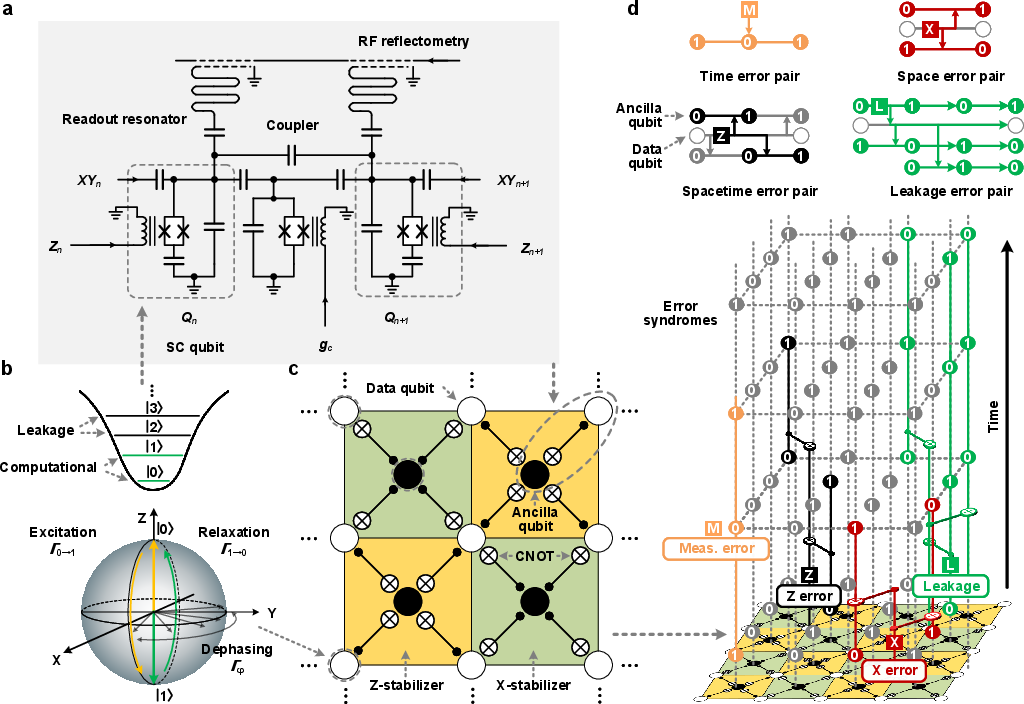
Figure 1: Schematic illustration of qubit error sources, gate architecture, and syndrome extraction in a superconducting quantum processor.
At the circuit level, operations in PAEMS are described by ideal logic gates followed by composite, parameterized stochastic error channels. Decoherence errors are mapped to Asymmetric Depolarizing Channels (ADC) derived from individual qubit relaxation (T1), dephasing (T2), and operation times, while gate errors are mapped to Symmetric Depolarizing Channels (SDC) parameterized by platform-calibrated fidelities. SPAM errors are modeled distinctly for initialization and measurement outcomes, addressing idiosyncrasies of hardware implementations. Leakage and seepage probabilities are also parameterized per qubit, allowing non-Markovian, temporally persistent errors to be explicitly represented.
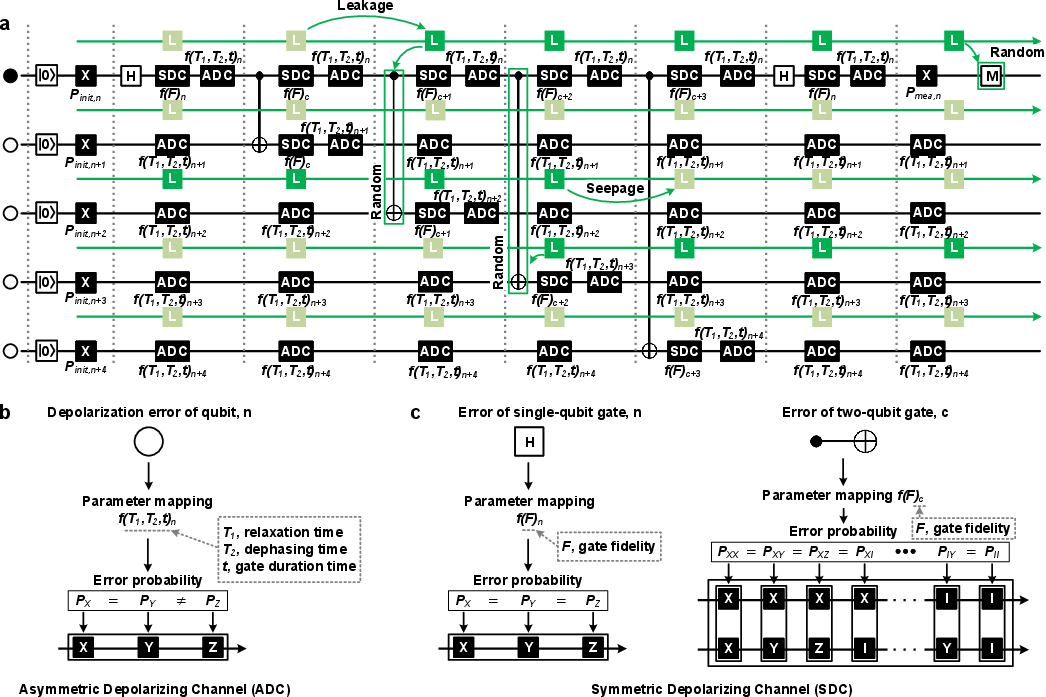
Figure 2: Structured overview of the PAEMS error model, including mapping from hardware calibration parameters to stochastic error channels and treatment of leakage.
Data-Driven End-to-End Optimization
To achieve accurate inference, PAEMS employs a closed-loop, data-driven training pipeline using experimentally obtained repetition-code datasets and platform-specific calibrations. Optimization uses the Covariance Matrix Adaptation Evolution Strategy (CMA-ES) for high-dimensional parameter search, beginning with qubit calibration and iteratively refining the PAEMS parameters to minimize correlation discrepancies between hardware and modeled data. A staged procedure is used: leakage parameters are handled first (due to entanglement with other error sources), followed by parallelized optimization of decoherence, gate, and SPAM parameters based on spatiotemporal error correlation structure, and final global refinement.
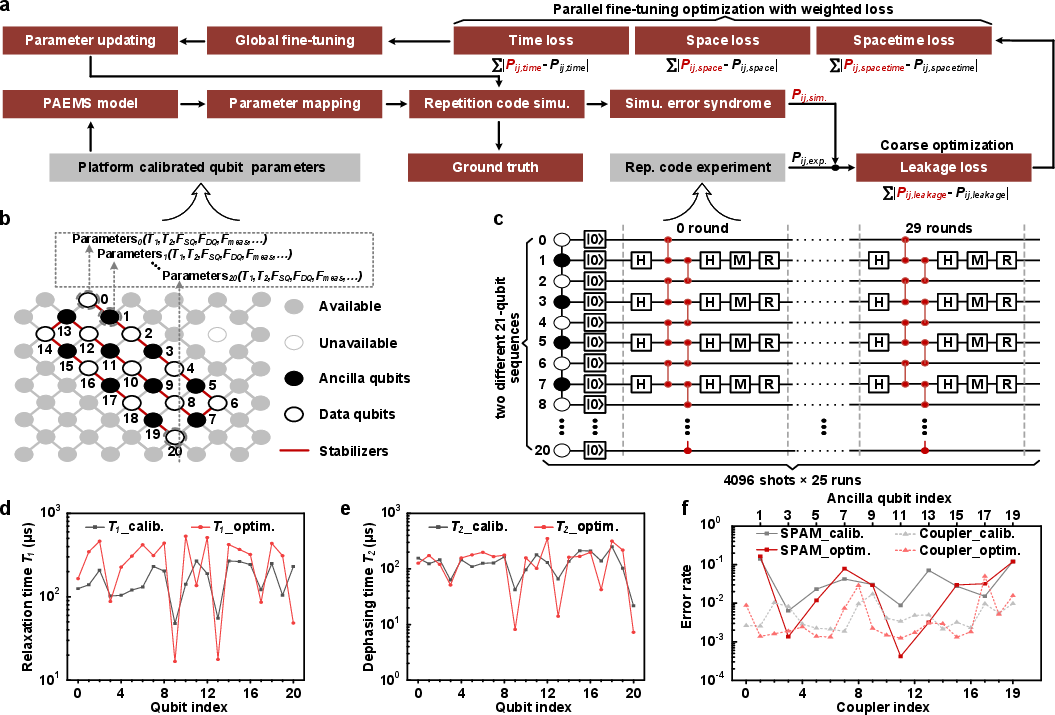
Figure 3: Workflow and parameter optimization strategy for PAEMS including dataset structure, experimental repetition code topology, and parameter comparison pre- and post-optimization.
The method demonstrates that post-optimization parameters can differ substantially (up to an order of magnitude) from default calibrations, reflecting factors like inter-qubit crosstalk, repeated measurement-induced effects, and parameter drift not captured by isolated calibration routines. This shows the necessity of an adaptive, experimentally validated model.
PAEMS is rigorously evaluated against state-of-the-art models (SD6, SI1000, etc.) using multi-round repetition code experiments on IBM's superconducting QPUs (Brisbane, Sherbrooke, Torino) and additional platforms (China Mobile’s Wuyue and QuantumCTek’s Tianyan). Highly non-uniform error rates and correlated error accumulations (especially due to leakage) are observed in reality, invalidating the homogeneity and Markov assumptions common to depolarizing models.
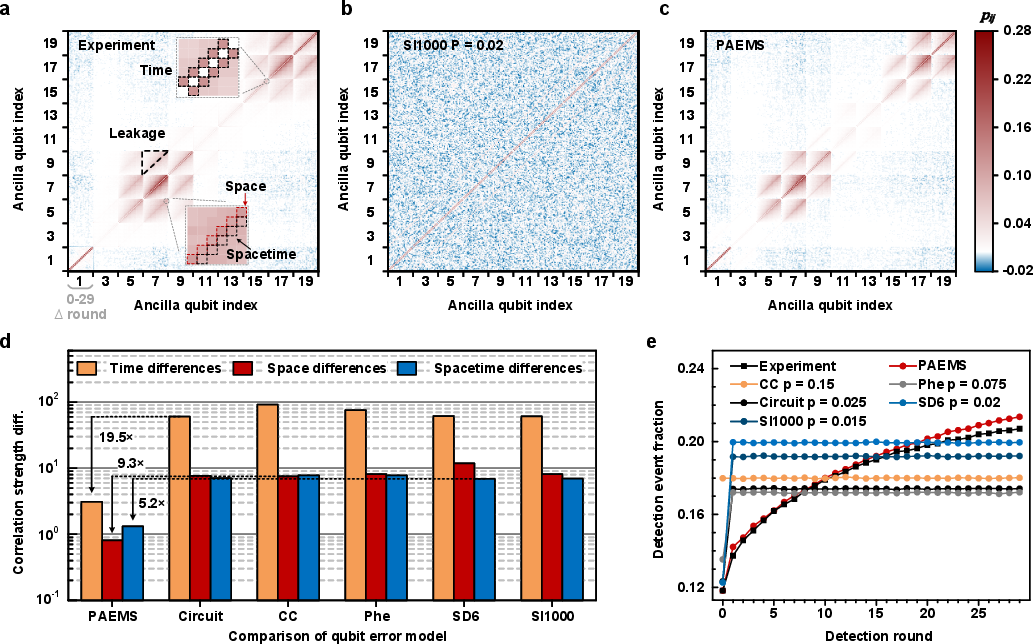
Figure 4: Visualization of experimental and modeled correlation matrices for 30-round, 21-qubit repetition code; PAEMS correctly reconstructs high-variance timelike, spacelike, and leakage-induced error correlations.
Key quantitative results:
The underlying cause is PAEMS’s explicit resolution of qubit heterogeneity, temporal error accumulation, and propagation of leakage—features absent in prior depolarizing models.
Computational Complexity and Scalability
While density matrix-based methods scale as O(4n) and are thus limited to small systems (n<20), PAEMS achieves favorable O(n2) scaling due to its stochastic, circuit-level structure with per-qubit parameterization. This allows for efficient simulation even as qubit array sizes approach those relevant for practical, large-distance QEC.
Implications and Future Directions
Practically, PAEMS enables the generation of high-fidelity synthetic datasets required for both classical (MWPM, union-find) and neural-network-based QEC decoders, ensuring that decoders trained with such data are much better matched to experimental performance. Its per-qubit, cross-platform adaptivity facilitates model transfer and iterative improvement as more advanced QPU hardware and QEC codes are developed.
Theoretically, this approach establishes a paradigm where hardware-aware error models are refined in tandem with decoder architectures, accelerating progress toward scalable, fault-tolerant quantum computation.
The primary remaining limitations of PAEMS are the absence of coherent error modeling and explicit gate crosstalk, which can be significant in simultaneous multi-qubit operation scenarios. Extension of the model to explicitly incorporate these effects and benchmarking on topological codes beyond repetition codes are proposed for further work.
Conclusion
PAEMS presents a circuit-level, adaptive, and physically grounded stochastic error framework for superconducting QPUs. By integrating experimental calibration, leakage modeling, and platform-specific datasets, it dramatically reduces modeling error in both spatiotemporal correlation structure and full output-state statistics as compared to widely used depolarizing models. PAEMS thereby enables more reliable and scalable QEC decoder design and evaluation, and provides a basis for the future development of physically interpretable noise models as quantum hardware continues to scale (2603.29439).