- The paper presents discovery potential for light scalars in the Two Real Singlet Model through Vh2 production channels and a focused analysis of multijet final states.
- It employs simulations using MadGraph5_aMC@NLO, Pythia8, and Delphes with optimized b-tagging to effectively reduce SM backgrounds.
- Statistical analysis indicates strong signal significance (up to 7.4σ at 300 fb⁻¹), underscoring promising avenues for probing extended scalar sectors.
Motivation and Theoretical Framework
The paper addresses the phenomenology of an extended scalar sector realized through the Two Real Singlet Model (TRSM), where the Standard Model (SM) Higgs sector is augmented by two real scalar singlet fields. This minimal extension is motivated by theoretical considerations including dark energy, CP violation, electroweak vacuum metastability, and the possibility of new scalar states beyond the SM. The TRSM yields three CP-even states (h1, h2, h3), with the SM-like Higgs identified as the heaviest, h3≡h125.
The model is constructed with two discrete Z2 symmetries to ensure the stability of the scalar potential and suppress unwanted couplings. The scalar spectrum arises from mixing among the doublet and two singlets, governed by three independent mixing angles (θhS,θhX,θSX) and seven physical parameters including the singlet VEVs.
Three benchmark points are selected after rigorous theoretical and experimental filtering, relying on tools such as ScannerS (Mühlleitner et al., 2020) and HiggsTools (Bahl et al., 2022). Constraints include perturbative unitarity, vacuum stability, LEP and LHC Higgs limits, and kinematic thresholds ensuring dominant h1→bbˉ branching. Selected points exhibit M1≪Mh125, moderate M2−2M1 mass splitting, and sizable h2→h1h1 branching ratios.
Signal Topology and Event Generation
The primary search is the associated production of a light scalar (h20) with an electroweak boson (h21), yielding final states h22. Vector bosons decay either leptonically (h23 or h24). The analysis targets events with four h25-jets and one or two isolated leptons, exploiting the inherently suppressed backgrounds and optimizing sensitivity to light h26 masses.
Signal and background generation is performed at LO with MadGraph5_aMC@NLO (Alwall et al., 2014), showered using Pythia8 (Sjöstrand et al., 2014), and reconstructed with Delphes (Favereau et al., 2013). h27-tagging leverages DeepCSV efficiencies, with fixed h28 tagging, h29 h30-mis-tag, and h31 light flavor mis-tag. Preselection requires h32 GeV, h33 GeV, h34, h35.
Kinematic Discriminants and Selection Strategy
Signal discrimination leverages low missing transverse energy and modest hadronic activity, reflecting the soft nature of the multi-h36-jet final state. As shown in the normalized distributions,
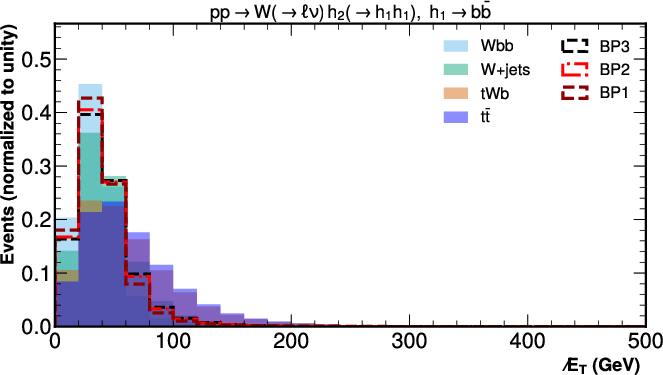
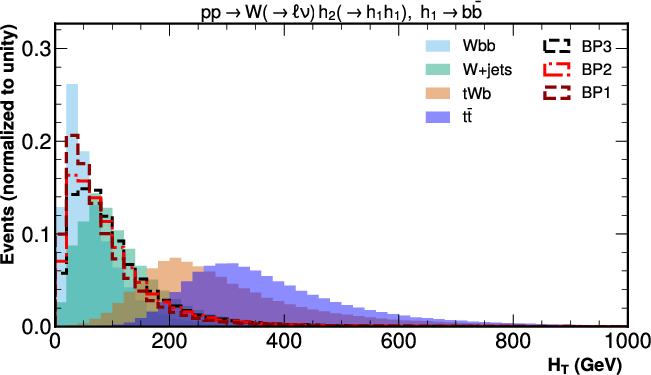
Figure 1: Missing transverse energy (left) and total hadronic transverse energy (right) for the signal and backgrounds; signal events prefer low h37 and h38 regions.
the signal is concentrated at h39 GeV and h3≡h1250 GeV, increasing separation from SM backgrounds such as h3≡h1251 and h3≡h1252+jets.
Further selection exploits the reconstruction of the h3≡h1253 resonance from h3≡h1254-jet pairs; invariant mass windows h3≡h1255 GeV and h3≡h1256 are applied to capture boosted h3≡h1257 decays. Additional requirements on h3≡h1258-jet h3≡h1259 (Z20, Z21 GeV for leading/subleading) and object multiplicity (at least four jets, Z222 Z23-tagged jets) are imposed. The dilepton channel reconstructs Z24 via Z25 GeV.
The efficacy of these cuts is evidenced by the characteristic invariant mass distributions,
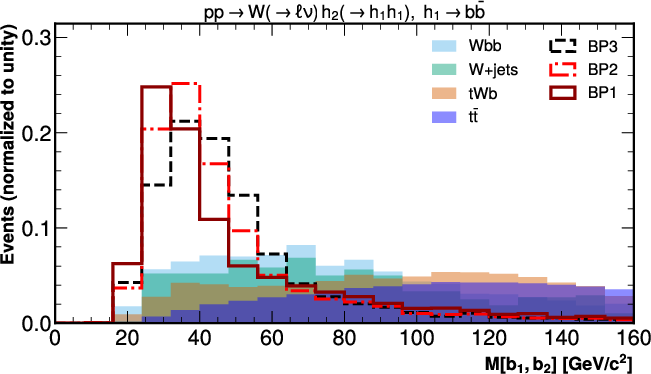
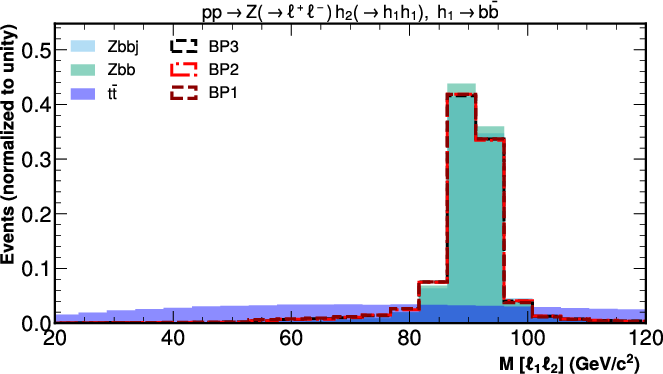
Figure 2: Reconstructed invariant mass for leading/subleading Z26-jets (left) and leading/subleading leptons (right), showing Z27 and Z28 resonance structures.
which illustrate clear signal peaks distinct from background shapes.
Statistical Analysis and Discovery Prospects
Significance is estimated with the profile likelihood approach (Cowan et al., 2010), using the formula:
Z29
Results demonstrate strong discovery sensitivity in single-lepton ((θhS,θhX,θSX)0) channels. At (θhS,θhX,θSX)1, significances for BP1/2/3 range from (θhS,θhX,θSX)2 to (θhS,θhX,θSX)3 (for (θhS,θhX,θSX)4/(θhS,θhX,θSX)5), well above the (θhS,θhX,θSX)6 threshold, with (θhS,θhX,θSX)7 channel below (θhS,θhX,θSX)8 at this luminosity. Scaling to (θhS,θhX,θSX)9, h1→bbˉ0 yields reach h1→bbˉ123 for BP3, with h1→bbˉ2 channel remaining subdominant but increasing to h1→bbˉ33.7.
Backgrounds are dominated by h1→bbˉ4, h1→bbˉ5jets, and h1→bbˉ6, but the optimized selection substantially reduces their impact. Uncertainties from background normalization are not considered in this preliminary estimate; further studies incorporating systematic effects and higher-order corrections remain ongoing.
Implications and Outlook
The study establishes the h1→bbˉ7 topology as a sensitive and complementary probe of extended scalar sectors, unconstrained by typical SM exotic decay searches that focus on h1→bbˉ8-mediated processes. The high single-lepton significance at moderate luminosities provides a robust avenue for TRSM discovery, and optimized h1→bbˉ9-tagging plus kinematic selections are crucial for suppressing backgrounds.
Theoretical implications center on the validation or exclusion of minimal scalar extensions with singlet fields, informing model building in cosmological and CP-violation frameworks. Practically, these results motivate dedicated triggers and reconstruction strategies for very low mass scalars, especially in the context of HL-LHC.
Future directions will require:
- Inclusion of systematic uncertainties and NLO corrections,
- Consideration of detector granularity and pileup for low-M1≪Mh1250 jets,
- Exploration of additional channels (M1≪Mh1251, M1≪Mh1252, M1≪Mh1253) as complementary avenues,
- Integration with global fits and limits from cosmological and astroparticle searches.
Conclusion
This analysis rigorously explores the search for light CP-even scalars in the TRSM via M1≪Mh1254 associated production at the LHC. The study identifies benchmark scenarios that offer strong discovery potential, particularly in single-lepton channels with multijet final states. The results underscore the unique sensitivity of this channel to hidden scalar sectors and highlight its value in broadening the phenomenological coverage of BSM Higgs extensions. Further refinement and incorporation of full statistical and detector modeling are necessary for quantitative projections, but the channel remains highly competitive and complementary to traditional exotic Higgs boson searches.

