- The paper establishes a novel theoretical framework for probing nuclear structure via E2 resonance mixing in kaonic atoms, yielding precise predictions of mixing amplitudes.
- The paper employs high-precision Dirac–Fock calculations and advanced detector techniques to quantify x-ray attenuation in molybdenum isotopes.
- The paper outlines experimental strategies using isotope-dependent resonance mixing to constrain nuclear models, with implications for double-beta decay and neutrino research.
Probing Nuclear Structure via E2 Resonance Mixing in Kaonic Atoms
Introduction
The use of kaonic atoms as a spectroscopic probe of nuclear structure leverages the unique coupling between atomic transitions and nuclear excitations, particularly in heavy elements where such overlaps are pronounced. This mechanism exploits the interaction between a negatively charged anti-kaon and a heavy nucleus, leading to a cascade of atomic transitions that becomes sensitive to nuclear properties in the innermost levels. The phenomenon of electric quadrupole (E2) nuclear resonance mixing enables indirect access to nuclear excitation properties, offering complementary information to that obtained by conventional nuclear spectroscopy.
Theoretical Framework of E2 Nuclear Resonance
When a kaonic atom forms, the large mass of the anti-kaon localizes the atomic wavefunctions near the nuclear surface. During the atomic cascade, as electrons are depleted and the kaon reaches lower-lying orbitals, transition energies can become resonant with low-lying collective nuclear excitations, most notably the first 2+ state. The E2 nuclear resonance effect manifests if the energy difference between two highly excited atomic states closely matches the energy of a nuclear quadrupole excitation. The coupling occurs via the electric quadrupole interaction, resulting in configuration mixing between the direct atomic transition and the process whereby the nucleus is excited concomitantly.

Figure 1: Schematic illustration of the E2 nuclear resonance effect in kaonic atoms, where atomic energy spacing matches the nuclear quadrupole excitation, enabling resonant mixing.
The mixing amplitude α quantifies the extent of this admixture and depends critically on the detuning between atomic and nuclear excitations, the quadrupole transition strength B(E2;0+→2+), and the relevant atomic matrix elements. The induced modifications to the partial width and intensity of x-ray transitions serve as experimental observables for the mixing effect. These parameters are calculated within a Dirac–Fock formalism, incorporating QED, recoil, finite-size, and electron-screening corrections.
Numerical and Computational Implementation
The study focuses on molybdenum isotopes, particularly 92Mo and 98Mo, where previous experimental evidence suggested attenuation in x-ray transitions attributed to E2 nuclear resonance mixing. Using the mcdfgme code, the authors compute transition energies, radial matrix elements, and radiative rates for transitions such as 6h→4f and 6h→5g. The radial overlap between kaonic wavefunctions in these orbitals determines the quadrupole matrix element.
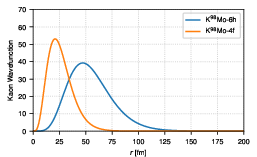
Figure 2: Radial wavefunctions for the kaonic 6h and 4f states in K98Mo, used in the calculation of quadrupole coupling.
For 98Mo, the atomic transition energy is nearly degenerate with the 2+ nuclear excitation (α0 keV), resulting in a mixing amplitude α1 and a substantial induced width in the upper atomic state. The corresponding attenuation of the x-ray intensity for the 6hα25g line is calculated as α3, in close congruence with historical, albeit uncertain, experimental values. In contrast, the larger detuning in α4Mo severely suppresses the effect.
Experimental Implications and Prospects
The enhanced mixing and observable attenuation in α5Mo make it an optimal candidate for future dedicated studies, as foreseen in the KAMEO and EXKALIBUR experimental programs. The utilization of high-purity germanium and CZT solid-state x-ray detectors as implemented by SIDDHARTA-2 enables high-precision measurements of line intensities at the sub-keV scale, crucial for identifying subtle modifications induced by E2 mixing. These advancements in detector technology directly impact the achievable sensitivity to resonance effects.
The empirical isolation of attenuation due to E2 resonance mixing extends beyond molybdenum. The methodology is readily applicable to isotopic sequences in heavier elements, thus facilitating systematic studies of the dependence of nuclear structure parameters (such as neutron distribution and rms radii) as extracted from atomic spectroscopy. Importantly, for molybdenum isotopes—especially α6Mo and α7Mo—these studies have direct implications for constraining nuclear models pertinent to double-beta decay, with ramifications for the interpretation of lepton-number-violating processes and fundamental neutrino properties.
Conclusion
This work establishes the theoretical and computational foundation for exploiting E2 nuclear resonance mixing in kaonic atoms as a probe of nuclear structure. The approach combines relativistic atomic calculations with updated nuclear input data to yield precise predictions for mixing amplitudes and x-ray transition attenuations. In the case study of kaonic molybdenum, α8Mo exhibits quantifiable and experimentally accessible attenuation effects, in line with prior inconclusive measurements. The formalism and methodology presented enable strategic isotope and transition selection for future experiments, maximizing sensitivity to E2 resonance phenomena and, by extension, to detailed nuclear structure properties. Future extensions to other heavy elements within the EXKALIBUR program will further expand the utility of kaonic-atom spectroscopy as a precision tool at the intersection of atomic and nuclear physics.