- The paper demonstrates that conventional MU-MIMO collapses in dense LEO channels due to high channel correlation from users in narrow angular sectors.
- It introduces Space-Time Adaptive Beamforming (STAB), exploiting residual Doppler across slow-time snapshots to create an augmented discrimination domain.
- Analytical and empirical results validate that STAB, combined with joint space-Doppler user selection, significantly restores achievable sum-rate in challenging regimes.
Overview
The paper "Space-Time Adaptive Beamforming for Satellite Communications: Harnessing Doppler as New Signaling Dimensions" (2603.29359) presents a rigorous theoretical and empirical analysis of the limitations of conventional multiuser MIMO (MU-MIMO) in line-of-sight (LoS)-dominant Low Earth Orbit (LEO) satellite channels. It identifies the fundamental performance collapse caused by user-induced channel correlation and proposes space-time adaptive beamforming (STAB), which augments the spatial domain with residual Doppler as a new discrimination axis. This framework is shown to restore non-vanishing sum rates in geometrically dense regimes where traditional spatial precoding fails.
Fundamental Limitations of MU-MIMO in LEO Downlinks
LEO satellites operate at high altitudes, resulting in users appearing within a narrow angular sector as seen from the satellite, thus rendering the multiuser channel matrix highly correlated and ill-conditioned. The lack of rich multipath scattering, in contrast with terrestrial channels, eliminates the abundance of independent spatial signatures necessary for large-scale spatial multiplexing.
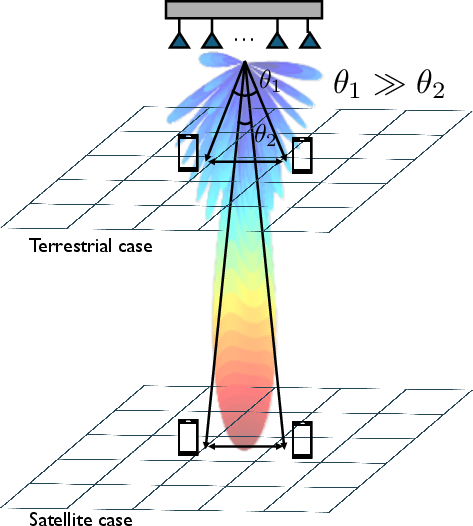
Figure 1: Large orbital altitudes induce strong user channel correlation and fundamentally limit spatial MU-MIMO in LEO satellite downlinks.
The key analytical lens in the paper is the use of the Vandermonde structure in the LoS user-channel matrix and a balls-and-bins abstraction to model geometric user crowding. By partitioning the spatial domain into resolution bins and mapping the presence of users to a balls-and-bins model, the authors derive sharp asymptotic scaling laws for the achievable sum rate as a function of the number of antennas, users, and cell size. The framework identifies a density threshold: when user count exceeds the effective number of spatial resolution bins, the conditioning of the Gram matrix deteriorates super-exponentially, and the sum rate achieved by zero-forcing (ZF) precoding collapses.
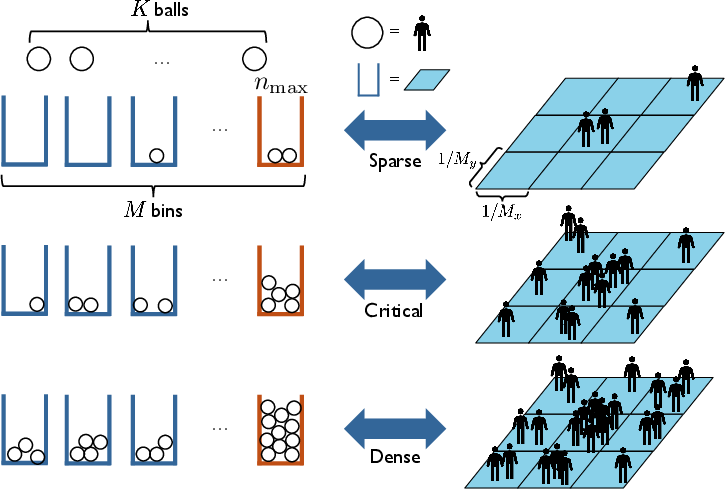
Figure 2: Balls-and-bins interpretation: spatial user distribution plotted across sparse, critical, and dense crowding regimes determines MU-MIMO feasibility.
Numerical simulations confirm the minimum eigenvalue of the channel Gram matrix rapidly decays as cluster size increases, validating the analytical claim that channel ill-conditioning, driven by spatial user crowding, is the root cause of performance collapse.
STAB introduces user-induced residual Doppler as an additional separability dimension. The core mechanism involves repeating each symbol across L slow-time snapshots, allowing each user’s mobility-induced Doppler to impart a distinct phase signature across time. The concatenated space-time channel thereby effectively expands from M to ML dimensions, providing new degrees of freedom for user discrimination even in the regime of minimal spatial separability.
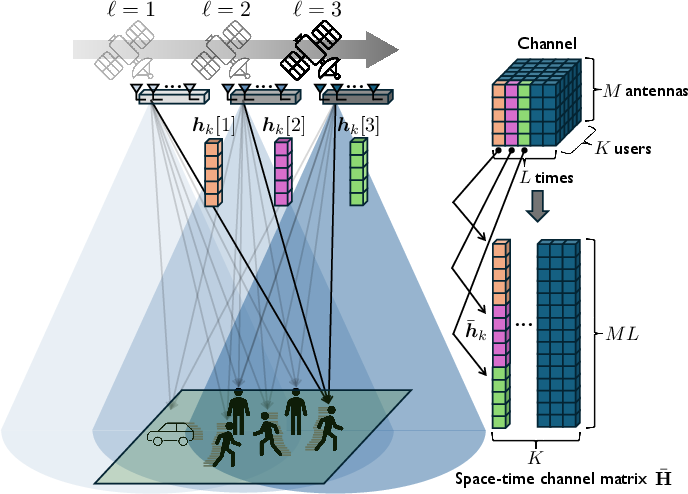
Figure 3: System model for STAB with symbol repetition, enabling the construction of a joint space-Doppler discrimination domain.
The theoretical analysis reveals that, in the high-crowding regime, the balls-and-bins abstraction extends into the space-Doppler domain, increasing the total number of effective resolution bins proportional to ML. This critically reduces the size of the most crowded cluster for fixed user count, thereby improving the minimum eigenvalue scaling of the channel Gram matrix and enabling feasible ZF precoding when it is otherwise impossible.
The sum-rate scaling law for STAB contains an explicit $1/L$ pre-log penalty due to symbol repetition but can be optimized to maximize throughput in practical systems. There is a clear separability-efficiency tradeoff: higher L increases the virtual aperture and user discrimination but reduces the net symbol rate per user.
Analytical and Empirical Results
The balls-and-bins model is extended to rigorously derive the asymptotic regimes under which sum-rate collapse occurs for both standard spatial-only ZF and STAB, for both ULA and UPA array geometries. For instance, the ZF sum rate is shown to vanish when the user count scales superlinearly with the spatial resolution M1−r for R/H∼M−r, but STAB can restore non-trivial sum rate scaling if the Doppler dimension (L) increases at least as fast as the excess user density.
Empirical results corroborate theoretical predictions. For moderate user and antenna counts typical of LEO systems, simulations reveal that spatial-only ZF’s performance aligns with the predicted threshold behaviors: sum rates drop sharply as user count or cell size pushes the system into the dense crowding regime.
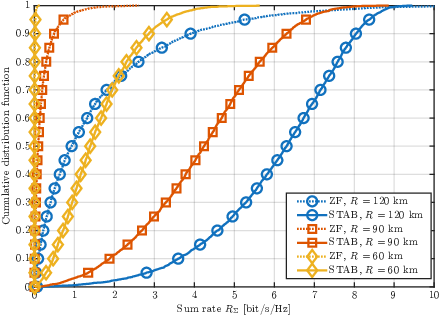
Figure 4: Empirical CDFs of the sum rate for ZF and STAB, verifying the drastic performance improvements of STAB in dense user settings.
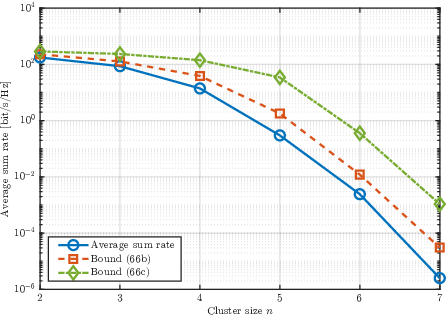
Figure 5: Validation of the sum rate upper-bound chain for ZF: as maximum cluster size grows, the sum rate collapses, confirming the theoretical scaling laws.
A comprehensive heat map quantifies the gains of STAB over spatial-only ZF for a wide sweep of user and Doppler dimension scaling parameters, highlighting the regime boundaries and the impact of the separability-efficiency tradeoff.
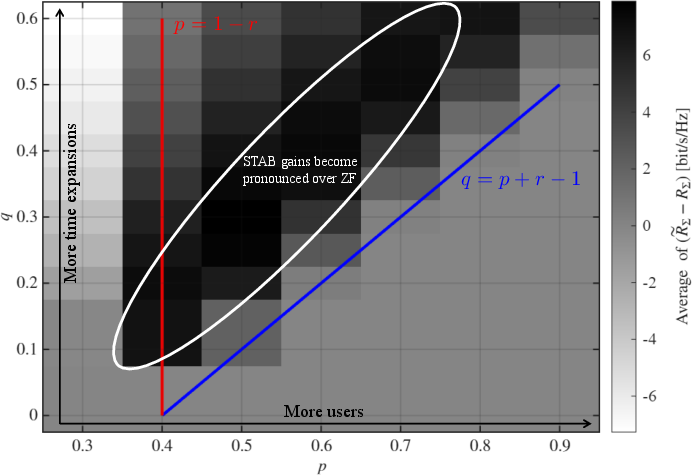
Figure 6: Heat map of STAB–ZF sum rate gain over (p,q) operating regime, showing regions of dominant STAB effectiveness in dense settings.
Joint Space-Doppler User Selection (SDS)
The benefit of an augmented space-Doppler domain is maximized when scheduling exploits both spatial and Doppler signatures. The paper introduces the Space-Doppler User Selection (SDS) algorithm, a greedy semi-orthogonal method operating in the concatenated space-time signature. SDS iteratively chooses users maximizing effective channel gain, filtered by space-Doppler semi-orthogonality, resulting in significantly improved sum rates in high-density scenarios compared to spatial-only scheduling.
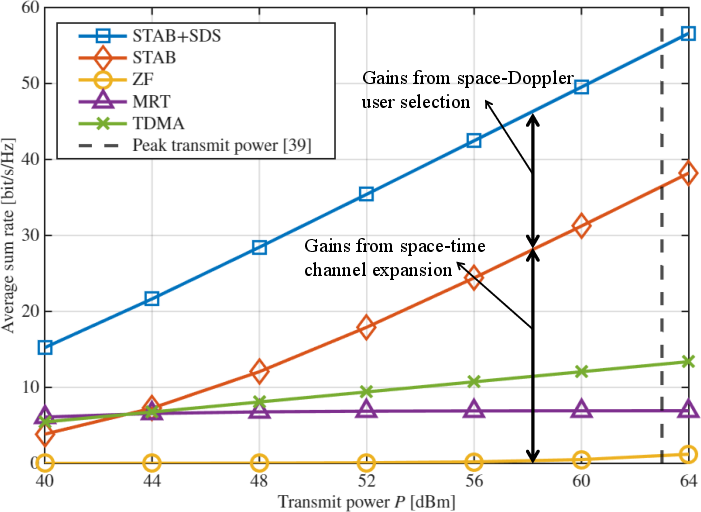
Figure 7: Average sum rate versus transmit power; STAB+SDS significantly outperforms conventional baselines, confirming the benefit of Doppler-aware scheduling under severe user crowding.
Theoretical and Practical Implications
The work bridges rigorous spectral analysis of random Vandermonde matrices and fundamental LEO satellite downlink capacity limits. It establishes that, in practical LEO systems, spatial user crowding is an unavoidable limitation due to geometry, not a mere artifact of suboptimal algorithms. No feasible increase in antenna count can indefinitely overcome this—without additional signaling dimensions, performance collapses with user density.
On the practical front, the introduction of residual Doppler as a novel discrimination axis is technically sound for LoS-dominant satellite channels, where user positions and velocities are uniquely available due to GNSS-augmented feedback protocols. The proposed STAB framework and SDS algorithm are implementable with phased array architectures and minimal operational changes.
Future Directions
The analysis suggests several directions for future research:
- Coordinated multi-satellite STAB: Exploiting the joint space-Doppler domain for user association and load balancing across satellites.
- Resource allocation algorithms: Adaptive selection of the slow-time repetition factor M0 to optimize the separability-efficiency tradeoff dynamically.
- Extension to non-idealities: Investigation of STAB robustness in the presence of inaccurate Doppler estimation, residual clutter, or multipath components.
Conclusion
This paper formalizes the spatial multiplexing barriers in LEO satellite MU-MIMO imposed by user geometry and LoS channel structure, and demonstrates that harnessing Doppler as a new signaling dimension decisively overcomes these limits. The combination of asymptotic analysis, balls-and-bins abstraction, and practical space-Doppler user scheduling presents a solid theoretical and algorithmic foundation for future high-capacity satellite communication systems in dense user scenarios.